








Executive Overview
The intersection of maritime heritage and green technology has yielded some of the most compelling design stories of the modern eco-conscious era. Enter the SAMAR 50, the inaugural watercraft from Mallorca-based boutique shipbuilder SAMAR Yachts. Derived from the local Mallorcan phrase "Sa Mar"—meaning simply "The Sea"—the company’s core philosophy is unapologetically rooted in a return to organic, unadulterated yachting. The overarching goal is not to pile on digital complexity or unnecessary automation, but to strip away the noise of modern vessel operation and reconnect the passenger directly with the elements.
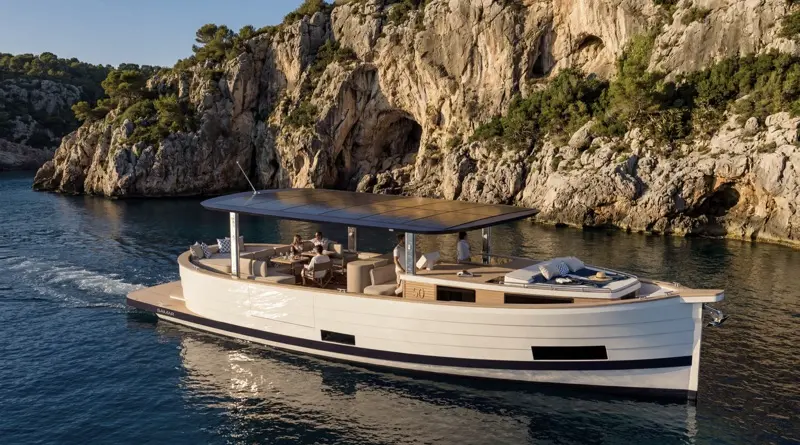
At 15.8 meters (50 feet) in length, the SAMAR 50 draws heavy inspiration from the classic llaut—a historic Balearic fishing and transport boat whose provenance stretches back to the Middle Ages. Widely recognized for its exceptional performance in choppy Mediterranean waters, the traditional llaut has been granted official status as an "Asset of Cultural Interest" across the islands. By marrying this centuries-old, laurel-leaf hull form with cutting-edge zero-emission electric propulsion, advanced battery storage, and solar generation, SAMAR Yachts has engineered a hybrid cruiser that pays profound homage to maritime history while delivering a quiet, sustainable, and luxurious 21st-century on-water experience.
Detailed Chronology: From Medieval Aixa to Modern Aluminum
The Genesis of the Llaut
To fully grasp the engineering significance of the SAMAR 50, one must look back at the evolution of the llaut. Historically, these double-ended, teardrop-shaped vessels were the absolute workhorses of the Balearic archipelago. Ranging anywhere from 4 meters to a staggering 60 meters (12 to 200 feet) over centuries of adaptation, llauts were crafted for virtually every conceivable maritime duty: net-fishing, cargo hauling, military combat, smuggling, and even the ceremonial transport of high-ranking government consuls and foreign dignitaries.
Centuries ago, construction of these craft was an art form governed by master shipwrights known as maestros de aixa (masters of the adze). These craftsmen would trek deep into local oak and pine forests during specific lunar phases, selecting timber based on the belief that the moon’s pull affected the sap content and subsequent durability of the wood. The resulting low gunwales and distinctive central openings—known locally as the cossia—were functional innovations designed to simplify hauling fishing nets, rowing, and boarding diplomats with dignity.
Reimagining the Form for Modern Leisure
Fast forward to the present day, and the team at SAMAR Yachts has systematically analyzed the functional architecture of the llaut to see how its centuries-proven hydrodynamics could serve the modern leisure boater.
Rather than relying on old-growth lumber harvested under specific lunar cycles, SAMAR has transitioned the construction methodology into the modern era by utilizing recycled and recyclable aluminum. This choice of material honors a long-term design philosophy centered on structural durability, ease of serviceability, and minimal material waste.
The first physical manifestation of this ethos, the SAMAR 50, made its debut with a clear mandate: to offer a quieter, more intuitive, and environmentally respectful way to experience the Mediterranean. Today, the very first hull of this groundbreaking series is available for charter out of the prestigious Club de Mar in Palma, Mallorca, signaling a tangible shift in how high-end day-cruising and coastal chartering can be approached.

Supporting Context & Metrics: Engineering and Performance
Underneath its classic, low-profile exterior, the SAMAR 50 is a marvel of modern hybrid-electric naval architecture. The vessel has been engineered to provide extended periods of completely silent, zero-emission cruising, relying on two distinct configurations depending on an owner’s intended range and performance requirements.

Propulsion Options: Serial vs. Parallel Hybrid
-
The Serial Hybrid System:
Designed for the purist seeking maximum silence and minimal environmental impact, this configuration features twin 40 kW (55 hp) electric motors, yielding a combined electric output of 80 kW (110 hp). Energy is drawn from a massive onboard battery bank boasting a capacity of 139 kWh. Using a standard baseline calculation (139 kWh divided by 80 kW), the electric motors can operate at absolute maximum continuous output for roughly one hour and forty-five minutes. However, operating at typical, leisurely displacement speeds in Mediterranean coves drastically extends this runtime. A diesel generator acts as a range extender when deep-water transits demand it. SAMAR estimates the top speed for the serial hybrid configuration to be approximately 10 to 11 knots. -
The Parallel Hybrid System:
For owners who require more immediate acceleration or higher transit speeds to reach distant islands, SAMAR offers a four-motor parallel arrangement. This setup pairs two 80 kW diesel engines (delivering a combined 220 hp) with two 30 kW electric motors (delivering 80 hp). This system pushes the top speed up to a brisk 14 to 15 knots, though naval architects and eco-boaters alike note that the true soul of the SAMAR 50 is best realized at slower, displacement-focused speeds where the serenity of the sea remains uninterrupted.
Deck Layout and Onboard Luxuries
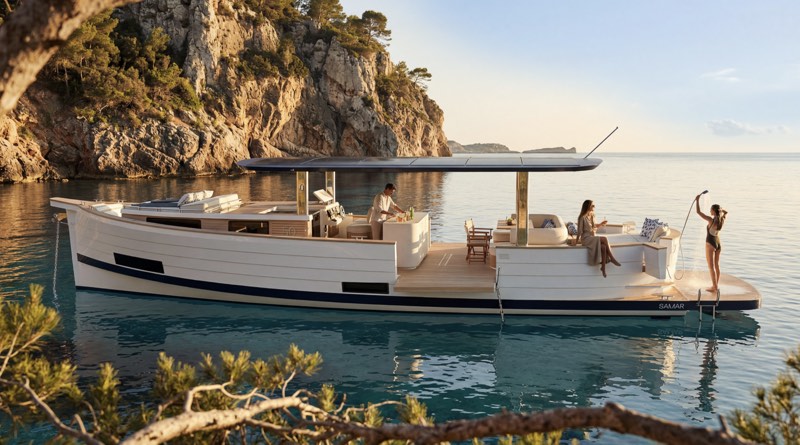
The clever translation of historic functionality into modern luxury is perhaps most evident on the deck. The traditional low gunwales and cossia—once used for hauling cargo and nets—have been reinvented as expansive, fold-down "hull wings." When deployed, these side walls widen the aft deck area, transforming the stern into what feels less like a traditional boat cockpit and more like a floating backyard patio.
Passengers can effortlessly move from the forward sun-lounging beds, through an open-air alfresco dining space, down into banquette-style cockpit seating, and finally out onto the low-profile swim and dive platforms. Hovering overhead is a sleek hardtop integrated with a high-efficiency solar array capable of generating up to 5.4 kWp (kilowatts-peak) of clean energy, helping to continuously top off house loads and reduce reliance on shore power.

Technical Specifications Matrix
| Metric / Feature | Specification |
|---|---|
| Length Overall (LOA) | 15.8 meters (50 feet) |
| Beam (Hull Wings Closed/Open) | Standard configuration optimized for stability |
| Draft | ~0.9 meters (~3 feet) |
| Displacement | 14 tonnes |
| Serial Hybrid Propulsion | 2 x 40 kW electric motors + 11 kW generator |
| Serial Hybrid Top Speed | ~10–11 knots |
| Parallel Hybrid Propulsion | 2 x 80 kW diesel engines + 2 x 30 kW electric motors |
| Parallel Hybrid Top Speed | ~14–15 knots |
| Battery Bank Capacity | 139 kWh |
| Solar Array Generation | Up to 5.4 kWp |
| Certified Passenger Capacity | Up to 12 passengers + crew |
Official Statements and Brand Philosophy
The design philosophy of SAMAR Yachts is rooted in subtraction rather than addition. In an era where modern superyachts are frequently packed with complex stabilization systems, sprawling digital helms, and high-maintenance gadgetry, SAMAR has intentionally pivoted back to basics.
"This project started with a very clear idea—to create a yacht that allows people to experience the sea in a quieter, more natural way," explains Miguel Rigo, CEO of SAMAR Yachts. "We are not trying to add more complexity, but to remove it. The result is a boat that feels intuitive, efficient, and truly connected to its surroundings."
This sentiment is echoed throughout the shipyard’s technical literature, which emphasizes that the marriage of the serial hybrid propulsion architecture with the open-air deck layout is purpose-built for Mediterranean waters. By minimizing engine noise, vibration, and exhaust fumes, passengers are afforded a sensory connection to the marine environment that modern planing yachts simply cannot replicate.
Furthermore, the choice of recycled aluminum construction underscores an institutional commitment to circular-economy principles. By replacing traditional, maintenance-heavy timber with infinitely recyclable metal, SAMAR ensures that the environmental footprint of the vessel’s manufacture is as considered as its operational footprint on the water.

Future Outlook: The Evolution of Sustainable Regional Yachting
The launch of the SAMAR 50 is more than just the introduction of a new model; it represents a broader ideological shift within the European boutique shipbuilding sector. As coastal municipalities, particularly across the Mediterranean, begin to implement stricter noise ordinances, speed restrictions, and zero-emission zones within marine protected areas and pristine bays, the demand for high-end, solar-electric vessels is poised to skyrocket.
By validating the historical design wisdom of regional watercraft—proving that a hull shape honed over a thousand years can seamlessly house lithium battery banks, electric inverters, and solar panels—SAMAR Yachts has established a compelling blueprint for other regional builders.
As the first SAMAR 50 enters service in the waters off Mallorca via its Club de Mar charter availability, industry watchers will be closely monitoring its real-world performance metrics, battery longevity, and guest feedback. If the early reception is any indication, the future of Mediterranean day-cruising may well belong to vessels that look backward to honor cultural roots, even as they sail quietly and confidently into a zero-emission future.