







Executive Overview
For decades, the commercial aviation arms race was fought exclusively at the pointy end of the aircraft. Airlines routinely poured hundreds of millions of dollars into ultra-luxurious first-class suites, private shower spas, onboard lounges, and ever-flatter business-class beds designed to mimic five-star hotel rooms.
However, a profound strategic pivot is underway across the global airline industry. The battleground for high-yield passenger revenue has quietly moved a few rows back.
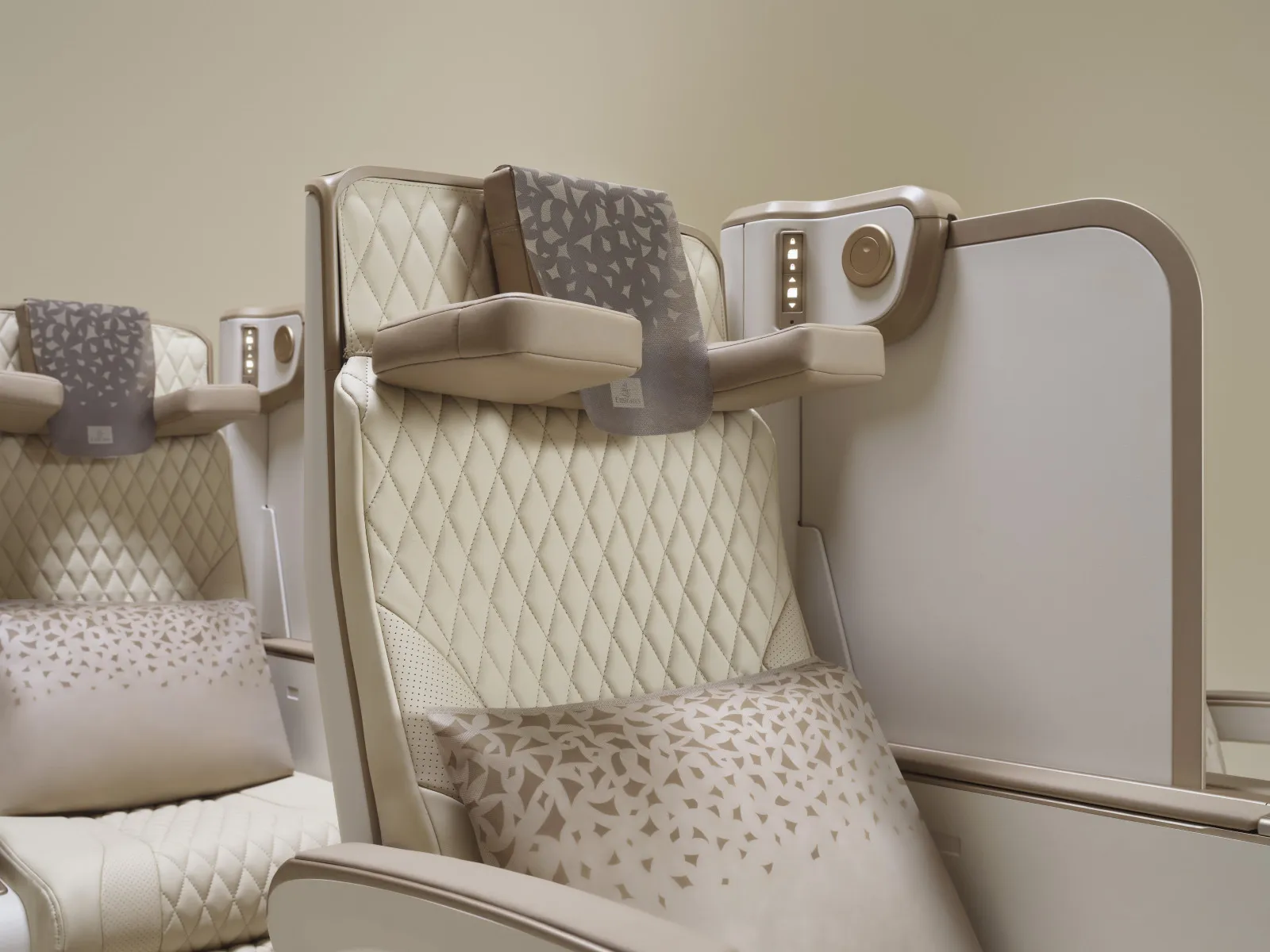
On Thursday, Dubai-based aviation giant Emirates officially unveiled its latest innovation: a newly minted premium economy seat equipped with a full-height, electrically operated privacy divider. Passengers can effortlessly raise and lock this partition using a personal control pad, turning a standard intermediate-cabin seat into a semi-private sanctuary.
Fitted directly into the carrier’s highly anticipated, new-generation Airbus A350 fleet, this sophisticated product signals a watershed moment in commercial aviation design. The seat transcends the traditional boundaries of premium economy—long viewed merely as an "economy-plus" afterthought with slightly more legroom. Instead, it blurs the line between traditional intermediate classes and legacy business class, offering features previously reserved for front-cabin flyers.
This hardware escalation arrives at a critical economic inflection point. The post-pandemic travel boom has officially run its course, and the global airline industry is settling into a period of more modest, normalized expansion. According to recent aviation metrics, global passenger revenue is projected to approach $900 billion by 2027. Yet, annual growth rates are steadily settling into the low single digits.
Consequently, boardrooms from Doha to Dallas are shifting their strategic focus. Carriers are thinking far less about aggressively chasing sheer passenger volume and far more about yield management, margin optimization, and capturing the lucrative "aspiring affluent" demographic. These travelers are unwilling to pay thousands for business class, but they are increasingly eager to spend extra for tangible comfort, personal space, and peace of mind.
Detailed Chronology: The Evolution of Intermediate Seating
To understand the magnitude of Emirates’ latest rollout, one must examine how the intermediate cabin evolved from a seating anomaly into the most fiercely contested real estate in commercial aviation.

The Era of the "Stretched" Economy Seat (Late 1990s – 2010s)
For years, the vast majority of commercial widebody aircraft featured a stark, three-tier class system: First, Business, and Economy. While a few pioneering carriers experimented with dedicated intermediate cabins in the late 20th century, the modern concept of "premium economy" truly took root in the early 2000s.
During this formative era, products were largely uninspired. Airlines simply took standard economy seats—typically boasting a 31-to-32-inch pitch—and added an extra three to four inches of legroom. Recline was modest, catering was identical to economy with perhaps the addition of a complimentary beverage or upgraded cutlery, and privacy was virtually nonexistent. For business travelers whose corporate travel policies prohibited business-class tickets, or for leisure travelers seeking marginal relief on long-haul flights, these seats were accepted as a modest upgrade, but rarely coveted.
The Mid-Decade Awakening and Hardware Differentiation (2015 – 2019)
As global wealth expanded and long-haul international travel surged throughout the mid-2010s, airlines recognized a glaring gap in their revenue models. A vast demographic of passengers existed who could not justify the $5,000-to-$10,000 price tag of a lie-flat business-class seat, yet felt profoundly alienated by the increasingly dense, cramped conditions of modern economy cabins.
Carriers began investing heavily in standalone shell seats for premium economy. Rather than simply modifying an economy frame, manufacturers engineered dedicated mid-cabin furniture featuring fixed-shell backs (ensuring that a reclining passenger ahead did not intrude into another’s knee space), integrated leg rests, larger entertainment screens, and upgraded soft-product amenities like noise-canceling headphones and amenity kits.
The Post-Pandemic Passenger Shift (2021 – 2023)
The COVID-19 pandemic temporarily devastated international aviation, but the subsequent reopening of global borders triggered an unprecedented phenomenon: "revenge travel." Consumers battered by lockdowns prioritized experiential spending over material goods, pouring discretionary income into premium travel experiences.
Crucially, corporate travel budgets did not return to their pre-pandemic peaks at the exact same rate. Many corporations permanently tightened travel guidelines, forcing middle-management executives who once flew business class to downgrade to premium economy. Simultaneously, affluent leisure travelers— flush with pandemic-era savings—upgraded out of standard economy. This dual-sided squeeze made premium economy the most profitable square footage on widebody aircraft almost overnight.
The Technological Leap: Emirates and the Airbus A350 Launch (Present)
Thursday’s announcement by Emirates represents the current zenith of this evolutionary trajectory. By integrating a full-height, electrically operated privacy divider into its new Airbus A350 premium economy cabin, Emirates has redefined what passengers can expect outside of a dedicated suite.
The seat features sophisticated electric recline mechanisms complete with preset lounge and meal modes, luxurious leather U-shaped headrests, deployable footrests, integrated wireless charging pads, and expansive 4K high-definition entertainment screens. By introducing these technological refinements to the intermediate cabin, Emirates has thrown down the gauntlet to rival global flag carriers, proving that the innovation cycle in airline seating has firmly shifted away from the front of the plane.
Supporting Context & Metrics: The Economics of the Modern Sky
The strategic pivot toward premium economy is not merely a design whim; it is a cold, calculated response to shifting macroeconomic realities and passenger psychology.
Revenue Realities and the $900 Billion Horizon
Global commercial aviation is navigating a complex financial landscape. According to industry forecasts, aggregate global passenger revenue is on a trajectory to approach the monumental $900 billion milestone by 2027. However, beneath the headline-grabbing top-line figures lies a more nuanced operational environment.
The post-pandemic recovery curve has officially flattened. Annual growth rates, which experienced explosive double-digit rebounds in 2022 and 2023, are settling back into traditional, predictable low single digits. Capacity constraints, persistent supply chain bottlenecks plaguing aircraft manufacturers like Boeing and Airbus, jet fuel price volatility, and rising labor costs mean that airlines can no longer rely on simply adding more flights to drive profitability.
Instead, airlines must maximize revenue per available seat mile (RASM) across every single square foot of their existing fleets.
| Cabin Class | Average Space Allocation | Typical Yield Contribution | Primary Demographic |
|---|---|---|---|
| First Class | ~2–5% of aircraft footprint | Low-to-Moderate (High cost of service) | Ultra-high-net-worth individuals, celebrities |
| Business Class | ~15–25% of aircraft footprint | High (Core profit driver historically) | Corporate executives, self-funded luxury travelers |
| Premium Economy | ~10–20% of aircraft footprint | Very High (Exceptional ROI per sq. foot) | Corporate mid-management, affluent leisure, upgraders |
| Economy | ~50–70% of aircraft footprint | Moderate-to-Low (Volume dependent) | Mass-market leisure, budget-conscious travelers |
The Yield-Per-Square-Foot Triumph
From a financial perspective, premium economy offers an extraordinary return on investment. While a business-class seat commands a massive footprint—requiring significant linear cabin length to accommodate lie-flat mechanisms, direct aisle access, and bulky privacy doors—a premium economy seat occupies significantly less space.
By packing rows into a tighter configuration (typically a 2-4-2 layout on widebody aircraft compared to 1-2-1 or 1-2-1 staggered business layouts), airlines can fit substantially more paying passengers into the intermediate zone. When a passenger pays 1.5 to 2.5 times the price of an economy ticket for a seat that takes up only 30% to 40% more physical room, the yield per square foot often eclipses that of both first and business classes.
Changing Consumer Psychology
Consumer research consistently indicates a profound shift in traveler priorities. Modern flyers—particularly millennials and Gen Z travelers who are increasingly driving corporate travel decisions—are willing to sacrifice the total isolation of a first-class suite if they can secure essential comforts at a more rational price point.
The inclusion of high-speed inflight Wi-Fi, modern device-charging capabilities (such as the wireless pads featured on Emirates’ new A350 seats), and enhanced personal space appeals directly to a generation that values connectivity, ergonomics, and personal well-being during grueling long-haul transcontinental and transoceanic journeys.
Official Statements and Industry Perspective
The rollout of advanced intermediate seating has sparked widespread commentary from industry executives, interior designers, and aviation analysts, all of whom recognize the profound shift taking place in cabin architecture.
Speaking on the strategic philosophy driving the airline’s latest fleet enhancements, senior Emirates commercial executives emphasized that modern travelers view comfort not as a luxury, but as an essential component of productivity and well-being.
"For too long, the intermediate cabin was treated as a compromise," notes a senior airline product development strategist familiar with the A350 rollout. "Passengers paying a substantial cash supplement above economy expected more than just an extra couple of inches of legroom. They expect personal domain, technological integration, and a genuine sense of privacy. With our new A350 premium economy installation, we are effectively bridging the chasm between economy and business class, offering a sophisticated refuge that honors the financial commitment of our customers."
Aviation analysts have been quick to praise the tactical brilliance of the move, particularly as airlines face rising operational pressures.
"Airlines are operating in an era where margin compression is a constant threat," explains Sarah Jenkins, senior aviation economist at Global Transit Research. "Capital expenditures must be deployed with surgical precision. Pouring tens of millions of dollars into ultra-exclusive first-class cabins that often fly half-empty is a high-risk gamble in a low-growth economic climate. Conversely, upgrading premium economy captures the exploding demand from affluent leisure travelers and budget-conscious corporate accounts. It is the smartest money an airline can spend right now."
Interior designers specializing in aerospace architecture point out that engineering a full-height, electrically operated privacy divider into an intermediate seat required overcoming formidable engineering hurdles.
"Weight is the eternal enemy of aviation design," explains aerospace interior engineer Marcus Vance. "Every single ounce added to a seat frame translates directly into higher fuel burn over the lifespan of an aircraft. To integrate electric recline motors, personal control pads, wireless charging architecture, and movable privacy partitions into a high-density cabin configuration without blowing weight budgets or sacrificing safety certification standards is an extraordinary technical achievement. It proves that premium economy is no longer an afterthought—it is where the cutting edge of cabin engineering is happening."
Future Outlook: The Next Decade of Cabin Innovation
As the global aviation industry looks toward 2027 and beyond, the implications of Emirates’ latest seat rollout extend far beyond a single aircraft type or a single airline. The entire commercial aviation sector is poised for a cascading wave of cabin redesigns.
The Ripple Effect Across Global Carriers
Major flag carriers and low-cost long-haul operators alike will be forced to respond. Airlines that have thus far dragged their feet on introducing or upgrading premium economy cabins—fearing cannibalization of their lucrative business-class revenue—will find themselves at a distinct competitive disadvantage.
When a corporate traveler has the choice between a legacy airline offering a cramped, outdated 2010-era premium economy seat and a modern competitor offering an Airbus A350 equipped with electric recline presets, 4K entertainment, wireless charging, and full-height privacy dividers, the choice is mathematically and experientially simple. Competitors will be compelled to accelerate their own cabin retrofit programs, driving a multi-billion-dollar market for advanced aircraft interior manufacturing.
Technological Convergence: Biometrics, Personalization, and AI
Looking further down the horizon, the next evolution of premium economy will likely intersect with advanced digital personalization and artificial intelligence.
Imagine stepping onto a long-haul flight where your premium economy seat automatically recognizes your biometric profile or digital boarding pass. Within seconds of settling in, the seat adjusts its ergonomic recline preset to your personal orthopedic preference, the 4K screen loads your preferred entertainment queue, and the intelligent cabin lighting shifts to support your circadian rhythm across multiple time zones.
Furthermore, as electric propulsion research, sustainable aviation fuels (SAF), and ultra-long-range airframes (such as those featured in Project Sunrise) reshape network planning, airlines will rely even more heavily on intermediate cabins to make ultra-long-haul routes economically viable. Routes spanning 18 to 20 hours non-stop require cabins that prevent passenger fatigue without requiring every traveler to purchase a $12,000 business-class suite. Premium economy is the structural answer to this operational equation.
Conclusion
The unveiling of Emirates’ electrically partitioned premium economy seat on the Airbus A350 is much more than a routine press release about new airline hardware. It is a defining milestone in the ongoing evolution of commercial aviation.
As global passenger revenue approaches the $900 billion threshold amidst a backdrop of low single-digit annual growth, the rules of profitability have been rewritten. The front of the plane will always remain a symbol of prestige, but the true battleground for the soul—and the financial health—of the modern airline industry has officially moved a few rows back.