









Executive Overview
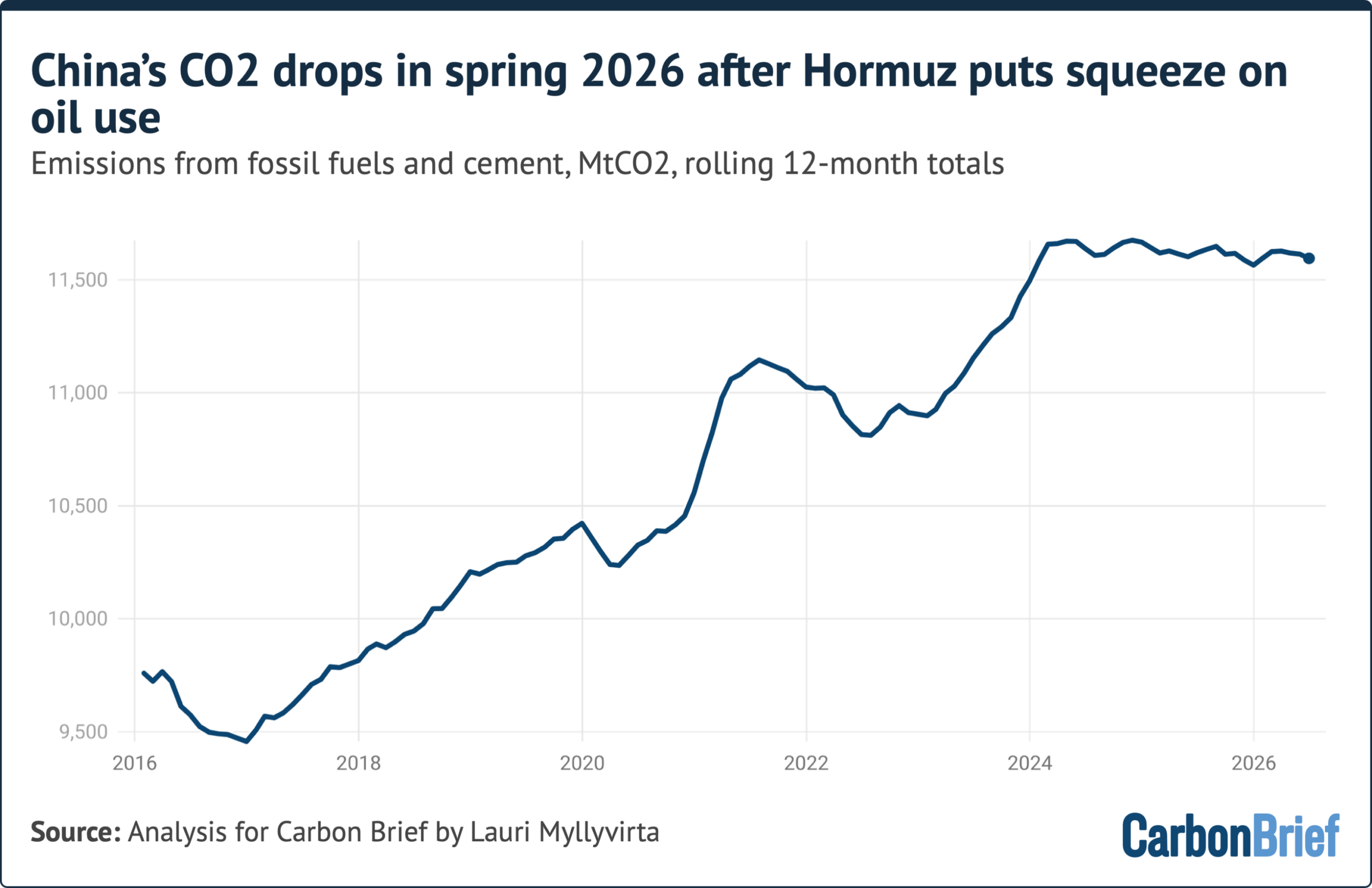
In a historic shift for global energy markets and climate metrics, China’s carbon dioxide ($textCO_2$) emissions fell by 1% in the second quarter of 2026. While modest on paper, this contraction marks a profound milestone: for the first time since modern industrial tracking began, a reduction in oil consumption—rather than a slowdown in coal—was the primary driver of an overall emissions decline.
Triggered by the severe geopolitical crisis in the Strait of Hormuz, which severely choked oil supplies from the Persian Gulf, China experienced an unprecedented 9% drop in total oil consumption and a staggering 16% collapse in transport-related oil demand. Although coal-fired power generation saw a minor rebound due to renewable energy curtailment issues, the structural displacement of liquid fossil fuels by an aggressively expanding electric vehicle (EV) fleet proved powerful enough to tip the national emissions balance downward.
This unexpected stress test on China’s energy infrastructure highlights a critical reality: the rapid electrification of the nation’s transportation sector is no longer just a long-term decarbonization strategy; it has evolved into a formidable pillar of national energy security. As Beijing rolls out its suite of 15th Five-Year Plan documents, the interplay between surging clean energy manufacturing, grid integration challenges, and structural oil demand destruction will dictate whether China’s post-2024 emissions plateau hardens into a permanent downward slope.

Detailed Chronology and Sectoral Dynamics
To understand how China arrived at this emissions inflection point in mid-2026, it is necessary to examine the cascading economic and geopolitical events of the preceding months.
The First-Quarter Rebound and the Hormuz Shock
The year 2026 began with a slight upward tick in China’s carbon trajectory. During the first quarter, $textCO_2$ emissions climbed by 2% year-on-year. Analysts attributed this early bump primarily to an increase in "wasted" or curtailed wind and solar power, as regional grids struggled to absorb the massive influx of variable renewable generation added through the record-shattering buildout of 2025.
However, the macroeconomic and energy landscape transformed dramatically entering the second quarter. The outbreak of the Strait of Hormuz crisis sent shockwaves through international maritime shipping and crude oil supply chains. China, as the world’s largest oil importer, faced an immediate squeeze. Crude oil processing volumes plummeted 11% in Q2, while total oil imports dropped by 32%.
While part of this import shortfall was cushioned by drawing down the nation’s vast strategic petroleum reserves and utilizing existing inventories (Sinopec sales fell 9%), real-world consumption adjustments were profound. Energy mix data reported by the National Bureau of Statistics (NBS) confirmed that actual oil consumption fell by roughly 9% in the second quarter, bringing the total reduction for the first half of the year to 3%.

Divergent Trends: Oil Plummets While Coal Climbs
The 1% overall emissions reduction in Q2 occurred despite contrasting trends across primary energy sources. While liquid fuels contracted sharply, the power sector experienced a 3% rise in emissions during the first half of the year (including a 2.4% increase in coal use during Q2, offset slightly by a 1.2% dip in gas-fired generation).
This coal rebound persisted despite strong historical tailwinds for clean energy: wind and solar capacity additions continued at a brisk pace, hydropower generation surged by 9% year-on-year in Q2 due to favorable hydrological conditions, and nuclear output ticked upward. The culprit behind the persistent coal burn was not a lack of green capacity, but rather acute grid bottlenecks. Inflexible coal-fired power plants, backed by capacity payment structures that reward mere availability rather than operational flexibility, crowded out variable renewables, pushing curtailment rates higher in several provinces.
Outside of power and transport, heavy industry exhibited mixed signals. Cement production dropped sharply—accelerating to a 9% decline in Q2, down from 8% in Q1—directly reflecting ongoing structural weaknesses in the real estate and construction sectors. Crude steel output slipped 1%, while pig-iron production fell 3%. Meanwhile, the coal-chemicals sector saw slowing growth as processing facilities hit maximum operational capacities, even as oil-based chemical production (such as ethylene, up 17%) maintained positive momentum.
Supporting Context & Metrics: The EV Revolution and Oil Displacement
The most compelling narrative of China’s Q2 emissions drop is the structural resilience provided by the nation’s aggressive pivot toward electrification. The oil price shocks and supply constraints of the Hormuz crisis did not induce panic or immobility; instead, they accelerated shifts in transportation that were already well underway.
The Decoupling of Mobility and Oil Demand
Remarkably, overall transportation activity levels in China remained stable or grew during the second quarter. Cross-regional passenger trips rose 0.1%, urban passenger trips increased by 2.9%, and commercial freight tonnage climbed 2.4%. The sole exception was commercial air travel, which saw passenger numbers dip 7% in May and June.
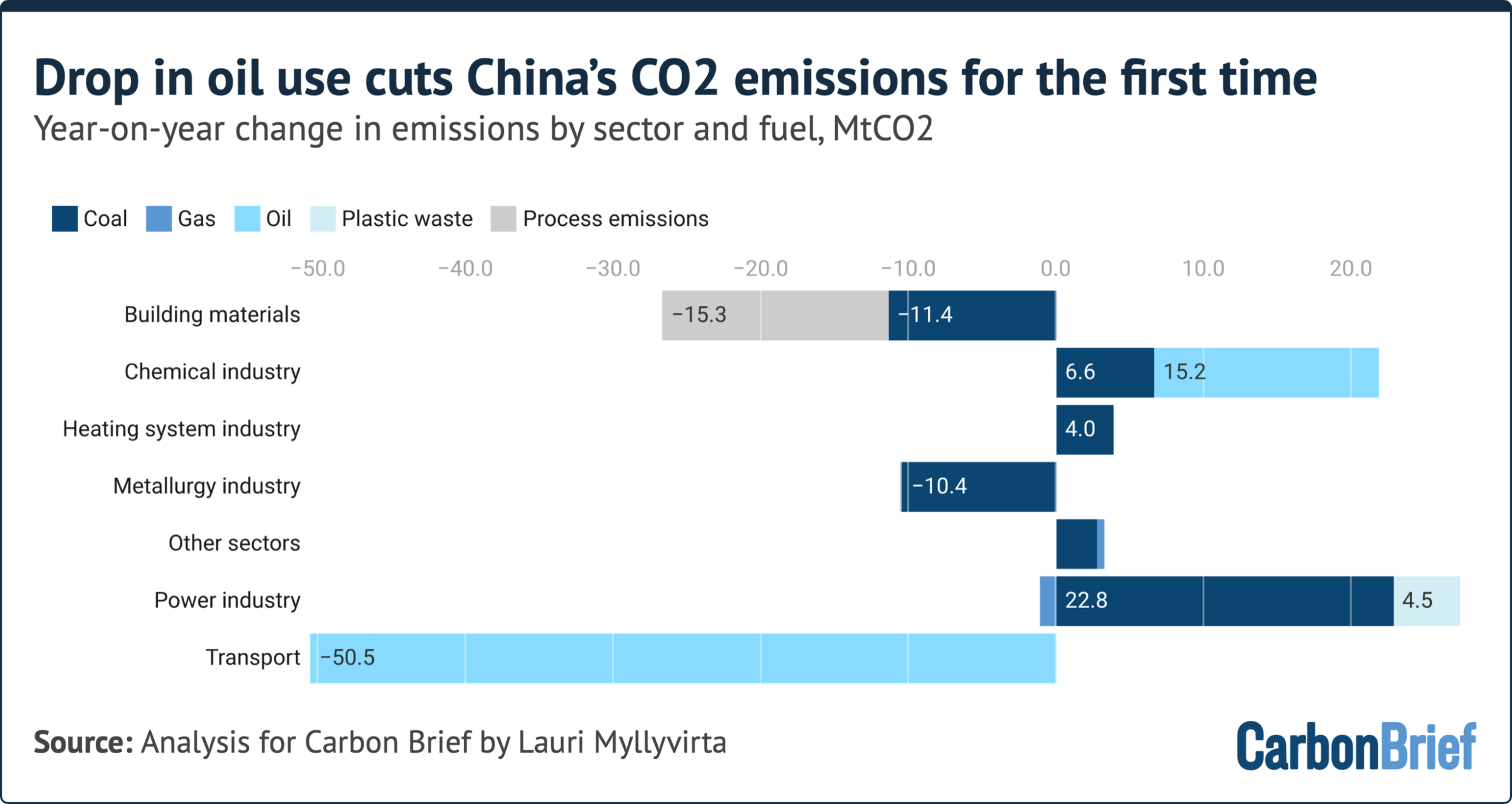
The fact that mobility continued to rise while petroleum demand cratered proves that substitution—specifically through EVs, high-speed rail, and electrified public transit—was the primary driver of oil displacement.
- Commercial Electrification: Electric heavy-truck sales skyrocketed by approximately 77% year-on-year in Q2, with June sales doubling and driving the market share of new electric trucks past the 45% threshold.
- Fleet Growth: By the end of Q2, China’s total population of New Energy Vehicles (NEVs) surged 33% year-on-year, welcoming 12.1 million new additions (8.1 million of which were pure battery electric vehicles).
- Intensified Utilization: Public charging volumes spiked 60% in Q2, demonstrating that existing EVs on the road were being driven significantly more than legacy internal combustion engine (ICE) vehicles. This trend was amplified by the rapid adoption of electric taxis, whose operating costs remained low amidst intense market competition, contrasting sharply with the rising cost of private gasoline.
Quantifying the Displacement
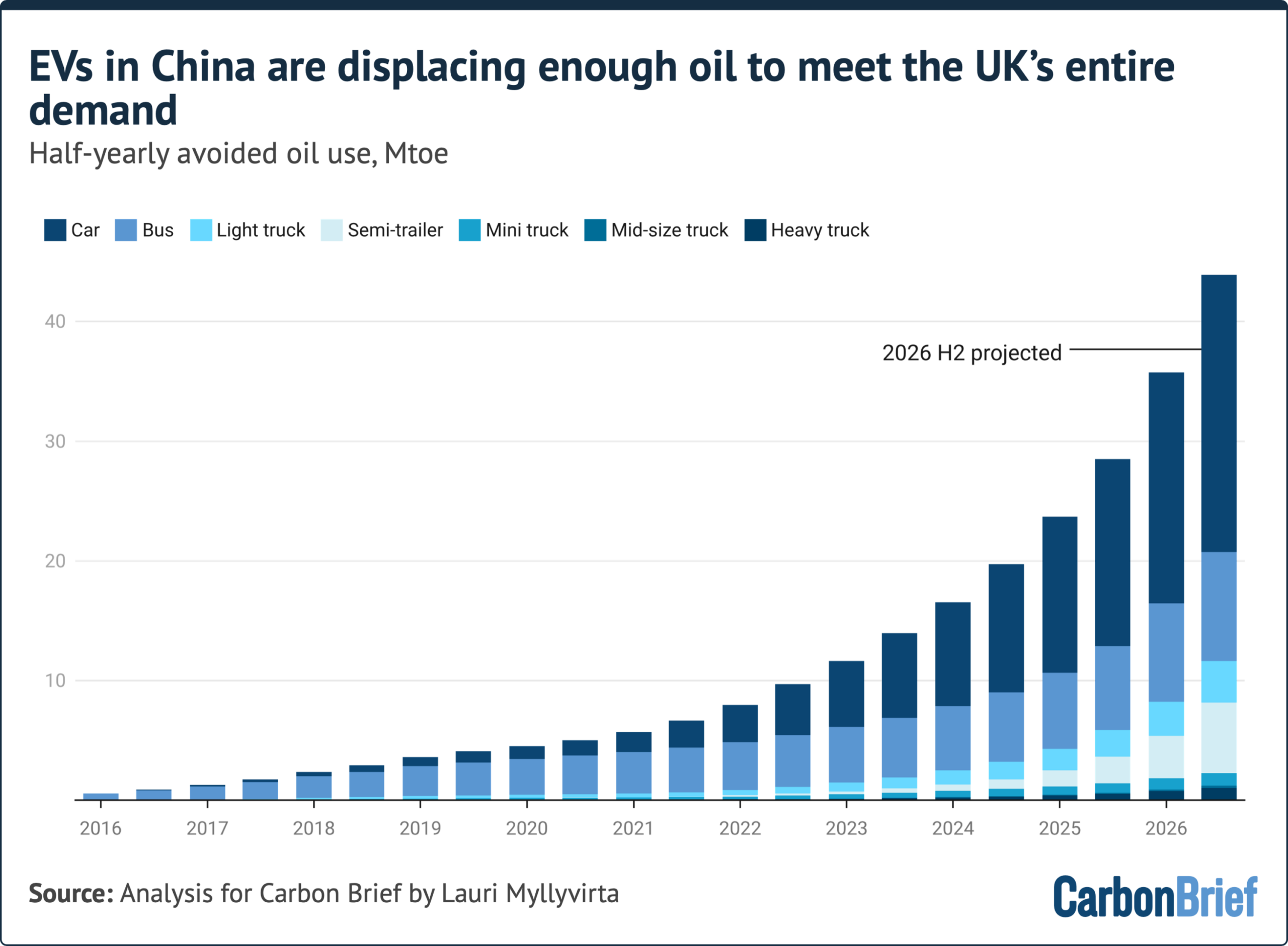
According to comprehensive industry data, EVs helped China avoid an estimated 19 million tonnes of oil equivalent (Mtoe) in consumption during the second quarter alone—a 50% year-on-year increase. This brought total avoided oil consumption for the first half of 2026 to 36 Mtoe, an amount exceeding the total six-month oil consumption of the United Kingdom.
Factoring in the emissions generated by the power plants charging these vehicles, the net $textCO_2$ emissions avoided by the EV transition reached 35 million metric tonnes in Q2, accounting for roughly 1.3% of China’s total emissions for the period. If current sales and charging trends persist through the second half of the year, total avoided oil consumption is projected to hit 80 million tonnes—roughly equivalent to the annual consumption of Mexico.
Official Statements and Policy Frameworks
Government planners in Beijing utilized the busy legislative window of mid-2026 to release a comprehensive suite of 15th Five-Year Plan documents. These blueprints establish clear priorities for the remainder of the decade, even as they introduce nuanced adjustments to long-term targets.

The 15th Five-Year Plan Architecture
The overarching energy, power, renewable, carbon-peaking, and environmental ("Beautiful China") plans issued by the National Development and Reform Commission (NDRC) and the Ministry of Ecology and Environment (MEE) emphasize several core pillars:
- Accelerated Electrification: The government has raised its ambitions, targeting electricity to comprise 35% of total final energy consumption by 2030, up from 30% in 2025. In the transport sector, officials are targeting NEVs to capture 30% of the total vehicle fleet (up from 12% in 2025) and 25% of commercial vehicles.
- Revising Coal Ambitions: For the first time, the government has formally vowed to control absolute "coal-power generation" rather than merely capping generation growth. Furthermore, the plans signal a higher bar for the approval of new coal plants. However, analysts note that managing this transition will prove challenging given the 204 GW of coal capacity currently under active construction.
- Redefining Grid Reliability: The new renewable energy five-year plan broadens the definition of system reliability. While coal has historically been framed as the sole guarantor of grid stability, the new framework increasingly relies on utility-scale battery storage, flexible industrial demand, virtual power plants, and smarter inter-provincial transmission lines to balance variable renewable loads.
Managing Curtailment Realities
A controversial element within the new power sector guidelines is the formal adjustment of wind and solar curtailment limits. While previous policies generally sought to cap waste at 5% to 10% across provinces, the updated framework allows curtailment limits to rise as high as 15% in select resource-rich regions.
While this expansion acknowledges the growing pains of integrating massive volumes of intermittent clean energy, energy analysts warn that if applied too broadly, it could institutionalize higher levels of wasted green power unless accompanied by rapid investments in flexibility solutions, smart grids, and localized energy storage. Notably, battery storage additions continued to expand in H1 2026, bringing total installed storage capacity to 153 GW, though additions slowed slightly compared to the blistering pace set in 2025.
Future Outlook: The Race Between Demand and Clean Energy Growth
As China looks toward the second half of 2026 and beyond, the national emissions trend remains a high-stakes race between total energy demand growth and clean energy deployment.
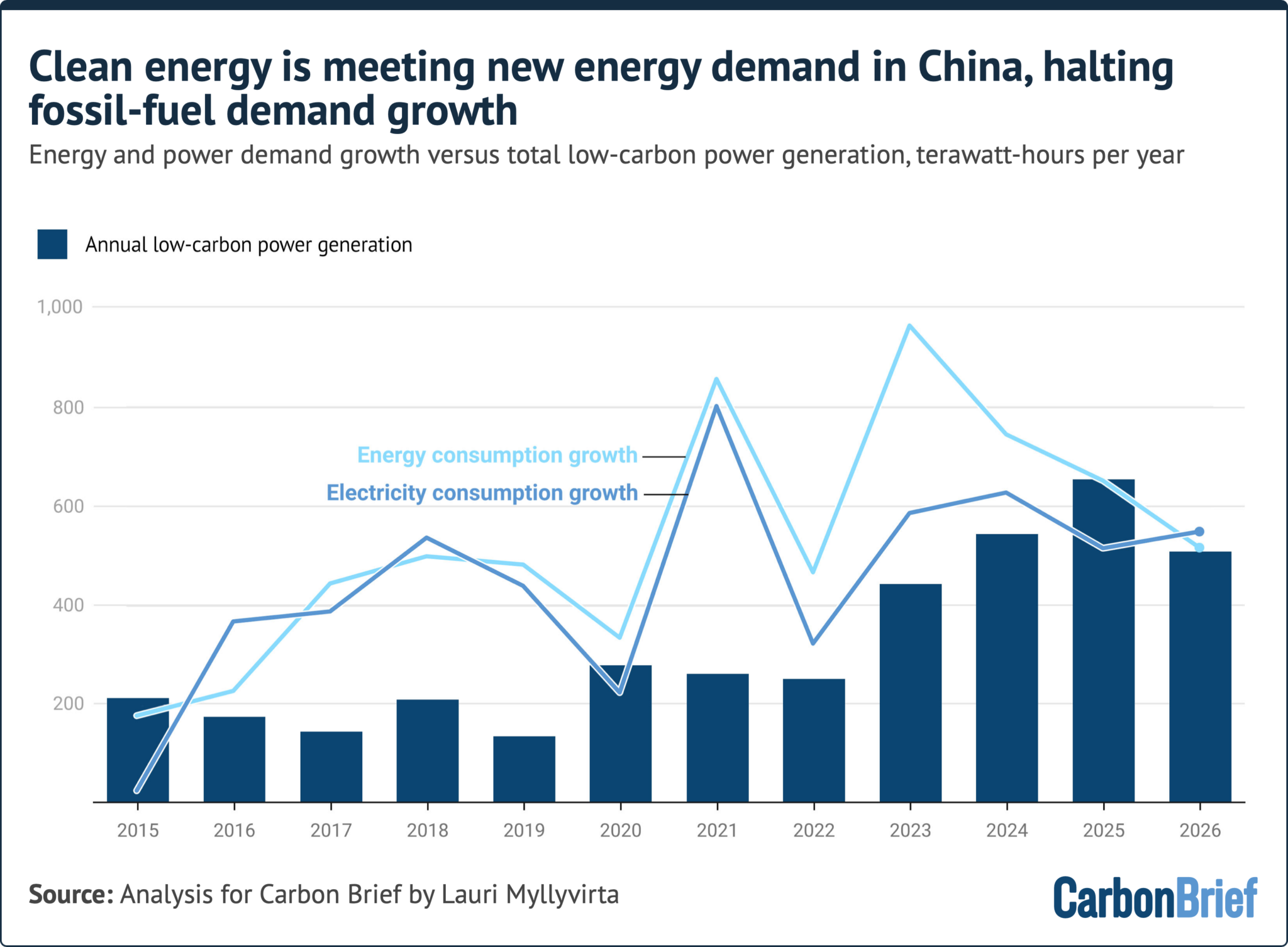
The structural pressures keeping emissions in check are formidable. Real estate construction continues its multi-year contraction, industrial coal use face growing scrutiny from zero-carbon industrial park initiatives, and transport oil demand is experiencing permanent structural erosion due to electrification.
At the same time, clean energy capacity growth remains robust. Despite a relative slowdown in solar installations compared to the historic highs of 2025, combined additions of wind, solar, nuclear, and hydropower are on track to fully cover electricity demand growth—which has moderated to roughly 5%–6% annually. Nuclear development is proceeding rapidly, underscored by the July approval of eight new reactors and the expected commercial rollout of advanced projects like the Linglong One small modular reactor.
If total energy demand growth remains subdued and policymakers successfully tackle grid bottlenecks to reduce solar and wind curtailment, China’s total $textCO_2$ emissions are well-positioned to resume their downward trajectory. The events of Q2 2026 have demonstrated that China’s economy can withstand severe external fossil fuel shocks by leveraging domestic clean technology—turning a geopolitical crisis into a powerful catalyst for long-term structural decarbonization.