









Executive Overview
The global transition toward a low-carbon economy has generated an insatiable appetite for clean hydrogen. Touted as the ultimate decarbonization vector for heavy industry, shipping, and aviation, hydrogen production methods are evolving rapidly. Among the contenders, methane thermolysis—frequently referred to as methane pyrolysis—has emerged as one of the cleanest propositions in the sector. By applying heat rather than flames to split methane molecules directly into hydrogen gas and solid carbon, the process bypasses the complex, energy-intensive carbon capture, utilization, and storage (CCUS) infrastructure required by traditional blue hydrogen.
Yet, as industrial pioneers like the Hazer Group advance their catalytic technologies from demonstration plants to commercial-scale engineering in partnership with global giants like KBR, a fundamental law of physics threatens to upend the economic model: the mass balance.
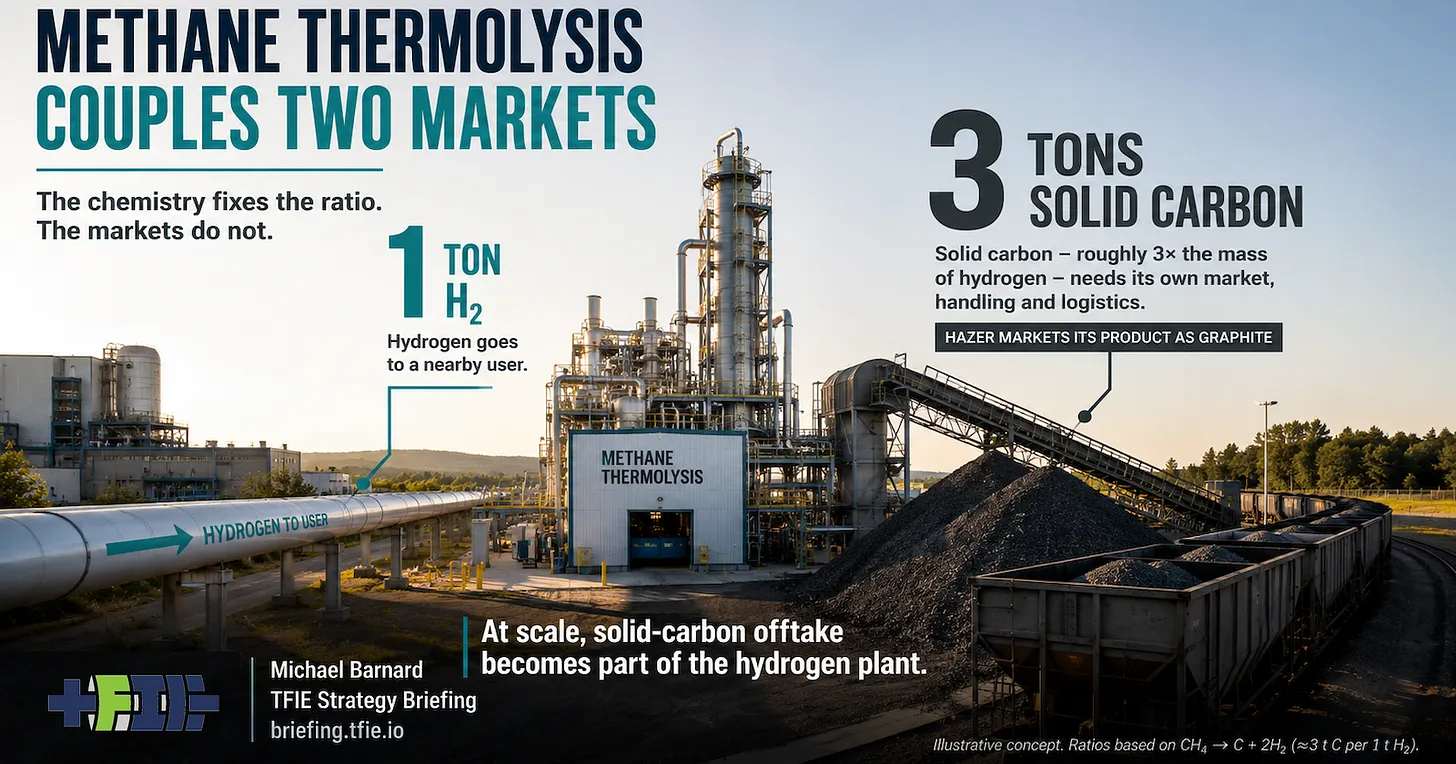
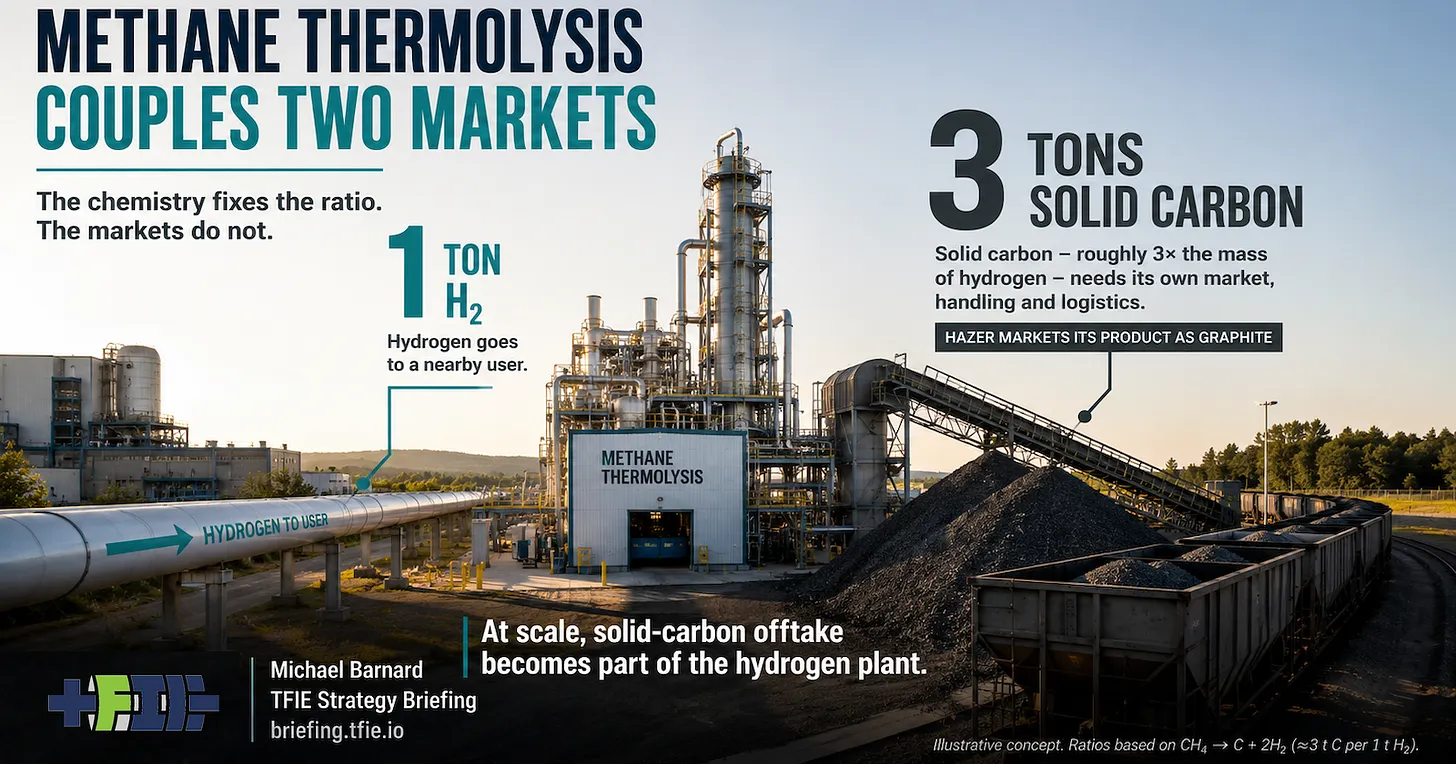
For every single tonne of hydrogen produced via methane thermolysis, approximately three tonnes of solid carbon are generated simultaneously. When scaled to meet modern industrial demands, this ratio creates an overwhelming surplus of material. Even under the most favorable theoretical conditions—such as pairing a thermolysis plant with a massive, state-of-the-art hydrogen-based Direct Reduced Iron (DRI) steelworks—the primary consumer can only absorb a fraction of the output. Calculations reveal that roughly 80% to 90% of the resulting thermolysis graphite will be left homeless, forcing hydrogen producers to become major players in global carbon markets.

This article explores the mechanics of methane thermolysis, breaks down the insurmountable mass balance mismatch, evaluates potential end-use markets, and questions whether investors and policymakers are miscalculating the true economics of the hydrogen transition.
Detailed Chronology and Technical Evolution of Methane Thermolysis
To understand the current commercial crossroads of methane thermolysis, it is necessary to examine how the technology transitioned from academic chemistry to industrial-scale engineering.
The Chemistry of Flame-Free Splitting
For decades, hydrogen production has relied primarily on Steam Methane Reforming (SMR), a process that yields hydrogen alongside vast quantities of carbon dioxide. To mitigate emissions, the industry championed "blue hydrogen," which appends CCUS to SMR facilities. However, managing gaseous $textCO_2$ requires high-pressure compression, dedicated pipeline infrastructure, and permanent geological storage—all fraught with regulatory, financial, and technical hurdles.
Methane thermolysis offers an elegant alternative. By definition, thermolysis involves thermal splitting driven by heat rather than combustion. Methane ($textCH_4$) is heated in the absence of oxygen, causing the molecule to crack into its constituent elements: hydrogen ($textH_2$) and solid carbon ($textC$).

- The SMR Pathway: $textCH_4 + 2textH_2textO rightarrow textCO_2 + 4textH_2$ (Produces greenhouse gases requiring complex capture).
- The Thermolysis Pathway: $textCH_4 rightarrow textC + 2textH_2$ (Produces clean gas and a manageable, solid byproduct).
Scaling from Laboratory to Commercial Reality
The theoretical appeal of this reaction has been understood for over a century, but practical implementation stalled due to reactor fouling—solid carbon tends to coat and deactivate the catalysts required to run the reaction efficiently at scale.
Over the past decade, innovators tackled this bottleneck. Companies like Australia’s Hazer Group developed proprietary iron-ore-based catalysts that continuously generate high-purity graphitic carbon rather than amorphous soot. By moving beyond laboratory-scale setups into operating demonstration plants, these pioneers proved that methane could be continuously split into marketable solid carbon and clean hydrogen.
The subsequent partnership between Hazer and engineering powerhouse KBR marked a critical milestone: the transition from proving the chemistry to designing commercial-scale industrial modules. However, as engineering teams drafted blueprints for multi-hundred-thousand-tonne facilities, the focus shifted from how to split methane to what to do with the mountains of solid carbon left behind.
Supporting Context and Metrics: The Implacable Math of Mass Balance
The central vulnerability of methane thermolysis is not chemical; it is mathematical. The atomic weights of carbon and hydrogen dictate an unyielding stoichiometric ratio: for every 1 unit of hydrogen produced by mass, roughly 3 units of solid carbon are produced alongside it.
The Scale of the Surplus
To visualize the magnitude of this mismatch, consider a mid-to-large-scale commercial hydrogen facility designed to produce 300,000 tonnes of clean hydrogen annually.
- Hydrogen Output: 300,000 tonnes/year.
- Solid Carbon Coproduct: ~900,000 tonnes/year.
- Daily Yield: Approximately 2,500 tonnes of solid carbon every single day.
To put this in perspective, a single plant would flood the market with nearly a million tonnes of carbon annually. While Hazer and other developers emphasize that their product is valuable graphitic carbon—suitable for applications ranging from lithium-ion batteries to asphalt—having a useful product is vastly different from having an immediate, scalable market that matches production rates.
The Denominator Problem
In traditional manufacturing, supply chases demand. If the market for graphite shrinks, producers dial back their operations. Methane thermolysis turns this economic logic on its head: hydrogen demand dictates carbon production.
The operational tempo of a thermolysis plant is tethered entirely to the consumer’s need for hydrogen. If a nearby industrial hub demands a steady stream of hydrogen fuel, the plant must run continuously, spewing out thousands of tonnes of graphite daily regardless of whether global carbon markets are saturated, prices are crashing, or logistics networks are jammed.
Furthermore, because hydrogen is notoriously expensive and complex to transport over long distances, thermolysis plants must be sited in close proximity to hydrogen consumers. This means hydrogen demand dictates not only how much carbon is produced, but where it is produced—frequently far away from the industrial centers that might actually consume the solid carbon.
Industry Analysis: Testing the Strongest Dual-Product Case (Steel)
To assess whether any single industry can absorb this immense carbon stream, analysts frequently point to steelmaking as the ideal testing ground. Steel is unique because it represents an apparent "strongest possible fit"—an industry capable of consuming both products of methane thermolysis.
The Hydrogen-DRI Synergy
In modern decarbonized steelmaking, green hydrogen is utilized for the Direct Reduction of Iron (DRI), stripping oxygen from iron ore to produce sponge iron without using coking coal. Concurrently, electric arc furnaces (EAFs) require carbon for final chemistry adjustments, $textFeO$ reduction, slag foaming, and process energy.
The proposition is seductive: build a methane thermolysis plant, pipe the hydrogen directly into a DRI tower to make green steel, and shovel the resulting graphitic carbon straight into the EAFs down the line.
The Stegra-Scale Stress Test
To test this hypothesis, we can apply the mass balance against a modern, mega-scale green steelworks, such as those planned by pioneers like Stegra (formerly H2 Green Steel).
- Steelworks Capacity: A 2.5-million-tonne-per-annum green steel facility.
- Hydrogen Requirement: To supply this facility entirely via methane thermolysis, the plant would need to generate roughly 340,000 to 365,000 tonnes of hydrogen-equivalent thermolysis throughput.
- Carbon Generation: This scale of production would yield approximately 340,000 to 365,000 tonnes of graphite annually.
- Carbon Consumption: How much carbon can that 2.5-million-tonne steelworks actually use? Realistic operational models indicate that an EAF steel mill of this size consumes only about 45,000 to 63,000 tonnes of carbon per year.
The conclusion is stark: even within this unusually favorable, purpose-built industrial symbiosis—where the steelmaker acts as a primary consumer for both outputs—roughly 80% to 90% of the generated graphite is left stranded, with no choice but to find external markets.
Evaluating Alternative Carbon Markets
If the steel industry can only absorb a fraction of the output, where does the remaining 80–90% go? To clear production, thermolysis operators must compete in broader industrial materials markets, none of which operate in a vacuum.
1. The Battery Sector
Lithium-ion battery manufacturers represent a high-value market for graphite, utilizing synthetic and natural variants for anodes. However, battery supply chains are notoriously exacting. Producers require precise particle sizes, specific morphologies, ultra-high electrochemical purity, and rigorous certifications. Dumping industrial-grade thermolysis carbon into the battery supply chain requires extensive downstream processing, purification, and qualification—processes that add cost and time while failing to guarantee acceptance.
2. Construction Materials (Asphalt and Concrete)
Producers often pitch asphalt and concrete as massive volumetric sinks for carbon. While carbon additives can enhance material properties or sequester emissions, carbon is fundamentally not a structural ingredient in these markets at the scale required. Asphalt and concrete plants consume aggregates and binders by the gigatonne; expecting them to absorb millions of tonnes of industrial byproduct graphite as a core input misunderstands their economic and operational drivers.
3. Incumbent Competitors
Thermolysis graphite does not enter an empty market. It must directly displace or compete against entrenched, highly optimized incumbents:
- Petroleum coke (petcoke)
- Anthracite coal
- Natural flake graphite
- Synthetic graphite
- Rapidly growing volumes of biochar
Because incumbent suppliers have spent decades refining their supply chains, pricing structures, and specifications, a new entrant driven by hydrogen production economics will struggle to compete purely on cost and quality consistency.
Future Outlook: Strategic Recommendations for Investors and Policymakers
Methane thermolysis is far from a dead-end technology. It remains a genuinely innovative pathway that offers distinct advantages over traditional steam methane reforming and blue hydrogen CCUS chains.
Finding Viable Niches
Thermolysis can thrive under specific, highly optimized conditions:
- Biogas Integration: Utilizing biomethane instead of fossil natural gas can yield negative-emission hydrogen and carbon, creating unique sustainability premiums.
- Localized Industrial Clusters: Operating in geographic pockets where a captive, durable hydrogen demand coincides with multiple specialized local consumers who specifically value the precise grade of carbon being produced.
- Displacement Economics: Where thermolysis carbon can directly replace emissions-intensive synthetic graphite or high-grade fossil carbon, additional regulatory and environmental value can be unlocked.
A Paradigm Shift for Project Finance
For investors, corporate strategists, and policymakers, the core takeaway is clear: do not book the solid carbon stream as automatic, hassle-free coproduct revenue.
When evaluating methane thermolysis projects, financial models must treat the carbon output not as a minor byproduct, but as a second, entirely independent business line. Success depends on a complex web of factors: material grading, customer qualification, incumbent competition, specialized logistics, massive storage infrastructure, market saturation rates, and ultimate disposal costs.
When the coproduct weighs three times as much as the headline product, its market is no longer a peripheral detail—it is the very foundation upon which the entire economic viability of the project rests.