






Executive Overview
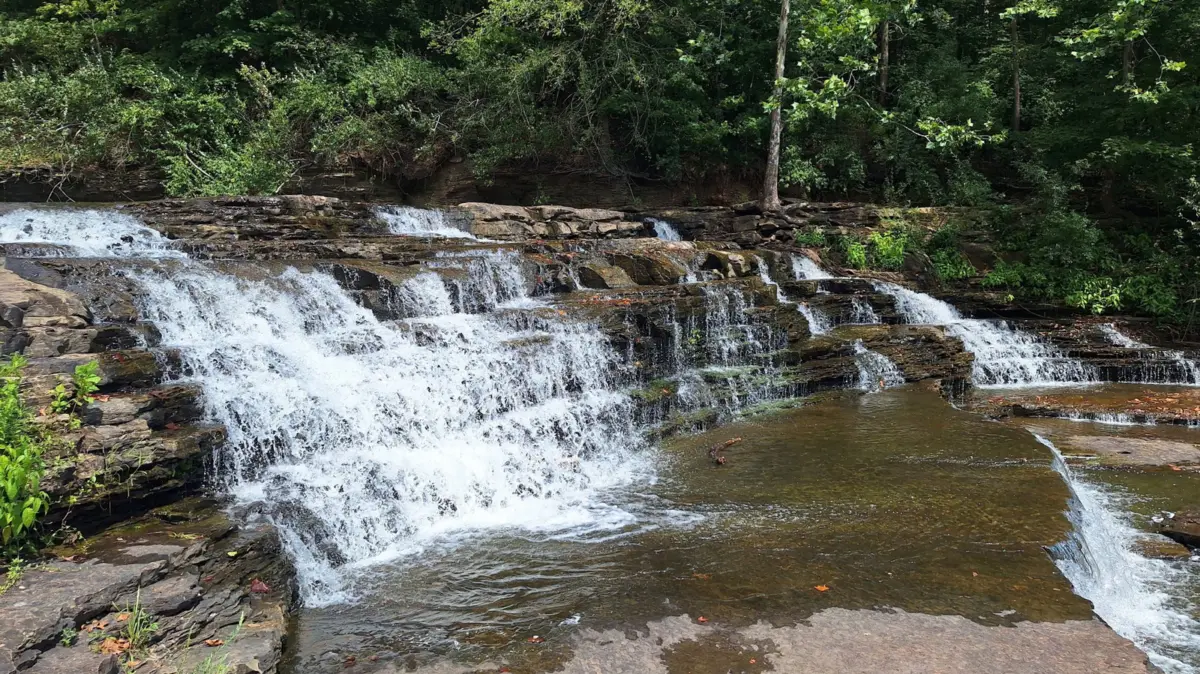
Tucked deep within the rugged topography of Southern Illinois’ Shawnee National Forest lies a geological and hydrological anomaly that challenges conventional perceptions of the American Midwest. Far from the flat, agricultural expanse commonly associated with the region, the Kinkaid Lake Spillway offers an exotic, almost tropical microclimate. Featuring a multi-tiered sandstone cascade that plunges into a crystalline, 15-foot-deep swimming hole, the location evokes comparisons to more famous, far-flung destinations like Hawaii’s Pools of ‘Ohe’o rather than a reservoir overflow channel in Jackson County.
Located just under a two-hour drive from St. Louis, Missouri, this destination has evolved from a utilitarian civil engineering project into a premier regional escape. Originally formed in the 1960s with the damming of Kinkaid Creek, the spillway was engineered to regulate excess water. Over the decades, however, nature reclaimed the architecture, transforming the stepped concrete and natural sandstone shelves into a picturesque, lushly canopied lagoon.
This report provides an exhaustive journalistic examination of the Kinkaid Lake Spillway. It covers its historical origins, ecological profile, recreational infrastructure, visitor dynamics, and its broader role within the Southern Illinois tourism ecosystem. Drawing on regional data, environmental assessments, and firsthand accounts, this article serves as the definitive guide for travelers, conservationists, and outdoor enthusiasts seeking to understand one of the Midwest’s best-kept secrets.

Detailed Chronology: From Civil Engineering Project to Natural Sanctuary
To understand the unique topography of the Kinkaid Lake Spillway, one must examine the timeline of human intervention and natural evolution that shaped the landscape over the last century.
Pre-1960s: The Wild Kinkaid Creek Era
Before the mid-20th century, the Kinkaid Creek watershed was a dynamic, free-flowing waterway carving its way through the ancient sandstone bluffs of the Illinois Ozarks. The surrounding terrain—characterized by dense oak-hickory forests, steep hills, and remote valleys—was sparsely populated and primarily utilized for small-scale agriculture, timber harvesting, and local recreation. The gorge where the spillway now sits was a narrow, rocky ravine typical of the Shawnee Hills region.
The 1960s: Dam Construction and Reservoir Creation
The modern history of the site began to take shape in the 1960s. Recognizing the region’s need for a reliable municipal water supply, flood control, and expanded recreational opportunities, state and local agencies initiated plans to dam Kinkaid Creek.
Engineers constructed a massive earthen and concrete dam across the creek, permanently altering the hydrology of the valley. As water backed up behind the barrier, it submerged acres of forest and valley floor, creating the sprawling, finger-like reservoir known today as Kinkaid Lake.

However, large reservoirs require sophisticated water management systems to prevent catastrophic structural failure during periods of heavy precipitation. To safely handle excess volume, planners designed a concrete and masonry spillway system. This structure was engineered to allow overflow water to step down a series of terraced levels, safely dissipating kinetic energy before rejoining the natural streambed below.
The 1970s to 1990s: Ecological Reclamation and Discovery
Shortly after construction concluded, nature began the process of biological succession. Silt, moss, and vegetation colonized the edges of the concrete and stone masonry. Native trees, including sycamores, maples, and oaks, grew densely along the banks, framing the cascade in a dense, green canopy.
During the late 20th century, the spillway remained largely a local secret. Anglers, nearby residents of Carbondale, and students from Southern Illinois University utilized the base of the waterfall for fishing and quiet respite. Word of mouth slowly spread across the region, drawing adventurous swimmers and hikers looking to escape the summer heat in a setting that felt worlds away from the Midwest.
The 2000s to Present: Digital Age Prominence and Sustainable Management
In the era of social media and location-sharing platforms, the Kinkaid Lake Spillway experienced a surge in visibility. High-definition imagery showcasing the turquoise waters, bright yellow butterflies, and tiered waterfalls captured the attention of travelers across Missouri, Illinois, and Kentucky.
Today, management of the broader area is a collaborative effort involving the Illinois Department of Natural Resources (IDNR), local tourism boards, and forest stewards. While increased foot traffic has brought economic benefits to nearby communities like Carbondale and Murphysboro, it has also heightened the need for sustainable visitor practices to protect the delicate riparian ecosystem surrounding the spillway.
Supporting Context & Metrics: Geography, Ecology, and Hydrology
The allure of the Kinkaid Lake Spillway lies in its unique combination of man-made structure and pristine natural surroundings. Analyzing the quantitative and qualitative metrics of the site reveals why it functions so effectively as a recreational haven.
Hydrological and Geological Profile
- Water Source: Kinkaid Lake overflow, fed by Kinkaid Creek and surrounding watershed tributaries.
- Cascade Structure: A multi-tiered series of sandstone and concrete shelves creating a cascading waterfall effect rather than a sheer vertical drop.
- Pool Dimensions: The plunge pool at the base of the spillway features a rocky bottom with seasonal depths ranging from 12 to 15 feet during peak summer months, making it deep enough for controlled jumping and deep-water swimming.
- Water Clarity: Due to the rocky substrate and filtration through surrounding sandstone formations, the water in the lower pool is frequently noted for its remarkable clarity, allowing swimmers to observe local fish species directly.
Flora and Fauna
The microclimate created by the rushing water, deep gorge, and surrounding forest supports a diverse ecosystem:
- Aquatic Life: The lake and spillway basin are heavily populated by sportfish, including largemouth bass and muskellunge (muskie), making it a popular destination for anglers.
- Invertebrate and Insect Life: During the summer months, the lush vegetation attracts an abundance of pollinators, notably swallowtails and other butterflies that congregate near the cascading mist.
- Terrestrial Canopy: The surrounding hills are dominated by an oak-hickory forest typical of the Shawnee National Forest, interspersed with sandstone bluffs that provide nesting habitats for local birds of prey and micro-habitats for specialized ferns and mosses.
Geographic Accessibility and Logistics
- Proximity to St. Louis: Approximately 115 miles southeast, translating to a drive time of roughly 1 hour and 45 minutes to 2 hours via major regional highways.
- Proximity to Carbondale, IL: Located roughly 25 minutes west of Carbondale, offering robust urban support services, hotels, dining, and medical facilities.
- Infrastructure: The site features an adjacent gravel parking area with direct line-of-sight to the waterfall, picnic benches for day-trippers, and restroom facilities, balancing remote wilderness appeal with basic modern amenities.
Official Statements and Expert Perspectives
Managing a natural recreation site that attracts thousands of visitors annually requires balancing public access with environmental preservation. Regional authorities and outdoor recreation experts have weighed in on the management and appeal of the Kinkaid Lake Spillway.
Illinois Department of Natural Resources (IDNR) Perspective
According to guidelines and documentation provided by the IDNR, the Kinkaid Lake area is classified as a multi-use recreational zone designed to promote sustainable outdoor activity. While the Spillway is celebrated as a family-friendly destination, state officials consistently emphasize safety and respect for the natural environment.
In public safety advisories concerning water recreation around spillways and dams, IDNR representatives note:
"While engineered spillways provide controlled release of reservoir waters, visitors must remain cognizant of changing water velocities, slippery rock surfaces, and fluctuating seasonal depths. Responsible recreation ensures that these unique naturalized spaces remain pristine for future generations."
Tourism and Visitor Insights
Regional tourism promotion boards, including Southern Illinois Tourism, frequently highlight the spillway as a prime example of the region’s unexpected geographical diversity. In promotional literature, tourism directors emphasize that the Shawnee Hills region serves as an affordable, accessible alternative to coastal or mountain vacations for Midwestern families.
Firsthand reviews from verified travelers underscore the unique psychological impact of the location. One frequent visitor noted in a regional travel blog:
"You step out of the car, and the sound of the rushing water completely isolates you from the rest of the world. Standing on those warm sandstone blocks with the spray hitting your face, you honestly forget you are in Illinois."
Another contributor on public mapping platforms remarked on the family-friendly nature of the site:
"Our kids’ new favorite place! Never overcrowded, at least on our visits. The water is warm, the views are gorgeous, and the layout makes it exceptionally easy to navigate up and down the banks."
Future Outlook: Preservation, Tourism, and Sustainability
As the Kinkaid Lake Spillway continues to grow in popularity via digital platforms and word-of-mouth recommendations, stakeholders face critical decisions regarding its future management.
Balancing Tourism Growth and Ecological Health
The primary challenge moving forward is mitigating the environmental impact of increased foot traffic. Heavy visitor volumes can lead to soil compaction, trail erosion along the unmarked hiking paths, and littering.
To address these challenges, local conservation groups and municipal leaders in Jackson County are advocating for enhanced trail marking, expanded waste management infrastructure, and educational signage emphasizing "Leave No Trace" principles. Preserving the crystal-clear quality of the swimming pool requires active cooperation from the public to prevent pollution in the watershed upstream.
Infrastructure and Access Improvements
While the immediate parking and restroom facilities serve current visitors adequately, discussions are underway among regional planners to improve accessibility routes. Enhancing the safety of the rocky scramble down to the pool—perhaps through strategically placed handrails or stabilized stone pathways—is being weighed against the desire to keep the area looking and feeling as wild and natural as possible.
Integration into the Broader Shawnee Regional Economy
The spillway does not exist in a vacuum; it is part of a larger constellation of natural wonders in Southern Illinois, including the nearby Lake Murphysboro State Park, Giant City State Park, and the extensive network of the Shawnee National Forest.
Future tourism initiatives aim to package these destinations into cohesive multi-day itineraries. By encouraging visitors to extend their stays in nearby college towns like Carbondale—utilizing local dining, lodging, and retail services—the region can capture sustained economic benefits while distributing visitor traffic more evenly across multiple sites, reducing environmental strain on the Kinkaid Spillway alone.
Conclusion
The Kinkaid Lake Spillway stands as a testament to the unexpected beauty hidden within the American Midwest. By harmonizing civil engineering with the raw, rugged power of nature, the site offers an immersive escape that defies regional stereotypes. Whether visitors are seeking the thrill of a 15-foot plunge into a clear rock-bound pool, a scenic hike through the oak-hickory forests of the Shawnee Hills, or simply a tranquil spot to picnic within earshot of a cascading waterfall, the spillway delivers an unforgettable experience. As long as conscientious stewardship and balanced management prevail, this Southern Illinois gem will continue to enchant travelers for generations to come.