







Executive Overview
Washington State’s transportation landscape is undergoing a profound transformation, driven by surging population growth, technological innovation, and a regional commitment to sustainable, high-capacity transit. Against this backdrop of rapid urbanization, the Community Transit Board of Directors has officially approved its comprehensive 2026–2031 Transit Development Plan (TDP). This landmark six-year roadmap sets a bold course for the future of public mobility in Snohomish County, outlining a sweeping expansion of fixed-route bus services, the deployment of innovative on-demand microtransit zones, and the continuous scaling of the region’s burgeoning Bus Rapid Transit (BRT) network.
At the core of this newly minted blueprint is a commitment to meeting the escalating transportation demands of one of the fastest-growing regions in the Pacific Northwest. Beyond traditional route expansions, the 2026–2031 TDP revives a critical institutional dialogue: exploring the potential annexation of Everett Transit into the broader Community Transit service area. If realized, this structural integration could fundamentally reshape how public transportation is governed, funded, and delivered across central Snohomish County, promising a more unified and seamless passenger experience.
As mandated by the Washington State Department of Transportation (WSDOT), transit agencies must continuously evaluate their financial forecasts and service strategies through annually updated, multi-year plans. Community Transit’s latest iteration does not merely check a regulatory box; it serves as a visionary strategic framework designed to align local bus networks with sweeping regional infrastructure investments, including the historic expansion of regional light rail. This report provides an exhaustive analysis of the 2026–2031 TDP, examining its structural components, the strategic implications of potential municipal annexation, the underlying metrics of Snohomish County’s transit evolution, and the long-term outlook for commuters in the Pacific Northwest.

Detailed Chronology: The Road to the 2026–2031 TDP
To understand the weight of the newly approved 2026–2031 Transit Development Plan, one must trace the evolutionary milestones of Community Transit and the broader socio-economic shifts that have defined Snohomish County over the past half-century.
A Legacy of Mobility: Celebrating 50 Years of Community Transit
Founded to address the suburbanization and rapid industrial growth of Snohomish County north of Seattle, Community Transit has spent the last five decades evolving from a modest suburban bus provider into a multi-modal transit powerhouse. Over the decades, the agency has adapted to economic shifts, aerospace manufacturing booms, and successive waves of residential development. The 50-year milestone—celebrated recently across the transit community—underscores an institutional resilience and a continuous capacity for reinvention.
The Post-Pandemic Pivot and Regional Light Rail Integration
The genesis of the current six-year plan can be traced back to the post-pandemic recovery period, characterized by shifting commuting patterns, a permanent rise in hybrid work models, and an unprecedented housing boom along the Interstate 5 and Highway 99 corridors. Simultaneously, the region has been preparing for the arrival of regional light rail.
As Sound Transit pushes its light rail extensions further north into Snohomish County, Community Transit has been tasked with completely redesigning its network architecture. The agency’s historical model—which largely relied on long-haul commuter buses whisking workers from Snohomish County directly into downtown Seattle—is being systematically replaced by a "feed-and-distribute" network. In this modern paradigm, local buses and high-frequency BRT lines act as vital feeder systems, fundling thousands of daily riders directly to rapid rail stations.
Drafting and Approving the 2026–2031 Roadmap
The formal creation of the 2026–2031 TDP involved months of meticulous data collection, demographic modeling, and public stakeholder engagement. Planners analyzed ridership recovery curves, traffic congestion metrics, and land-use changes approved by municipal governments throughout the county.
The multi-stage drafting process culminated in a comprehensive review period, during which community members, municipal leaders, and labor representatives weighed in on proposed service enhancements. Following rigorous debate and refinement, the Community Transit Board officially voted to approve the plan. This formal adoption locks in the agency’s programmatic priorities for the next six years, ensuring that capital investments, operational expenditures, and staffing projections remain tightly synchronized with regional growth.
Supporting Context & Metrics: Unpacking the Six-Year Vision
The 2026–2031 Transit Development Plan is underpinned by a robust matrix of financial projections, demographic realities, and technological deployments. To fully grasp the magnitude of the agency’s goals, one must examine the specific mechanics driving the plan forward.
+-----------------------------------------------------------------+
                 COMMUNITY TRANSIT 6-YEAR TDP CORE PILLARS
+-----------------------------------------------------------------+
  [Fixed-Route Expansion] --------> Scaling Frequent Bus Networks
  [Microtransit Integration] -----> Expanding Zip Shuttle Zones
  [BRT Infrastructure] -----------> Scaling the Swift Network
  [Structural Consolidation] -----> Exploring Everett Transit Annexation
+-----------------------------------------------------------------+
Financial Forecasting and WSDOT Compliance
Under Washington State law, specifically guidelines enforced by WSDOT, public transportation agencies operating within the state are required to adopt a six-year Transit Development Plan and update it annually. This statutory requirement ensures transparency, fiscal accountability, and long-range coordination with state-level transportation goals.
Community Transit’s TDP functions as a rolling financial forecast. It balances anticipated sales tax revenues—the primary funding mechanism for Washington transit agencies—against operational costs, fleet electrification expenses, labor negotiations, and capital construction projects. Despite economic fluctuations and inflationary pressures on parts and labor, the 2026–2031 plan presents a fiscally constrained yet ambitious vision, leveraging federal grants, state climate commitment funds, and local revenues to maintain a healthy operating reserve while aggressively expanding service hours.
Expanding the Swift Bus Rapid Transit (BRT) Network
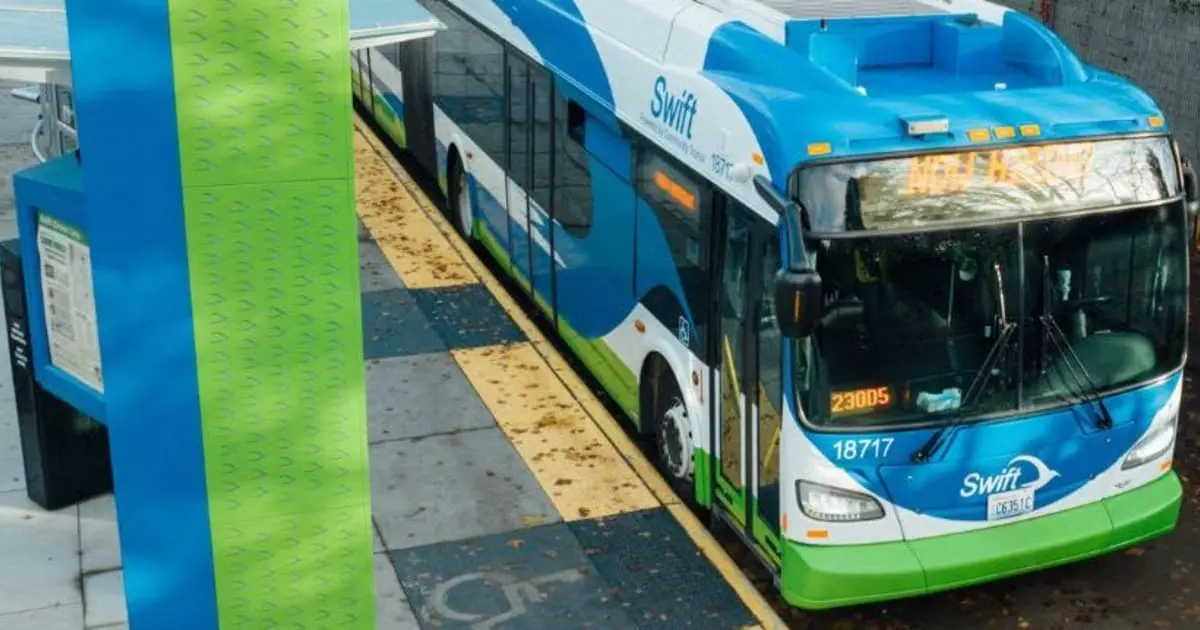
A cornerstone of Community Transit’s modern identity is its Swift Bus Rapid Transit system. Designed to mimic the high-capacity, reliable characteristics of light rail at a fraction of the capital cost, Swift features:
- Off-board fare collection for rapid boarding.
- Transit signal priority (TSP) to keep buses moving through congested intersections.
- Level, station-platform boarding.
- Dedicated runningways in key segments.
The agency currently operates successful lines, such as the Swift Blue Line and Green Line, and is actively preparing for future expansions, including the Swift Orange Line and subsequent corridors. The 2026–2031 TDP incorporates funding and operational frameworks to continuously scale the Swift network, ensuring that high-frequency connections link major residential hubs, commercial centers, and upcoming light rail stations.
Scaling Microtransit: The Evolution of Zip Shuttle Zones
While fixed-route buses and BRT form the backbone of the system, Community Transit recognizes that suburban and semi-rural geographies present unique "first-mile/last-mile" challenges. Traditional fixed-route buses cannot efficiently serve winding cul-de-sacs or low-density neighborhoods without incurring unsustainable operational costs.
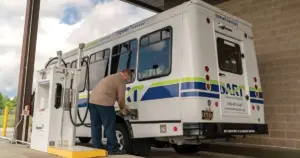
To solve this, the agency pioneered Zip Shuttle, an on-demand microtransit service operating via dedicated smartphone applications. Riders can hail a shared vehicle within designated zones to connect directly to major transit hubs, shopping centers, or high-frequency bus lines. The 2026–2031 TDP outlines a deliberate expansion of existing Zip Shuttle zones and the establishment of entirely new operational boundaries across Snohomish County, targeting areas experiencing rapid residential development where fixed routes are not yet viable.
The Everett Transit Annexation Question: A Structural Paradigm Shift
Perhaps the most consequential policy discussion revived within the new TDP framework is the potential annexation of Everett Transit into the Community Transit service area. This prospective consolidation represents a major structural realignment for public transit in the Pacific Northwest.
Historical Context and Current Realities
Everett Transit operates as a municipal department serving the city limits of Everett, Washington’s seventh-largest city and the county seat of Snohomish County. While Everett Transit has a proud history of serving its local urban core, it has historically operated independently of Community Transit, which serves the broader county outside city limits.
However, jurisdictional boundaries matter little to modern commuters. Workers, students, and shoppers regularly cross municipal lines, and the artificial administrative division between city-operated transit and county-wide transit has occasionally led to complex fare structures, fragmented route planning, and duplicated administrative overhead.
Drivers of Annexation: Population Growth and Travel Demand
Talks of annexation are primarily a direct response to accelerating population growth and shifting transportation demands. As Everett densifies and urban corridors blur into surrounding unincorporated areas, a unified transit network becomes increasingly imperative.
Proponents of integration argue that merging Everett Transit into Community Transit would yield profound benefits:
- Administrative Efficiency: Eliminating redundant administrative functions, back-office operations, and maintenance scheduling.
- Seamless Passenger Experience: Creating a unified fare policy, harmonized schedules, and a single, coherent brand identity for riders traveling across the city-county boundary.
- Enhanced Service Investment: Leveraging Community Transit’s broader tax base and robust regional funding streams to inject fresh capital into Everett’s aging bus fleet, upgrade transit facilities, and increase service frequencies on heavily patronized urban corridors.
The Path Forward: Approvals and Governance
Despite the clear strategic logic, structural annexation is a complex political and legal undertaking. The 2026–2031 TDP formally re-establishes the framework for Community Transit and the City of Everett to resume exploratory talks, technical studies, and financial audits.
Any final decision regarding annexation cannot be executed unilaterally by transit planners. It remains strictly subject to formal authorization and approval by both the Everett City Council and the Community Transit Board of Directors. Furthermore, public outreach and potential voter engagement may play a pivotal role depending on the specific legal mechanisms chosen to effectuate the merger. Should negotiations succeed, future iterations of the TDP will undergo significant restructuring to incorporate Everett’s routes, assets, and personnel into the unified agency.
Official Statements and Institutional Perspectives
The approval of the 2026–2031 Transit Development Plan has elicited strong responses from regional leaders, transit advocates, and agency executives, reflecting the high stakes of public mobility planning in a rapidly expanding economy.
Agency Leadership on the Six-Year Horizon
Speaking on the adoption of the TDP, Community Transit executive leadership emphasized that the plan is fundamentally people-centric.
"Our mission over the next six years is not simply to add miles of bus routes or purchase vehicles; it is about connecting human lives to opportunity," noted a senior transit official during the board proceedings. "As Snohomish County continues to grow at an unprecedented pace, our transit system must anticipate that growth rather than chase it. The 2026–2031 TDP gives us the tactical flexibility and the financial discipline required to build a world-class, multi-modal network."
Municipal and Regional Alignment
Representatives from municipal governments across Snohomish County have praised the collaborative nature of the planning process. Mayors and city council members from Lynnwood, Edmonds, Marysville, Lake Stevens, and Arlington have highlighted the importance of aligning local land-use planning with Community Transit’s service expansions.
Regarding the revival of Everett Transit annexation talks, local stakeholders have expressed cautious optimism. City officials in Everett note that while financial sustainability and equitable service distribution within city limits are paramount concerns, the potential to leverage county-wide resources to enhance urban mobility is an opportunity worth rigorous exploration.
Future Outlook: Snohomish County Mobility Beyond 2031
As Community Transit looks toward the horizon of 2031 and beyond, the agency’s strategic trajectory points toward a fully integrated, highly digital, and environmentally sustainable mobility ecosystem.
Fleet Electrification and Environmental Commitments
A critical underlying dimension of the 2026–2031 TDP—though amplified by parallel agency initiatives—is the aggressive transition toward zero-emission fleet technologies. As Washington State enacts stringent climate policies and mandates reductions in greenhouse gas emissions from the transportation sector, Community Transit is actively integrating battery-electric buses (BEBs) and exploring hydrogen fuel cell technology. The six-year planning horizon accounts for the heavy capital investments required to construct high-capacity charging depots, upgrade electrical grid connections at transit bases, and retrain maintenance personnel to service advanced propulsion systems.
The Digital Transformation of Transit
The rider experience of 2031 will bear little resemblance to the paper-schedule era of the past. Community Transit is heavily investing in intelligent transportation systems (ITS), real-time predictive arrival algorithms, and account-based ticketing systems that integrate seamlessly across all regional operators via the ORCA card platform and mobile applications. The expansion of Zip Shuttle microtransit is inherently tied to this digital transformation, utilizing dynamic dispatch software to optimize vehicle routing in real-time based on passenger demand.
Conclusion
Community Transit’s approved 2026–2031 Transit Development Plan is more than a bureaucratic roadmap; it is a declaration of intent for the future of the Pacific Northwest. By coupling aggressive fixed-route and BRT expansions with nimble microtransit solutions and exploring structural consolidation through the potential annexation of Everett Transit, the agency is positioning itself to meet the complex demands of a booming population.
As light rail tracks extend northward and new residential communities take root across Snohomish County, Community Transit’s six-year blueprint ensures that public mobility remains a dependable, equitable, and forward-looking pillar of regional prosperity.