








Executive Overview
The global maritime landscape is undergoing a profound structural shift as climate change, geopolitical realignments, and trade disruptions reshape traditional shipping corridors. At the center of this transformation is the Northern Sea Route (NSR), a passage stretching across Russia’s Arctic coastline that promises to slash transit times between East Asia and Europe. While once regarded as a speculative, ice-locked frontier, the NSR is rapidly transitioning into an active seasonal commercial highway.
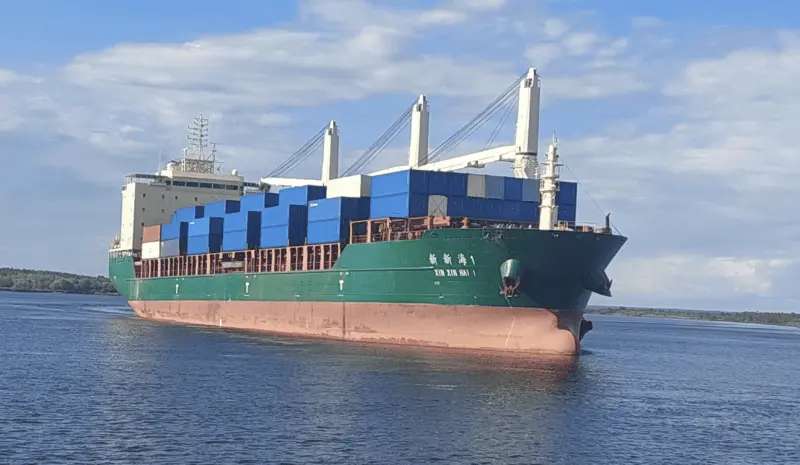
In a milestone development, Chinese operator NewNew Shipping Line has significantly expanded its Arctic footprint with the first-ever delivery of containerized cargo from Asia directly to the port of Murmansk via the NSR. The arrival of the 29,000-dwt container ship Xin Xin Hai 1 on August 19, carrying automotive components from Tianjin, underscores a deepening logistics partnership between Moscow and Beijing. This voyage represents more than a single successful transit; it is the vanguard of a highly structured, long-term strategy by Chinese operators to establish a permanent commercial presence in the Arctic.
This expansion comes at a critical juncture. As Western sanctions isolate Russia from traditional European markets and force a dramatic pivot to the East, Moscow is actively seeking foreign investment to realize its ambitions for the NSR. Concurrently, major Asian economies—notably China, South Korea, and India—are intensifying their engagement with the Arctic corridor. By positioning itself as a primary mover, NewNew Shipping Line is transitioning from an experimental operator into a cornerstone infrastructure partner, with plans that extend far beyond shipping to include massive equity investments in Russian deepwater ports and the deployment of specialized, large-capacity ice-class vessels.
                    NORTHERN SEA ROUTE (NSR) VS. SUEZ CANAL ROUTE

     [East Asia Ports] ──(Suez Canal: ~21,000 km / 35-45 Days)──> [Northern Europe]
     [East Asia Ports] ──(NSR Route:  ~13,000 km / 18-25 Days)──> [Murmansk/Arkhangelsk]
Detailed Chronology: From Experimental Voyages to Scheduled Services
The progression of NewNew Shipping Line’s Arctic operations reveals a calculated, rapid scaling of capacity and frequency over a remarkably short timeframe.
  NewNew Shipping Line: Annual Arctic Voyages (Historical & Projected)

  Year | Voyages
  ─────┼───────────────────────────────────
  2023 | ■■■■■■■ (7)
  2024 | ■■■■■■■■■■■■■ (13)
  2025 | ■■■■■■■■■■■■■ (13)
  2026 | ■■■■■■■■■■■■ (12 - Projected target for Arkhangelsk route alone)
The Murmansk Milestone (August 2024)
The voyage of the Xin Xin Hai 1 marks a historical shift for the port of Murmansk. Departing from the industrial hub of Tianjin, China, the 29,000-dwt vessel undertook a roughly monthlong journey through the challenging waters of the Bering Strait, the East Siberian Sea, and the Kara Sea, before finally berthing at Murmansk on August 19.
The vessel carried approximately 500 containers loaded primarily with automotive components—a cargo category of vital strategic importance to the Russian domestic market, which has faced severe supply chain deficits following the exit of Western automakers. This transit was the first time Murmansk, an ice-free port situated beyond the Arctic Circle, had received containerized cargo sourced from Asia via the NSR.
The Evolution of the Arctic Express
NewNew Shipping Line’s operational expansion is characterized by a steady upward trajectory:
- 2023: The operator initiated its Arctic campaign with seven successful voyages, testing the operational limits of its vessels and establishing basic protocols with Rosatomflot, Russia’s state-owned nuclear icebreaker operator.
- 2024–2025: The company increased its commitment, executing 13 voyages in 2024 and maintaining a similar cadence of 13 voyages in 2025. Crucial to this expansion was the formalization of the Arctic Express No. 1 service. This scheduled service directly links the major Chinese manufacturing and export hubs of Shanghai and Ningbo with the Russian port of Arkhangelsk via the NSR.
- 2026 and Beyond: Looking ahead, the company is targeting up to 12 dedicated voyages between China and Arkhangelsk alone for the 2026 season, reflecting a strategy aimed at building dense, predictable seasonal schedules rather than sporadic transits.
Supporting Context & Metrics: The Economics of the Polar Silk Road
To understand the rapid influx of Asian operators into the Arctic, one must examine the stark economic and logistical metrics that govern global container shipping.
Distance and Time Advantages
For cargo moving from northern Chinese ports to Western Russia or Northern Europe, the NSR offers a dramatic reduction in transit distance compared to the traditional southern route via the Malacca Strait, the Indian Ocean, and the Suez Canal.
| Route Parameter | Suez Canal Route (SCR) | Northern Sea Route (NSR) | Variance / Savings |
|---|---|---|---|
| Average Distance | ~21,000 kilometers | ~13,000 kilometers | ~8,000 km (38% shorter) |
| Average Transit Time | 35 to 45 days | 18 to 28 days | 15 to 20 days saved |
| Primary Security Risks | Piracy, Red Sea geopolitical conflict | Extreme weather, ice blockage, remote salvage | Variable risk profile |
While the Suez Canal route remains plagued by security bottlenecks—most notably the ongoing threat of Houthi rebel attacks in the Red Sea, which have forced global shipping giants to divert around the Cape of Good Hope—the Arctic route presents a politically secure, state-monopolized corridor free from the threat of maritime piracy or regional military conflict.
Operational Metrics and Tonnage Targets
According to Russian maritime authorities, during the combined 2024–2025 shipping seasons, NewNew Shipping’s Arctic Express service completed a total of 14 transits (consisting of seven export and seven import voyages). These voyages moved approximately 17,500 TEUs (Twenty-foot Equivalent Units) of cargo.
While these figures represent a fraction of the millions of TEUs that pass through the Suez Canal annually, the growth rate is exponential. NewNew Shipping Line has set an aggressive target to transport 1.2 million tonnes of cargo along the NSR by 2027. Achieving this volume will require transitioning from medium-sized, general-purpose vessels to highly specialized, larger-capacity container ships.
       NewNew Shipping Line: Cargo Volume Target (NSR)

       2024-2025:  [██] ~17,500 TEUs
       2027 Target:[████████████████████████████████] 1.2 Million Tonnes
The Broader Asian Context
China is not alone in recognizing the strategic value of the Arctic. The region is attracting diverse Asian entrants eager to hedge their logistical risks:
- South Korea: Seoul is actively accelerating its Arctic footprint. South Korean logistics provider PanStar dispatched the 2,700-TEU vessel PanStar Acro from the port of Busan on August 22, bound for Europe. This voyage serves as South Korea’s first commercial container trial through the NSR, aimed at assessing the viability of regular seasonal transits.
- India: New Delhi is also moving to secure its interests in the High North. Following high-level bilateral discussions with Russian officials in the Arkhangelsk region, India is planning its first pilot cargo voyage through the NSR in 2027. This initiative aligns with India’s broader strategy to establish the Chennai-Vladivostok Eastern Maritime Corridor, eventually linking it with Arctic logistics nodes.
Official Statements and Corporate Strategy
The statements emerging from corporate and state leaders indicate that NewNew Shipping Line’s objectives have evolved from pure freight carriage to deep infrastructural integration.
At a prominent Russia-China cooperation forum held in Kazan, Ke Jin, the General Director of NewNew Shipping, made the company’s capital expenditure ambitions clear:
"Of particular interest to us are investment projects in Arctic ports, in Murmansk and Arkhangelsk, as well as the opportunity to participate in the equity of the port of Ust-Luga."
This statement signals a strategic shift. By seeking equity stakes in key Russian gateway ports, NewNew Shipping is looking to secure priority berthing, dedicated container yards, and long-term tariff stability, shielding itself from potential capacity bottlenecks as traffic on the NSR grows.
This vision was echoed by Fan Yuxin, Board Chairman of NewNew Shipping, who emphasized the long-term, structural nature of the company’s relationship with Russian regional authorities:
"We are highly interested in developing Murmansk as a premier logistics hub. Our company is counting on a stable, long-term partnership that extends beyond seasonal transits to encompass year-round logistical planning."
Russian regional and federal authorities have welcomed this interest with open arms. Faced with a complete withdrawal of Western maritime operators and terminal developers, Russian officials have indicated that NewNew Shipping could invest as much as 200 billion rubles ($2.5 billion) in the planned deepwater expansion of the Arkhangelsk port. Such an investment would transform Arkhangelsk from a regional timber and bulk port into a state-of-the-art container hub capable of handling modern ice-class cellular vessels.
Future Outlook: Infrastructure, Mega-ships, and Geopolitical Friction
As the Northern Sea Route prepares for increased commercial traffic, several critical variables will dictate whether the corridor can sustain its current growth trajectory.
                  THE SINO-RUSSIAN ARCTIC LOGISTICS LOOP

   ┌─────────────────────────────────────────────────────────────────┐
   │                                                                 │
   ▼                                                                 │
[Chinese Manufacturing Hubs] (Tianjin, Shanghai, Ningbo)             │
   │                                                                 │
   │  Cargo: Automotive components, electronics, industrial machinery │
   ▼                                                                 │
[Northern Sea Route] (NSR transit supported by Rosatomflot)          │
   │                                                                 │
   │  Strategic investment: Up to $2.5B in port upgrades             │
   ▼                                                                 │
[Russian Gateway Ports] (Murmansk, Arkhangelsk, Ust-Luga) ───────────┘
The Push for Ice-Class Mega-Ships
To overcome the physical limitations of the Arctic environment, NewNew Shipping Line plans to deploy significantly larger vessels. The company has announced plans to introduce 4,800-TEU ice-class container ships into its Arctic services.
Operating ships of this scale in the Arctic presents unique engineering and operational challenges:
- Ice Classification: These vessels require high ice-class notations (typically Arc4 or Arc5 under the Russian Maritime Register of Shipping), featuring reinforced hulls, ice-strengthened propellers, and specialized winterization packages to protect mechanical systems from temperatures dropping below -40°C.
- Draft Limitations: Larger vessels draw more water. Key straits along the NSR, such as the Sannikov Strait, have draft limitations that restrict the passage of deep-draft vessels, requiring precise hydrographic surveying and routing.
- Escort Logistics: While climate change is reducing summer ice cover, escort support from Rosatomflot’s nuclear-powered icebreakers remains mandatory for much of the shoulder seasons to ensure safety and schedule reliability.
Port Bottlenecks and Investment Realities
While the proposed 200-billion-ruble expansion of Arkhangelsk and the integration of Ust-Luga are ambitious, the transition from memorandum to reality remains highly complex. Developing deepwater berths, installing high-speed container gantry cranes, and establishing robust inland rail connections in sub-zero environments require massive, sustained capital expenditure. Observers note that while negotiations are advanced, the final investment decisions (FIDs) and concrete timelines for these port upgrades remain fluid.
Geopolitical and Environmental Implications
The commercialization of the NSR is fraught with geopolitical tension. Western nations view the growing Sino-Russian cooperation in the Arctic with deep suspicion, fearing that commercial maritime infrastructure could eventually serve dual-use military purposes. Furthermore, environmental organizations continue to raise alarms regarding the ecological impact of increased commercial shipping in the fragile Arctic ecosystem, citing the risks of heavy fuel oil (HFO) spills, increased black carbon emissions on Arctic ice, and underwater noise pollution disrupting marine mammals.
Despite these headwinds, the economic imperatives driving China, South Korea, and India to secure alternative trade routes are powerful. As NewNew Shipping Line targets its ambitious 1.2-million-tonne threshold for 2027, the Northern Sea Route is rapidly shedding its status as an exotic geographical alternative, solidifying its role as a vital, highly contested artery of 21st-century global commerce.