






Executive Overview
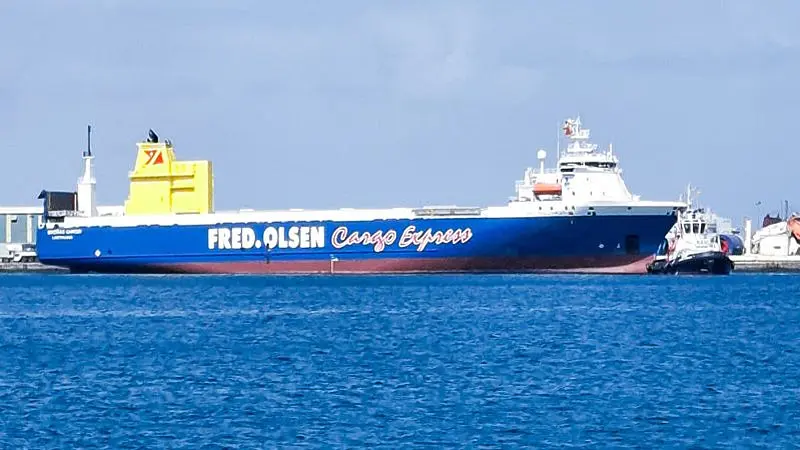
Since its official inauguration in May 2024, Fred. Olsen Cargo Express has quietly engineered a structural transformation in the maritime logistics landscape of the Canary Islands. Within slightly more than a year of continuous, dedicated operations, the freight arm of the established Spanish shipping operator has crossed critical operational milestones: moving more than one million metric tonnes of physical goods and exceeding 140,000 linear metres of roll-on/roll-off (RoRo) cargo across the Atlantic archipelago.
This rapid scaling reflects a strategic response to long-standing supply chain vulnerabilities inherent to insular economies. While mixed passenger-vehicle ferries historically carried the burden of archipelagic transport, the market demanded dedicated, high-frequency, and uncompromised freight channels. By carving out a specialized business division powered by a growing fleet of dedicated RoRo freight vessels—most recently fortified by the addition of the Breña Cargo in July 2025 alongside the Bentayga Cargo and Bahía Cargo—Fred. Olsen Express has established a resilient maritime backbone connecting mainland Spain, major economic hubs, and outer islands alike.
The economic ramifications of this service expansion extend beyond simple tonnage metrics. By delivering high reliability and specialized handling for unaccompanied freight, cold-chain logistics, and industrial heavy loads, Fred. Olsen Cargo Express has reinforced food security, bolstered local trade, and created a scalable framework for archipelagic supply chain management in an outlying region of the European Union.
Detailed Chronology
[May 2024] -------------------> [Late 2024 / Early 2025] -------------> [July 2025]
Launch of Dedicated Freight      Establishment of Strategic Mainland      Fleet Triplication with
Service (Bentayga & Bahía Cargo) Maritime Bridge via Port of Huelva        Addition of Breña Cargo
Phase I: The Inception and Strategic Reconfiguration (May 2024)
In May 2024, Fred. Olsen Express launched Fred. Olsen Cargo Express, a division created specifically to address specialized cargo demands. Historically, freight across the Canary Islands relied heavily on spare garage space aboard high-speed passenger catamarans or conventional RoPax vessels. While effective for light commercial traffic, this hybrid model proved susceptible to seasonal passenger surges, variable weather restrictions, and space limitations for heavy industrial or articulated vehicles.
To decouple commercial logistics from passenger traffic, the operator introduced dedicated RoRo vessels into service, deploying the Bentayga Cargo and Bahía Cargo. Initial schedules focused on critical arterial routes linking the major capital islands—Tenerife and Gran Canaria—with peripheral nodes, immediately relieving freight congestion at port terminals in Santa Cruz de Tenerife and Las Palmas.
Phase II: Network Integration and the Mainland Logistics Corridor (Late 2024 – Early 2025)
Following initial operational success, the company expanded its maritime grid. A fundamental step was integrating the Port of Huelva in southwestern Andalusia as the primary gateway for mainland Spanish cargo bound for the archipelago.
By linking the mainland directly with Tenerife, Gran Canaria, and outer islands like La Palma, Fuerteventura, and Lanzarote, Fred. Olsen Cargo Express established an integrated logistics chain. Unaccompanied semi-trailers loaded in continental distribution hubs could now be rolled onto vessels at Huelva, shipped across the Atlantic, and seamlessly transferred onto inter-island feeder routes without driver accompaniment, significantly optimizing transit times and operational expenditures for regional logistics operators.
Phase III: Fleet Escalation and Route Optimization (July 2025)
Recognizing surging volume demand and the imperative for absolute schedule integrity, the carrier executed the next phase of its expansion plan in July 2025. The company acquired and commissioned a third dedicated RoRo vessel, the Breña Cargo.
Named in honor of the agricultural and commercial heritage of La Palma, the Breña Cargo joined the Bentayga Cargo and Bahía Cargo, bringing the dedicated freight fleet to three uniform, high-capacity RoRo vessels. This acquisition directly supported an intensified sailing schedule, including three dedicated weekly rotations between Tenerife and La Palma, while locking in continuous feeder connections across the eastern and western islands.
Supporting Context & Metrics
+-------------------------------------------------------------------------+
|                  FRED. OLSEN CARGO EXPRESS PERFORMANCE                  |
+-----------------------------------+-------------------------------------+
| Total Freight Volume Transported  | > 1,000,000 Metric Tonnes           |
| Linear Metres of RoRo Capacity    | > 140,000 Metres                    |
| Dedicated Freight Fleet           | 3 RoRo Vessels                      |
| Primary Island Hubs               | Tenerife, Gran Canaria, La Palma,   |
|                                   | Fuerteventura, Lanzarote            |
| Mainland Logistics Gateway        | Port of Huelva (Andalusia, Spain)   |
| Tenerife – La Palma Direct Service| 3 Weekly Dedicated Sailings         |
+-----------------------------------+-------------------------------------+
Deconstructing the Operational Metrics
To appreciate the operational scale of moving over one million metric tonnes of freight and 140,000 linear metres of cargo within a fifteen-month timeframe, one must analyze the logistics mechanics of archipelagic roll-on/roll-off ocean freight:
- Linear Metre Capacity: In RoRo logistics, linear metres (or lane metres) represent the physical deck space available for rolling stock. A standard semi-trailer occupying approximately 13.6 metres means that 140,000 linear metres equates to more than 10,000 fully loaded articulated truck trailers traversing the archipelago.
- Tonnage Mix: The composition of the 1,000,000+ tonnes reflects the broad-spectrum needs of an isolated economic region. This includes temperature-controlled foodstuffs (cold-chain), fast-moving consumer goods (FMCG), construction materials, industrial machinery, hazardous materials (ADR), and agricultural exports—most notably La Palma’s banana yield bound for mainland markets.
Archipelagic Supply Chain Dynamics
As an Outermost Region (OR) of the European Union, the Canary Islands depend heavily on maritime transport for survival and economic vitality. More than 90% of all physical goods consumed within the archipelago arrive via ocean freight.
                                 [MAINLAND SPAIN]
                                        |
                                  (Port of Huelva)
                                        |
                                        v
                            [TENERIFE / GRAN CANARIA]
                                (Central Hubs)
                                        |
             +--------------------------+--------------------------+
             |                          |                          |
             v                          v                          v
        [LA PALMA]              [FUERTEVENTURA]               [LANZAROTE]
   (3x Weekly Sailings)         (Feeder Services)          (Feeder Services)
The multi-island geography introduces distinct vulnerabilities:
- The "Double Insularity" Dilemma: Peripheral islands such as La Palma, El Hierro, and La Gomera face compound logistical hurdles. Goods must first reach a primary hub (Tenerife or Gran Canaria) before being re-loaded onto secondary inter-island feeders. Fred. Olsen Cargo Express mitigated this bottleneck by establishing direct, dedicated schedules—such as the three weekly Tenerife–La Palma runs—guaranteeing fixed delivery windows for fresh produce and time-sensitive goods.
- Unaccompanied Freight Advantage: Traditional freight required transport companies to send a tractor unit and driver aboard the ferry, incurring significant labor, accommodation, and downtime costs. The dedicated RoRo model utilized by Breña Cargo, Bentayga Cargo, and Bahía Cargo prioritizes unaccompanied trailers. Local hauliers drop off trailers at port marshaling yards; the shipping line handles stowage, ocean transit, and discharge; and destination hauliers collect the trailers upon arrival. This operational model maximizes fleet utilization, lowers carbon footprints per tonne-kilometer, and reduces driver shortages across the region.
Official Statements
Reflecting on the achievement of passing the one-million-tonne threshold and the deployment of the third RoRo vessel, executive leadership from Fred. Olsen Express emphasized the strategic importance of tailored maritime solutions for regional resilience.
"Reaching the milestone of one million tonnes transported in such a short timeframe validates the strategy we set in motion in May 2024," stated Jesús Valle, Fleet and Freight Manager at Fred. Olsen Express. "Our goal was never simply to add cargo capacity, but to re-engineer how commercial freight moves across the Canary Islands. By establishing a dedicated, purpose-built division insulated from seasonal passenger dynamics, we have offered logistics operators, local businesses, and distributors an unprecedented level of schedule stability."
Highlighting the recent fleet expansion, Valle added:
"The integration of the BREÑA CARGO in July 2025 marked the realization of our triple-vessel dedicated structure. Working alongside BENTAYGA CARGO and BAHÍA CARGO, this vessel gives us the operational elasticity required to serve outer islands like La Palma with high-frequency sailings, while maintaining our vital connections to the Spanish mainland through Huelva. We are providing a reliable maritime bridge that local commerce can depend on 365 days a year."
Industry stakeholders have similarly praised the dedicated freight model for improving regional supply chain continuity. Representatives from the Canary Islands Transportation Federation noted that specialized RoRo services have substantially decreased port dwell times and eliminated cargo backlog during peak tourist seasons, when passenger traffic traditionally constrained commercial freight availability on key routes.
Future Outlook
Regulatory Compliance and Environmental Decarbonization
As Fred. Olsen Cargo Express enters its second full year of operational expansion, the business faces a changing regulatory landscape driven by European Union environmental policies. The inclusion of maritime transport within the EU Emissions Trading System (EU ETS) and the phased implementation of FuelEU Maritime mandate operational efficiencies across the entire fleet.
To meet these stringencies without compromising freight capacity, the company is evaluating several strategic initiatives:
- Hydrodynamic and Hull Optimization: Retrofitting existing RoRo vessels with advanced anti-fouling coatings and optimized propulsion systems to minimize fuel consumption during transit.
- Cold-Chain Electrification: Installing advanced shore-side power connections (Cold Ironing) at key port terminals, allowing docked RoRo vessels to run reefer trailer cooling units directly from local electrical grids rather than auxiliary diesel generators.
- Alternative Fuel Feasibility: Assessing future vessel builds capable of utilizing low-carbon or zero-carbon alternative fuels, such as green methanol or bio-LNG, aligning with broader corporate sustainability roadmaps.
Network Expansion and Digital Transformation
Looking beyond vessel operations, Fred. Olsen Cargo Express is investing heavily in digital infrastructure to offer end-to-end cargo visibility. Future operational upgrades include:
+-------------------------------------------------------------------------+
|                  STRATEGIC PILS OF FUTURE GROWTH                        |
+--------------------------+----------------------------------------------+
| Real-Time Visibility     | IoT-enabled tracking for reefer units and     |
|                          | unaccompanied trailers across all terminals. |
+--------------------------+----------------------------------------------+
| Port Automation          | Digitized terminal operating systems (TOS)   |
|                          | to accelerate drop-off/pick-up protocols.    |
+--------------------------+----------------------------------------------+
| Network Expansion        | Potential optimization of secondary routes to |
|                          | La Gomera and El Hierro based on demand.     |
+--------------------------+----------------------------------------------+
With a consolidated three-vessel fleet carrying unprecedented cargo volumes, Fred. Olsen Cargo Express has positioned itself as an essential partner in Macaronesian trade. By combining dedicated maritime assets, targeted schedule frequencies, and an understanding of insular economics, the carrier has redefined the movement of commercial freight across the Canary Islands, establishing a high benchmark for archipelagic logistics in Western Europe.