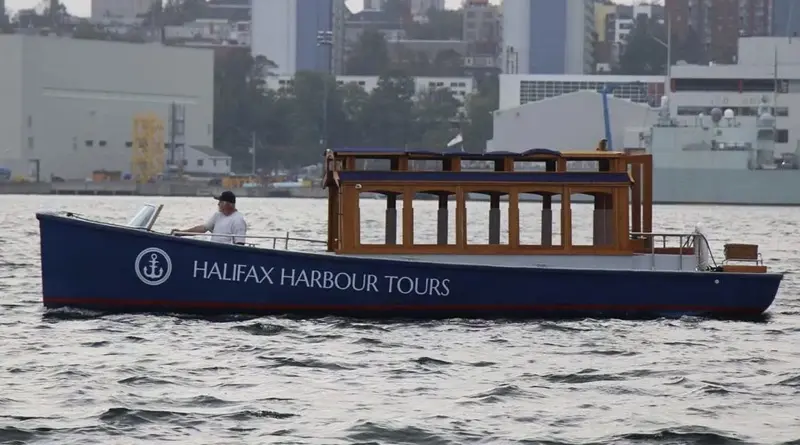
In a milestone achievement for sustainable maritime engineering, Indian solar boat pioneer Navalt has completed a transcontinental delivery that effectively redraws the map for zero-emission water transport. A luxury 10-meter solar-electric catamaran—the Navalt "Limo"—has been shipped 12,703 kilometers (7,893 miles) from its production facility in Kerala, India, to Halifax, Nova Scotia. There, it is undergoing final assembly to join the operational fleet of Halifax Harbour Tours.
This transatlantic crossing is far more than a standard commercial delivery. It represents a triple-first for Navalt: the company’s inaugural vessel destined for the North American market, its first deployment of a fully engineered "knock-down kit" shipped across oceans inside standard cargo containers, and its first rigorous adaptation of marine solar-electric propulsion to endure the freezing extremes of an Atlantic Canadian winter.
For Colin Smith, founder of Halifax Harbour Tours, the arrival of the Limo marks the next chapter in a mission that began over a decade ago: replacing the fumes, vibration, and noise of conventional diesel engines with silent, clean, and passenger-centric maritime experiences. As governments and tourism operators worldwide look for ways to decarbonize coastal waters, this cross-hemispheric collaboration between an Indian engineering innovator and a Canadian boutique tour operator offers a compelling blueprint for the future of green marine mobility.
Detailed Chronology: From Kerala Backwaters to Atlantic Harbours
Navalt’s Genesis: Building a Zero-Emission Legacy
Navalt’s story begins in 2009 under the leadership of naval architect Sandith Thandassery, whose career has been defined by an unwavering commitment to cleaning up marine transport. From its inception, the company pursued unconventional goals. Its very first vessel, the Sunrider, earned a place in the Limca Book of Records as the fastest solar boat ever built.
However, Thandassery’s ambitions extended well beyond speed records; he wanted to tackle high-volume public transport. In 2017, Navalt achieved a major breakthrough by designing and building Aditya, India’s first solar-electric ferry. Operating in the tranquil backwaters of Kerala, the Aditya proved that commercial electric ferries could be reliable, robust, and economically disruptive.
While typical diesel ferries incur heavy, recurring fuel expenditures, the Aditya operates at a fraction of that cost. More importantly, its environmental footprint is minimal: carrying approximately half a million passengers annually—over 4 million since its launch—the vessel has saved roughly 225,000 liters of diesel fuel and prevented over 500,000 kilograms (1.25 million pounds) of carbon dioxide emissions from entering the atmosphere.
Recognizing its global significance, the Aditya won the inaugural Gustave Trouvé Electric Boat Award in 2020. Navalt cemented its international reputation by capturing a second Gustave Trouvé Award in 2024 for its Srav solar-electric workboat. Today, Navalt is India’s leading builder of solar-electric ferries, boasting a catalog of 18 distinct models—spanning workboats, leisure vessels, defense craft, water taxis, and public ferries—none of which burn a single drop of fossil fuel. Over 80 Navalt vessels now ply waters around the globe, including high-altitude tourist hubs like Sukhna Lake in the foothills of the Himalayas.
The Halifax Connection: The Evolution of Halifax Harbour Tours
Concurrently, on the opposite side of the planet, Colin Smith was laying the groundwork for a radically different kind of maritime enterprise. A former captain of a conventional diesel tour boat in Halifax Harbour, Smith grew weary of the acoustic pollution, exhaust fumes, and environmental degradation associated with traditional internal combustion engines. He envisioned an intimate, low-impact tour business that prioritized passenger connection and ecological harmony.
Smith’s search for the ideal hull led him to an unusual discovery: a former British Thames River tow barge steeped in maritime history. Originally deployed on the River Thames in London, the barge had been acquired by a Puerto Rican tour operator who fitted it with a 40-horsepower diesel motor. It subsequently ferried sightseers through the Florida Everglades before airboats took over the route, weathered a period of retirement, served briefly as a tourist vessel on Lake Erie, and was ultimately located by Smith inside a nearby barn.
Recognizing the exceptional efficiency of the barge’s displacement hull, Smith stripped out the diesel engine and replaced it with an 8kW Lynch axial-flux motor paired with a 7kWh battery pack. He added a custom solar roof to trickle-charge the battery, restored the historic vessel—dubbed the Violet Mac—to its Thames River elegance, and launched Halifax Harbour Tours in 2018.
"When we first started, our ‘fuel costs’ were about 60 cents a day," Smith recalls. "They’re not an awful lot more now, but the thing isn’t the cost for me; it’s the passenger experience. It’s quiet, there’s only eight people on board, and the guides are told to let people know about all of the historic sites in the harbour, but not get in the way of the passengers having a chance to talk among themselves and get to know each other. We often get reviews with people saying it’s the best experience they had on their visit to Canada."
Supporting Context & Metrics: Engineering for the Atlantic Cold
While the Violet Mac was an immense success, Halifax Harbour Tours faced a persistent operational hurdle: the region’s notoriously fickle and variable weather. Smith needed a vessel capable of operating reliably across extended seasons while providing adequate shelter for passengers navigating Atlantic Canada’s unpredictable microclimates.
After discovering Navalt’s cutting-edge work through industry media, Smith reached out to Thandassery to explore acquiring a fully covered solar-electric ferry. They selected the Limo, a premium 10-meter leisure catamaran designed for upscale, private cruising.
Overcoming Logistical Barriers: The Knock-Down Kit
Transporting a 10-meter-long, 3.5-meter-wide catamaran across 12,700 kilometers of ocean presents profound logistical challenges. Shipping an assembled vessel of this size on a cargo deck is notoriously expensive and risks structural damage. Navalt solved this dilemma through innovative industrial design: they engineered the Limo as a modular "knock-down kit" capable of being disassembled and packed flat into standard 40-foot equivalent unit (FEU) shipping containers.
The entire vessel was systematically partitioned into modular sections, hull components, and superstructures, packing neatly into five standard shipping containers. This modular export strategy drastically reduced freight costs and carbon logistics, proving that high-value, custom passenger vessels can be manufactured in one hemisphere and efficiently erected in another.
Re-Engineering for Extreme Climates
A watercraft engineered for the tropical backwaters of Kerala cannot simply be dropped into the sub-Arctic conditions of Nova Scotia without major modifications. Navalt’s engineering team had to thoroughly re-architect the Limo’s propulsion, thermal management, and energy storage systems to survive and thrive through harsh Atlantic Canadian winters.
At the heart of this cold-weather adaptation is the energy storage architecture. The Limo is equipped with dual 20 kWh marine-grade Lithium Iron Phosphate (LFP) battery packs. Crucially, each pack features an integrated, automated thermal heating system. Because lithium-ion and LFP cells suffer severe performance degradation and risk permanent damage if charged in sub-zero temperatures, these custom heating loops maintain optimal cell temperatures regardless of external weather conditions. This ensures that the vessel retains its range, charging efficiency, and reliability throughout extended operational seasons.
Propulsion is handled by dual 15 kW inboard electric motors tied into Navalt’s signature independent dual battery-and-motor architecture. This redundancy guarantees system resilience: in the unlikely event of a single motor or battery fault, the vessel retains full maneuverability, preventing any possibility of being stranded on the open water.
Official Statements & Perspectives
Reflecting on the milestone, Navalt founder and CEO Sandith Thandassery shared his insights on the company blog:
"There are projects that move a business forward, and then there are projects that redraw the map. For us, shipping a Limo to Halifax, Canada is firmly the second kind. It is our first vessel headed to North America—and it travelled there in a way no Navalt boat has before: as a knock-down kit, packed flat into five containers, ready to be reborn on Canadian shoreline."
Thandassery emphasized the precision required for the assembly phase:
"Right now, on the ground in Halifax, under the guidance of Colin Smith and his team, those five containers are becoming a boat again. The hulls are being joined, the deck and superstructure reassembled, and the battery and outfitting items integrated into the vessel. It is painstaking, precise work—and watching a kit transform back into a sleek, water-ready cruiser is genuinely one of the most satisfying things to witness in our line of work."
Colin Smith, looking ahead to the upcoming launch, highlighted how the new vessel complements his existing eco-tourism philosophy:
"We’ve always focused on offering an intimate, quiet, and respectful way to experience Halifax Harbour. With the Limo, we are scaling up our capacity to provide comfort and shelter against the weather, without ever compromising our commitment to zero-emission, sustainable travel."
Future Outlook & Industry Implications
As the final assembly of the Limo progresses in Halifax, local anticipation is reaching a fever pitch. Halifax Harbour Tours is scheduled to officially launch the vessel into commercial service this July, marking a new era for Canadian eco-tourism.
The successful execution of this project carries broad implications for the global maritime sector. By proving that advanced solar-electric passenger vessels can be successfully exported as modular container kits and customized for cold-weather climates, Navalt has effectively unlocked international markets previously deemed inaccessible due to prohibitive freight costs and climate barriers.
As coastal cities worldwide face mounting pressure to reduce greenhouse gas emissions, eliminate noise pollution in harbors, and transition away from fossil fuels, the partnership between Navalt and Halifax Harbour Tours demonstrates a scalable path forward. From the sun-drenched backwaters of Kerala to the rugged shores of Nova Scotia, the message is clear: the electrification of the world’s oceans is no longer a distant vision—it is an accelerating, global reality.