








EXECUTIVE OVERVIEW
For America’s 11.5 million registered recreational boat owners, the changing of the calendar from autumn to winter triggers more than just the end of the peak cruising season—it initiates a silent, high-stakes battle against physics. When temperatures plummet below freezing, moisture becomes a destructive force capable of transforming fiberglass, rendering engine blocks into scrap metal, and turning pristine gelcoats into chalky ruins.
According to marine industry data, thousands of boat owners experience catastrophic off-season damage every year simply because they underestimated the destructive capacity of expanding water. Yet, marine experts emphasize that proper winterization is not merely a chore; it is an investment. A few hours of disciplined preparation and the selection of appropriate storage conditions separates a smooth, triumphant splash day in the spring from a disastrous, four-figure repair bill at the local service yard.

This authoritative guide breaks down the essential science, strategic storage options, step-by-step winterization protocols, and proactive maintenance techniques required to safeguard your watercraft through the harshest winter months.
DETAILED CHRONOLOGY: THE ANATOMY OF FREEZE DAMAGE
To understand why winterization brooks no shortcuts, one must first understand the unique chemistry and physics of water. Water is among the few substances on Earth that expands when it freezes—increasing in volume by approximately nine percent. When trapped within the microscopic crevices of fiberglass, the threads of a bilge pump, or the raw-water cooling channels of an inboard/outboard engine, this expansion generates tremendous hydraulic pressure.
The Chain Reaction of Destruction
When a thumbnail-sized puddle inside a cockpit scupper or a drain plug freezes, the resulting pressure can easily split fiberglass laminates. However, the true financial casualties of winter neglect occur within the propulsion systems:
- Cracked Engine Blocks and Exhaust Manifolds: Water left standing in the raw-water side of an engine freezes, expands, and systematically fractures cast-iron or aluminum blocks. A single cracked manifold often costs significantly more to replace than an entire season’s worth of professional, covered dry-stack storage.
- Compromised Steering and Control Systems: Unlubricated cables and steering tubes retain ambient moisture. When temperatures drop, this moisture freezes the internal mechanisms solid, often snapping internal linkages upon the first spring actuation.
- Gelcoat Blistering and Osmotic Degradation: Trapped moisture beneath poorly vented covers, subjected to repeated freeze-thaw cycles, exacerbates osmotic blistering, breaking down the protective barrier between the water and the fiberglass hull.
SUPPORTING CONTEXT & METRICS: CHOOSING THE IDEAL STORAGE VECTOR
Selecting the proper storage location is the foundational decision of off-season boat care. Marine logistics experts generally categorize storage into three distinct tiers, each balancing cost, accessibility, and environmental protection.
1. In-Water Slips (Mild Climates and Bubbler-Equipped Marinas)
Keeping a boat in the water through the winter offers the distinct advantage of avoiding heavy hauling and blocking fees. However, this method is strictly reserved for mild climates or marinas equipped with operational bubblers or de-icers that churn warmer water from the depths to prevent surface ice from locking the hull in a vice-like grip.
- The Risk Factor: Total reliance on shore power. If a winter storm knocks out local power grids and the de-icers fail, sheet ice can crush hulls, shear off underwater running gear, and warp docks. Furthermore, continuous galvanic corrosion monitoring is required.
2. Dry Outdoor Storage (Yards and Driveways)
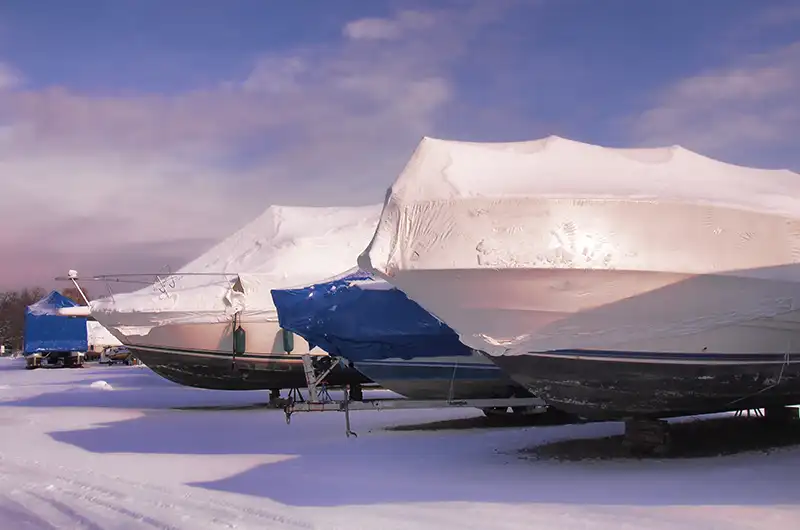
The most popular and cost-effective option for trailerable watercraft, outdoor storage in a fenced yard or residential driveway provides affordable access for DIY maintenance.
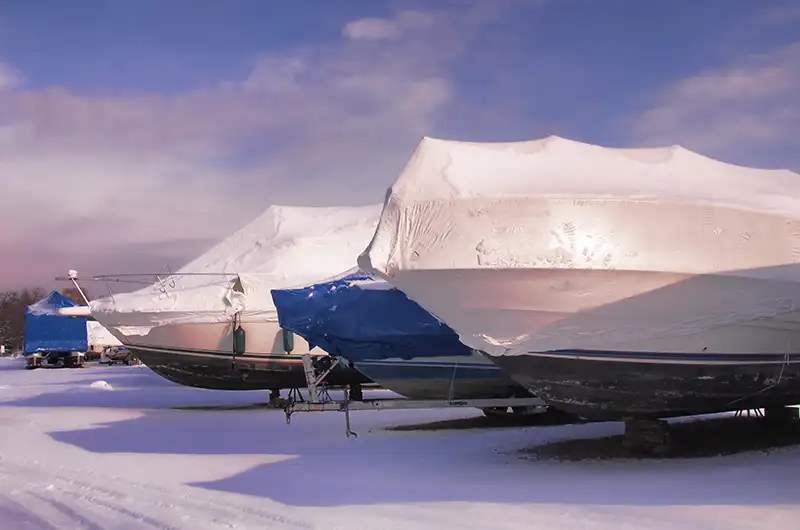
- Financial Metric: Typically ranges between $20 and $50 per linear foot for the season.
- Operational Requirements: Owners must invest in a heavy-duty, breathable, custom-fit cover or professional shrink-wrap, and schedule regular visits to clear heavy snow loads and check mooring lines.
3. Indoor Storage and Heated Dry-Stack Facilities
Widely considered the gold standard of marine preservation, indoor facilities house boats on specialized multi-tier racks inside massive, weather-tight warehouses.
- Financial Metric: Expect to pay between $50 and $200 per linear foot.
- The Value Proposition: While more expensive, heated dry-stack facilities completely eliminate exposure to UV degradation, ice storms, and wind-borne debris. Many facilities also offer "splash-and-go" launch services, occasionally eliminating the need for a separate summer slip rental.
OFFICIAL INDUSTRY BEST PRACTICES: THE FIVE CORE PRINCIPLES
Navigating the off-season successfully requires adherence to five foundational principles established by marine rescue and towing professionals:
- Strategic Site Selection: Whether on a trailer or cradle, the storage footprint must feature solid, well-draining ground. The bow should be pitched slightly higher than the stern to guarantee unimpeded gravity drainage through the garboard plug.
- Absolute Moisture Eradication: Moisture combined with sub-freezing temperatures equals structural failure. All scuppers must be sealed, leaf debris cleared from gunwales, and high-performance, vented covers or professional shrink-wrap installed.
- Wind Mitigation and Aerodynamics: Covers act as giant sails in winter gales. Tarps must be secured with heavy-duty webbing straps and weighted down with sandbags or water jugs. A poorly secured cover that tears loose can become a lethal hazard to neighboring property.
- Component Offloading: Items vulnerable to mold, mildew, and freeze cracking—such as marine cushions, personal flotation devices (PFDs), dock lines, portable electronics, and handheld marine radios—should be removed and stored in a climate-controlled home or garage. Batteries should be brought indoors for continuous trickle-charging.
- Proactive Winter Engagement: Winter storage is never a "set-and-forget" endeavor. Responsible owners conduct physical inspections after every major heavy snow or high-wind event to verify cover integrity, check for pest infestations, and ensure bilges remain bone-dry.
THE COMPREHENSIVE STEP-BY-STEP WINTERIZATION CHECKLIST
To ensure zero structural or mechanical surprises come spring, marine technicians recommend executing the following protocols in precise chronological order:
Drainage and Desiccation
- Activate all automatic and manual bilge pumps until the system runs completely dry.
- Open all seacocks, sea strainers, and freshwater tank drains.
- Manually sponge out any remaining low-point puddles in the bilge, livewells, and storage lockers.
Engine Protection and Flushing
- Flush the raw-water cooling system thoroughly with fresh water to remove salt, silt, and marine organisms.
- For raw-water cooled inboard/outboard and outboard motors, backfill the engine block with non-toxic, propylene glycol-based marine antifreeze (rated to at least -50°F or -100°F) using a flushing muff or dedicated winterization tank.
- Fog the cylinders by spraying marine fogging oil directly into the carburetor air intakes or spark plug holes while the engine is running (or manually cranked), coating internal piston walls and valves to prevent corrosion.
Fuel System Stabilization
- Fill the fuel tank to approximately 95 percent capacity. This leaves minimal room for air condensation while allowing adequate head-space for thermal expansion if ambient temperatures rise sharply.
- Introduce an ethanol-stabilizing fuel additive to prevent phase separation and varnish buildup.
- Run the engine for 15 minutes to circulate the treated fuel through the fuel pumps, injectors, or carburetors.
Lubrication and Mechanical Preservation
- Apply marine-grade grease to all steering cables, pivot points, control linkages, hinges, and latches.
- Relieve tension on all drive belts and accessory belts to prevent premature cracking and stretching.
- Change the lower unit gear lube, inspecting the drained oil carefully for milky discoloration—an unmistakable indicator of failing gearcase seals that must be addressed immediately.
Electrical System Maintenance
- Fully charge the marine battery, clean corrosion from the terminals, and coat them with terminal protector spray.
- Disconnect the battery and store it in a frost-free, temperate environment connected to a smart, multi-stage trickle charger.
Detailing, Waxing, and Covering
- Wash the hull, superstructure, and decks using specialized, biodegradable boat soap. Allow all surfaces to dry completely.
- Apply a generous coat of marine-grade wax to seal the gelcoat against UV oxidation and airborne pollutants.
- Construct a rigid interior support frame (using PVC piping or lumber) beneath your cover to ensure rain and snow shed cleanly off the sides rather than pooling in the cockpit. Ensure all built-in vents remain open to promote cross-ventilation and prevent mildew.
SPECIALIZED CARE FOR ALTERNATIVE WATERCRAFT
Different vessel types demand tailored off-season strategies:
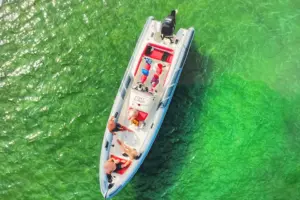
- Rafts and Inflatables: Hypalon and PVC inflatables must be cleaned and coated with a specialized UV protectant (such as 303 Aerospace Protectant) across all surfaces and valves to prevent rubber degradation. Whenever possible, store inflatables partially inflated in a temperature-stable room.
- Drift Boats and Wooden Hulls: Wooden hulls require special humidity management to prevent the wood from drying out, cracking, or developing dry rot. Install specialized cradles to distribute weight evenly, and place fine wire mesh over all drain holes to permanently exclude rodents and nesting mice.
- Trailer Preservation: Tires left stationary under heavy loads all winter will develop flat spots. Inflate trailer tires to their maximum rated PSI, place heavy-duty chocks beneath the wheels, and position heavy jack stands beneath the main trailer frame (never the axle) to relieve tire stress. Repack wheel bearings before the spring launch.
AVOIDING CRITICAL OFF-SEASON MISTAKES
Even seasoned boaters occasionally fall victim to preventable oversight. Watch out for these four common pitfalls:
- Leaving Water in Raw-Water Circuits: Assuming "it won’t get that cold this year" is a gamble that routinely costs boat owners thousands of dollars. Always flush and drain every millimeter of the cooling pathway.
- Neglecting the Fuel Vent: Failing to check or clear the external fuel vent can lead to a blocked breather line. As temperatures fluctuate, a blocked vent creates a vacuum that can structurally collapse portable fuel tanks or starve the engine of fuel during initial spring commissioning.
- Storing Batteries on Bare Concrete: While modern battery casings are durable, storing lead-acid batteries directly on uninsulated concrete floors remains a poor practice that accelerates self-discharge due to ambient thermal transfer and moisture migration. Always elevate batteries onto wooden blocks or plastic shelving.
- Skipping Mid-Winter Inspections: Assuming a shrink-wrapped boat is indestructible leads to disaster when heavy wet snow rips seams, tree branches puncture protective films, or field mice chew through primary wiring harnesses unnoticed.
DE-WINTERIZING: THE FAST TRACK TO SPRING COMMISSIONING
When the ice finally breaks, executing a methodical de-winterization protocol guarantees a safe and seamless return to the water:
- Uncover and Inspect: Carefully strip away the shrink-wrap or custom cover, inspecting the hull for any signs of winter impact, cracking, or pest intrusion.
- Reinstall Essentials: Reinstall fully charged batteries, reconnect drain plugs, and return cushions, electronics, and safety gear to their proper mounts.
- Flush and Test Systems: Connect a fresh water supply to the cooling system, start the engine, and meticulously verify that raw-water pumps are priming correctly, exhaust output is normal, and all gauges are functioning.
- System Checks: Test the bilge pumps, navigation lights, VHF radios, and steering linkages thoroughly before untying from the dock for your maiden voyage of the new season.
FUTURE OUTLOOK: THE EVOLUTION OF MARINE STORAGE
As marine technology advances, the off-season landscape is rapidly modernizing. The increasing adoption of electric propulsion systems in recreational boating is altering traditional winterization checklists—replacing winter oil changes and fuel stabilization with high-voltage battery health management and thermal coolant flushes for electric motor loops. Furthermore, the rise of smart-boat telemetry allows owners to monitor bilge water levels, internal compartment temperatures, and battery voltage remotely via smartphone applications throughout the dead of winter.
Final Thoughts
Winter may feel like an insurmountable intermission for passionate boaters, but a vessel properly prepared today is a vessel primed for adventure the moment the ice melts. By selecting intelligent storage, eliminating every drop of destructive moisture, shielding your investment from the elements, and remaining proactively engaged throughout the off-season, you ensure a faster, cheaper, and trouble-free return to the water—leaving you more weekends to make wakes rather than waiting on expensive marine mechanics.