Long before the current wave of electrification reshaped South Korea’s automotive landscape—spurring massive domestic investments from corporate giants and establishing brands like Hyundai and Kia as global EV powerhouses—a more unlikely contender was quietly experimenting with the future of mobility.
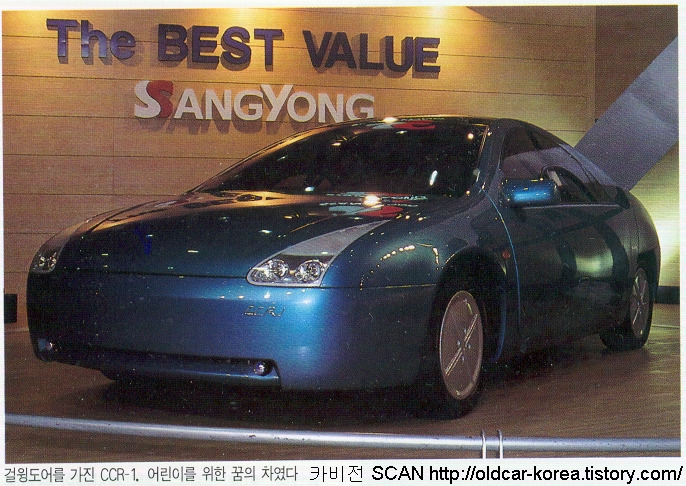
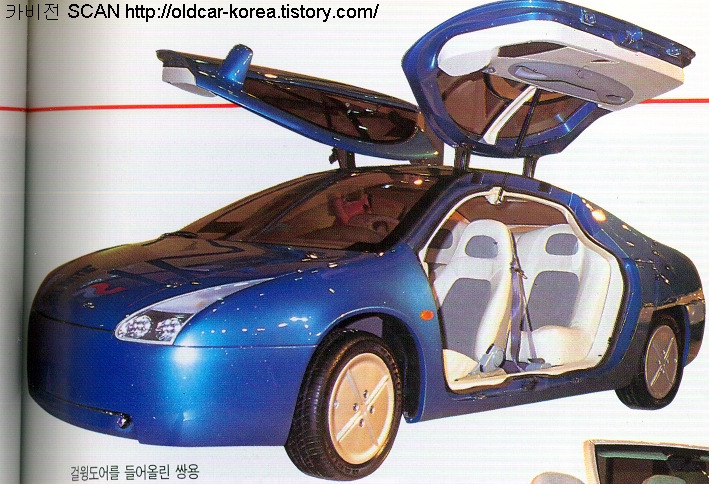
In 1995, SsangYong Motor, a company historically synonymous with rugged four-wheel-drive utility vehicles, diesel-powered workhorses, and heavy commercial transport, stunned international automotive crowds by pulling the covers off a revolutionary electric vehicle. The machine was called the CCR-1—standing for Clean Car 1—a low-slung, mid-engined electric sports coupe featuring dramatic gull-wing doors, an aluminum space-frame chassis, and an aerodynamic profile that looked as if it had been dropped in from an alternate, far more advanced future.
Unlike the vast majority of concept cars from that era, which typically served as static styling exercises constructed merely of fiberglass over wooden bucks, the CCR-1 was a fully functional, running prototype. It was built to be driven, tested, and pushed through its paces on engineering test tracks. The vehicle represented an ambitious, forward-thinking attempt by SsangYong’s engineering corps to master the complex trinity of electric propulsion, lightweight material construction, and aerodynamic efficiency at a time when battery-powered vehicles were largely dismissed as impractical laboratory novelties.
Though ultimately derailed by the catastrophic regional shocks of the late-1990s Asian financial crisis, the CCR-1 remains a vital, if largely forgotten, stepping stone in the historical lineage of alternative-fuel vehicles. This deep dive examines the genesis, engineering triumphs, international debuts, and eventual demise of SsangYong’s lost electric sports car—a machine that predated the modern EV boom by decades.
Detailed Chronology: From California Mandates to the Seoul Debuts
The Catalyst: California’s 1990 ZEV Mandate
The genesis of the CCR-1 can be traced back to April 1993, driven largely by regulatory seismic shifts occurring thousands of miles away from SsangYong’s headquarters in Seoul. In 1990, the state of California passed its landmark Zero Emission Vehicle (ZEV) regulations. This aggressive legislative framework mandated that a specific, escalating percentage of new vehicles sold by major automakers in the state must produce zero tailpipe emissions starting around the turn of the decade.
While the regulation was formulated in the United States, its shockwaves reverberated globally. Automakers in Europe, Japan, and South Korea suddenly realized that access to lucrative American markets—and compliance with an inevitable wave of global environmental standards—would soon require viable electric vehicle technology.
For SsangYong Motor, the regulatory pressure arrived at a unique crossroads in the company’s corporate evolution. Domestically recognized for producing tough, utility-oriented SUVs based largely on licensed Mercedes-Benz architectures, SsangYong was eager to shed its image as a niche industrial manufacturer. Leadership wanted to prove that the company’s engineering division possessed the sophisticated technical capacity to conceptualize and build advanced passenger vehicles entirely from scratch.
Thus, the Clean Car 1 project was born. Rather than taking the lazy industry shortcut of converting an existing internal-combustion sedan chassis into an electric vehicle—a compromise that plagued early compliance cars with excessive weight and poor weight distribution—SsangYong’s team chose a clean-sheet approach. Led by Engineering Team Manager Lee Myung-hak, the designers and builders set out to construct a purpose-built, aerodynamic two-seat sports car optimized from the ground up for battery propulsion.
Building the Rolling Laboratory (1993–1995)
Designing an electric vehicle in the early 1990s meant operating in uncharted territory. As Lee Myung-hak frequently noted, the primary hurdle of the project was defining what an electric car ought to be at a time when no standardized engineering blueprint or commercial component supply chain existed for EVs.
The engineering team tackled this dilemma by treating the CCR-1 as a comprehensive "rolling laboratory." To combat the debilitating weight of 1990s battery technology, weight savings became the absolute gospel of the project. The chassis was constructed around an advanced extruded aluminum space-frame structure, providing high torsional rigidity while keeping the curb weight down to a remarkably lean 1,212 kilograms (2,672 lbs).
Draped over this aluminum skeleton were high-rigidity fiber-reinforced plastic (FRP) body panels. The exterior styling was heavily informed by aerodynamic wind-tunnel testing, resulting in a slippery, teardrop-shaped silhouette with a low roofline peaking at just 1,300 millimeters. The car’s most arresting visual signature was its set of hydraulically assisted gull-wing doors, which swung dramatically upward to reveal a driver-focused, futuristic cockpit.
Global Debuts: Seoul and Frankfurt
By the spring of 1995, the CCR-1 prototype was ready for the world stage. SsangYong chose its home turf for the vehicle’s global debut, unveiling the car in May 1995 at the inaugural Seoul Motor Show, held at the Korea General Exhibition Center (now COEX). Displayed alongside another experimental SsangYong prototype known as the CRS, the CCR-1 captured intense media attention, signaling to the domestic public that South Korea’s automotive industry was actively preparing for a post-petroleum future.
Following its successful domestic introduction, SsangYong shipped the CCR-1 to Europe. In September 1995, the sleek South Korean electric coupe made its international debut at the prestigious Frankfurt Motor Show in Germany.
Placing a battery-powered sports car concept before a hyper-critical European automotive audience in 1995 was a bold statement. At the time, electric vehicles in Europe were largely confined to postal delivery vans and low-speed urban quadricycles. The CCR-1, by contrast, offered the undeniable visual appeal and packaging of a genuine sports car, demonstrating that zero-emission mobility did not necessarily require sacrificing styling and driving emotion.
Supporting Context & Engineering Metrics
To truly appreciate what SsangYong achieved with the CCR-1, one must evaluate the vehicle through the technological lens of the mid-1990s. Modern electric vehicles benefit from high-density lithium-ion cells, sophisticated silicon-carbide power electronics, and advanced thermal management systems. In 1995, the engineering team had to rely on industrial-grade components that seem primitive by contemporary standards, yet they managed to extract impressive performance out of them.
Powertrain and Performance
The CCR-1 utilized a mid-engine, rear-wheel-drive layout, placing the propulsion unit behind the two-seat cabin to optimize weight distribution and traction. The motor chosen was a multi-face bipolar brushless DC (MPBLS DC) unit operating on a 144-volt direct current system.
The motor generated a modest output of approximately 37 kilowatts, translating to a rated 50 horsepower, coupled with a peak torque figure of 196 Newton-meters (20 kg.m) delivered seamlessly from a standstill. Drive was transmitted to the rear wheels via a direct-coupling arrangement with the motor, eliminating multi-speed manual or automatic gearboxes in favor of a clean, single-speed delivery.
Energy storage was handled by high-performance lead-acid batteries (specifically DCM-24 units developed in partnership with Korea Battery Co., Ltd.), featuring a capacity of 12V-50A. While lead-acid chemistry is heavy, suffers from rapid degradation, and offers low energy density compared to modern lithium-ion chemistries, the CCR-1’s lightweight aluminum-and-composite construction partially offset these physical penalties.
SsangYong’s testing figures claimed a respectable top speed of 120 kilometers per hour (approx. 75 mph) and a maximum driving range of roughly 200 kilometers on a single charge—though this optimal range was calculated at a steady, uninterrupted eco-driving speed of 40 km/h.
Systemic Efficiency: The Hankook Tire Partnership
One of the most telling indicators of the project’s sophisticated engineering depth was SsangYong’s refusal to treat the CCR-1 merely as a motor-and-battery science project. Recognizing that rolling resistance is a major parasitic drain on an electric vehicle’s limited energy reserves, the engineering team partnered directly with Hankook Tire Co., Ltd.
Together, they developed a specialized, low-rolling-resistance tire sized at 195/65VR15. These bespoke EV tires were engineered to reduce rolling resistance by approximately 7 percent compared to standard passenger car tires of the era. This holistic approach—combining aerodynamics, lightweight space-frame architecture, customized low-resistance tires, and efficient electric propulsion—proved that SsangYong’s engineers understood the systemic nature of EV design decades before the industry-wide transition took hold.
Comprehensive Technical Specifications of the SsangYong CCR-1
Category
Specification Item
CCR-1 Technical Data
General Overview
Manufacturer / Vehicle Name
SsangYong Motor / CCR-1 (Clean Car 1)
Vehicle Type / Propulsion
Two-Seat Electric Sports Coupe / Battery Electric (BEV)
Motor & Electrics
Motor Type
Multi-face Bipolar Brushless DC (MPBLS DC)
Rated Voltage
DC 144V
Rated Output
50 HP (approx. 37 kW)
Maximum Torque
20 kg.m / 5,000 rpm (196 Nm)
Drivetrain
Layout
Mid-Motor, Rear-Wheel Drive (MR)
Transmission
Direct Coupling with Motor
Dimensions & Weight
Total Length
4,290 mm
Width
1,840 mm
Total Height
1,300 mm
Vehicle Curb Weight
1,212 kg
Gross Vehicle Weight
1,332 kg
Performance
Maximum Speed
120 km/h
Constant Speed Range
Up to 200 km on a single charge (tested at a steady 40 km/h)
Passenger Capacity
2 persons (Seating design max: 4 listed in registry notes)
Battery System
Classification & Type
DCM-24 / Lead-Acid (Pb-Acid)
Capacity & Co-Developer
12V-50A / Developed with Korea Battery Co., Ltd.
Tire Technology
Size & Co-Developer
195/65VR15 / Developed with Hankook Tire Co., Ltd.
Official Statements and Historical Perspectives
While contemporary press releases from 1995 have largely faded into yellowed archival folders and digital screenshots preserved on enthusiast blogs like oldkoreacars.com, the recorded statements of the project leads provide a fascinating window into the mindset of SsangYong’s skunkworks division.
Engineering Team Manager Lee Myung-hak, speaking to automotive journalists during the vehicle’s debut circuit, emphasized that the CCR-1 was never intended to be a hollow marketing gimmick.
"Building an electric vehicle when there are no established industry standards forces you to rethink every single component of the automobile," Lee noted during the vehicle’s development phase. "We did not want to merely adapt an old chassis. We wanted to understand how light materials, advanced aerodynamics, and electric power could coalesce into an entirely new driving experience."
Automotive historians looking back at the project recognize the CCR-1 as a glaring casualty of unfortunate timing. Had the global economic climate remained stable through the late 1990s, SsangYong’s early prototyping efforts could have positioned the South Korean automaker as an early global leader in alternative powertrains. Instead, the project became a profound "what-if" scenario of automotive history.
Future Outlook: From the CCR-1 to KG Mobility
The story of the CCR-1 does not end with its cancellation in the late 1990s. Though the physical prototype was tucked away into corporate archives—surviving multiple tumultuous ownership transitions, including acquisitions by Daewoo, SAIC, and Mahindra, before the company finally emerged under its current identity as KG Mobility—the foundational knowledge acquired by the engineering staff left an indelible institutional imprint.
For many years after 1995, SsangYong was forced by harsh economic realities to retreat to its core competencies: building diesel SUVs, rugged pickup trucks, and commercial vehicles to ensure corporate survival. Experimental EV research took a back seat as the company navigated wave after wave of financial restructuring.
However, history has a way of coming full circle. Decades after the debut of the gull-wing electric coupe, KG Mobility has officially re-entered the battery-electric vehicle space with modern production models such as the Korando e-Motion and the rugged Torres EVX.
These contemporary vehicles bear virtually no physical resemblance to the low-slung, lead-acid-powered sports coupe of 1995. Built upon modern skateboard platforms, powered by high-density lithium-ion chemistry, and integrated with sophisticated power electronics and fast-charging networks, today’s KGM EVs belong to an entirely different technological era.
Yet, when observers look at KG Mobility’s modern electric lineup, it is worth remembering the bold ambition displayed by SsangYong engineers over thirty years ago. In an era when most traditional automakers dismissed electric vehicles as impractical toys, a small team in Seoul dared to build a mid-engined, aluminum-framed, gull-winged electric sports car—proving that the vision for a clean-energy automotive future in South Korea was burning brightly long before the world was finally ready to receive it.