






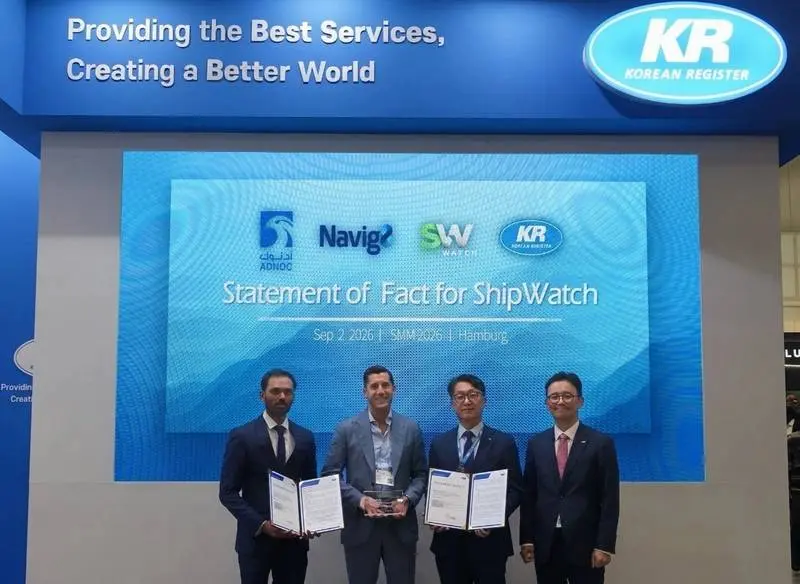
HAMBURG, GERMANY — At the SMM 2026 trade fair in Hamburg, a critical milestone was reached in the maritime industry’s transition toward digital transparency and decarbonization. The Korean Register (KR), an international classification society, formally presented a Statement of Fact to ShipWatch for its Vessel Performance Calculation Methodology.
ShipWatch is an advanced voyage execution and performance monitoring platform backed by shipping giants Navig8 and ADNOC Logistics & Services (ADNOC L&S). This validation confirms that the platform’s core algorithms and performance-monitoring sequences align with international standards ISO 15016:2015 and ISO 19030:2016.
This development occurs at a time when the global shipping sector faces unprecedented regulatory pressure. With the European Union Emissions Trading System (EU ETS) expanding, FuelEU Maritime taking effect, and the International Maritime Organization (IMO) tightening its Carbon Intensity Indicator (CII) thresholds, the financial consequences of inaccurate vessel performance data have never been higher.
By securing third-party verification from a leading classification society, ShipWatch addresses a critical vulnerability in maritime digitalization: the "data trust deficit" between ship owners, charterers, and regulators.
Executive Overview: The Fight Against "Greenwashing" and Data Discrepancies
For years, the maritime industry has struggled with a lack of standardized data. Ship operators have relied on a fragmented ecosystem of software solutions to track fuel consumption, speed loss, and emissions. However, without a standardized baseline, these proprietary systems often yield inconsistent results. This lack of standardization complicates charter party dispute resolutions and leaves owners vulnerable to accusations of greenwashing or compliance failures.
+-----------------------------------------------------------------------------+
|                         THE MARITIME DATA TRUST DEFICIT                      |
+-----------------------------------------------------------------------------+
|                                                                             |
|   [ Proprietary Software ]  --->  Inconsistent Algorithms  --->  Disputes   |
|                                                                             |
|   [ KR Verified Platform ]  --->  ISO 15016 / 19030        --->  Compliance |
|                                                                             |
+-----------------------------------------------------------------------------+
The Statement of Fact issued by the Korean Register provides independent verification of ShipWatch’s calculations. By validating that ShipWatch’s methodology conforms to ISO standards, KR has confirmed that the platform’s environmental data corrections and performance indicators are mathematically sound and scientifically repeatable.
For Navig8, ADNOC L&S, and the growing roster of third-party shipowners and charterers utilizing ShipWatch, this verification is more than a technical achievement. It is a commercial asset that provides assurance that voyage optimization, emissions reporting, and charter party compliance are backed by verified calculations.
Detailed Chronology: From Algorithm Development to SMM 2026 Validation
The journey toward the Statement of Fact presented in Hamburg involved a rigorous, multi-stage technical audit by KR’s specialized software and performance validation teams.
   [Phase 1: Methodology Submission]
                 │
                 ▼
   [Phase 2: Technical Audit by KR]
   • Environmental Correction (ISO 15016)
   • Performance Indicators (ISO 19030)
   • Uncertainty Analysis of Noon Reports
                 │
                 ▼
   [Phase 3: Code & Algorithmic Verification]
                 │
                 ▼
   [Phase 4: Statement of Fact Presentation] (Sept 2, 2026 - SMM Hamburg)
Phase 1: Methodology Submission and Scope Definition
ShipWatch submitted its comprehensive technical documentation to the Korean Register. The submission detailed the platform’s mathematical models for isolating environmental factors (such as wind, waves, and currents) from a vessel’s intrinsic performance. It also outlined its procedures for analyzing daily noon reports, which are notoriously prone to human error and environmental noise.
Phase 2: Rigorous Technical Audit
KR’s engineers conducted a deep-dive assessment focusing on three primary areas of the ShipWatch methodology:
- Environmental Data Correction: Verifying that the algorithms used to normalize the effects of wind, waves, and seawater temperature aligned with the physics-based principles of ISO 15016:2015.
- Performance Indicator Calculation: Evaluating how the software derives key metrics, such as speed loss and power deviation, to ensure compliance with ISO 19030:2016.
- Evaluation of Performance Changes: Analyzing how the platform tracks changes in hull and propeller efficiency over time.
Phase 3: Algorithmic Verification and Uncertainty Analysis
A key challenge in vessel performance monitoring is the quality of the incoming data. While some modern vessels are equipped with high-frequency auto-logging sensors, a significant portion of the global fleet still relies on manual daily noon reports.
KR reviewed ShipWatch’s proprietary uncertainty analysis framework, which applies statistical filters to noon report data. This framework identifies outliers, corrects reporting errors, and produces reliable performance trends despite the limitations of manual data entry.
Phase 4: Formal Presentation at SMM 2026
Following the successful completion of the audit, the Korean Register drafted and issued the Statement of Fact. The formal presentation took place on September 2, 2026, at the SMM exhibition in Hamburg—the world’s leading maritime trade fair. Representatives from KR, ShipWatch, Navig8, and ADNOC L&S attended, highlighting the collaborative effort required to bring this level of transparency to market.
Supporting Context & Technical Metrics: Understanding ISO 15016 and ISO 19030
To understand the significance of KR’s validation, it is necessary to examine the technical standards that serve as the foundation of the ShipWatch methodology.
| Standard | Primary Focus | Application in ShipWatch |
|---|---|---|
| ISO 15016:2015 | Guidelines for the assessment of speed and power performance by analysis of speed trial data. | Corrects for environmental "noise" (wind, waves, water temperature, shallow water effects) to isolate true vessel efficiency. |
| ISO 19030:2016 | Measurement of changes in hull and propeller performance. | Establishes a systematic framework for calculating speed loss, power deviation, and long-term fouling trends. |
The Physics of ISO 15016:2015
Originally developed to standardize sea trials for newbuildings, ISO 15016:2015 defines how to correct ship speed and power measurements to account for environmental conditions. In real-world operations, a vessel rarely encounters calm water. Wind resistance, wave-induced motion, water density variations, and shallow-water effects all alter fuel consumption and speed.
ShipWatch adapts these sea-trial principles for continuous, in-service performance monitoring. By applying ISO-compliant correction algorithms, the platform calculates "corrected power" and "corrected speed." This allows ship operators to compare a vessel’s current performance against its baseline design curve, regardless of the weather conditions encountered during a voyage.
[Raw Performance Data] (Wind, Waves, Currents, Temp)
          │
          ▼  <-- ISO 15016 Correction Algorithms
[Normalized Performance Data] (True Hydrodynamic Efficiency)
          │
          ▼  <-- ISO 19030 Calculations
[Hull & Propeller Degradation Metrics] (Speed Loss & Power Deviation)
The Operational Insights of ISO 19030:2016
While ISO 15016 handles environmental corrections, ISO 19030:2016 focuses on measuring changes in hull and propeller performance. Hull fouling—the accumulation of marine growth such as algae and barnacles—can increase a vessel’s fuel consumption by up to 30% over a docking cycle.
ISO 19030 provides a methodology for calculating:
- Speed Loss: The reduction in vessel speed at a given power output, indicating hull degradation.
- Power Deviation: The extra power required to maintain a target speed compared to the vessel’s clean-hull baseline.
By verifying that ShipWatch adheres to these sequences, KR ensures that the platform’s hull degradation metrics are highly accurate. This enables owners to optimize hull cleaning schedules, saving hundreds of thousands of dollars in fuel costs and drydocking fees.
Official Statements: Industry Leaders Weigh In
The presentation of the Statement of Fact at SMM 2026 brought together key executives who emphasized the role of independent verification in driving maritime decarbonization.
A senior technical representative from the Korean Register commented on the rigorous nature of the audit:
"As classification societies, our role is to act as impartial arbiters of safety and compliance in an increasingly complex digital landscape. Our technical review of the ShipWatch Vessel Performance Calculation Methodology was exhaustive. We confirmed that their software does not just generate estimates; it adheres strictly to the mathematical principles laid out in ISO 15016 and ISO 19030. This provides the industry with the confidence that the data generated by ShipWatch is accurate, auditable, and aligned with international standards."
A spokesperson for ShipWatch highlighted the commercial implications for shipowners and charterers:
"We developed ShipWatch to serve as a single source of truth for voyage execution and performance monitoring across highly diverse, multi-segment fleets. In an era of strict environmental regulations and rising fuel costs, players cannot afford to make operational decisions based on unverified data. This Statement of Fact from the Korean Register validates our commitment to transparency. It assures our users—including Navig8, ADNOC L&S, and our third-party clients—that their emissions reports, charter party compliance metrics, and voyage optimization strategies are built on a verified foundation."
Future Outlook: The Role of Verified Telemetry in a Decarbonizing Fleet
As the maritime industry looks toward 2030 and beyond, the role of validated digital platforms will expand from an operational advantage to a regulatory necessity.
                           THE COMPLIANCE FLYWHEEL

     ┌─────────────────────────────────────────────────────────────────┐
     │                                                                 │
     ▼                                                                 │
[Verified Data] ──> [Optimized Voyages] ──> [Reduced Fuel & Emissions] ┘
     │
     ▼
[Accurate EU ETS / FuelEU Reporting] ──> [Mitigated Financial Risk]
Mitigating Regulatory and Financial Risk
With the integration of shipping into the EU ETS, carbon emissions now carry a direct financial cost. Shipowners must purchase European Union Allowances (EUAs) for every ton of CO2 emitted on voyages touching EU ports. Inaccurate emissions reporting can result in significant financial liabilities or regulatory penalties.
Furthermore, the upcoming FuelEU Maritime regulations will impose penalties on vessels exceeding set greenhouse gas (GHG) intensity limits. Platforms like ShipWatch, verified by classification societies like KR, will be essential for calculating, predicting, and proving compliance with these complex regulatory frameworks.
Resolving the Owner-Charterer Split Incentive
Historically, the maritime industry has suffered from a "split incentive." Charterers typically pay for fuel, while owners are responsible for capital investments in hull coatings and efficiency technologies. This dynamic often leads to disputes regarding whether a vessel performed according to its charter party agreements.
By utilizing an independent, ISO-compliant platform like ShipWatch, both parties can access a shared, verified dataset. If a vessel experiences speed loss, the platform’s ISO 19030-compliant calculations can determine whether the cause was poor weather (an environmental factor) or hull fouling (an owner maintenance issue). This transparency reduces legal friction and fosters more collaborative, long-term relationships between owners and charterers.
The Path to Autonomous and AI-Driven Routing
Looking further ahead, the verification of performance methodologies paves the way for advanced artificial intelligence (AI) and machine learning applications in voyage routing. AI models are only as good as the data used to train them. By establishing a verified pipeline of normalized performance data, ShipWatch and its partners can develop highly accurate predictive models. These models will allow vessels to dynamically adjust their routes, speeds, and fuel consumption profiles in real time, maximizing efficiency and minimizing emissions on a global scale.
The Statement of Fact presented by the Korean Register to ShipWatch at SMM 2026 is a key step forward for the industry. By bridging the gap between digital innovation and established international standards, this partnership demonstrates how the maritime sector can build the trust, transparency, and accuracy required to navigate its decarbonization journey.