








WASHINGTON, D.C. — For over two decades, the global hospitality landscape has operated under an unyielding digital feudalism. Online travel agencies (OTAs)—giants such as Booking Holdings, Expedia Group, and smaller specialized aggregators—have sat squarely between hoteliers and their guests. Armed with billions of dollars in performance marketing budgets, sophisticated user interfaces, and vast inventories of fragmented hotel supply, these platforms became the mandatory tollbooths of modern travel. For hotel brands, large and small, the cost of doing business meant paying hefty commissions to rent back their own customers.
No amount of corporate ad spend, loyalty marketing, or direct-booking campaigns could fundamentally dislodge the structural advantage that OTAs held in aggregating a wildly fragmented market. Until now.
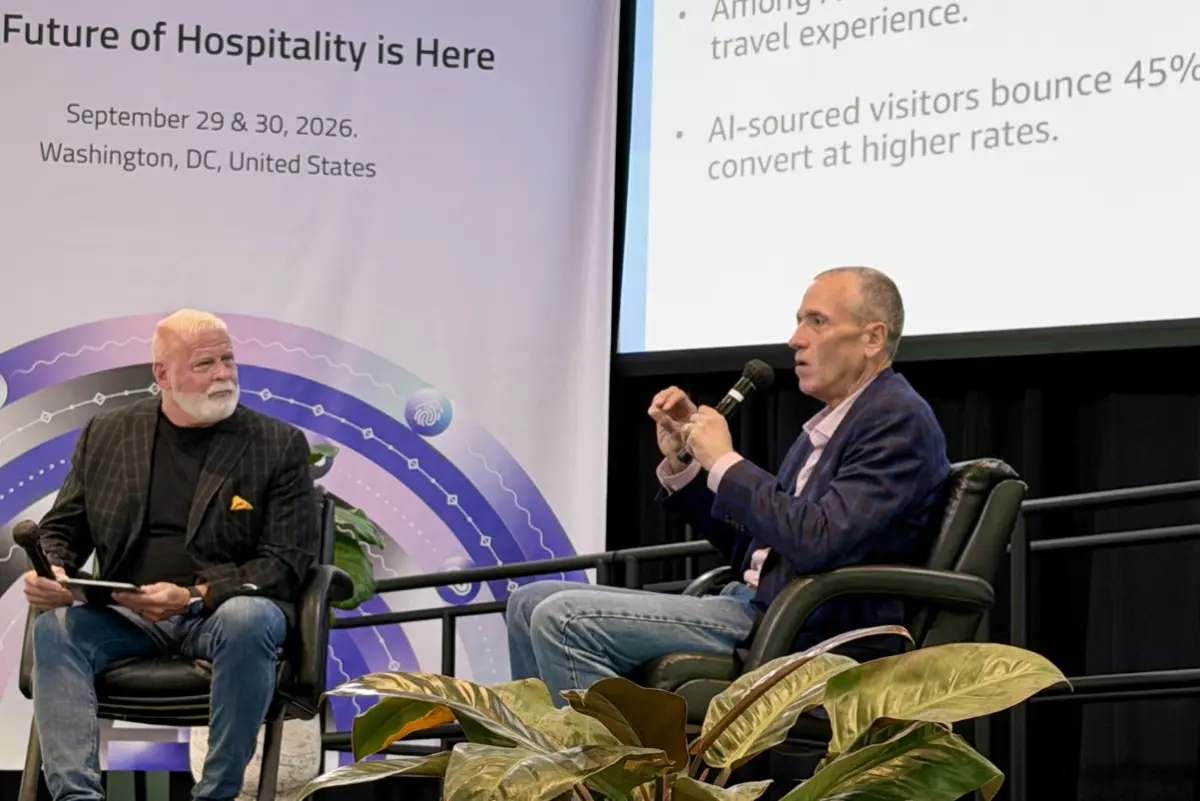
Speaking at the Skift Destination AI conference in Washington, D.C., Hilton Senior Vice President and Chief Information Officer Michael Leidinger delivered a provocative assessment that has sent ripples through the travel technology sector. According to Leidinger, the rapid maturation of generative artificial intelligence, large language models (LLMs), and agentic AI systems are achieving what decades of traditional marketing could not: they are placing the foundational business model of OTAs under an existential threat.

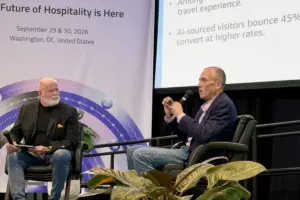
In an onstage conversation with Greg Land, Global Industry Leader for Hospitality at Amazon Web Services (AWS), Leidinger outlined a future where the traditional blue-link search engine and OTA aggregation pages are bypassed entirely. By empowering travelers to converse naturally with intelligent agents, AI is poised to dismantle the asymmetries that have long favored third-party intermediaries, opening a transformative window for direct-to-consumer engagement by hotel giants like Hilton.
Executive Overview
The convergence of generative AI and cloud infrastructure is fundamentally rewriting the rules of digital discovery in travel. For years, the OTA value proposition was straightforward: the global hotel ecosystem is fragmented, disparate, and difficult to search across single-brand channels. OTAs solved this friction by pooling millions of properties, standardizing reviews, pricing, and amenities into a single, easily searchable interface.
Leidinger argues that this historic moat is evaporating in real time. Today, a consumer can open a conversational interface powered by an LLM and input a hyper-specific, multi-layered travel prompt—such as: "Plan a five-day family trip to a boutique resort in the Mediterranean with gluten-free dining options, accessible ground transportation, and adjacent nature trails for under $400 a night in late September."
Within seconds, the LLM cuts through the fragmentation, synthesizes unstructured data from across the web, cross-references real-time availability, and constructs a coherent, workable itinerary. The need to click through multiple tabs on an OTA aggregator begins to fade.

This structural shift transforms AI from a mere customer service chatbot into an active transactional participant—a phenomenon increasingly known as "agentic AI." For hospitality executives, the implications are profound. Rather than viewing generative AI as an incremental tool for back-office efficiency or automated email responses, visionary technology leaders like Leidinger see it as the ultimate equalizer in the perennial battle for direct-channel supremacy.
Detailed Chronology: The Evolution of Digital Disintermediation in Travel
To understand the weight of Leidinger’s remarks, it is essential to trace the historical tug-of-war between hospitality brands and digital intermediaries over the past thirty years.
Phase 1: The Dawn of Web Aggregation (Late 1990s – Mid 2000s)
When the internet first disrupted travel, hotels were slow to digitize. Independent properties and major brands alike lacked robust centralized booking engines capable of handling global traffic efficiently. Into this vacuum stepped early OTAs. They built sophisticated digital directories, secured prime search engine optimization (SEO) real estate, and quickly amassed massive user bases by promising consumers a "one-stop shop" for flights, hotels, and car rentals.
Phase 2: The Commission Squeeze and Brand Retaliation (2000s – 2010s)
As OTAs consolidated market power, commission rates climbed, often ranging between 15% and 25% per booking. Major hotel groups—led by Marriott, Hilton, Hyatt, and IHG—recognized the long-term danger of losing direct relationships with their guests. This realization catalyzed massive multi-billion-dollar investments in proprietary enterprise tech stacks, unified loyalty programs (such as Hilton Honors), and aggressive "Book Direct" ad campaigns. While these initiatives successfully stabilized direct-booking percentages, they required astronomical marketing expenditures to out-bid OTAs on Google search engine marketing (SEM) auctions.
Phase 3: The Mobile Era and App Dominance (2010s – 2020s)
The transition to smartphones further entrenched OTA dominance. Apps like Booking.com and Expedia became frictionless repositories for travelers on the go. OTAs leveraged superior software engineering resources to craft hyper-personalized mobile experiences, leaving many traditional hotel brands playing catch-up in mobile user experience (UX) and digital loyalty integration.
Phase 4: The Generative AI Disruption (2023 – Present)
The public debut of foundational large language models in late 2022 marked the beginning of the current epoch. Initially viewed as novelty text generators, LLMs rapidly evolved into multimodal reasoning engines capable of executing complex workflows. By 2026, as highlighted at the Destination AI summit, agentic AI systems have moved beyond answering simple customer inquiries. They are now capable of end-to-end travel planning, negotiation, and booking orchestration. This evolution represents the first genuine architectural threat to the OTA aggregation model since its inception.
Supporting Context & Metrics: The Economics of the Disintermediation Battle
The friction between hotel brands and OTAs is ultimately a battle over data, customer acquisition costs (CAC), and lifetime value (LTV).
The Cost of Fragmentation
For decades, the sheer scale of the global travel market—comprising millions of independent hotels, boutique inns, and branded resorts—guaranteed the viability of aggregators. Consumers simply did not have the time or patience to visit fifty individual hotel websites to compare prices, room layouts, and amenities. OTAs capitalized on this friction, extracting a heavy tax on every transaction.
According to industry estimates, global OTA gross bookings have continued to scale upward, surpassing hundreds of billions of dollars annually. However, the cost of customer acquisition for these platforms has also escalated, driven by rising digital advertising costs on dominant search engines.
The AI Efficiency Dividend
Generative AI flattens the advantage of scale that traditional aggregators held. Because LLMs are trained on vast corpuses of global data—and can be dynamically connected via Application Programming Interfaces (APIs) to live inventory databases—they can synthesize a fragmented market on-demand for any individual user.
For a hospitality titan like Hilton, which boasts a portfolio of over 7,000 properties globally and more than 180 million Hilton Honors members, this technical shift offers a powerful strategic opening. By integrating deep, context-aware AI assistants into direct brand channels (such as the Hilton Honors app and website), the company can replicate—and even surpass—the comprehensive discovery capabilities of third-party OTAs while keeping the customer firmly within its proprietary ecosystem.
Furthermore, generative AI dramatically reduces the friction of personalization. Traditional digital marketing relied on broad demographic segmentation and rule-based recommendation engines. Agentic AI evaluates nuanced, real-time user intent, tailoring room suggestions, on-property dining options, and local excursion itineraries with hyper-granular precision.
Official Statements & Insights from the Frontlines
The dialogue between Hilton’s Michael Leidinger and AWS’s Greg Land at the Destination AI conference underscored the collaborative nature of this technological pivot. Modern enterprise AI adoption requires robust cloud infrastructure, rigorous data governance, and scalable machine learning pipelines—capabilities forged through deep partnerships between hospitality brands and hyperscale cloud providers.
"It really, for the first time, puts the OTAs under real threat," Leidinger stated during the onstage panel. "Because in many ways they were providing those aggregated views in this highly fragmented environment and now, the LLMs have kind of, they’re providing that."
Leidinger’s analysis points to a fundamental redistribution of power in the travel digital value chain. When the interface for discovery shifts from a static directory or keyword-stuffed search page to an intelligent, conversational agent, the brand that controls or integrates best with that conversational interface captures the intent.
Greg Land of AWS expanded on the technological underpinnings enabling this transformation, emphasizing that the hospitality industry is moving past the experimental phase of AI deployment. Today, major brands are architecting secure, enterprise-grade data lakes that feed real-time inventory, pricing, and guest preference data into fine-tuned language models. This ensures that brand-owned AI agents provide accurate, up-to-the-minute responses that third-party scrapers cannot reliably replicate.
Future Outlook: What Lies Ahead for Hospitality and Intermediaries
As the travel industry looks toward the latter half of the decade, the implications of Leidinger’s insights will reverberate across every corner of the tourism ecosystem. The race is officially on to see who will own the conversational layer of travel discovery.
1. The Rise of Proprietary Brand Agents
Major hotel chains are no longer content to let external tech platforms define the digital front door. Expect accelerated investments by hospitality leaders in proprietary, generative AI concierges embedded directly into mobile applications. These assistants will not only book rooms but manage end-to-end travel experiences—coordinating airport transfers, spa appointments, dynamic room upgrades, and local dining reservations based on deeply stored historical preference data.
2. The Evolution of OTA Strategies
In response to this existential pressure, online travel agencies are not standing still. Major OTAs are aggressively developing their own proprietary conversational AI tools, attempting to transition from simple aggregators to comprehensive "travel super-apps." However, their strategic dilemma remains acute: if an AI model answers a user’s prompt directly, the need to display sponsored ad listings or commission-heavy banner ads diminishes, potentially disrupting the core monetization engine of the OTA business model.
3. The Re-bundling of Travel Services
The traditional battle line between direct booking and OTA booking was drawn over room inventory. In the age of agentic AI, the competitive frontier expands into total trip orchestration. Whichever ecosystem—brand-direct or intermediary—can most seamlessly orchestrate flights, ground transportation, lodging, and experiential itineraries through a single conversational thread will capture the modern consumer.
Conclusion
Michael Leidinger’s assessment at the Destination AI summit captures a pivotal inflection point in travel technology. For twenty years, the fragmentation of the hotel industry guaranteed the supremacy of the aggregator. Today, large language models and agentic AI are dissolving that fragmentation into fluid, conversational dialogues. For Hilton and the broader direct-booking vanguard, this technological leap offers a historic opportunity to reclaim the guest relationship, outflank digital intermediaries, and redefine the future of hospitality.