Executive Overview
To the casual observer standing on a shoreline, the global ocean appears as a singular, undulating expanse of blue. Beneath the surface, however, this planetary life support system is defined by staggering thermal extremes. Temperatures range from the sub-zero, diamond-clear depths of the Southern Ocean—where waters hover just below freezing—to blazing hydrothermal vents erupting along tectonic rifts at blistering temperatures exceeding 400°F (and peaking near 660°F).
Unlike terrestrial animals, which can seek shade, migrate across landmasses, or exploit modern climate-control technologies, marine species face profound physical limitations imposed by water’s high thermal conductivity. Heat drains from or floods into aquatic bodies up to 25 times faster in water than in air. To survive, marine organisms have spent millions of years fine-tuning the art of thermoregulation: the biological processes that maintain internal body temperatures within functional physiological limits.
Today, this evolutionary mastery is facing its ultimate trial. Anthropogenic climate change is supercharging marine heatwaves, driving global sea surface temperatures to record highs, and fundamentally destabilizing ocean chemistry. Understanding how marine life regulates heat—from the giant leatherback turtle navigating cold northern seas to the bizarre icefish operating entirely without red blood cells—is no longer merely an academic exercise in marine biology. It is a vital lens through which scientists, conservationists, and policymakers must view the collapsing climate stability of the world’s oceans, highlighting an urgent need for global mitigation strategies.

Detailed Chronology of Marine Adaptation and Discovery
The study of how marine organisms cope with extreme temperatures spans centuries of oceanographic discovery, tracking the evolution of physiological traits that modern science is only just beginning to fully decode.
- Pre-20th Century (The Era of Observation): Early naturalists and mariners noted the presence of life in seemingly impossible marine environments, from Arctic waters teeming with fish to deep-sea creatures recovered from the abyss, though the exact physiological mechanisms remained largely a mystery.
- 1928 (The Discovery of the White-Blooded Marvel): Researchers exploring Antarctic waters made a startling biological discovery: the Antarctic icefish (Channichthyidae), a vertebrate possessing completely translucent, milky-white blood entirely devoid of hemoglobin and red blood cells.
- Mid-to-Late 20th Century (Uncovering Countercurrents and Antifreeze): Marine physiologists unraveled the specialized circulatory mechanisms of large pelagic animals, identifying the rete mirabile ("wonderful net") in bluefin tuna and tracing the mechanics of countercurrent heat exchange in leatherback sea turtles. Simultaneously, scientists discovered specialized Antifreeze Glycoproteins (AFGPs) in polar fish species.
- 1977 (The Hydrothermal Vent Revolution): The discovery of deep-sea hydrothermal vents along the Galapagos Rift shattered the long-held biological dogma that all life on Earth depends ultimately on solar energy. Scientists found thriving ecosystems powered by chemosynthesis, home to organisms capable of enduring extreme thermal gradients.
- 2025–2026 (Modern Genetic Revelations): Cutting-edge genetic sequencing continues to unearth unprecedented biological adaptations. Recent studies revealed that Asian noodlefishes have entirely lost their myoglobin and hemoglobin genes, paralleling the extreme evolutionary pathways carved by Antarctic species in response to thermal and metabolic pressures.
Supporting Context & Metrics: The Physics of Thermal Regulation
To appreciate the marvel of marine thermoregulation, one must understand the physiological divides that separate aquatic animals. Marine creatures generally fall into two thermal strategies: ectotherms (cold-blooded animals that rely on external environmental heat) and endotherms (warm-blooded animals that generate internal metabolic heat). However, the ocean blurs these lines through remarkable hybrid strategies.
1. Countercurrent Heat Exchange and Gigantothermy: The Leatherback Strategy
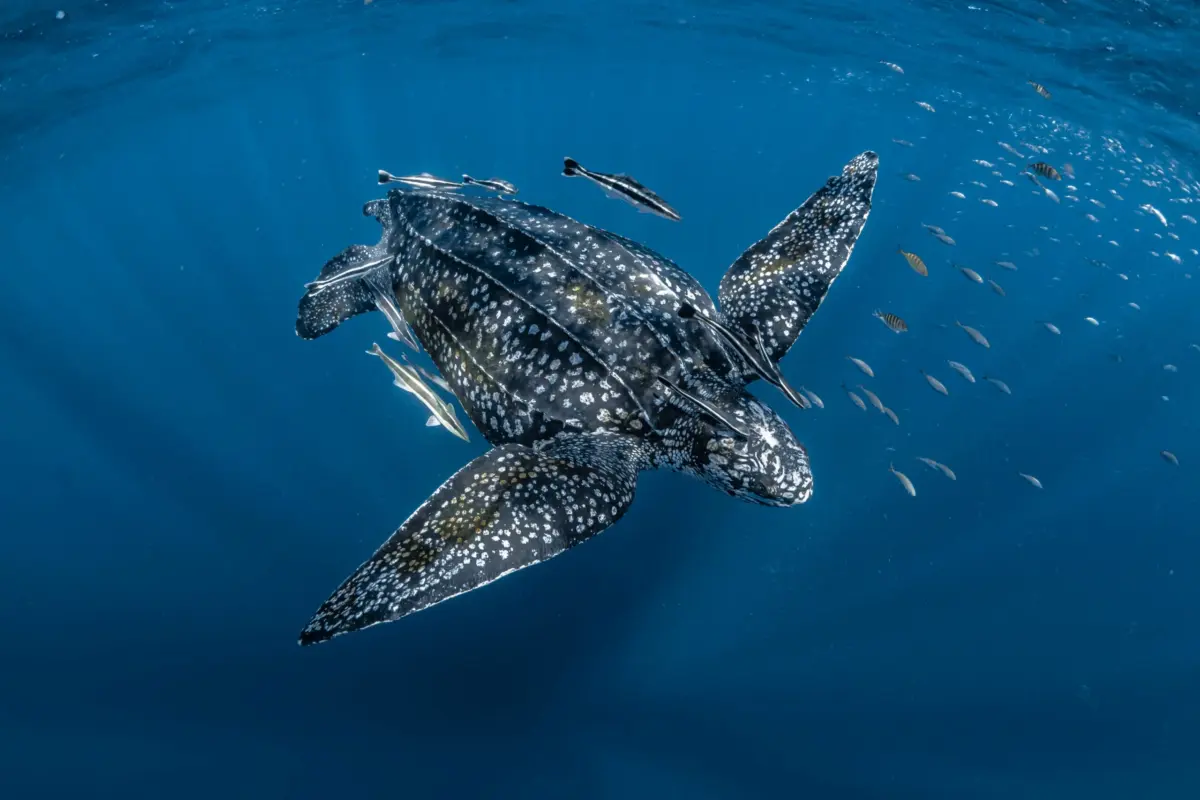
Leatherback sea turtles (Dermochelys coriacea) routinely plunge into near-freezing sub-polar waters to feed on sea jellies. Because they are reptiles—traditionally classified as ectotherms—this behavior would normally induce lethal cold-stunning.
Leatherbacks combat this through two primary adaptations:

- Countercurrent Heat Exchange: The arteries carrying warm blood from the heart run parallel to the veins returning cool blood from the flippers. Heat is transferred directly from arterial blood to venous blood, warming it before it re-enters the core. This system can be dynamically reversed during nesting season in tropical zones to dump excess metabolic heat.
- Gigantothermy: As the largest sea turtle species, leatherbacks possess a low surface-area-to-volume ratio. Combined with a thick layer of oily, insulating subcutaneous fat and a flexible, leathery shell, they trap internal metabolic heat efficiently, maintaining body temperatures significantly warmer than the surrounding water.
2. The Tuna’s "Wonderful Net" (Rete Mirabile)
While most teleost fish are strictly ectothermic, pelagic apex predators like bluefin tuna are regionally endothermic. They maintain elevated temperatures in specific, high-performance organs—including their swimming muscles, viscera, eyes, and brain—while allowing their hearts to remain cool to preserve cardiovascular efficiency.
This is achieved via the rete mirabile, a dense, countercurrent network of tiny blood vessels that recaptures metabolic heat generated by muscle contraction before it can be lost to the surrounding water through the gills. This internal heating gives bluefin tuna superior muscle contraction speeds, heightened visual acuity, and unmatched acceleration when hunting in cold, deep waters.
3. Biological Antifreeze in Polar Seas
In the frigid waters of Antarctica and the Arctic, water temperatures regularly drop below the freezing point of standard biological fluids (-1.8°C or 28.8°F). To prevent ice crystals from nucleating and rupturing cellular membranes, polar fish—such as Antarctic notothenioids, dragonfish, icefish, and northern cod—synthesize specialized Antifreeze Glycoproteins (AFGPs).
These proteins bind to microscopic ice crystals as they begin to form in the bloodstream, physically blocking water molecules from aggregating into destructive ice lattices. It is a biological equivalent to automotive antifreeze, protecting cellular integrity under sub-zero conditions.
4. Extreme Thermal Gradients at Hydrothermal Vents
At the other end of the thermal spectrum lie deep-sea hydrothermal vents. As superheated water—rich in sulfur, minerals, and carbon dioxide—erupts from the Earth’s crust at temperatures reaching up to 660°F, it mixes instantly with near-freezing bottom water (around 35°F).
Within inches of these vents, giant tubeworms (Riftia pachyptila) anchor themselves in mixed-temperature zones. Growing up to eight feet long, these creatures rely on a symbiotic relationship with internal chemosynthetic bacteria. Their bright red plumes absorb hydrogen sulfide and oxygen, feeding the bacteria, which in turn supply the organic compounds the tubeworms need to survive in an environment of ferocious thermal extremes.
Official Statements and Conservation Perspectives
As global marine heatwaves intensify, the limits of these evolutionary adaptations are being tested as never before. Conservation organizations and marine biologists emphasize that natural adaptation has a temporal threshold.
"While our ocean may seem like one giant body of water, its temperatures fluctuate widely… Years of evolution have equipped these creatures with several remarkable ways to regulate temperature and survive in extreme conditions. But thermoregulation can be the difference between life and death in extreme environments throughout the ocean,"
— Ocean Conservancy
Experts warn that the unprecedented speed of anthropogenic climate change is outpacing the evolutionary rate of marine species.
"These adaptations showcase incredible evolutionary wonders, but they also help scientists understand how species respond to a changing climate. Threats like historic marine heatwaves, intense hurricanes fueled by warming waters, and mass coral bleaching events paint a clear picture. The climate crisis is here, and it will only get worse without immediate action."
— Digital Outreach & Conservation Leadership, Ocean Conservancy
Future Outlook: A Warming Ocean at a Crossroads
The intricate physiological mechanisms that allow leatherbacks to dive into icy depths, tuna to hunt in frigid pelagic zones, and tubeworms to thrive beside volcanic vents are testaments to the resilience of life on Earth. Yet, these marvels of thermoregulation were forged over millions of years of gradual climatic shifts.
The current rate of global ocean warming is unfolding over decades, not millennia. As marine heatwaves become more frequent, intense, and prolonged, even the most robust physiological buffers are reaching their breaking point. When water temperatures exceed the threshold of countercurrent heat-exchange capacities or destabilize the delicate enzymatic reactions protected by antifreeze proteins, mass mortality events, localized extinctions, and trophic cascades follow.
Safeguarding the future of marine biodiversity requires more than documenting biological resilience; it demands immediate, decisive global action to curb greenhouse gas emissions and stabilize global temperatures. Mitigating the climate crisis is the single most effective conservation tool available to protect the wondrous array of life beneath the waves—ensuring that the ocean’s thermal extremes remain habitats of fierce evolutionary triumph rather than monuments to rapid ecological collapse.
Join conservationists worldwide in calling for urgent, systemic policy action to mitigate climate change and protect the future of our global ocean. Visit conservation networks to add your voice to the movement.