In an era where maritime industries are rapidly re-evaluating their environmental impact, a quiet revolution is taking place on the freshwater lakes and coastal routes of Europe. At the vanguard of this movement is WIA Yachts, a boutique Hungarian shipbuilder founded in 2009 along the shores of Lake Balaton—affectionately dubbed the "Hungarian Sea." What began as a local marina venture born out of a localized need for combustion-free propulsion has matured into a premier European manufacturer of luxury, all-electric watercraft.
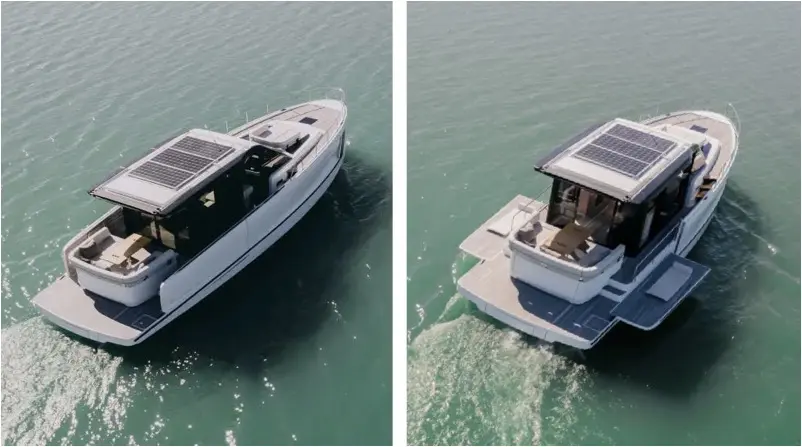
Today, WIA Yachts boasts a diverse catalog of seven zero-emission models. The crown jewel of this lineup is the newly unveiled Hardtop version of the popular WIA 520. Measuring 16.1 meters (52 feet) in length with a sprawling 4.7-meter (15.5-foot) beam, the WIA 520 Hardtop redefines what a sustainable luxury cruiser can be. Driven by twin ePropulsion I-40 inboard motors and a standard 160-kWh energy storage system, the vessel offers an uncompromising blend of residential comfort, innovative naval architecture, and true eco-friendly performance.
This article explores the trajectory of WIA Yachts—from its humble origins adapting forklift batteries on an inland lake to its current status as an international contender in sustainable marine engineering. We will examine the design philosophy of the new WIA 520 Hardtop, unpack its technical specifications, and look ahead at how pioneers like WIA are shaping the future of European recreational boating.
Detailed Chronology: From Forklift Motors to Marine Luxury
The genesis of WIA Yachts is rooted in geography and personal reinvention. In the mid-2000s, András Viszkei, a successful corporate lawyer and advertising executive, sought an exit from the frantic pace of his professional life. Viszkei had nurtured a lifelong passion for water and boating, leading him to invest in a marina opportunity on Lake Balaton.
Lake Balaton: A Strict Environmental Pioneer
Spanning roughly 75 by 14 kilometers (50 by 10 miles), Lake Balaton is Central Europe’s largest freshwater body. Following a massive surge in post-World War II recreational boating through the 1970s, the region faced severe ecological strain. In response, local authorities enacted stringent environmental protections, banning internal combustion engines from the lake. Consequently, Lake Balaton became an early European bastion for sailing.
However, as Viszkei expanded the marina—adding a hotel, a restaurant, and berthing space for over 200 vessels—he noted a distinct market gap. While sailors were well-served, a growing demographic of water enthusiasts wanted the effortless power of motorized boats without breaking environmental codes. Viszkei realized that electric propulsion was the key to satisfying this market while preserving the purity of the lake.
The Experimental Early Years (2009–2013)
When WIA Yachts was officially founded in 2009, the dedicated electric marine propulsion market was in its infancy. High-density lithium marine batteries and efficient brushless electric inboards were not readily available off-the-shelf.
Undaunted, the early WIA team improvised. Their prototype models—compact 7-meter (23-foot) day boats that served as the precursors to today’s 230 CC—relied on electric motors and battery banks ingeniously adapted from industrial forklifts and golf carts. While rudimentary by today’s standards, these experimental platforms proved robust. Early adopters embraced the silent, fumeless ride, and the company began to refine its craft alongside the rapid technological maturation of the broader electric vehicle and component supply chain.
Industrial Scaling and Portfolio Expansion
By 2013, demand had outgrown the initial workshop footprint. WIA acquired an abandoned manufacturing facility, converting it into a specialized shipyard capable of rigorous quality control and bespoke craftsmanship.
The introduction of a 34-foot model marked a turning point, signaling the brand’s pivot toward larger, more luxurious cruisers. Today, WIA operates at a deliberate, high-quality production capacity of roughly 15 bespoke, all-electric boats per year. The expanding portfolio now includes:
WIA 230 CC (7 meters)
WIA 330 (10 meters)
WIA 350 (10.5 meters)
WIA 450 (14 meters, available in Cabriole or Hardtop)
WIA 520 Open & Hardtop (16.1 meters)
What began as a regional solution for a single Hungarian lake has steadily evolved. WIA watercraft can now be spotted navigating the intricate canal networks of Western Europe and tracing sheltered coastal waters from the Mediterranean to the Baltic.
Supporting Context & Metrics: The WIA 520 Hardtop Explored
The public debut of the WIA 520 Hardtop at Boot Düsseldorf drew significant attention from industry insiders and eco-conscious cruisers alike. The vessel represents a masterclass in spatial optimization and human-centric naval design.
Hull Architecture and "Hull Wings"
The foundation of the WIA 520’s livability is its generous 4.7-meter beam. This wide stance provides an expansive footprint that rivals coastal apartments rather than traditional motor yachts.
A standout exterior feature is the inclusion of folding hull walls. These hydraulic panels fold downward to create two expansive "hull wings"—floating side platforms that extend the main deck. Whether guests are sunbathing, staging scuba equipment, or simply dangling their feet directly into the water, these platforms blur the boundary between vessel and aquatic environment.
Interior Volume and the "Floating Home" Philosophy
Stepping inside the WIA 520 Hardtop reveals a layout explicitly engineered around comfort. Unlike traditional yachts where living spaces feel retrofitted around mechanical constraints, WIA designed the 520 from the inside out.
The main deck features a convertible salon and galley area flanked by panoramic windows. Forward of the helm is an open-air lounging zone, while the aft cockpit acts as an alfresco dining area. Because the vessel produces zero exhaust fumes and operates in virtual silence, passengers in the aft cockpit can converse normally without shouting over diesel clatter or breathing in noxious hydrocarbons.
Below deck, the headroom is exceptional. Bence Viszkei, Director of Sales and Business Development, points out a deliberate design choice: the master stateroom was scaled to accommodate tall passengers comfortably. Standing at 190 cm (6 feet 3 inches), visitors can walk upright through the master cabin without a hint of spatial compression. The owner’s suite includes a remarkably spacious attached head (bathroom), while remaining lower-deck configurations allow for secondary and tertiary guest cabins, sleeping up to six individuals comfortably for multi-day excursions.
Propulsion and Energy Storage
To power a 16.1-meter luxury cruiser reliably across extended itineraries, WIA partnered with ePropulsion, a global leader in electric marine propulsion.
Motors: Twin 40-kilowatt ePropulsion I-40 inboard motors deliver a combined 80 kW (equivalent to approximately 110 horsepower).
Battery Capacity: A standard 160-kilowatt-hour (kWh) lithium energy storage bank provides the ship’s backbone, with scalable options available for owners requiring extended autonomy.
Range & Efficiency: For inland waterways, sheltered lakes, and coastal cruising, the WIA 520 delivers a comfortable range of roughly 100 kilometers (54 nautical miles / 62 miles) at standard cruising speeds. Crucially, because electric motor torque curves remain flat and efficient across lower velocities, operators can easily extend their range by throttling back to leisurely cruising speeds.
Technical Specifications: WIA 520 Hardtop
Metric
Specification
Imperial Equivalent
Length Overall (LOA)
16.1 meters
52 feet
Beam (Width)
4.7 meters
15.5 feet
Draft
0.7 meters
27 inches
Motors
2 x 40 kW (80 kW total)
2 x 55 hp (110 hp total)
Battery Bank
160 kWh (Scalable)
160 kWh
Sleeping Capacity
Up to 6 persons
Up to 6 persons
Official Statements and Industry Insights
The generational transition of leadership at WIA Yachts reflects a deep-seated family commitment to sustainable maritime recreation. Bence Viszkei, who quite literally grew up alongside the expansion of his father’s enterprise, articulates the core philosophy driving their designs today.
"We wanted to create a boat that feels like home, even if it’s only for a few days," explains Bence Viszkei. "I think the height makes a big difference. The people on board often don’t realize it, but that is what helps create that home atmosphere—the atmosphere of a very nice apartment. The floor area is not larger, but everything just feels bigger, easier, more relaxing."
Furthermore, the evolution of component availability has transformed how WIA designs its vessels for international buyers. In the early days of 2009, utilizing adapted industrial parts meant bespoke, localized maintenance. Today, partnering with established international giants like ePropulsion grants WIA owners access to a worldwide network of service partners and certified technicians. This global support infrastructure reassures buyers transitioning from fossil-fuel yachts to high-voltage electric platforms.
Future Outlook: The Green Ribbon Regatta and Beyond
As WIA Yachts looks to the future, the brand’s footprint extends far beyond its factory walls. While their vessels now navigate diverse international waterways, Lake Balaton remains the spiritual and cultural testing ground for the company.
Each July, the Balatonfüred Yacht Club (BCYC) marina—the very property that inspired András Viszkei to enter the marine industry—hosts the annual Green Ribbon Regatta (Zöld Szalag Regatta). Now in its eleventh consecutive year, the event has grown into Central Europe’s premier gathering for sustainable watercraft, attracting hundreds of participants across multiple competitive categories.
The regatta serves a dual purpose: it acts as a rigorous stress test for the battery packs, drivetrains, and hull designs of modern electric vessels, and it provides a vibrant public showcase of mature, reliable, zero-emission marine technology. Events like the Green Ribbon Regatta prove that high-performance electric boating is no longer an experimental niche, but a flourishing, mainstream lifestyle.
With the introduction of the WIA 520 Hardtop, WIA Yachts has solidified its position at the pinnacle of luxury sustainable boatbuilding. By combining residential ergonomics, avant-garde deck layouts, and robust electric propulsion, WIA proves that the future of yachting does not require a compromise between luxury and environmental stewardship. On lakes, rivers, and coastal seas alike, the future of navigation is quiet, clean, and unmistakably home-like.