







Executive Overview
The pursuit of long-duration energy storage (LDES) solutions has driven engineers and investors to explore unconventional physical paradigms. Among the more heavily publicized mechanical alternatives to chemical batteries and pumped hydro is rail-based gravity energy storage, championed by developers like Advanced Rail Energy Storage (ARES) North America.
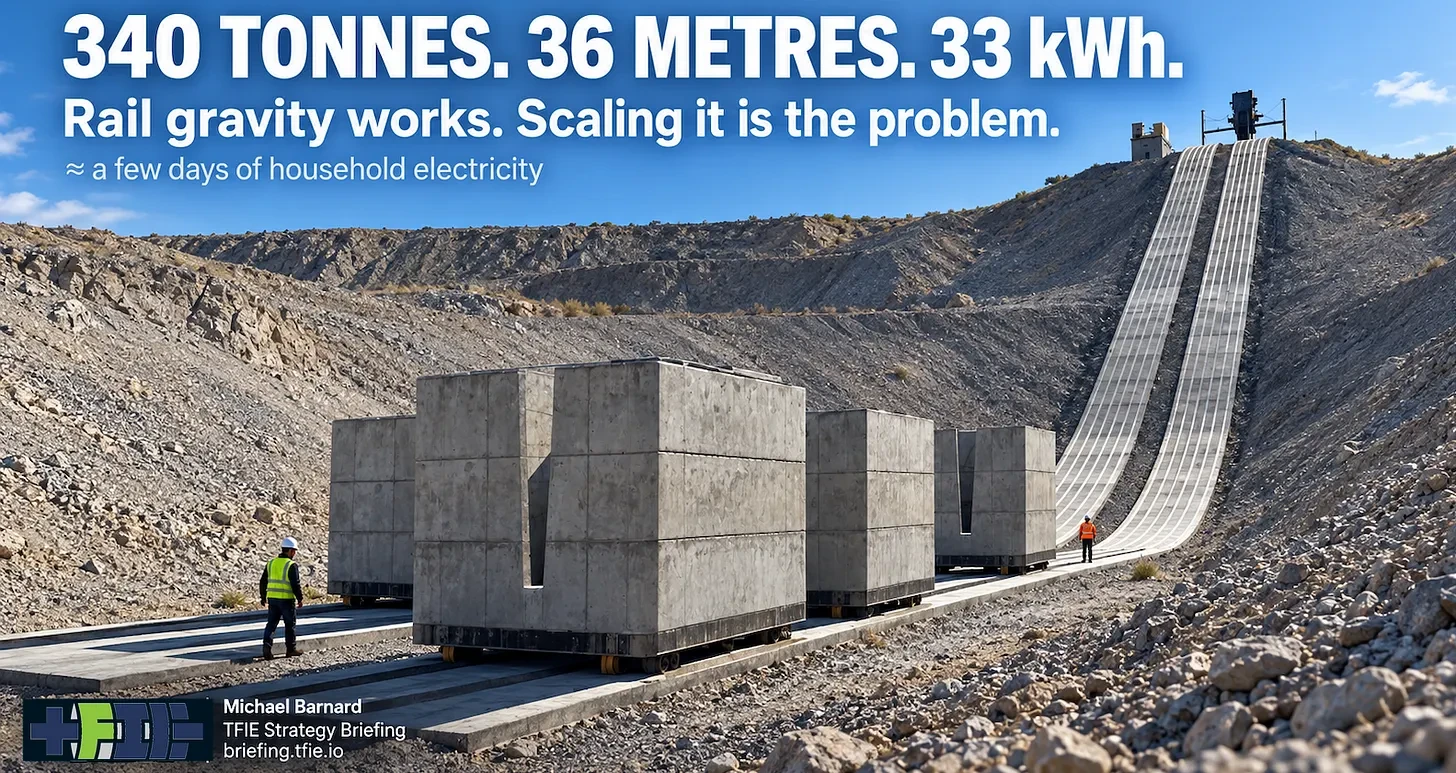
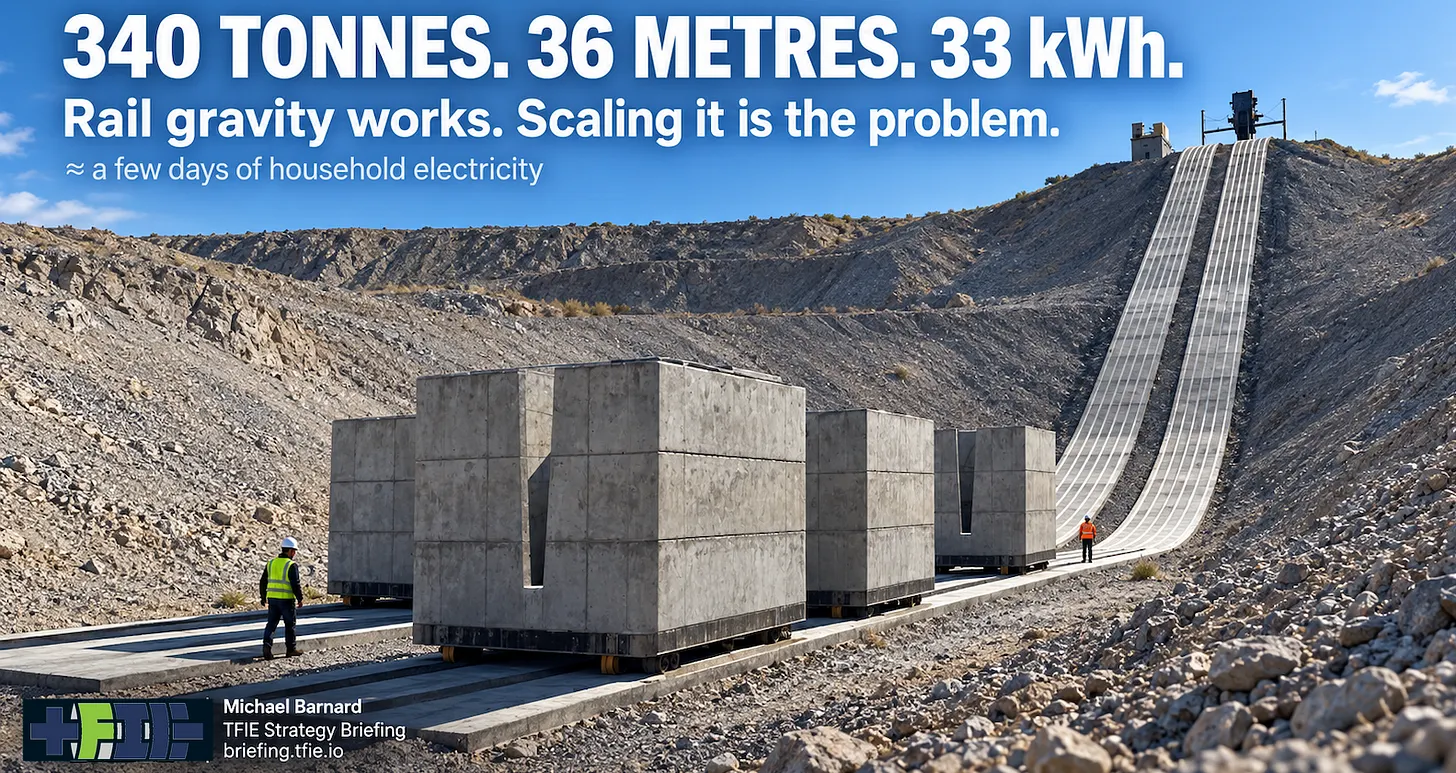
Recent field data from ARES’s GravityLine system deployment at the Gamebird Pit in Nevada provides a definitive real-world stress test for the technology. According to documentation compiled by Sandia National Laboratories, the system recently demonstrated a mechanical cycle involving roughly 340 tonnes of mass moving across a 55% grade over an elevation change of approximately 36 meters. The gross gravitational energy stored during this operation totaled a modest 33 kilowatt-hours (kWh).
While mechanical demonstrations of this scale succeed in proving basic kinematic functionality—such as the capability of a chain-drive or cable system to move heavy carriers up a steep incline—they simultaneously expose the uncompromising constraints of fundamental physics. Solid-mass gravity storage suffers from inherently low energy density. Scaling this technology to meet grid-level demands requires managing vast industrial footprints, thousands of manufactured heavy-rail carriers, and extensive concrete-and-steel infrastructure. When evaluated against the backdrop of rapidly advancing lithium-ion battery capabilities and the elegant fluid-handling architecture of closed-loop pumped hydro, rail-based gravity storage faces severe economic, logistical, and environmental hurdles.
Detailed Chronology and Technical Background
The Evolution of Solid-Mass Gravity Storage
For years, alternative energy storage developers have sought to capture gravitational potential energy without relying on the specific topographical requirements of traditional hydroelectric reservoirs. The concept behind rail gravity storage is conceptually straightforward: excess electrical grid energy powers electric motors that haul heavy masses up a steep incline. When electricity demand peaks or generation dips, the masses roll back down, driving the motors in reverse to act as generators, feeding electricity back into the grid.
Early iterations of these systems often envisioned funicular cable configurations, which introduced strict mechanical limitations regarding tension, load distribution, and track length. ARES North America sought to bypass some of these hurdles by employing a proprietary chain-drive and stationary motor configuration.
The Gamebird Pit Demonstration
The deployment at the Gamebird Pit in Nevada offered a controlled environment to validate these mechanical concepts. Sandia National Laboratories documented the performance of the system: two mass-laden rail cars, weighing a collective 340 tonnes, navigated an elevation shift of roughly 36 meters on a 55% grade.
While the system successfully performed the physical translation of mass, the resulting energy yield underscored the stark realities of physics. Stored gravitational energy is dictated by a strict mathematical equation:
$$textEnergy = textMass times textGravity times textElevation$$
Moving 340 tonnes over 36 meters yields a gross stored energy of just 33 kWh. To put this in perspective, 33 kWh is roughly equivalent to the daily energy consumption of an average American household, generated or stored by moving an immense fleet of heavy industrial equipment up a mountainside.
Supporting Context & Metrics: The Math of Scale
To understand why a 33 kWh demonstration highlights a profound structural bottleneck, analysts have modeled what a commercially viable long-duration storage facility would actually require.
Scaling Up: From Kilowatt-Hours to Megawatt-Hours
If an operator intends to deploy a modest 20-megawatt (MW) facility capable of delivering power over a twenty-hour duration—a 400 megawatt-hour (MWh) storage requirement—the physical scale of the project escalates exponentially.
Assuming an optimistic effective elevation change of 400 meters (more than eleven times the vertical rise available at the Gamebird Pit), the math reveals the sheer magnitude of the machinery needed:
- Mass Requirements: Hundreds of thousands of tonnes of ballast must be deployed.
- Rolling Stock: Because raw rock cannot simply be dumped onto a slope without containment, this mass must be distributed across hundreds of purpose-built, heavy-duty rail cars featuring reinforced steel, braking systems, onboard electronics, and chassis infrastructure.
- Infrastructure Footprint: Each site requires dedicated upper and lower switching yards, massive stationary winches, extensive transfer systems, maintenance sheds, and robust grid interconnection assets.
The Problem of Embodied Carbon and Industrial Overhead
Proponents of solid-mass storage frequently point out that the primary working medium—rock, gravel, or concrete ballast—is cheap and locally sourced. However, critiques from energy strategists highlight a critical oversight: the rock may be low-carbon, but the infrastructure required to move it is not.
To build thousands of concrete-filled steel rail cars, lay specialized high-grade tracks on steep 55% grades, and construct industrial-scale winches requires immense quantities of Portland cement and structural steel. Independent lifecycle analyses suggest that the embodied carbon footprint per kilowatt-hour of delivered energy for such custom, one-off mechanical systems can rival or exceed the emissions profile of fossil-fuel peaking plants. Far from being a clean climate solution, the heavy industrial manufacturing required to build the mechanical ecosystem introduces a substantial carbon debt before the facility ever begins cycling energy.

Comparative Analysis: Rail Gravity vs. Alternative LDES Technologies
To properly contextualize ARES’s GravityLine system, industry experts compare its operational architecture against two established storage paradigms: closed-loop pumped hydro and lithium-ion battery energy storage systems (BESS).
1. Closed-Loop Pumped Hydro
Pumped hydro utilizes the exact same foundational physics—mass, gravity, and elevation—as rail gravity storage, but employs a fundamentally superior material-handling architecture.
- Fluid Dynamics vs. Mechanical Friction: Water is a fluid that naturally finds its own level. It flows through common conduits, penstocks, and turbines without requiring individual chassis, wheels, bearings, or dedicated parking stalls.
- Redundancy and Maintenance: If a single turbine or valve in a pumped hydro facility requires maintenance, the rest of the system remains functional. In contrast, if a rail carrier derails or a stationary chain-drive mechanism seizes on an inclined rail line, massive blocks of stored energy can become entirely trapped uphill, inaccessible to the grid regardless of market demand.
2. Lithium-Ion Battery Energy Storage Systems (BESS)
While batteries rely heavily on manufactured components, their production model leverages the efficiencies of a globalized, permanent factory supply chain.
- Standardization: Developers receive standardized, modular battery containers rather than constructing a bespoke, project-specific heavy-equipment manufacturing and rail maintenance yard in a sensitive landscape.
- Duration Convergence: The historical argument that mechanical storage is uniquely suited for multi-hour or multi-day storage has weakened. Recent procurement trends—such as the United Kingdom’s LDES auctions—demonstrate that lithium-ion battery projects are successfully bidding for durations well into the teens of hours, encroaching directly into territory previously thought exclusive to mechanical or pumped-storage alternatives.
Future Outlook
The field demonstration at Gamebird Pit has answered a narrow mechanical question: ARES has proven that its specialized chain-drive and carrier systems can successfully navigate steep grades with heavy loads.
However, answering the mechanical question only brings the technology face-to-face with the true commercial test. The decisive hurdle for rail gravity storage is not whether heavy objects can be moved uphill, but whether the astronomical quantity of machinery required to build a useful energy inventory can economically and environmentally compete with established alternatives.
As energy markets demand faster deployment times, lower embodied carbon footprints, and higher round-trip efficiencies, bespoke mechanical systems like GravityLine face an uphill battle. Unless developers can radically reduce the structural, material, and maintenance overhead of their rolling stock, rail gravity storage risks remaining an engineering curiosity rather than a cornerstone of the global clean energy transition.