










Executive Overview
As temperatures across the British Isles shatter historical records and push public infrastructure to its absolute breaking point, a dangerous ideological divide has crystallized at the highest levels of political discourse. Against a backdrop of unprecedented summer heatwaves, raging wildfires, agricultural collapse, and thousands of excess heat-related deaths, senior political figures continue to downplay the existential emergency of a warming planet.
Most notably, Richard Tice, a deputy leader of the right-wing Reform UK party, recently asserted that Britons should simply "enjoy" the soaring temperatures and abandon efforts to achieve net-zero carbon emissions. Tice’s remarks mirror a broader global populist playbook—echoing past statements by fossil fuel executives and international climate obstructionists—that prioritizes political posturing over scientific reality.
While climate skeptics dismiss global heating as a natural and benign variation, the empirical data tells a vastly different story. A surge in uncompensable heat stress, staggering agricultural losses, buckling healthcare systems, and widespread ecosystem disruption point to an undeniable truth: the planet is warming at a pace far exceeding the evolutionary capacity of humans and the broader biosphere. This investigative report examines the dangerous rhetoric of climate complacency, the harrowing public health data emerging from institutions like The Lancet, and the urgent political clashes defining the modern climate debate in the United Kingdom.

Detailed Chronology: The Summer That Broke the Thermostat
The unfolding climate crisis in the United Kingdom is no longer a distant projection for the mid-21st century; it is an active, unfolding catastrophe measured in hospital admissions, scorched earth, and lost lives.
The Early-Season Heatwave
The warning signs manifested early. The late-spring and early-summer periods of recent years established a blistering precedent, marked by consecutive months of anomalous heat. Government data indicates that the early-season heatwaves of May and June triggered an estimated 2,877 temperature-related deaths across England and Wales alone—a staggering figure that doubles the mortality toll recorded during the entirety of the previous summer season.
Temperatures frequently breached the 35°C (95°F) threshold, overwhelming a national infrastructure fundamentally engineered for a temperate, maritime climate. Unlike regions of Southern Europe or the American Southwest, British homes, schools, and hospitals largely lack air conditioning, turning standard buildings into thermal traps during peak heat events.
The "Fire Wave" and Agricultural Ruin
As the dry conditions persisted into mid-summer, the UK confronted its most widespread wildfire emergency in modern history. Fuelled by a volatile combination of wet winters that stimulated rapid vegetation growth, followed by prolonged, baking heatwaves, the landscape was primed for combustion. Fire brigades across the Midlands, Wales, and Northern Ireland battled ferocious blazes tearing through grasslands, forests, and peatlands.

Simultaneously, the agricultural sector was dealt a devastating blow. The National Farmers’ Union reported that domestic producers were grappling with "one of the worst ever" harvests. Prolonged drought conditions severely compromised crop yields, threatened livestock welfare, and raised immediate concerns regarding long-term national food security.
It was precisely amid this national emergency—while firefighters battled blazes and citizens suffered under oppressive heat—that Reform UK’s Richard Tice took to public forums to dismiss the crisis entirely. Asked about the extreme conditions, Tice downplayed the utility of climate mitigation policies, stating:
"Of course, the climate changes, but where is the evidence that net zero is going to stop it? Where is the evidence? There is no evidence. Climate change has always happened. It always will. Maybe the smarter thing to do is to adapt to it than think arrogantly that you can stop it. When it’s a bit warm, let’s enjoy it."
Tice went on to suggest that the rising temperatures could paradoxically benefit the UK by improving domestic wine production, urging the public to celebrate the warming climate rather than succumb to "doom and gloom."
Supporting Context & Metrics: The Science of Heat and Denial
Tice’s dismissal of climate action relies on a common, albeit flawed, rhetorical pivot: acknowledging that the Earth’s climate has historically fluctuated while deliberately ignoring the anthropogenic mechanism driving current changes.
The Historical Precedent vs. Modern Reality
Earth’s geological history is indeed characterized by dramatic climatic shifts, ranging from tropical hothouse eras when dinosaurs dominated the globe to deep glacial periods buried under miles of ice. None of these prehistoric fluctuations were driven by human activity. However, Tice’s argument collapses when it attempts to divorce these natural cycles from the unprecedented speed of contemporary warming.
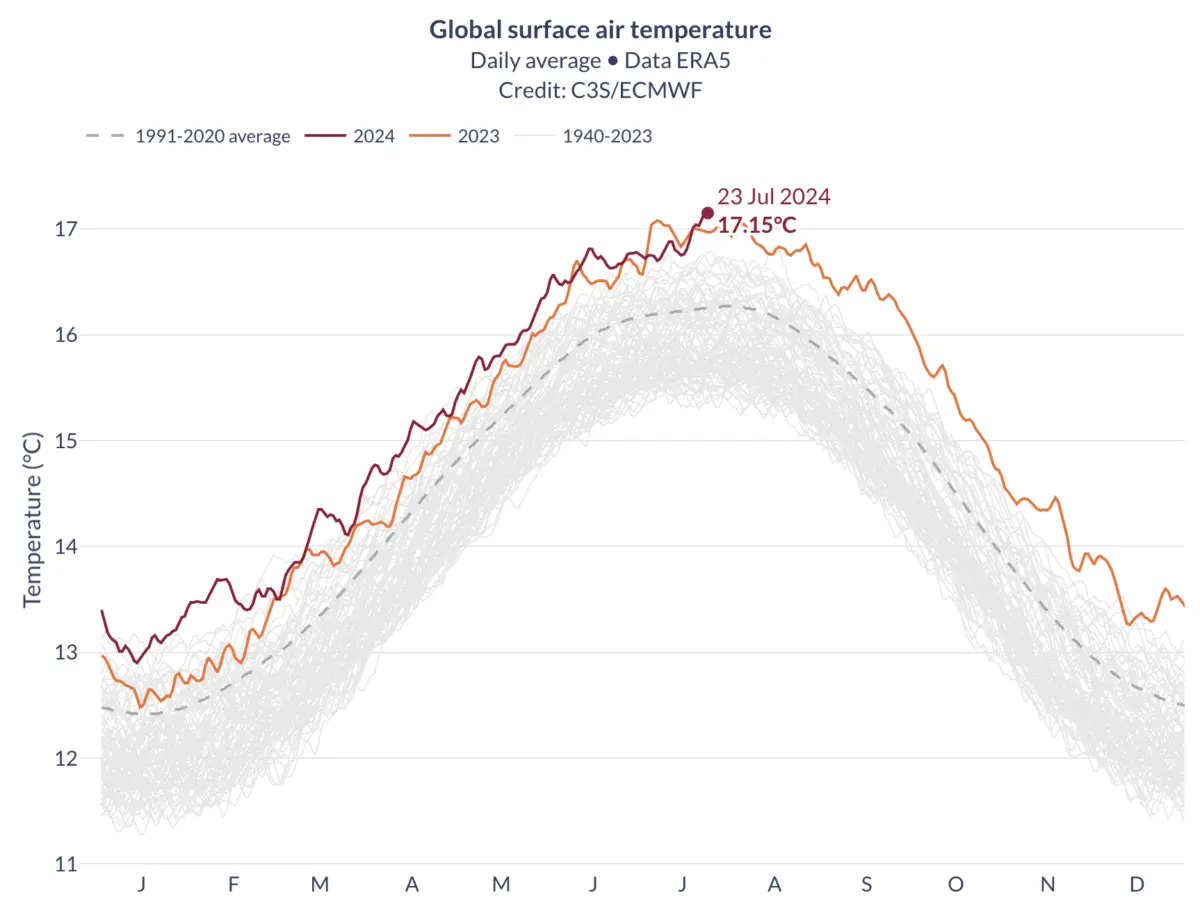
There is an overwhelming mountain of peer-reviewed scientific consensus demonstrating that average global temperatures are rising in direct correlation with the accumulation of atmospheric carbon dioxide. This chemical enrichment of the atmosphere coincides precisely with the dawn of the Industrial Revolution, when human civilization began extracting and combusting fossilized carbon on a planetary scale.
While nature possesses an extraordinary capacity for adaptation, genetic adaptation requires centuries, if not millennia, to manifest. The current rate of planetary warming is orders of magnitude faster than the adaptive capacity of humans, fauna, and flora, triggering systemic ecological collapse rather than smooth transition.
Medical Realities: The Lancet and the Threat of Uncompensable Heat Stress
The physical toll of this rapid warming is laid bare in alarming new research published in the medical journal The Lancet. Led by health academics from Stanford University, the study reveals that older populations and vulnerable demographics are affected by extreme heat at significantly lower temperature thresholds than previously understood.
The research highlights the growing global threat of uncompensable heat stress (UHS)—a physiological state in which the human body entirely loses its ability to regulate its internal temperature through sweating and vasodilation. When UHS occurs, the risk of multi-organ failure, severe neurological damage, and death escalates dramatically.
Furthermore, the economic and human costs are quantifiable. Recent summer extremes have cost the UK an estimated £4 billion in lost economic output, driven by reduced workplace productivity, infrastructural strain, and emergency healthcare surges.
The obstinacy displayed by political figures like Tice—who spend their lives insulated within climate-controlled homes, offices, and vehicles—draws sharp historical parallels. Their refusal to engage with empirical reality mirrors historical rejections of scientific progress, driven not by a lack of available data, but by ideological stubbornness and political expediency.
Official Statements: Condemnation from Across the Spectrum
The disconnect between populist rhetoric and the lived reality of British citizens has sparked fierce condemnation from political leaders, public health researchers, trade unions, and medical professionals.
Political Backlash
Responding directly to Tice’s remarks in The Guardian, Labour Party Chair Bridget Phillipson did not mince words:
"Richard Tice’s comments are tone-deaf. With wildfires raging across the UK and drought threatening water supplies and food security, comments like these don’t just raise serious questions about his judgment—they also expose where his interests really lie."
Reform UK has consistently campaigned on a platform to scrap the UK’s legally binding commitment to reach net-zero carbon emissions by 2050, promising to dismantle green subsidies and roll back environmental regulations if elected. Critics argue that this platform relies on manufacturing public fear and leveraging misinformation to secure short-term political gains at the expense of long-term planetary survival.
The Healthcare and Public Health Response
The medical community, bearing the brunt of the climate emergency on the frontline, expressed deep outrage at the minimization of heat-related illness.
A spokesperson for the Royal College of Nursing issued a powerful rebuke:
"Those calling for people to enjoy the impacts of climate change should say it to the nurses collapsing in hospitals where temperatures are hitting 36 degrees. Or to the thousands of patients lining corridors every day as extreme heat causes severe illness among the vulnerable, older people, and even those without pre-existing conditions. Climate change is a public health emergency that’s getting worse in front of our eyes. The nursing profession doesn’t want out-of-touch interventions, but action to reduce emissions and make NHS and care facilities safe to work and be cared for in."
Academic and public health voices echoed these concerns. Dr. Simon Williams, a public health researcher at Swansea University, warned of the insidious nature of heat exposure:
"It’s concerning to see someone so high profile spreading misinformation around climate change and its impacts. Particularly for the elderly, heatwaves over time make them less capable of regulating their body temperature. Even a few degrees either way can have a major impact."
Caroline Abrahams, charity director for Age UK, reinforced these warnings, declaring that the latest medical data leaves no room for denial regarding the lethal threat extreme weather poses to senior citizens.
Future Outlook: The Dangerous Crossroads of Climate Politics
The rhetoric espoused by Richard Tice and Reform UK is not happening in a vacuum. It represents a factional, reactionary pushback against the global energy transition—a phenomenon also visible in the American political landscape via the MAGA movement and past statements by figures like former Exxon CEO and Secretary of State Rex Tillerson, who similarly suggested that humanity would simply have to adapt to a hotter world.
Yet, "adapting" without mitigating the root cause of the crisis is a mathematical and physical impossibility. If greenhouse gas emissions continue on their current trajectory, uncompensable heat stress will transition from a seasonal emergency to a permanent, year-round existential threat. Major urban centers in the UK will require massive, energy-intensive retrofitting of every public building, school, and hospital to remain habitable during summer months, ironically increasing electrical grid demand at a time when power generation is strained by water shortages and extreme weather.
Furthermore, the political weaponization of climate denial threatens to delay crucial structural investments in flood defenses, water grid interconnectors, wildfire management, and sustainable agricultural subsidies. When politicians tell the electorate to "enjoy" a dangerous heatwave, they are actively obstructing the societal mobilization required to protect future generations.
As global temperatures continue to climb and the economic and human toll mounts, the ideological shielding enjoyed by climate skeptics is wearing thin. The public, the medical profession, and the scientific community are increasingly united in viewing climate obstructionism not merely as a differing political opinion, but as a severe dereliction of duty and a profound moral failure.
In the face of relentless heatwaves, failing crops, and buckling healthcare corridors, the choice facing modern democracies is stark: heed the mounting weight of scientific evidence and adapt through aggressive mitigation, or heed the dangerous apathy of denialists and watch the world burn.