






Executive Overview
The marine leisure and commercial transport sectors stand at a critical crossroads. As global climate imperatives intensify, maritime regulatory bodies, municipal authorities, and consumers are increasingly demanding sustainable alternatives to fossil-fuel-powered vessels. Yet, marine electrification has long been hampered by a stubborn physical reality: water is dense, drag is relentless, and conventional hull designs require immense amounts of energy to push through waves at speed. Traditional electric boats have consequently suffered from severely limited ranges, transforming potential marine cruisers into short-hop harbour craft.
Enter Optima Yachts. Hailing from the United Kingdom and crowned a winner at the prestigious 2024 Gussies International Electric Boat Awards, the company has spent the better part of a decade defying conventional naval architecture. Backed by over five years of rigorous research and development and fueled by £1.6 million (approximately €1.85 million or $2.15 million) in innovation grants, Optima has engineered a revolutionary hull technology that shatters historic boundaries in vessel efficiency.
Today, following proven milestones—such as the groundbreaking non-stop circumnavigation of the Isle of Wight by its e10 model—Optima Yachts has reached a pivotal commercial inflection point. The company is actively seeking strategic acquirers, operators, and visionary investors capable of scaling its award-winning recreational and commercial electric vessels into full-scale mass production. This development presents a rare, turnkey opportunity for stakeholders looking to secure a dominant footprint in the rapidly expanding clean-tech maritime sector.
Detailed Chronology: From Concept to Award-Winning Reality
The journey of Optima Yachts is a testament to the methodical, science-led evolution of modern naval engineering. Rather than simply retrofitting electric motors into traditional fibreglass hulls—a common practice in the early days of marine electrification—Optima’s leadership recognized that the entire hydrodynamic equation needed to be rewritten from the keel up.
The R&D Phase (2018–2023)
Over five years of intensive research and development, supported heavily by public and private innovation grants totalling £1.6 million, Optima’s engineering teams leveraged advanced computational fluid dynamics (CFD). Their goal was to drastically minimize hydrodynamic resistance, thereby reducing the power draw required to maintain comfortable cruising speeds.
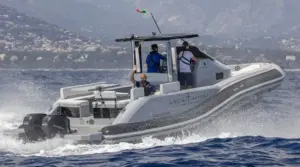
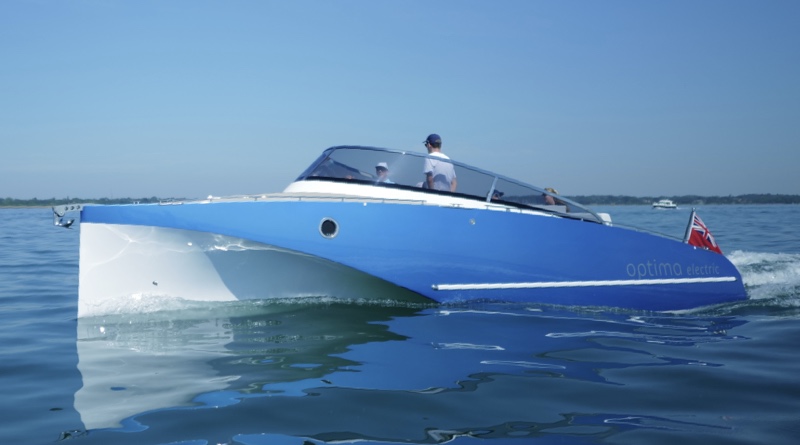
This multi-year effort culminated in the creation of a proprietary "trimaran tunneling hull." Unlike standard planing hulls or traditional displacement vessels, Optima’s design features a central hull flanked by two extremely sharp V-profile side pontoons. These secondary hulls connect to the main structure via an arching configuration, creating an aerodynamic and hydrodynamic tunnel reminiscent of those found in high-performance speedboat racing. This geometry cleanly parts the water, dampens wake, and significantly decreases energy consumption without sacrificing internal volume or stability.
The Historic Milestone: Circumnavigating the Isle of Wight (2023)
The ultimate test of any marine technology is out on the open water, where theory meets unpredictable weather. In 2023, Optima proved the viability of its concept in spectacular fashion. Powered by a modest 40kW electric propulsion system, the 10.6-metre (35-foot) Optima e10 became the first-ever electric boat to successfully circumnavigate the Isle of Wight non-stop.
The vessel completed the grueling 55-nautical-mile journey through challenging maritime conditions—including thick fog and lively, unpredictable seas off St. Catherine’s Point—while costing a mere £20 (€23, $27) in electricity to recharge. More importantly, it demonstrated that electric boating could abandon compromise: passengers enjoyed a quiet, vibration-free ride smooth enough to comfortably host lunch and conversation while underway.
Recognition and the 2024 Gussies Awards
Building on the momentum of its sea trials, Optima’s design philosophy received international validation when the company was named a winner at the 2024 Gussies International Electric Boat Awards. This recognition cemented Optima’s status among the top tier of non-foiling electric watercraft globally, validating its core intellectual property and establishing high expectations for its upcoming commercial lineup, which features the flagship e10 and the larger, highly anticipated e14.
Supporting Context & Metrics: Engineering Efficiency and Luxury
To understand why industry observers are closely watching Optima’s search for capital, one must examine the specific metrics and design choices that separate these vessels from the broader marine market.
Efficiency vs. Utility
In the current electric boat landscape, manufacturers generally fall into two camps: planing boats designed for high-speed thrills (which drain battery banks in minutes) and low-speed harbour workboats. Optima occupies a highly coveted middle ground. Its hulls are optimized for displacement and semi-displacement efficiency, enabling a cruising range exceeding 150 nautical miles on a single charge.
This extraordinary range addresses "range anxiety," the psychological barrier that has historically kept mainstream boaters tethered to internal combustion engines. Yet, this efficiency has not been achieved at the expense of luxury or comfort.

Model Lineup Specifications
- Optima e10 (10.6 metres / 35 feet): Designed to accommodate up to 8 guests in sophisticated comfort. It features a double-bed cabin, a fully equipped galley area with a fridge/freezer, sink, and induction stovetop hob/grill, a hot-water transom deck shower, an electric marine toilet with a holding tank, and a high-end four-speaker audio system.
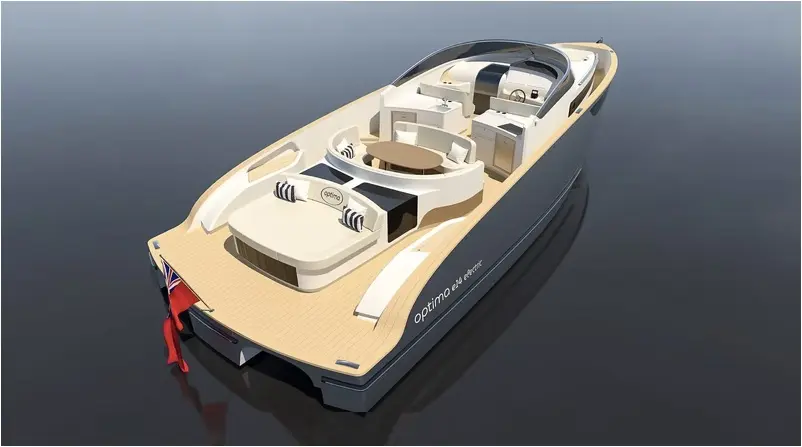
- Optima e14: Expanding upon the foundation of the e10, the award-winning e14 takes luxury and capacity to the next level. It incorporates an expansive sunbed, a central alfresco dining area, and certified capacity for up to 12 guests, making it ideal for day charters, resort transfers, and high-end coastal cruising.
- Commercial Lineup (Water Taxis and Ferries): Recognizing the massive economic shift toward urban waterfront mobility and sustainable tourism, Optima has adapted its core hull technology for commercial applications. Adaptable configurations range from 12-passenger luxury water taxis to small ferries and larger models capable of carrying up to 50 passengers. These vessels promise commercial operators dramatic reductions in long-term "refuelling" and maintenance expenditures.
| Metric / Feature | Optima e10 | Optima e14 & Commercial Variants |
|---|---|---|
| Length | 10.6 metres (35 ft) | Scalable (up to 50-passenger capacity) |
| Passenger Capacity | Up to 8 guests | 12 to 50 guests depending on configuration |
| Range | Over 150 nautical miles | Optimized for all-day commercial duty cycles |
| Propulsion | 40kW electric (e10 benchmark) | Scalable electric drivetrain architecture |
| Notable Achievements | Non-stop Isle of Wight circumnavigation | Gussies International Electric Boat Award Winner |
Official Statements and Industry Perspective
The transition from a research-and-development prototype to an industrial-scale manufacturing operation requires more than just brilliant engineering; it requires strategic vision, patient capital, and operational muscle.
Reflecting on the successful 2023 Isle of Wight voyage, Optima CEO David Kendall highlighted the human-centric benefits of their engineering choices:
"It was an incredibly comfortable and enjoyable trip—we were able to have lunch and engage in pleasant conversation on passage thanks to the good sea keeping of the innovative hull and noise reduction from the electric drive. We arrived back in Lymington as relaxed and refreshed as we started, despite some challenging conditions south of the island including thick fog and lively seas off St Catherine’s Point."
Addressing the current juncture of the enterprise, Kendall emphasized that the company is primed for its next evolutionary phase:
"We have spent years solving one of the biggest barriers to marine electrification—vessel efficiency. We believe the business is now at an exciting inflection point and are looking for the right investment and ownership to take Optima to the next level, whether through commercial production, strategic partnerships or expansion into markets."
Industry analysts point out that Optima’s timing aligns perfectly with global regulatory trends. Island resorts, eco-tourism destinations, and municipal governments are facing mounting pressure to eliminate fossil-fuel emissions. At the same time, high-end hospitality brands are urgently seeking premium guest-transfer vessels that visibly align with corporate sustainability commitments. Optima’s commercial water taxis and ferries offer a direct, turnkey solution to these evolving market demands.

Future Outlook: The Investment Opportunity
The global electric marine market is no longer a speculative frontier; it is a fast-accelerating commercial sector projected to grow exponentially over the coming decade. As battery chemistry improves, charging infrastructure expands, and maritime jurisdictions enact zero-emission zones in sensitive coastal waters, traditional combustion engine boatbuilders face an existential threat to their business models.
For investors, private equity firms, major marine conglomerates, or strategic operators, Optima Yachts represents a rare acquisition target. Rather than starting from scratch, an incoming partner acquires:
- Validated Intellectual Property: Over five years of CFD research yielding a uniquely efficient trimaran tunneling hull.
- Proven Market Validation: Award-winning status at the Gussies International Electric Boat Awards and a record-breaking public sea trial.
- A Dual-Market Portfolio: Intellectual property and designs spanning both lucrative luxury recreational yachts and high-demand commercial passenger vessels.
As Optima Yachts opens its doors to discussions with interested parties, the message to the market is clear: the foundational heavy-lifting of hydrodynamic innovation has been successfully completed. Now, the company invites visionary stakeholders to provide the capital and operational infrastructure required to bring these next-generation electric vessels from the drawing board to global waterways.
Interested investors, operators, and strategic acquirers are encouraged to initiate dialogue directly through the official Optima Yachts website.