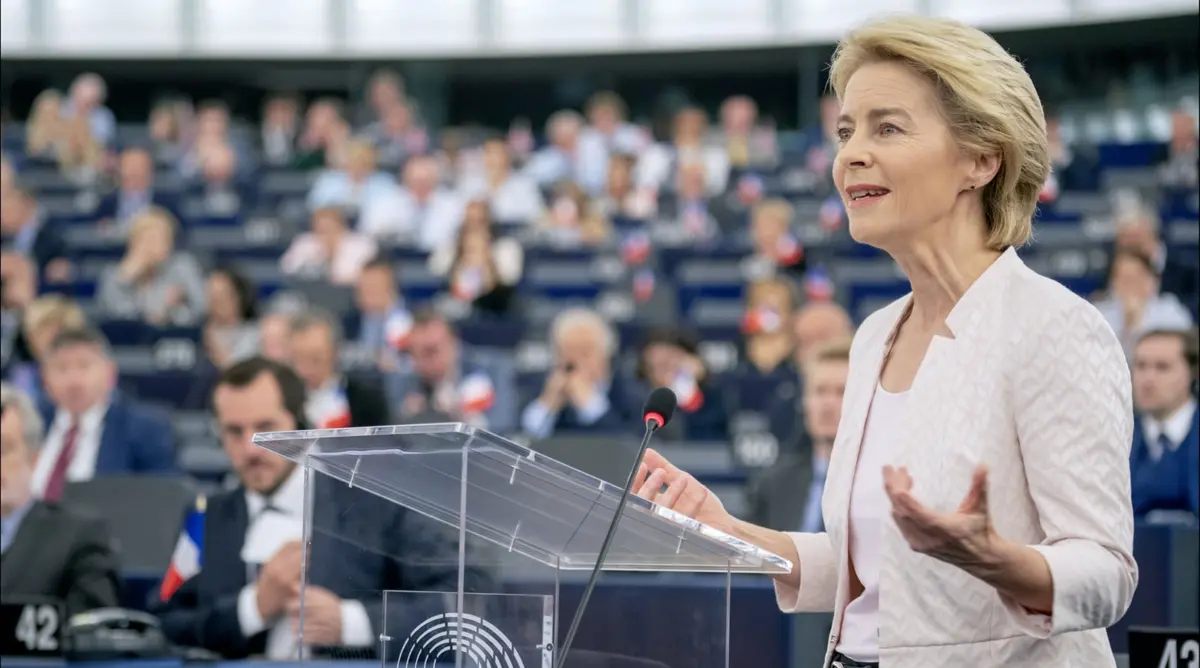
Europe’s road transport sector is standing at a critical juncture. As geopolitical instability collides with worsening climate impacts, the continent’s heavy-duty vehicle (HDV) fleet—comprising the trucks, buses, and coaches that form the backbone of European commerce and logistics—faces unprecedented stress. In response to these converging crises, the International Road Transport Union (IRU) and Transport & Environment (T&E) have joined forces to issue a formal appeal to European Commission President Ursula von der Leyen.
The two organizations are demanding the immediate launch of a high-level, cross-sectoral strategic dialogue dedicated to heavy-duty vehicle decarbonisation. This initiative aims to bridge the widening gap between ambitious EU climate goals and the harsh, on-the-ground economic realities faced by transport operators. With key legislative frameworks up for review—namely the Alternative Fuels Infrastructure Regulation (AFIR) and the Heavy-Duty Vehicle $textCO_2$ Standards—policymakers are being urged to recalibrate their strategies. Without a coordinated, inclusive approach that places fleet operators and real-world infrastructure at the center of decision-making, Europe risks stalling its transition toward a resilient, zero-emission transport network.
Detailed Chronology & Regulatory Landscape
The push for a renewed strategic dialogue does not happen in a vacuum; it is the culmination of years of escalating regulatory tightening, compounding market pressures, and the realization that current implementation timelines are falling short of industry capabilities.
Over the past decade, the European Union has systematically ramped up its climate ambitions for the transport sector, seeking to align with the overarching goal of climate neutrality by 2050.
The Initial Frameworks: Early EU climate policies primarily targeted passenger vehicles, leaving heavy-duty transport—responsible for a disproportionate share of transport-related emissions—largely under-regulated.
The Tightening of $textCO_2$ Standards: Recognizing this gap, the EU introduced binding $textCO_2$ emission reduction targets for new heavy-duty vehicles, demanding progressive cuts relative to 2019 baselines. These standards have pushed manufacturers to accelerate research and development into battery-electric and hydrogen fuel-cell commercial fleets.
The AFIR Mandate: Running parallel to vehicle standards is the Alternative Fuels Infrastructure Regulation (AFIR). AFIR was designed to legally bind member states to roll out adequate public recharging and refueling stations along major European transport corridors (such as the TEN-T network). However, the rollout speed has consistently lagged behind the manufacturing curve of zero-emission trucks.
The Impending Reviews
As Europe navigates the mid-2020s, both AFIR and the HDV $textCO_2$ Standards are approaching critical legislative review periods. These reviews offer a legislative window to evaluate what is working, discard unworkable mandates, and address the systemic bottlenecks hindering rapid deployment.
IRU and T&E argue that these reviews cannot be conducted in a legislative bubble. Instead, they must be informed by the lived experiences of transport operators who are navigating soaring energy costs, grid connection delays, and fluctuating capital expenditures. The proposed strategic dialogue under President von der Leyen is envisioned as the vital precursor to these regulatory updates, ensuring that policy matches practical execution.
Supporting Context & Metrics: The Multiple Crises Facing European Transport
The urgency behind the IRU and T&E appeal is fueled by a triad of compounding pressures: volatile energy markets, geopolitical friction, and accelerating climate change.
The protracted conflicts in Ukraine and the broader Middle East have fundamentally destabilized European energy markets. For transport operators, whose profit margins are notoriously thin (often hovering around 1% to 3%), diesel price spikes act as an immediate and severe tax on business operations.
Relying heavily on imported fossil fuels leaves European logistics vulnerable to external shocks. As T&E Executive Director William Todts points out, this diesel crisis is a wake-up call. The most viable, long-term insulation against these shocks is a decisive shift toward domestically generated, clean electricity powering electric trucks. However, the transition from pump to plug remains plagued by prohibitive upfront vehicle costs and unpredictable electricity pricing for commercial charging.
2. Climate-Driven Infrastructure Strain
Paradoxically, the very sector contributing to global emissions is also suffering the immediate physical consequences of climate change. Across Europe, extreme weather events—ranging from historic droughts compromising inland waterways and rail lines to severe storms and floods washing out critical road infrastructure—are wreaking havoc on supply chains.
Transport operators are increasingly forced to reroute fleets, absorb delays, and manage equipment degradation caused by extreme heat and flooding. This operational strain diverts capital that might otherwise be allocated toward fleet electrification, compounding the difficulty of meeting green mandates.
3. Grid Capacity and the Infrastructure Deficit
Transitioning a fleet of heavy-duty trucks from diesel internal combustion engines to high-capacity battery-electric systems requires massive amounts of electrical power. A single depot charging multiple heavy-duty trucks simultaneously demands energy equivalent to a small town.
However, Europe’s electrical grids are facing severe bottlenecks:
Connection Delays: Transport operators frequently report wait times of several years simply to secure grid connection upgrades for depot chargers.
Megawatt Charging Gaps: While public passenger car chargers are increasingly common, the deployment of Megawatt Charging Systems (MCS) required for long-haul trucks to recharge during mandatory driver rest breaks is still in its infancy.
Financing Hurdles: Smaller and medium-sized transport companies—which make up the vast majority of Europe’s fragmented road transport market—often lack the balance sheets required to absorb the high initial capital costs of zero-emission vehicles and private charging infrastructure.
Official Statements & Industry Perspectives
The joint initiative brings together two influential organizations that often approach transport policy from distinct vantage points—the IRU representing commercial transport operators and employers, and T&E representing environmental advocacy. Their consensus on the need for a presidential-level dialogue underscores the severity of the current impasse.
Raluca Marian, IRU EU Advocacy Director
Emphasizing the voice of the commercial operators who bear the operational risk, Raluca Marian stated:
"The transition of heavy-duty transport needs renewed political momentum at the highest level. The EU has set a clear direction, but delivering it will require EU and national efforts to go hand in hand. A strategic dialogue led by President von der Leyen would send an important signal that the transition of trucks, buses and coaches remains an EU priority. It would bring together the key actors to identify what is still holding back deployment and where action is most urgently needed. Operators are the ones investing in and running these vehicles every day. Their operational and economic realities need to be at the heart of the decisions shaping the next phase of the transition."
Marian’s comments highlight a persistent frustration within the commercial transport sector: top-down climate targets established in Brussels frequently underestimate the complex logistical choreography required to keep goods moving across national borders. By demanding that operational realities drive policy, the IRU is pushing for flexibility, targeted financial support, and synchronized infrastructure deployment across member states.
William Todts, T&E Executive Director
Focusing on energy security and environmental imperatives, William Todts framed the transition as an urgent matter of geopolitical resilience:
"The diesel crisis is a wake up call for Europe. We must rapidly reduce our dependence on imported oil and the single best way to do that is by scaling up electric trucks run on clean, homegrown electricity. The EU is preparing action on charging and $textCO_2$ standards. What we need to succeed is a transparent, inclusive process with all the key players around the table."
Todts’ perspective reinforces the notion that decarbonizing heavy-duty transport is no longer solely an environmental objective; it is a pillar of European economic sovereignty. By phasing out imported diesel in favor of locally produced renewable electricity, Europe can insulate its logistics sector from foreign price manipulation and supply chain disruptions.
Future Outlook: What Lies Ahead for European Trucking?
As the European Commission considers the joint appeal from the IRU and T&E, the stakes for the continent’s logistics network could not be higher. The path forward requires a delicate balancing act between maintaining rigorous environmental timelines and providing the economic scaffolding necessary for industry survival.
Key Milestones for Success
For the proposed strategic dialogue to yield tangible results, several core pillars must be addressed:
Holistic Stakeholder Inclusion: Any strategic forum must sit vehicle manufacturers (OEMs), energy providers, grid operators, financial institutions, and transport operators around the same table to synchronize supply and demand.
Targeted Financial De-Risking: Policymakers must introduce robust financial instruments—such as purchase subsidies, pan-European leasing guarantees, and toll differentials favoring zero-emission vehicles—to ease the capital burden on small and medium-sized transport enterprises.
Grid Prioritization: European governments must fast-track grid modernization and prioritize industrial and transport corridor connections to eliminate the infrastructure bottlenecks currently stalling depot and en-route charging deployment.
Pragmatic Regulatory Reviews: As AFIR and the HDV $textCO_2$ Standards undergo review, lawmakers must remain adaptable, ensuring that regulatory milestones reflect real-world infrastructure availability rather than arbitrary calendar dates.
Ultimately, the transition of Europe’s heavy-duty fleet from fossil fuels to zero-emission alternatives is an inevitable and necessary evolution. However, whether that transition occurs smoothly or triggers widespread economic distress depends entirely on the willingness of EU leadership to listen to the operators on the ground. By launching a high-level strategic dialogue, President von der Leyen has the opportunity to transform a fragmented, anxiety-ridden regulatory process into a unified roadmap for sustainable European mobility.