






By Nicholas Lua
Published: August 28, 2026
Executive Overview
The global maritime commons is facing an unprecedented logistical crisis as the Panama Canal—one of the world’s most critical trade arteries—becomes a severe bottleneck. A volatile mix of climate-induced drought and escalating geopolitical conflict in the Middle East has forced global energy shippers to abandon standard operating procedures. In their place, logistics managers are deploying highly unusual, costly, and complex workarounds to keep global energy supply chains flowing.
In recent weeks, industry analysts have observed two distinct and dramatic responses to the mounting congestion: the emergence of localized "shuttle" operations using ship-to-ship (STS) transfers off the coast of Panama, and a return to the historic, grueling voyage around the southern tip of South America. These maneuvers highlight the extreme measures to which energy majors must resort to avoid crippling delays and multimillion-dollar transit auction fees.
As the Panama Canal Authority (ACP) continues to restrict daily transits and draft limits due to depleted water levels, the broader implications for the global liquefied petroleum gas (LPG) and liquefied natural gas (LNG) markets are profound. With the Strait of Hormuz and Suez Canal routes severely compromised by geopolitical tensions, the gridlock in Panama represents a compounding disruption that threatens the energy security of import-dependent Asian economies.
Detailed Chronology: The Anatomy of a Logistics Workaround
To understand the scale of the disruption, one must look to the waters off Balboa, on Panama’s Pacific coast. Here, vessel-tracking data, traders, and shipbrokers recently captured a highly unusual operational maneuver that illustrates the lengths to which charterers will go to bypass the canal’s queue.
+-----------------------------------------------------------------------+
|                       THE SHUTTLE STRATEGY                            |
|                                                                       |
|  [ US Gulf Coast ] ---> (Panama Canal) ---> [ Balboa Port (Pacific) ] |
|                                                    |                  |
|                                            (STS Transfer)             |
|                                                    v                  |
|  [ Japan/Asia ] <-------------------------- [ Eneos Wisdom ]          |
|  (Long-haul)                                (Neopanamax)              |
+-----------------------------------------------------------------------+
The Pacific Coast Ship-to-Ship Transfer
In mid-August 2026, the Energia Grandeur, a Panamax-class gas carrier owned and managed by MOL Energia Pte., was traversing the Pacific Ocean toward Japan, laden with US-sourced LPG. Mid-voyage, the vessel received orders to execute a dramatic U-turn and head back toward the Pacific entrance of the Panama Canal.
Upon arriving off the port of Balboa, the Energia Grandeur came alongside the Eneos Wisdom, a much larger Neopanamax supertanker. Over several days, crew members conducted a delicate and rare ship-to-ship (STS) cargo transfer, pumping the liquefied gas from the smaller vessel to the larger one.

According to market sources, the logic behind this maneuver is rooted in the bifurcated transit fees and waiting times currently plaguing the canal:
- The Panamax Advantage: Smaller Panamax vessels like the Energia Grandeur transit through the canal’s older, narrower locks. These locks have not experienced the same astronomical rise in wait times or auction premiums as the larger Neopanamax locks.
- The Neopanamax Bottleneck: The newer, wider Neopanamax locks, which handle the bulk of US-to-Asia LPG trade, are heavily restricted.
- The Shuttle Hack: By turning the Energia Grandeur into a dedicated "shuttle" that repeatedly passes through the Panamax locks to fetch cargo from the Atlantic side, the charterer—French energy giant TotalEnergies SE—can keep a steady flow of gas moving across the isthmus. The larger Eneos Wisdom then acts as the trans-Pacific workhorse, carrying the consolidated cargo to Asian markets without ever having to wait in the grueling Panama Canal queue.
The Cape Horn Alternative
While some shippers are hacking the transit system through localized shuttles, others are opting to bypass the Western Hemisphere’s premier shortcut entirely.
The Gas Scorpio, a Neopanamax supertanker, recently abandoned its plans to transit the Panama Canal. Instead, the vessel embarked on a rare and costly detour around Cape Horn, navigating the treacherous waters at the southern tip of South America to return to the US Gulf Coast to load its next cargo.
Route Comparison (US Gulf Coast to Asia):
--------------------------------------------------------------
Via Panama Canal:   ~12,500 nautical miles  |  ~30-35 days
Via Cape Horn:      ~16,000+ nautical miles |  ~60-65 days
--------------------------------------------------------------
Net Penalty:        +3,500+ miles           |  +30 days transit
This detour adds approximately 30 days to the vessel’s journey and incurs massive fuel, crew, and operational costs. The last time such desperate routing decisions were observed at scale was during the historic drought of late 2023, signaling that the current 2026 crisis has reached similarly critical proportions.
Supporting Context & Metrics: The Dual Pressures of Climate and War
The operational chaos in Panama is not occurring in a vacuum; it is the direct result of a "perfect storm" where global environmental changes intersect with geopolitical conflict.
The Climate Crisis: El Niño and Gatun Lake
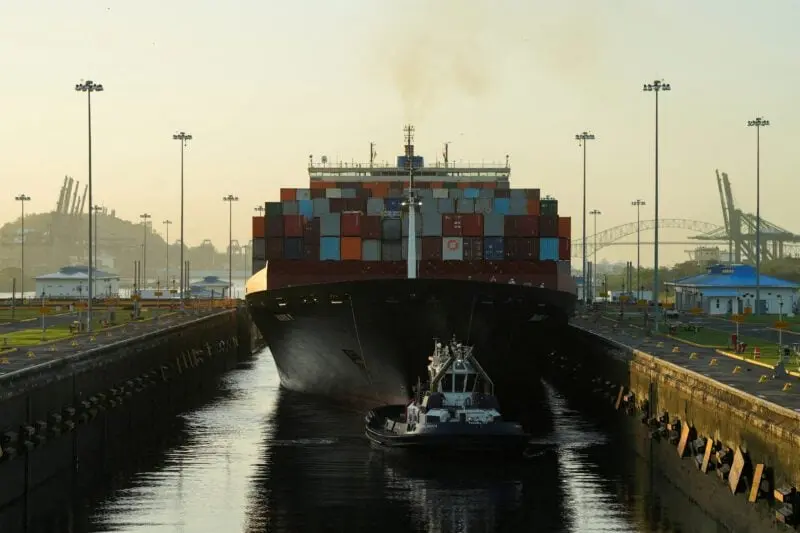
The primary physical constraint on the Panama Canal is water. Unlike sea-level canals like Suez, the Panama Canal relies on a gravity-fed lock system powered by freshwater from Gatun Lake. Each ship transit flushes roughly 50 million gallons of freshwater out to sea.
===================================================================
PANAMA CANAL TRANSIT METRICS (AUGUST 2026)
===================================================================
Vessels Waiting Without Reservations:   14
Vessels Scheduled to Transit:           115
Maximum Northbound Wait (No Booking):   8 Days
Maximum Southbound Wait (No Booking):   4 Days
Record Auction Fee Paid to Skip Line:   $5.3 Million
===================================================================
A severe El Niño cycle has severely reduced rainfall across the Panamanian isthmus, dragging Gatun Lake’s water levels down to near-record lows. In response, the Panama Canal Authority has implemented strict draft limits—reducing the amount of cargo a ship can carry to avoid scraping the channel floor—and slashed the number of daily transits.
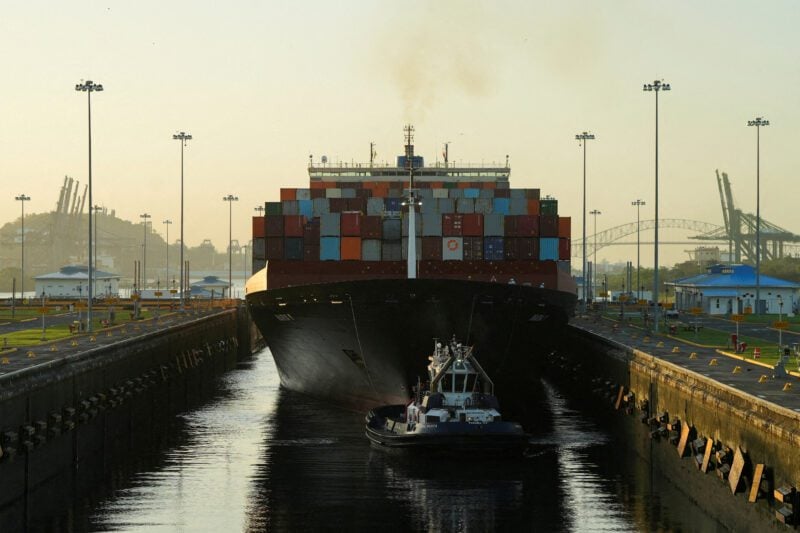
While a canal spokesperson confirmed that 115 vessels are currently scheduled to transit, those arriving without a reservation face lengthy delays. Northbound vessels without bookings face up to an eight-day wait, while southbound transits can take up to four days.
The Geopolitical Multiplier: The Iran War
Compounding the climate crisis is the ongoing conflict involving Iran, which has effectively shut down or severely restricted traditional shipping lanes in the Middle East. With the Red Sea and the Suez Canal deemed unsafe for many Western-flagged or Western-chartered vessels, a massive volume of global trade has been diverted.
Shippers who would normally transport goods from the US or Europe to Asia via the Suez Canal have been forced to re-route around Africa’s Cape of Good Hope or rely more heavily on the Panama Canal. This surge in diverted traffic has placed an unsustainable burden on Panama’s drought-stricken infrastructure.
The Rise of the Multi-Million Dollar Auction
For ship operators carrying high-value, time-sensitive commodities like LPG or LNG, waiting a week in the tropical sun is financially ruinous. To accommodate desperate shippers, the ACP runs an auction system for unscheduled transit slots.
These auctions have devolved into a high-stakes bidding war. Recently, a supertanker paid a record $4.6 million in a single auction just to skip the queue, while another auction hit an astronomical peak of $5.3 million. When added to standard transit fees, a single canal passage can now top $6 million, completely altering the economics of global commodity arbitrage.
Official Statements and Industry Reactions
The corporate entities involved in these high-stakes maneuvers have remained highly guarded, reflecting the sensitive nature of energy logistics in a volatile market.
- TotalEnergies SE, the charterer of both the Energia Grandeur and the Eneos Wisdom, declined to comment on the ship-to-ship transfer operations off Balboa.
- Eneos Holdings Inc., which holds a stake in the ship manager of Eneos Wisdom, also declined to comment on the strategic deployment of their vessel.
- MOL Energia Pte., the owner and ship manager of the Energia Grandeur, did not respond to multiple requests for comment regarding the vessel’s sudden trans-Pacific turnaround.
Despite corporate silence, independent energy analysts are sounding the alarm on the structural vulnerability of global energy supply chains.
"The global LPG market is already stretched thin from Strait of Hormuz tensions, and the Panama Canal is one more disruption it simply couldn’t afford. It’s a vivid illustration of how geopolitics, climate, and energy security are colliding in real time."
— Julian Renton, Lead Analyst for Natural Gas Liquids, East Daley Analytics
Renton’s assessment underscores a growing consensus: the traditional trade routes that defined the late 20th and early 21st centuries are buckling under the weight of 21st-century realities.
Future Outlook: A Structural Shift in Maritime Trade
The events of August 2026 suggest that the maritime industry is moving past temporary fixes and entering an era of structural adaptation. Shippers can no longer treat the Panama Canal as a reliable, default option for moving goods between the Atlantic and Pacific basins.
Permanent "Shuttle" Hubs
If water restrictions in Panama persist as long-term climate models suggest, the ship-to-ship transfer model seen off Balboa could become formalized. Shippers may establish permanent transshipment hubs on both the Atlantic and Pacific sides of the canal. Smaller, shallow-draft vessels would handle the canal crossing, while massive Neopanamax and VLCC (Very Large Crude Carrier) vessels would operate exclusively in the deep ocean basins, never actually transiting the waterway.
Infrastructure Alternatives
The crisis is breathing new life into alternative land-bridge projects. Countries like Mexico are aggressively promoting the Interoceanic Corridor of the Isthmus of Tehuantepec—a rail-based alternative to the canal—while Colombia and Costa Rica have floated similar dry-canal concepts.
Pricing Pressures for Consumers
Ultimately, the cost of these logistics workarounds will be borne by the end consumer. Whether through multimillion-dollar auction fees, the burning of extra bunker fuel around Cape Horn, or the added operational costs of STS transfers, the premium on moving energy from West to East is rising. For Asian nations relying on US shale gas to power their industries and heat their homes, the bottleneck in Panama is a direct threat that will manifest as higher utility bills and increased inflation.
As winter approaches in the Northern Hemisphere, the pressure on these fragile maritime corridors will only intensify. The shipping hacks observed today off the coast of Panama may soon become the new, costly normal of global trade.