






Executive Overview
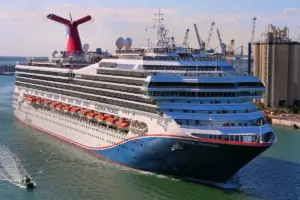
On Monday, August 31, 2026, the 3,690-guest Dream-class cruise ship Carnival Breeze experienced a minor marine allision while executing a docking maneuver in the popular Mexican port of Cozumel. Approaching its designated berth at approximately 9:00 a.m. local time, the vessel made physical contact with the corner of the concrete pier. The incident, captured by multiple witnesses on video and rapidly disseminated across social media networks, resulted in visible cosmetic damage to the ship’s starboard hull. Despite the visual severity of peeled paint and structural scraping above the waterline, the incident caused no operational disruptions, injuries, or hull compromises.
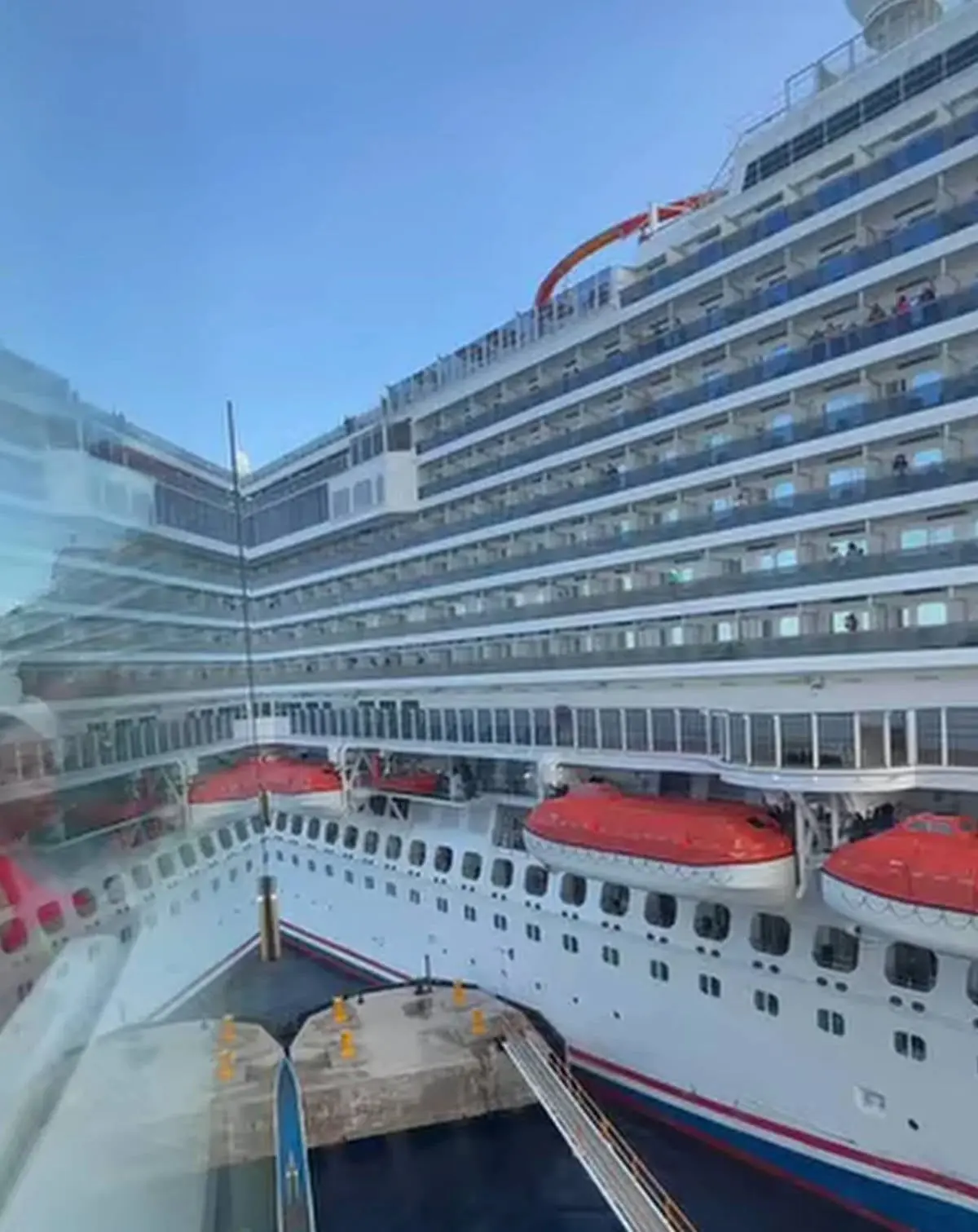
The ship was attempting to secure a berth adjacent to its fleetmate, the much larger Carnival Jubilee, which was scheduled to use the same pier infrastructure. While initial video analysis shows the vessel approaching at a sharp and potentially problematic entry angle, official confirmation regarding the root cause—whether attributed to local environmental forces, mechanical steering anomalies, or human error during navigation—remains under internal review by maritime authorities and the cruise line’s technical operators.
Remarkably, passengers aboard the ship reported feeling little to no impact during the allision, highlighting the dampening effects inherent to massive modern cruise vessels. Following a rapid inspection protocol standard for such occurrences, port and shipboard authorities cleared Carnival Breeze to continue its scheduled itinerary without delay. The vessel departed Cozumel at 5:00 p.m. that same evening, maintaining its course toward Progreso, Mexico, before returning to its homeport in Galveston, Texas. This incident joins a small historical catalog of routine pier-contact episodes across the global cruise industry, serving as a reminder of the complex hydrodynamics involved in berthing multi-thousand-ton floating metropolises.
Detailed Chronology of Events
The sequence of events unfolded during the first port call of a five-night Western Caribbean itinerary that had departed Galveston, Texas, just two days prior on Saturday, August 29, 2026. Following an uneventful Sunday at sea dedicated to passenger orientation, relaxation, and transit across the Gulf of Mexico, the Carnival Breeze approached the island of Cozumel on Monday morning under standard operating parameters.
1. The Approach and Approach Angle
At approximately 8:45 a.m., maritime tracking data and onboard visual markers indicated the vessel was positioning itself for standard stern-first or parallel docking procedures at the Cozumel cruise terminal. Eyewitness accounts and video footage recovered from the scene reveal that the Dream-class vessel approached the pier at an unusually steep angle. Navigating a cruise ship weighing over 130,000 gross tons requires precise calculations involving current velocity, windage, and momentum. The steep trajectory observed in user-submitted video footage likely compressed the margin of error available to the bridge team and local harbor pilots attempting to judge micro-distances between the hull and the immovable concrete pier infrastructure.
2. The Point of Impact
At approximately 9:00 a.m., the starboard side of the vessel near the forward accommodations brushed the corner of the concrete dock. A video uploaded to Facebook prominently captures a distinct, resonant metallic "bong" sound precisely at the 25-second mark as the hull meets the pier structure. The physical contact lasted only a matter of seconds as the vessel’s momentum carried it past the obstruction into its final, secured berth. Notably, there was no physical contact between Carnival Breeze and Carnival Jubilee, which was sharing or staging near the same multi-berth pier facility.
3. Immediate Onboard Reaction and Assessment
In stark contrast to dramatic imagery circulating online, life on board the vessel proceeded with minimal disruption. Passengers enjoying breakfast or gathering on outer decks near the forward and midship areas reported that the contact was virtually imperceptible. Several guests took to online forums, including Reddit, to confirm they felt no physical jolt or jarring motion that would typically signify a vessel collision.
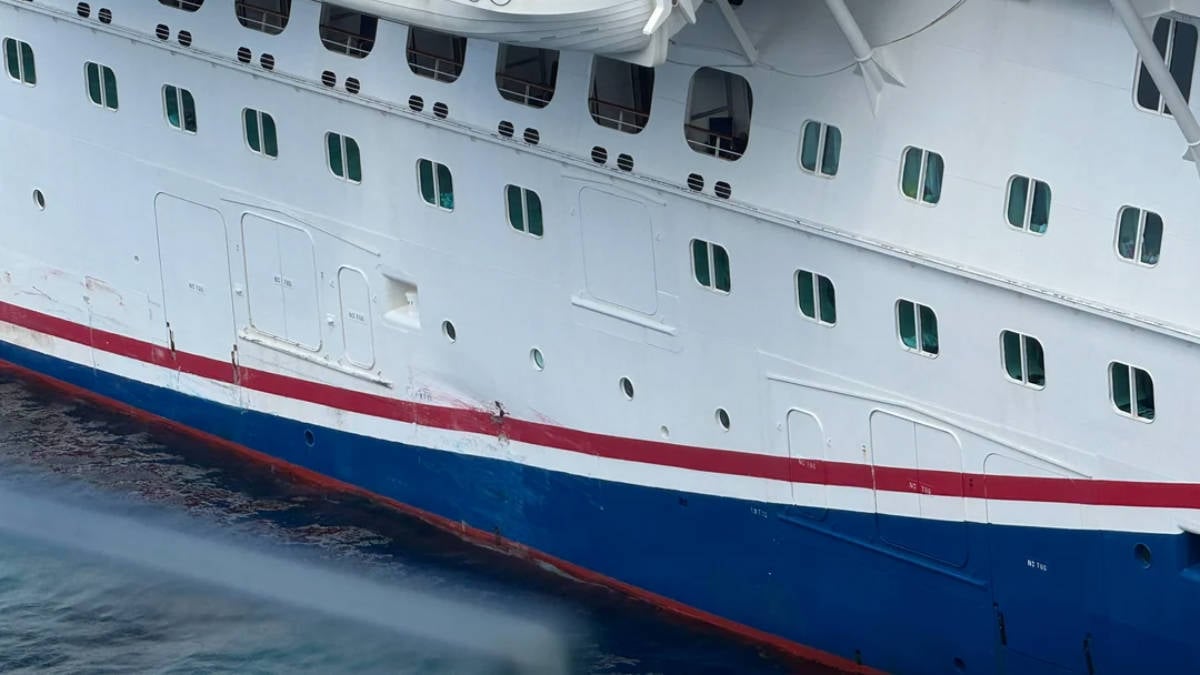
Immediately following the contact, shipboard marine engineers and safety officers initiated standard damage control and assessment protocols. Because the impact occurred high above the waterline—nestled between two sets of crew and passenger access doors—the risk of water ingress was negligible. Engineers inspected the internal bulkheads, structural frames, and immediate spaces adjacent to the scraped area to verify that the internal framing remained entirely uncompromised.
4. Departure and Itinerary Continuity
With structural integrity confirmed and no injuries reported among guests or crew members, port officials permitted the ship to remain alongside the pier for the duration of its scheduled call. Carnival Breeze maintained its planned departure time of 5:00 p.m., slipping lines and turning its bows away from Cozumel to execute the next phase of its voyage. Automatic Identification System (AIS) tracking verified that the ship navigated out of the harbor cleanly and adhered precisely to its published timetable.
Supporting Context, Specifications, and Technical Metrics
Understanding the mechanics of an allision of this nature requires an examination of the vessel’s physical specifications, the environmental constraints of port operations, and the technical safeguards implemented by modern cruise lines.
Vessel Profile: Carnival Breeze
- Class: Dream-class
- Gross Tonnage: Approx. 130,000 GT
- Passenger Capacity: 3,690 (double occupancy); maximum capacity exceeding 4,500 guests.
- Crew Complement: Approximately 1,386 international crew members.
- Builder: Fincantieri (Monfalcone, Italy)
- Inaugural Date: June 2012
As a Dream-class vessel, Carnival Breeze has a massive windage profile—the expanse of superstructure exposed to wind forces—making it particularly susceptible to sudden crosswinds during delicate low-speed maneuvers like docking. When massive vessels interact with stationary structures, even minor miscalculations in thrust vectoring via bow and stern thrusters can lead to localized friction events against pier fenders or concrete corners.
Itinerary Footprint
The voyage affected by the event follows a reliable, high-demand short-cruise schedule originating from the Port of Galveston:
- Saturday, August 29, 2026: Departure from Galveston, Texas.
- Sunday, August 30, 2026: Day at sea (Western Caribbean transit).
- Monday, August 31, 2026: Cozumel, Mexico (Scheduled arrival 9:00 a.m., departure 5:00 p.m.) — Incident Date.
- Tuesday, September 1, 2026: Progreso, Mexico (Scheduled arrival 9:00 a.m., departure 5:00 p.m.).
- Wednesday, September 2, 2026: Day at sea.
- Thursday, September 3, 2026: Return arrival to Galveston, Texas.
Progreso operations proceeded without operational adjustments, and preliminary assessments of the Cozumel pier structure indicated no major structural failures or hazards that would prohibit subsequent cruise ships from utilizing the facility.
Official Statements and Industry Response
As is standard operating procedure for major corporate entities navigating unexpected public relations hurdles, official communication channels are subjected to rigorous internal verification before release.
Carnival Cruise Line Response
At the time of publication, Cruise Hive and other leading maritime news outlets reached out to Carnival Cruise Line’s corporate communications department for an official statement detailing the exact nature of the mechanical or environmental factors contributing to the allision. While a comprehensive formal corporate press release was not immediately issued, representatives speaking off the record or through localized port updates emphasized that guest safety was never compromised.
Because the damage was categorized strictly as cosmetic—confined to chipped paint, superficial steel scraping, and rubber-transfer marks from pier fenders—the line opted to manage the technical assessments internally through its shoreside marine operations teams and classification societies (such as Lloyd’s Register or RINA, which oversee Carnival’s fleet safety certifications).
Passenger and Public Reactions
The proliferation of smartphone technology and ubiquitous mobile internet connectivity ensures that virtually any operational mishap aboard a cruise ship is documented within seconds. Videos uploaded to platforms such as Facebook and discussions on Reddit drove significant public engagement.
Public sentiment was largely pragmatic. Unlike catastrophic groundings or engine room fires, experienced cruisers recognized that hull scrapes against piers are an occupational hazard of navigating multi-story floating cities into confined concrete berths. Comments across social media forums highlighted relief that no injuries occurred and expressed admiration for the resilience of modern shipboard steel construction.
Comparative Industry Incidents and Historical Context
While passengers may view a pier contact as an alarming anomaly, maritime historians and safety inspectors classify such events as low-velocity allisions. Unlike a collision (which involves two moving vessels), an allision occurs when a moving ship strikes a stationary object, such as a pier, navigational buoy, or docked vessel.
Environmental variables—including sudden microbursts, localized tidal currents, rogue swells, and crosswinds—frequently test the limits of even the most sophisticated Azipod propulsion systems and traditional rudder-and-propeller configurations.
To contextualize the Carnival Breeze event, a review of similar modern cruise ship pier allisions illustrates that such incidents are rare but recur periodically across various global ports:
- September 5, 2025: Miray Cruises’ MV Gemini suffered significant structural damage while attempting to dock in the historic port of Piraeus, Greece, requiring extended structural remediation.
- February 6, 2024: The Dream-class sister ship Carnival Magic encountered severe high-wind conditions while maneuvering in Ocho Rios, Jamaica, resulting in structural contact with the pier and leaving a small contingent of guests ashore temporarily.
- May 26, 2022: Royal Caribbean’s mega-class vessel Harmony of the Seas crashed into the docking infrastructure in Falmouth, Jamaica. Subsequent investigations confirmed the incident was primarily caused by pilot error amidst shifting local currents.
- December 2020: Norwegian Cruise Line’s Norwegian Escape collided with a concrete pier in Civitavecchia, Italy, sustaining localized bow damage during adverse weather conditions.
- August 2018: Carnival Horizon made contact with Pier 90 in Manhattan, New York, during heavy harbor traffic and wind gusts, sustaining minor structural scrapes.
- September 2017: Disney Cruise Line’s Disney Dream impacted the pier structure in Nassau, Bahamas, during tropical weather disturbances, resulting in minor cosmetic hull repairs.
In every historical instance listed above, standard maritime protocol dictated that classification societies inspect the damaged areas before granting a Certificate of Fitness to resume passenger operations. The protocol applied to Carnival Breeze follows this exact time-tested blueprint.
Future Outlook and Operational Implications
The Carnival Breeze Cozumel allision serves as a minor footnote in an otherwise robust operational history for Carnival Cruise Line’s Dream-class fleet. However, incidents of this nature inevitably prompt internal reviews within corporate marine operations and training academies.
1. Bridge Resource Management (BRM) and Port Pilots
Modern cruise ships rely heavily on Bridge Resource Management training, where captains, staff captains, bridge officers, and local harbor pilots collaborate to share navigational responsibilities. When an approach vector appears overly steep, as witnessed in the Cozumel footage, post-incident investigations focus intensely on communication clarity, bridge teamwork, and environmental data integration. Simulator training sessions often incorporate real-world anomalies like the Cozumel approach to refine algorithmic predictive models for wind and current drift.
2. Hull Maintenance and Dry-Dock Scheduling
While the cosmetic damage to the starboard hull does not threaten the structural integrity of the vessel, the aesthetic blemish requires remediation. Cruise lines typically address exterior paint loss and scraping during scheduled dry-dock intervals, where hulls are sandblasted, primed, and repainted with antifouling coatings. Depending on the severity of the indentation (if any exists beneath the paint layer), temporary touch-ups performed by riding crews during sea days may suffice until the vessel’s next major regulatory dry-dock overhaul.
3. Port Infrastructure Resilience
As cruise ships continue to increase in physical scale—with new classes pushing past 180,000 to 250,000 gross tons—port authorities worldwide face mounting pressure to upgrade pier fendering systems, mooring dolphins, and turning basins. The Cozumel terminal incident highlights the ongoing engineering challenge of accommodating massive modern vessels within historic or constrained island harbor layouts. Fortunately, because neither the Cozumel pier nor the Carnival Breeze sustained critical structural failures, standard schedules for subsequent cruise arrivals remain completely unaffected.
As Carnival Breeze completes the remainder of its Western Caribbean voyage and returns safely to Galveston, the incident will pass into the archives of routine maritime administrative reviews—a testament to the resilience of modern ship design, the effectiveness of standardized safety protocols, and the reality that navigating the world’s oceans always carries a degree of unpredictable natural challenge.