







Executive Overview
In the face of intensifying climate change impacts, rising sea levels, and increasingly volatile winter storm patterns, coastal municipalities across the British Isles are forced to radically rethink their infrastructure resilience strategies. Nowhere is this more pressing than along the exposed shorelines of North Wales, where communities have long battled the encroaching forces of the Irish Sea.
Addressing this critical vulnerability head-on, prominent civil engineering firm Jones Bros Civil Engineering UK has officially completed the comprehensive Kinmel Bay coastal defense project. Appointed as the Principal Contractor by the Conwy County Borough Council, Jones Bros spearheaded a massive shoreside enhancement initiative designed to safeguard more than 2,000 residential and commercial properties situated between Towyn and Kinmel Bay.
Valued as a vital regional infrastructure undertaking, the project seamlessly combines heavy engineering prowess with environmental sensitivity and local economic support. By reinforcing aging revetments, elevating critical stretches of the seawall, upgrading public access points, and integrating modern floodgate systems, the scheme significantly reduces the threat of catastrophic tidal inundation. Furthermore, the project underscores a growing industry standard: prioritizing sustainable supply chains by procuring the vast majority of its heavy construction materials from quarries within North Wales.
This in-depth report explores the mechanics of the Kinmel Bay intervention, detailing the engineering milestones achieved, the logistical triumphs of sourcing tens of thousands of tons of rock armor, and the broader socioeconomic impacts of fortifying one of Wales’ most vulnerable coastal stretches.
Detailed Chronology and Engineering Scope
Planning, executing, and finalizing a coastal defense project of this magnitude requires a meticulously staged sequence of civil engineering operations. Operating in a dynamic intertidal zone introduces constant variables—from tidal windows and unpredictable weather fronts to the necessity of maintaining public access during peak tourism seasons.
Phase One: Material Procurement and Quarry Logistics
The foundation of the Kinmel Bay defense scheme rested on robust shore protection infrastructure, specifically heavy-duty rock armor designed to dissipate wave energy before it can breach landward assets. Under the direction of Jones Bros Project Manager Sam Roberts, the engineering team initiated the procurement phase, targeting roughly 66,500 tons of high-grade rock armor.
Rather than relying on imported materials that carry a heavy carbon footprint through long-distance maritime or road haulage, Jones Bros leveraged its regional footprint. By partnering with five local quarries across North Wales, the contractor successfully sourced 96% of the required rock armor locally. This strategy not only minimized transport emissions and curbed supply chain vulnerabilities but also pumped vital capital directly back into the regional economy.

Phase Two: Seawall Elevation and Floodgate Replacement
With the heavy rock armor staged, engineering crews turned their attention to the structural backbone of the coastal defense line: the concrete seawall spanning the Towyn and Kinmel Bay frontage. Over decades of service, changing sea level projections dictated that the existing crest heights were no longer adequate to prevent overtopping during severe storm surges.
Crews systematically raised 2 kilometers of existing seawall by 560 to 750 millimeters. This deceptively simple vertical extension acts as a critical hydraulic barrier, preventing wind-driven waves from spilling over into low-lying residential neighborhoods and commercial zones.
In tandem with the seawall elevation, the project team tackled vulnerable points in the perimeter by replacing two major floodgates. These mechanical barriers are essential for managing tidal access points, allowing authorities to seal off potential ingress pathways during red-alert weather warnings without permanently cutting off visual and physical connections to the waterfront.
Phase Three: Revetment Reinforcement and Wave Energy Dissipation
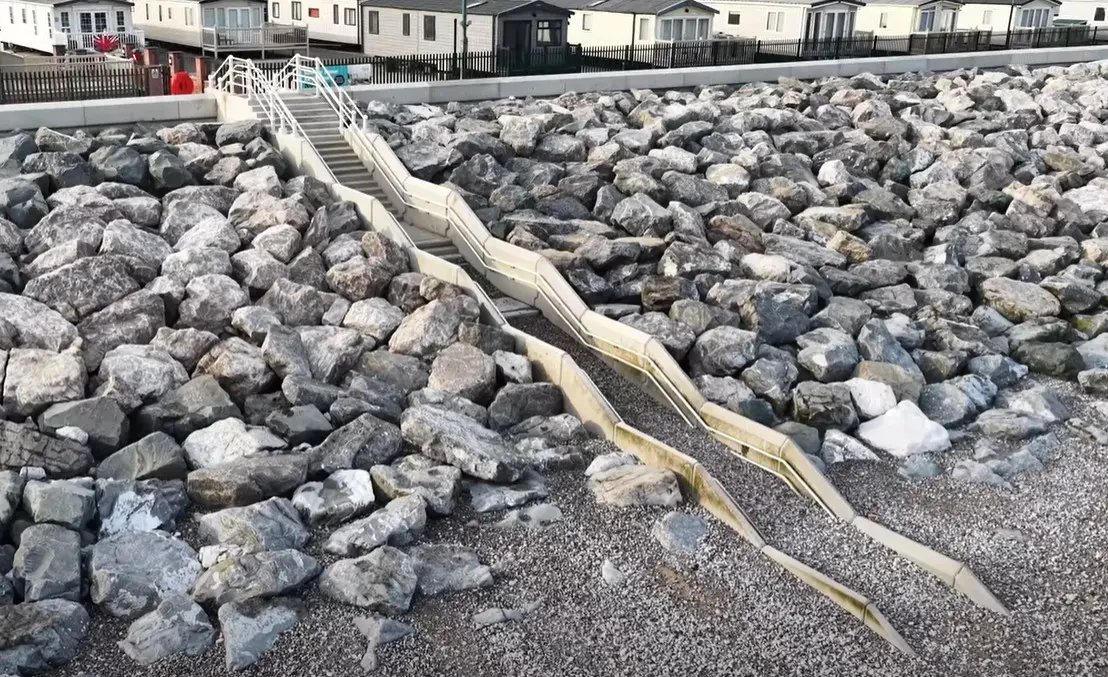
Beyond the vertical concrete defenses, the sloping shore protection revetments required substantial bolstering. The placement of the 66,500 tons of locally quarried rock armor was executed with surgical precision using heavy plant machinery operated by Jones Bros’ specialized marine and civil teams.
Engineers arranged the boulders in interlocking configurations designed to absorb, scatter, and reflect incoming wave energy. By breaking up the kinetic force of storm-driven swells before they impact the base of the seawall, the risk of structural undermining and catastrophic toe erosion is drastically mitigated.
Phase Four: Public Realm Enhancements and Amenity Upgrades
While flood mitigation remained the primary driver of the initiative, Conwy County Borough Council and Jones Bros recognized the importance of maintaining and enhancing the coastline as a community and recreational asset. Coastal defense projects often risk creating imposing, unfriendly barriers between towns and their beaches; the Kinmel Bay scheme actively worked against this pitfall.
The project successfully delivered eight new stepped or ramped access points to the beach, ensuring that residents of all mobility levels can safely traverse the newly reinforced revetments. Additionally, the public realm received a thorough refresh through the installation of contemporary street furniture.
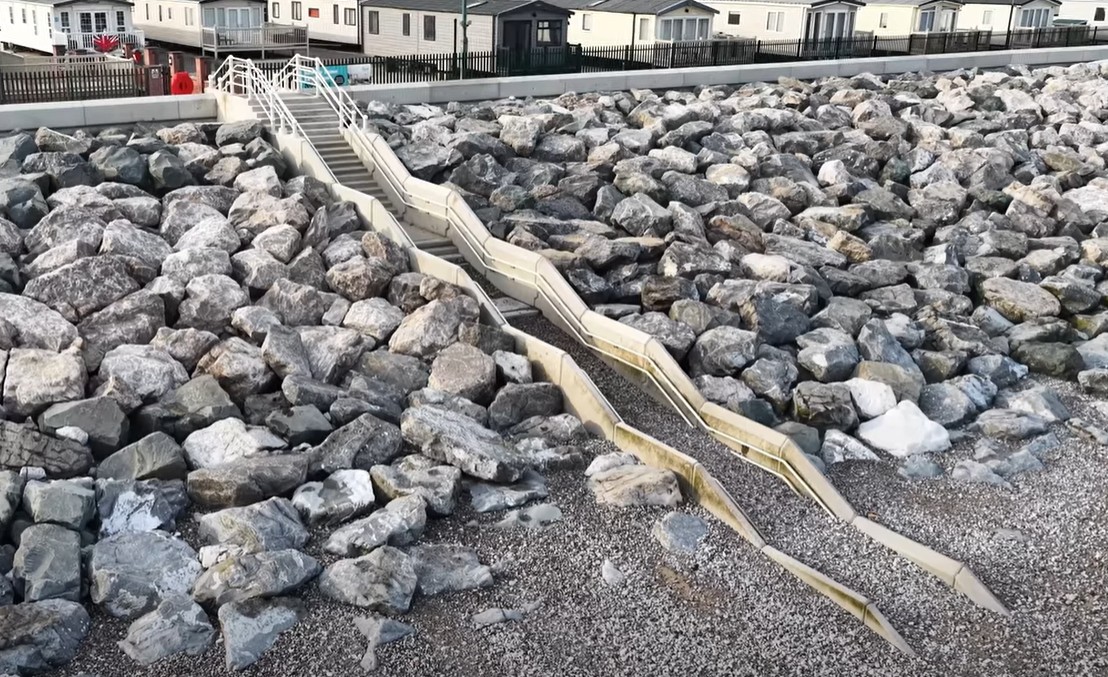
Infrastructure upgrades also extended to logistical nodes supporting beachgoers and locals alike. The bustling St Asaph Avenue car park underwent a comprehensive modernization, accompanied by the revitalization of two distinct mini-parklets. These integrated civil improvements ensured that the completion of the heavy engineering phase left behind a clean, accessible, and aesthetically pleasing coastal environment.
Supporting Context & Metrics
To fully grasp the scope of the Kinmel Bay coastal defense project, it is essential to analyze the numbers, economic dynamics, and corporate history driving the operation.
Key Project Metrics at a Glance
- Client: Conwy County Borough Council
- Principal Contractor: Jones Bros Civil Engineering UK
- Project Manager: Sam Roberts
- Workforce Peak: Up to 60 specialized civil engineering and heavy plant personnel on-site
- Properties Protected: More than 2,000 residential and commercial properties
- Rock Armor Deployed: Approximately 66,500 tons
- Local Sourcing Rate: 96% of rock armor procured from five regional North Wales quarries
- Seawall Upgraded: 2 kilometers of barrier raised by 560mm to 750mm
- Access Improvements: 8 new stepped/ramped beach access points constructed
- Additional Infrastructure: 2 floodgates replaced, St Asaph Avenue car park upgraded, and 2 mini-parklets built
The Contractor: A Regional Powerhouse with National Reach
Founded in the 1950s, Jones Bros Civil Engineering UK has grown from its humble Welsh roots into one of the most respected and capable civil engineering firms in the United Kingdom. Headquartered in North Wales, the company has built an enviable reputation across multiple sectors, including renewable energy (such as wind farm infrastructure), waste management, marine works, and heavy highways.
A key differentiator for Jones Bros is its ownership and maintenance of one of the largest plant fleets in the UK. By maintaining control over its heavy machinery—excavators, dump trucks, cranes, and specialized rock-handling equipment—the company reduces reliance on third-party equipment hire, ensuring tighter scheduling, higher safety standards, and greater operational efficiency on complex sites like Kinmel Bay.
With an active workforce of approximately 550 employees, Jones Bros remains deeply committed to local employment and apprenticeship programs, ensuring that major regional infrastructure investments translate directly into long-term career pathways for Welsh engineers and construction specialists.
Official Statements and Industry Perspective
Reflecting on the successful culmination of the multi-month engineering effort, project leadership emphasized the collaborative ethos that defined the undertaking from day one.
Sam Roberts, Project Manager for Jones Bros, shared his pride in steering the development through to completion:
"It’s been fantastic to work alongside Conwy County Borough Council to deliver such an important scheme, one that will no doubt help preserve the existing infrastructure from flooding and storm damage.
As a North Wales-headquartered civil engineering firm, it’s brilliant to procure the rock armor required from five quarries in the region and use local suppliers where possible. This project represents a win-win: state-of-the-art protection for local families and businesses, achieved while keeping our carbon footprint low and supporting our local supply chain partners."
Local authorities have similarly praised the partnership, noting that the completion of the Kinmel Bay and Towyn defense line represents a critical milestone in Conwy’s long-term climate adaptation strategy. As local weather patterns grow increasingly unpredictable, municipal planners are under mounting pressure to future-proof coastal assets against compound flooding risks—events driven by high spring tides coinciding with severe low-pressure storm systems.
Future Outlook: Coastal Resilience in a Changing Climate
The completion of the Kinmel Bay coastal defense project arrives at a critical juncture for European infrastructure. Across the coastline of the UK and wider Eurasia, local governments are grappling with the harsh realities of accelerating sea-level rise. Traditional "hard" engineering approaches are increasingly being scrutinized for their environmental impact, leading to hybrid models that combine heavy structural defenses with ecological enhancement and sustainable material sourcing.
By prioritizing local quarrying, Jones Bros and Conwy County Borough Council have demonstrated that major heavy civil works can be executed with a conscious eye toward sustainability. Furthermore, the structural lifespan of the upgraded seawall and the 66,500-ton rock revetment is projected to shield the region for decades to come, providing the psychological and economic peace of mind necessary for local businesses to invest, expand, and thrive.
As climate projections continue to evolve, the methodologies deployed at Kinmel Bay—combining rigorous structural elevation, strategic wave-energy dissipation through local rock armor, and integrated public realm enhancements—will undoubtedly serve as a blueprint for future coastal defense initiatives across the British Isles and beyond.