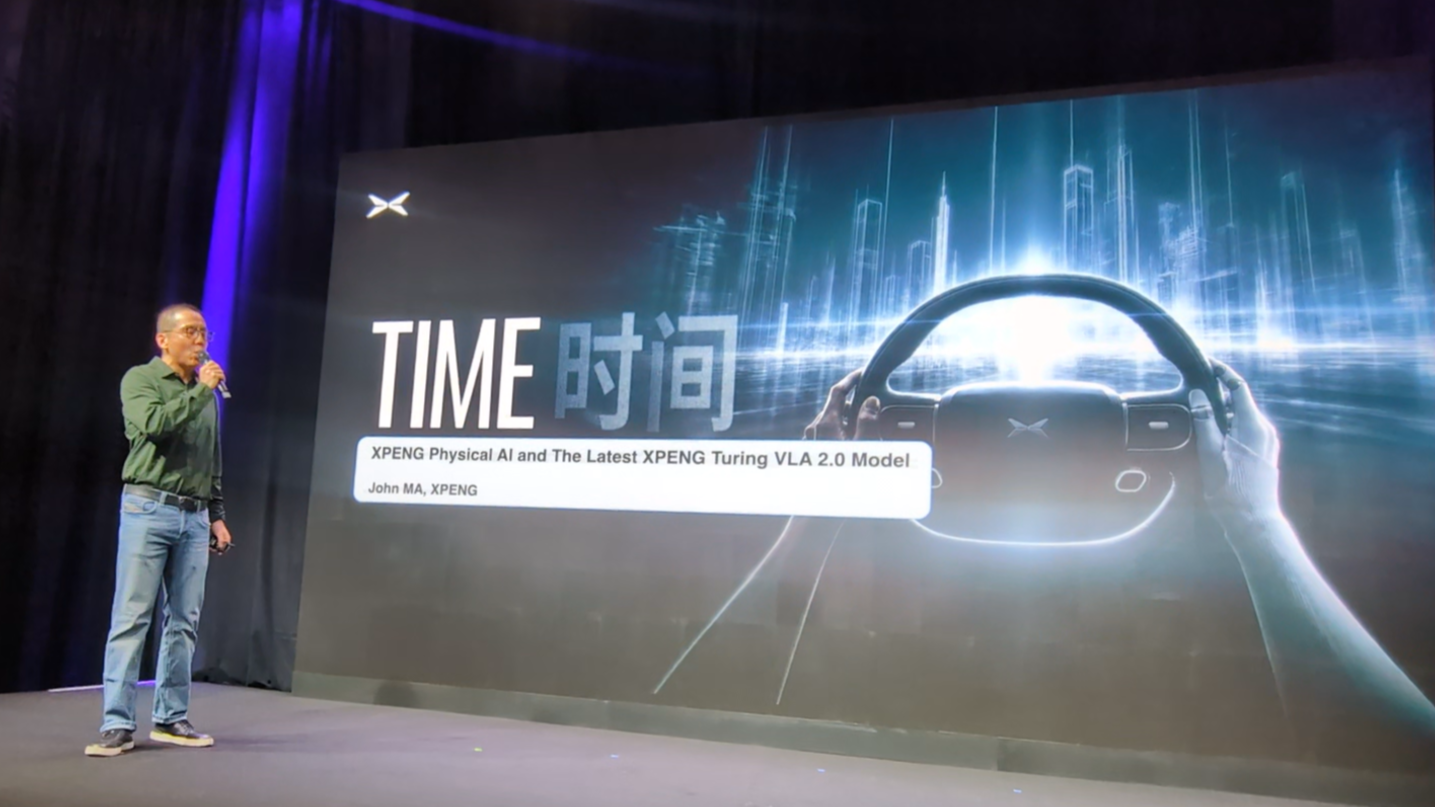
At IFA Berlin, amidst a sea of consumer electronics and routine smart-home appliances, XPENG emerged as a distinct technical powerhouse. Rather than simply leaning on artificial intelligence as a trendy marketing buzzword, the company delivered a masterclass in applied engineering. Dr. John MA, XPENG’s Senior Director and Head of ADAS & Smart Cabin Overseas Delivery, stepped onto the keynote stage to dissect the realities of Physical AI. His presentation unveiled the inner mechanics of XPENG’s latest VLA 2.0 Turing model—a proprietary stack designed to bridge the gap between abstract computing and real-world execution.
For European consumers and industry watchers alike, XPENG’s showcase signaled a pivotal shift: advanced autonomous driving and physical robotics are no longer theoretical concepts confined to research laboratories or restricted testing grounds. They are rapidly transitioning into commercial reality. By pairing industry-leading onboard processing power with strict energy-efficiency constraints and localized regulatory compliance, XPENG is positioning itself at the vanguard of the global mobility transition. This report explores the technical architecture of VLA 2.0, details exclusive insights from an interview with Dr. MA, and examines the broader implications of XPENG’s expanding ecosystem—spanning intelligent vehicles, humanoid robotics, and aerial mobility.
Detailed Chronology & Technical Architecture: The Evolution of VLA 2.0
To understand the leap XPENG has made, one must examine the physical constraints that govern real-world artificial intelligence. During his keynote, Dr. MA emphasized that deploying AI in a physical environment differs vastly from running server-side large language models. Onboard automotive computers must operate under strict power envelopes to prevent vehicle range degradation, while maintaining hyper-low latency to guarantee safety. In autonomous driving, milliseconds dictate the difference between a smooth trajectory and a collision.
Overcoming Physical Constraints Through Temporal AI
The most significant breakthrough in the recent VLA 2.0 (version 6.3.0) software update is its integration of time into onboard decision-making. Traditional autonomous driving models often react strictly to immediate sensory inputs. XPENG’s architecture, however, processes history, present reality, and future projection simultaneously.
Infini-VLA: This system anchors onboard decision-making in a temporal context. By digesting up to 30 seconds of historical environmental data, the vehicle gains a comprehensive understanding of past trajectories without overwhelming onboard computing resources.
Streaming Inference: Building directly upon historical datasets, Streaming Inference anticipates upcoming environmental changes, boosting the model’s reactive response time by an impressive 300%.
X-Foresight: Looking further down the timeline, X-Foresight predicts scenarios up to 6 seconds into the future, dynamically throttling its data consumption to preserve processing efficiency.
Flow Matching: Once future trajectories are mapped, Flow Matching synthesizes multiple potential navigation solutions, instantly selecting and executing the safest, most efficient path.
These technologies are not mere blueprints; they are actively operating in fleet deployment. XPENG’s commercial Robotaxi fleet is already navigating the complex urban landscape of Guangzhou, China, with plans for a broader geographical expansion slated for the coming year. While the presentation at IFA Berlin was intentionally tailored for a broader European audience—distilling dense engineering equations into accessible concepts—the underlying computational muscle remained unchanged.
Supporting Context & Metrics: XPENG’s Global Footprint and On-Floor Reception
XPENG’s rapid maturation is mirrored in its corporate structure and engineering investments. The company now employs over 31,600 personnel globally, with an extraordinary 44.79% dedicated entirely to Research and Development (R&D). This heavy emphasis on engineering talent explains the rapid deployment cycle of features that competitors often take years to commercialize.
Inside the XPENG IFA Berlin Booth
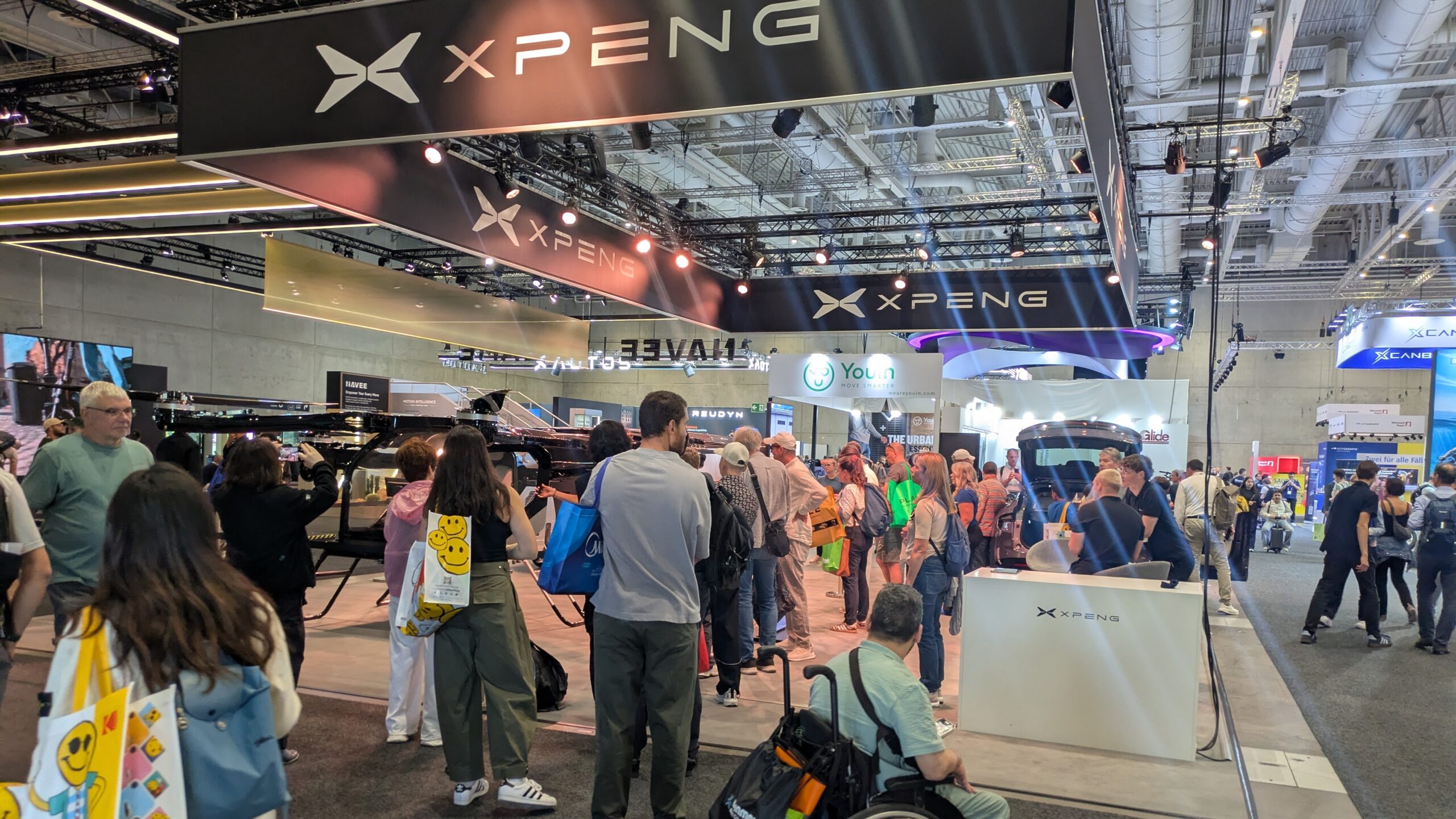
Away from the keynote hall, XPENG’s physical exhibition booth served as a bustling microcosm of future mobility. Three primary exhibits captured public and media attention:
The IRON Humanoid Robot: Drawing continuous crowds and frequent photo-ops, the IRON robot showcased XPENG’s cross-industry ambitions. Attendees were consistently surprised to learn that the foundational AI driving the robot shares its core architecture with the company’s vehicles.
The Flying Car: Many visitors initially dismissed XPENG’s on-display flying vehicle as an unachievable futuristic design exercise. Booth personnel repeatedly clarified that production lines are scaling up this year as the company actively pursues formal regulatory airworthiness approvals.
The L03 Intelligent Vehicle: Having previously made waves at its Munich debut, the L03 drew intense scrutiny from European consumers. Observers frequently praised its remarkably spacious cabin and premium material finish. During impromptu demonstrations, visitors connected personal devices to the vehicle’s audio system, noting that the sound reproduction remained crisp, distortion-free, and full-range even at high volumes. Several attendees expressed genuine disbelief upon learning the vehicle’s actual price point, mistakenly assuming its power-operated features and acoustic performance belonged to a far more expensive luxury tier.
European deliveries for the L03 are slated to ramp up shortly. Industry analysts anticipate that consumer reception will surge even further once the VLA 2.0 intelligent driving system receives local regulatory sign-off, unlocking advanced autonomous features early next year.
Official Statements & Exclusive Insights: An Interview with Dr. John MA
Following his keynote presentation, Dr. John MA sat down for an exclusive conversation to discuss the deployment strategy of VLA 2.0, multilingual voice architecture, and the convergence of vehicular and robotic AI.
Scaling VLA 2.0 Across Hardware Tiers
XPENG’s flagship "Ultra" configuration utilizes three in-house developed Turing chips, with a fourth dedicated chip ensuring hardware redundancy in their Robotaxi lineup. However, the company is preparing to scale the software down to single-chip architectures and legacy dual-Orin hardware. When asked how users will experience the "distilled" single-chip variant compared to the ultra-powerful multi-chip setup, Dr. MA emphasized that safety remains non-negotiable:
"We just did some public trials of our single Turing chipset machine, and Orin execution is still under development. I would not like to say that we want to do something for the experience. We still think that at least for safety. That must be guaranteed. There’s no safety issue. And for the smoothness, maybe some slight difference, because the computing power has some physical constraints, even though we try to distill the best part of the model to some small-size model. But still, it may have some slight differences in some scenarios. I don’t know for sure; we have not gotten the formal release to all the passengers. We are also gathering feedback. If we saw some cases or some scenarios are not good enough, maybe we will make it some OTA update, something like that. So, I don’t know for sure, but in theory, we do not want to lose anything. We will try our best to make sure that it can be something comparable with our Ultra machine… But there must be some slight difference. So, by our current approach, we are also gathering feedback from customers."
Multilingual Natural Language Processing
The 6.3.0 update also introduced "Master Agent" voice control, enabling conversational, context-aware command of complex vehicle operations. Addressing how this natively local Large Language Model (LLM) scales globally across diverse linguistic regions, Dr. MA noted:
"With our Turing chipset, as you mentioned, it’s about the 3rd chipset. We use it for some voice control and audio interactions. It’s still based on our foundation model, and it’s a large language model itself, which means that it’s very natural. It can learn something about language. So, we have supported multiple languages, including not only English, but also Mandarin and Cantonese. And also including some other foreign languages: French, German, and maybe some others—Spanish, Italian… But I think that there’ll be some news released during the Paris Car Show, and maybe we have some demos on that. So, stay tuned."
Onboard Privacy vs. Centralized Cloud
Unlike competitors reliant on massive centralized data farms and intensive human-in-the-loop data labeling, XPENG performs the vast majority of its heavy AI computing directly onboard the vehicle. This design choice inherently safeguards user data privacy, effortlessly satisfying strict European regulatory frameworks like GDPR. When questioned about the broader implications of embedding high-capacity AI processing inside consumer hardware, Dr. MA explained the philosophical underpinnings of their architecture:
"Yes, exactly. So that’s the beauty of our technology. We use the VLA 2.0 architecture, which means everything in the physical world with vision, language and actions… That’s why also we use this model as the base model or foundation model of our humanoid robots and also our flying cars. So, I think it does have a good potential to be derived into different applications, not only the vehicles, not only the robots, maybe anything could happen. I’m still asking. So maybe we can figure something out in the future.
But for now, the key thing is that we can make very good quality for the European market. Very, very mature delivery to our customers and to pass homologation and to tune our models to be more adapted to European traffic and traffic laws and user habits… We have overseas development. We have one big mission, which is to embrace the different markets and adapt to the local market."
Future Outlook: The Convergence of Vehicles, Robots, and AI Agents
As the interview concluded, Dr. MA outlined XPENG’s ultimate vision for Physical AI—one that extends far beyond individual vehicle sales. By uniting autonomous cars, flying vehicles, and humanoid robotics under a single foundational model architecture, XPENG is designing a closed-loop ecosystem.
Envisioning the next evolutionary phase of consumer utility, Dr. MA offered a compelling glimpse into the future:
"If we only limit our AI to vehicles, it will be very narrow. So, another application is humanoid robots. Humanoid robots are our very central product. And the humanoid has recently got investment, independent investment…
So, I think that for me that for what’s next, I will check that we can do what we can do for the humanoid robots, but we can combine those physical AI devices together… The robots can be onboard the vehicles and do things for the customers. For example, you want to buy something. Previously, you have to go out and drive your vehicle and buy something. For now, maybe you can ask your vehicle to drive itself. But still need some delivery and ask your robot to step out from your vehicle to the supermarket and get the bag and can return to the vehicle and the vehicle drives back…
Which means it’s closed loop. For example, you can use the Xiaopeng App in our device. We can make an XPENG Agent. We can ask the agent to be more than current digital agents. It’s a new physical agent. It’ll be fantastic."
Conclusion
XPENG’s presence at IFA Berlin underscored a maturing technological roadmap. By rigorously solving the physics of onboard edge-computing, prioritizing local data privacy, and aggressively scaling a unified AI model across cars, robots, and aerial platforms, the company is transcending its identity as a traditional automaker. As European deliveries of models like the L03 accelerate and regulatory approvals for VLA 2.0 approach, XPENG is well-positioned to redefine what consumers expect from intelligent physical hardware. The future of mobility, it appears, is not just electric—it is autonomous, localized, and profoundly physical.