The Open Sea Class of the Monaco Energy Boat Challenge stands as the ultimate crucible for the global electric boat industry. Unlike traditional marine exhibitions—where pristine vessels sit docked for static viewing by the buying public—the waters off Monaco’s storied coastline transform into a dynamic, high-stakes proving ground. Here, industry pioneers do not merely display concepts; they push cutting-edge electric propulsion, battery chemistries, and hull designs to their absolute structural and thermal limits.
The 2026 edition of the Challenge delivered an extraordinary narrative of technical evolution, tactical seamanship, and relentless endurance. While the podium winners in the event’s two marquee races—the Yacht Club de Monaco (YCM) Speed Record and the grueling 16 Nautical Mile (NM) Open Sea Speed Race—mirrored the victors of the previous year, the underlying engineering realities shifted dramatically.
In a testament to rapid iteration, both winning teams secured their titles using entirely new vessel configurations compared to their 2025 campaigns. Frauscher × Porsche captured the glamorous straightaway speed crown with a lighter, shorter variant of their evolutionary platform, while the high-performance outboard specialist Explomar—racing in close partnership with X-Tenders and XNRG—successfully defended its open-sea crown. This time, Explomar achieved victory aboard a significantly heavier and longer carbon-fiber platform, proving that real-world endurance requires a delicate balance of raw mechanical robustness, advanced thermal management, and strategic tactical deployment.
Day One: The YCM Speed Record and the "Washing Machine" Warm-Up
The competitive weekend opened with the YCM Speed Record, a high-octane, one-kilometer straightaway sprint stretching along the picturesque Monaco coastline, directly east of the prestigious Yacht Club. While shorter in duration, this event is visually and mechanically dramatic, prioritizing peak acceleration, hydrodynamic efficiency, and instantaneous power delivery.
On the opening day, the Frauscher × Porsche collaboration dominated the straightaway. Piloting a refined iteration of their electric vessel lineup—lighter and more compact than the previous year’s Fantom 850 Air—the Frauscher × Porsche Specter 797 blazed across the one-kilometer course in a breathtaking 38.2 seconds. This performance established a blistering new speed record of 51.05 knots (84.95 km/h or 52.16 mph).
Hot on their heels was the XNRG-Explomar team, whose high-performance RIB (Rigid Inflatable Boat) secured a commendable second place. However, the coastal waters were already signaling trouble for the days ahead. A combination of pre-race meteorological shifts and building swells created choppy, unpredictable cross-wakes near the shore, offering a subtle forewarning of the punishing conditions awaiting the fleet in the open sea.
Day Two: Surviving the 16 Nautical Mile Open Sea Endurance Race
If the straightaway sprint is a drag race, the 16 Nautical Mile Speed Race from Monaco to Ventimiglia, Italy, and back is a punishing cross-country rally. Designed to test both maximum speed and long-term autonomy in open water, the endurance race quickly transformed into a survival test against Mother Nature.
Competitors encountered severe Force 4 winds, generating sustained winds of 13.9 to 20.7 knots alongside chaotic 1-to-2-meter waves. For marine architects and propulsion engineers, these conditions present a worst-case scenario. The severe pitching and heaving motions of the hulls cause repetitive propeller ventilation—where the propeller completely exits the water—followed by violent re-immersion. This creates instantaneous load fluctuations that can shatter drive shafts, destabilize inverter systems, and push battery thermal management systems into thermal runaway.
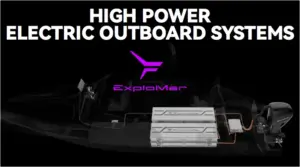
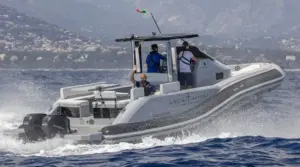
Despite these harrowing conditions, the XNRG 8.3-meter carbon-fiber RIB—powered by the ExploMar WAVE 300+ electric outboard system—mastered the chaos. Piloted expertly by XNRG’s Gerben Boomsma, the vessel crossed the finish line in an astonishing 35 minutes and 24 seconds. In doing so, it successfully defended its title, defeating the second-place Frauscher × Porsche Specter 797 by a remarkable margin of nearly nine minutes.
Supporting Context & Metrics: Engineering for the Elements
The triumph of the XNRG-Explomar entry was no accident of luck; it was the direct result of rigorous data analytics gathered during the 2025 championship campaign. Armed with telemetry from the previous year, ExploMar’s engineering team collaborated closely with Boomsma to micro-tune the WAVE 300+ propulsion package specifically for the hostile Force 4 environment.
Overcoming Hydrodynamic and Thermal Hurdles
When a boat’s propeller repeatedly ventilates and re-enters the water, the electric motor experiences violent torque spikes. ExploMar engineers recalibrated their proprietary torque-control software to actively suppress these oscillations, safeguarding the drivetrain against mechanical fatigue. Simultaneously, the battery management system’s thermal algorithms were overhauled. By refining cooling loops and load distribution, the system successfully maintained peak operating efficiency despite the erratic energy draws demanded by the heavy seas.
The telemetry data tell a remarkable story of efficiency under duress:
Average Speed: The XNRG 8.3 maintained a blistering average speed of 27 knots across the entire 16-nautical-mile course.
Energy Reserves: Despite the heavy sea state requiring aggressive throttle modulation, the boat crossed the finish line with 40% of its battery capacity still untouched.
Thermal Integrity: Throughout the sustained high-load operation, maximum battery temperatures remained strictly below 45°C, proving that advanced marine lithium-ion systems can handle extreme endurance tasks without overheating.
Tactical Seamanship: Winning the Strategic Battle
Beyond hardware capabilities, the race was decided by veteran watercraft tactics. Reflecting on the brutal conditions, Gerben Boomsma described the course near the shoreline stone walls as a "washing machine."
"It was a little bumpy for sure," said Boomsma. "A lot rougher than last year… In front of the stone walls on the shore where all the waves are coming back, there are random peaks and cross-wakes all around you; the pilots call it ‘the washing machine’ when conditions are like this."
Rather than burning energy fighting every peak at the start, Boomsma exercised seasoned patience. "We held back a bit at the beginning when everyone took off to look at what was happening and how the boats were behaving in the waves. We were together with Frauscher-Porsche and Vita at the first buoy and we were the first ones turning at the Ventimiglia buoy, but then we decided to take a bit of a different route, running almost half-wind for more comfort. We had to travel a bit more distance, but that gave us a steadier speed, and that was basically where we pulled ahead."
The Broader Fleet: Showcasing Explomar’s Diverse Ecosystem
While the XNRG 8.3 took top honors in the headline endurance race, the Monaco Energy Boat Challenge served as a comprehensive product showcase for Explomar’s entire scalable ecosystem. Four distinct vessels utilized Explomar technology, proving the modularity of the company’s electric outboard architecture across various hull lengths and displacement weights.
Tokarex & Gala Atlantis A500: Polish distributor Tokarex debuted their first commercially available all-electric offering for the consumer market—a Gala Atlantis A500 Cruising RIB paired with the compact Explomar WAVE 70+. Despite its modest footprint, the agile craft achieved a respectable 20 knots, proving that accessible electric leisure boating is ready for the mainstream.
Yacht Technik & ZAR Formenti: German full-service marina and brokerage firm Yacht Technik married the Explomar WAVE 150 system to a 6.5-meter (21-foot) RIB from renowned Italian builder ZAR Formenti. This configuration punched well above its weight, recording an impressive average speed of 26.06 knots.
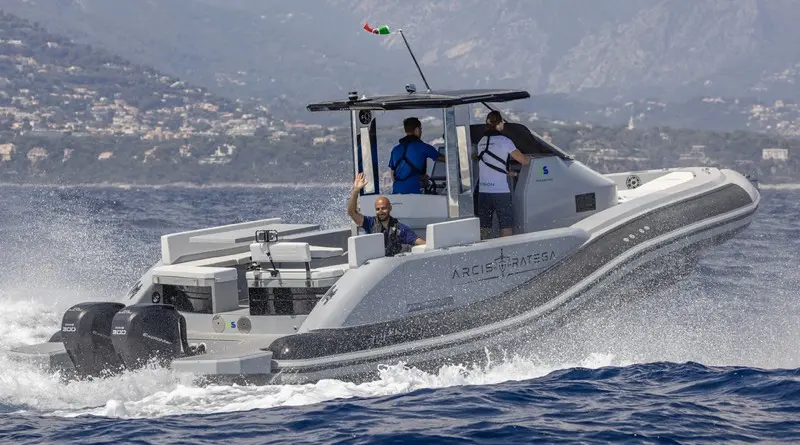
AS Labruna’s Arcistratega: Perhaps the most technologically ambitious vessel in the fleet was the Arcistratega, presented by AS Labruna. Developed on a Python 33 platform, this 10-meter (33-foot) luxury RIB utilized dual WAVE 300+ outboards. Despite carrying a fully loaded displacement of 5.5 tonnes, the vessel achieved a remarkable 29.58 knots. To extend its operational range, the Arcistratega featured a sophisticated hybrid setup integrating high-capacity Explomar batteries, rooftop solar panels, and a methanol-powered fuel cell designed to generate supplemental electricity silently at night or during low-solar intervals.
Every single propulsion package across the fleet was optimized in close collaboration with official propeller partner SOLAS, ensuring that hydrodynamic pitch and blade geometry matched the specific torque curves of the electric motors.
Official Statements and Future Outlook
The prevailing sentiment across the dockyards of Monaco was one of validation. Electric propulsion has officially graduated from a novelty class to a commercially viable, exceptionally reliable alternative to fossil-fuel engines in high-stress maritime environments.
Reflecting on the milestone achievement of back-to-back victories, Alex Dong, Founder and CEO of ExploMar, shared his perspective on the team’s ongoing mission:
"Winning this championship for the second consecutive year is both an honour and a responsibility for our entire team," stated Dong. "Every victory is built upon countless engineering iterations, extensive sea trials, and the dedication of our partners. Looking ahead, ExploMar will continue pushing the boundaries of electric propulsion performance along with a broader electric marine ecosystem to deliver higher-performance, reliable, and smarter electrification solutions for waterways worldwide."
The Road Ahead for Electric Maritime Mobility
The 2026 Monaco Energy Boat Challenge provided critical data that will shape the next generation of commercial and recreational electric watercraft. By subjecting high-voltage battery packs, high-torque outboards, and advanced thermal management systems to extreme offshore abuse, manufacturers have proven that zero-emission marine tech can survive—and win—in the harshest conditions on Earth.
As companies like Explomar, Frauscher × Porsche, and their industry partners refine their architectures based on Monaco’s rigorous testing grounds, the transition from fossil-fueled maritime fleets to smart, clean, high-performance electric propulsion is no longer a distant vision—it is an accelerating, unstoppable reality.