




Executive Overview
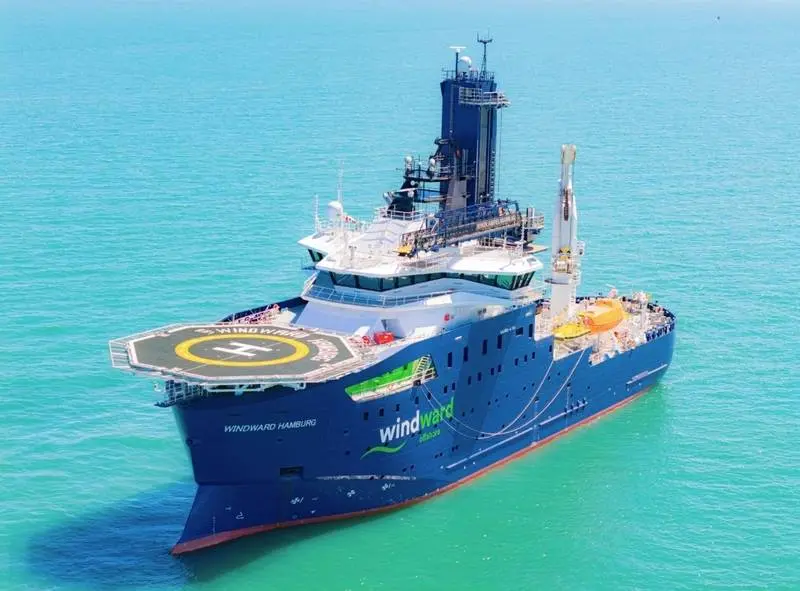
In a milestone deployment for the global offshore wind logistics sector, Windward Offshore has officially taken delivery of the Windward Hamburg. The delivery represents the final chapter in an ambitious, four-vessel shipbuilding program executed in partnership with the renowned Norwegian shipbuilder Vard. As the fourth purpose-built Commissioning Service Operation Vessel (CSOV) to join the fleet, the Windward Hamburg cements Windward Offshore’s transition from an asset-development vehicle into a fully operational, tier-one maritime logistics provider.
The delivery arrives at a critical juncture for the offshore wind industry. As offshore wind projects scale globally—moving further offshore into deeper waters and harsher marine environments—the demand for highly specialized, technologically advanced support vessels has surged. The Windward Hamburg joins her sister vessels—the Windward Athens, Windward Paris, and Windward Munich—to form a standardized, high-performance fleet designed to support wind farm developers throughout the high-stakes construction, commissioning, and long-term Operations & Maintenance (O&M) phases of utility-scale projects.
Notably, the entire four-vessel series was delivered either on or ahead of schedule. In an era marked by persistent global supply chain disruptions, shipyard backlogs, and equipment bottlenecks, this flawless execution underscores the operational synergy between Windward Offshore, Vard, and their key equipment suppliers.
Detailed Chronology: From Blueprint to Operational Fleet
The realization of Windward Offshore’s four-vessel fleet is a testament to disciplined project management and strategic alignment. The timeline of this capital-intensive newbuilding program showcases a rapid transition from design concepts to active offshore deployment:
+-----------------------------------------------------------------------------+
|                          FLEET DELIVERY TIMELINE                            |
+-----------------------------------------------------------------------------+
|                                                                             |
|  [Phase 1: Initial Deployments]                                             |
|  * Windward Athens & Windward Paris                                         |
|  * Status: Fully Operational                                                |
|  * Performance: 14,000+ safe personnel transfers completed                  |
|                                                                             |
|                                     v                                       |
|                                                                             |
|  [Phase 2: Mid-Year Expansion]                                              |
|  * Windward Munich                                                          |
|  * Delivered: July 2024                                                     |
|  * Status: Transit to Hamburg for naming ceremony & maiden charter          |
|                                                                             |
|                                     v                                       |
|                                                                             |
|  [Phase 3: Fleet Completion]                                                |
|  * Windward Hamburg                                                         |
|  * Delivered: Q4 2024                                                       |
|  * Status: Final integration & preparation for active service               |
|                                                                             |
+-----------------------------------------------------------------------------+
The Early Deliveries: Windward Athens and Windward Paris
The first two vessels in the series, the Windward Athens and Windward Paris, served as the operational vanguard for the company. Upon delivery, both vessels were immediately chartered to offshore wind developers. They have already established a formidable operational track record, collectively executing more than 14,000 safe personnel transfers using their advanced walk-to-work (W2W) motion-compensated gangway systems. This high utilization rate underscores the immediate market demand for high-spec CSOVs capable of operating in challenging sea states.
The Summer Milestone: Windward Munich
In July 2024, Vard delivered the third vessel, the Windward Munich. This vessel introduced key design modifications to the fleet’s baseline, most notably the integration of an offshore helideck. The Windward Munich is currently en route to the Port of Hamburg, where it will undergo its official naming ceremony before immediately commencing its maiden charter contract.
The Final Piece: Windward Hamburg
The delivery of the Windward Hamburg completes the quartet. Built to the identical high-specification VARD 4 19 design as the Windward Munich, the vessel is undergoing final operational preparations. With all four vessels now delivered, Windward Offshore possesses a young, homogeneous fleet that offers significant operational advantages, including standardized crew training, interchangeable spare parts, and consistent service delivery for developers across multiple offshore wind lease areas.
Supporting Context & Technical Metrics: Engineering the Future of Offshore Logistics
To understand the strategic value of the Windward Hamburg, one must examine the engineering choices behind the VARD 4 19 design. Developed by Vard Design in Norway, this vessel class represents a highly optimized platform tailored specifically to the unique requirements of offshore wind developers, technicians, and marine crews.
+-------------------------------------------------------------------------+
|                  VARD 4 19 DESIGN SPECIFICATIONS                        |
+-------------------------------------------------------------------------+
|  Length Overall (LOA)      |  87.5 meters                               |
|  Beam (Width)              |  19.5 meters                               |
|  Accommodation Capacity    |  120 persons (single/double cabins)        |
|  Aviation Capability       |  D-value compliant helideck                |
|  Propulsion System         |  Battery-hybrid (Methanol-ready)           |
|  Primary Access System     |  Motion-compensated, height-adjustable W2W |
|  Heavy Lift Capability     |  3D motion-compensated electric crane      |
+-------------------------------------------------------------------------+
Dimensions and Accommodation
Measuring 87.5 meters in length and 19.5 meters in width, the vessel offers an optimal balance between hydrodynamic stability and maneuverability. The hull form is engineered to minimize motion in rough seas, directly improving technician comfort and reducing the risk of motion sickness—a critical factor in maintaining workforce productivity on long offshore rotations.
The vessel can accommodate up to 120 personnel in high-standard, low-noise cabins. It features state-of-the-art recreational spaces, modern dining facilities, and dedicated offices and workshops for wind turbine technicians. This ensures that the vessel serves as a highly functional, comfortable "home away from home" during extended offshore campaigns.
Advanced Access and Lifting Systems
The primary functional interface of any CSOV is its "Walk-to-Work" (W2W) system. The Windward Hamburg features a height-adjustable, motion-compensated gangway with an integrated elevator. This system actively counteracts the pitch, roll, and heave of the vessel, allowing technicians to walk safely from the ship directly to the transition piece of a wind turbine generator (WTG) or substation, even in significant wave heights.
Complementing the gangway is a state-of-the-art, 3D motion-compensated electric crane. Unlike traditional hydraulic cranes, electric cranes offer superior energy efficiency, precise control, and a reduced risk of hydraulic fluid leaks, aligning with the clean-energy ethos of the offshore wind sector. Additionally, the vessel is equipped with a height-adjustable boat landing system, providing safe boarding options for Crew Transfer Vessels (CTVs).
Multi-Modal Logistics: The Helideck Integration
Like its sister ship, the Windward Munich, the Windward Hamburg features a fully certified helideck. This feature provides wind farm operators with maximum logistical flexibility. While the motion-compensated gangway remains the primary method for bulk technician transfers, the helideck enables rapid emergency medical evacuations (Medevac), swift transfers of specialized technicians, and the delivery of critical spare parts without interrupting the vessel’s primary marine operations.
Decarbonized Propulsion: Prepared for Green Methanol
As the maritime industry faces tightening environmental regulations from the International Maritime Organization (IMO) and the European Union’s Emissions Trading System (EU ETS), future-proofing vessel propulsion is a commercial necessity.
The Windward Hamburg features an advanced battery-hybrid propulsion system designed to optimize engine load, reduce fuel consumption, and minimize greenhouse gas emissions. The onboard battery packs act as an energy buffer, providing peak-shaving capabilities during dynamic positioning (DP) operations and allowing for zero-emission port stays.
Importantly, the vessel’s propulsion architecture has been designed with a clear upgrade path for future operation on green methanol. This dual-fuel readiness ensures that as green methanol supply chains mature, Windward Offshore can transition the fleet to near-zero-carbon operations, offering wind farm developers a truly sustainable logistics chain.
Official Statements & Leadership Perspectives
The successful conclusion of this four-vessel newbuilding campaign has been met with praise from both Windward Offshore’s leadership and the wider maritime community. The project is being highlighted as a model of successful collaboration between shipowners, designers, and shipyards.
Bastian Hagebeuker, Managing Director of Windward Offshore, emphasized the strategic and emotional weight of the delivery:
“The delivery of Windward Hamburg is a very special moment for us. What began as an ambitious newbuilding program has now become a fleet of four state-of-the-art CSOVs. Reaching this point is a proud achievement for the entire team; it reflects the tremendous commitment of everyone involved and the strong cooperation with VARD and our equipment suppliers.”
Hagebeuker also highlighted the critical role played by the shipbuilder in navigating the complexities of modern shipbuilding:
“Vard has been an important partner throughout this journey, bringing deep shipbuilding expertise and a clear understanding of what we set out to achieve. With all four vessels now delivered and already in operation or shortly commencing operations, we have established a strong foundation as we enter the next stage of Windward Offshore’s development.”
Industry analysts note that delivering four highly sophisticated vessels on or ahead of schedule is an exceptional achievement in the post-pandemic shipbuilding landscape. Shipyards worldwide have struggled with component delays, labor shortages, and rising material costs. The timely completion of this series reflects Vard’s robust supply chain management and Windward Offshore’s clear project execution strategy.
Future Outlook: Navigating the Global Offshore Wind Expansion
The delivery of the Windward Hamburg occurs against the backdrop of an unprecedented global expansion in offshore wind capacity. Governments worldwide have set ambitious targets for offshore wind installations as part of their broader net-zero carbon strategies. Europe aims to reach at least 111 GW of offshore wind capacity by 2030, while the United States has targeted 30 GW by the same year.
+----------------------------------------------------------------------------+
|                  MARKET DYNAMICS & FUTURE GROWTH DRIVERS                   |
+----------------------------------------------------------------------------+
|                                                                            |
|  [Regulatory Pressure]                                                     |
|  * IMO & EU ETS carbon reduction targets                                   |
|  * Demand for green methanol-ready and hybrid propulsion assets            |
|                                                                            |
|                                     v                                      |
|                                                                             |
|  [Supply-Demand Imbalance]                                                 |
|  * High demand for tier-1 CSOVs outstripping shipyard capacity             |
|  * Windward's standardized fleet positions them as a preferred partner     |
|                                                                            |
|                                     v                                      |
|                                                                             |
|  [Technological Evolution]                                                 |
|  * Deeper waters require dynamic positioning (DP2) capability              |
|  * Larger wind turbines require taller gangways and higher crane capacities|
|                                                                            |
+----------------------------------------------------------------------------+
Overcoming the Vessel Shortage Bottleneck
This massive installation pipeline has created a significant bottleneck: a severe shortage of specialized offshore support vessels, particularly CSOVs and Service Operation Vessels (SOVs). Industry forecasts suggest that without significant newbuilding activity, the demand for high-spec walk-to-work vessels will outstrip supply before the end of the decade.
By completing its initial four-vessel program ahead of schedule, Windward Offshore has positioned itself as a preferred partner for wind farm developers. The standardized nature of its fleet is a key competitive advantage. Operators can deploy these vessels across various European and global projects, confident that the crews, safety protocols, and operational capabilities are identical across all assets.
The Next Strategic Phase
With its fleet now fully built, Windward Offshore’s primary focus shifts from asset construction to asset optimization and commercial execution. The company is well-positioned to secure lucrative, long-term charter agreements with major utility companies and offshore wind developers.
Furthermore, the design of the VARD 4 19 platform ensures that these vessels will remain competitive for decades. Their adaptability to future fuels like green methanol, combined with their high accommodation capacity and advanced walk-to-work systems, ensures they are well-suited to service the next generation of ultra-large wind turbines, which are expected to exceed 15 to 20 megawatts in capacity.
Ultimately, the delivery of the Windward Hamburg is more than just the arrival of a new vessel; it is a clear signal of Windward Offshore’s intent to be a long-term leader in the offshore wind sector. By combining advanced engineering, operational discipline, and a forward-looking environmental strategy, the company has built a resilient foundation to support the global transition to clean, ocean-based energy.