











Executive Overview
As the global hospitality industry races headlong into the era of artificial intelligence, executives are routinely confronted with an overwhelming deluge of vendor pitches, model benchmarks, and promises of frictionless automation. However, beneath the polished surface of generative AI agents and predictive pricing engines lies a harsher operational reality: the underlying architecture of most enterprise technology is fundamentally broken.
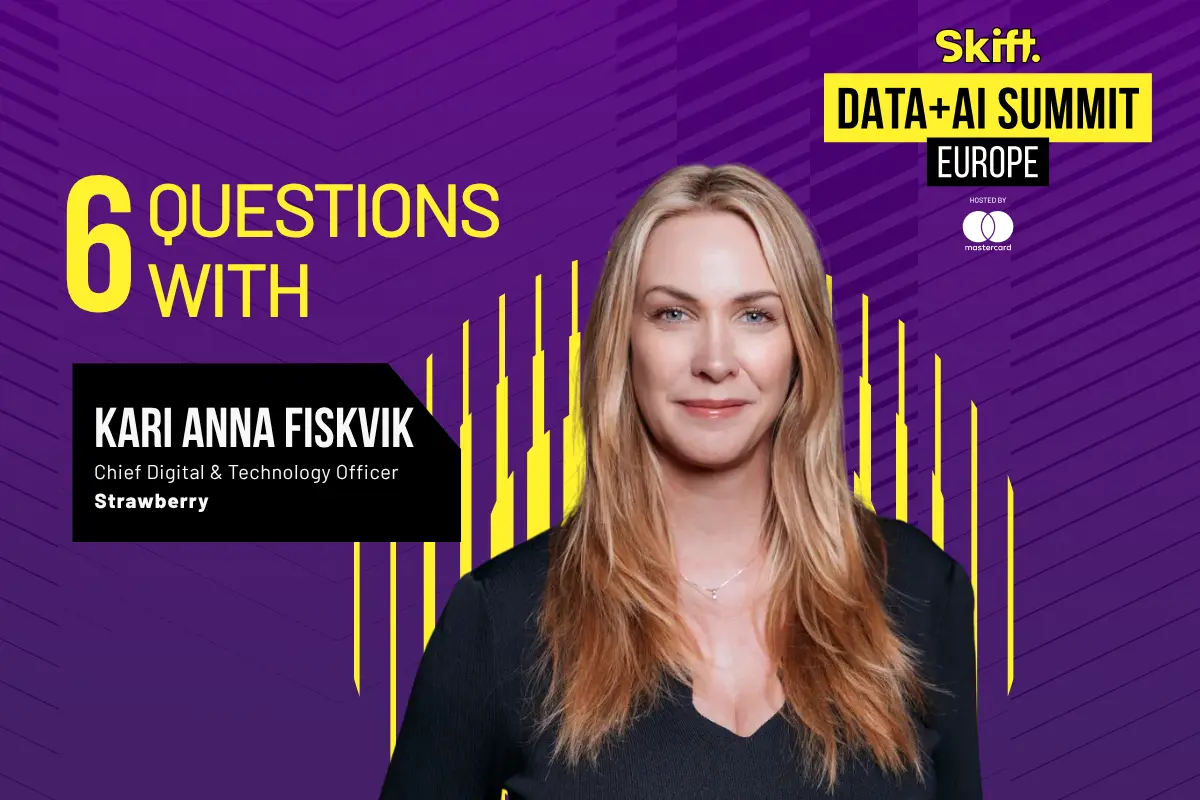
According to Kari Anna Fiskvik, Chief Digital and Technology Officer of the Nordic hotel giant Strawberry (formerly Nordic Choice Hotels), the rush to adopt advanced machine learning models is frequently built on foundations of sand. Ahead of her appearance at the upcoming Skift Data + AI Summit Europe—scheduled for October 6, 2026, at Mastercard London—Fiskvik has issued a stark warning to travel operators across Europe. Her core thesis is as provocative as it is straightforward: the AI model is rapidly becoming a commoditized utility, while the plumbing, the data architecture, and the human judgment governing it remain the ultimate differentiators.
In this deep-dive analysis, we examine Fiskvik’s strategic philosophy on scaling AI in travel operations, the lessons learned from surviving a devastating mid-pandemic ransomware attack, the true nature of European regulatory compliance, and how Strawberry is weaponizing conversational AI to transform passive guest inquiries into immediate conversions.

Detailed Chronology: From Ransomware Recovery to Real-Time AI Architecture
To understand Fiskvik’s pragmatic, highly operational view of technology, one must look back to the crucible of the COVID-19 pandemic. In 2021, while the global hospitality sector was already reeling from unprecedented occupancy drops and travel restrictions, Strawberry was struck by a severe ransomware attack orchestrated by the notorious Conti cybercrime syndicate.
The attack crippled a vast majority of the Nordic hotel group’s core digital infrastructure, threatening to paralyze operations entirely during an already precarious period. Yet, remarkably, Strawberry was fully back online within a mere four days.
The 2021 Conti Ransomware Incident: A Timeline of Resilience
- The Breach: Mid-pandemic, Conti ransomware infiltrates Strawberry’s systems, locking down critical reservations, property management systems, and internal communications.
- The Crisis: The enterprise faces a catastrophic operational standstill across its portfolio of hundreds of hotels in Scandinavia and the Nordics.
- The Response: Rather than relying on rigid compliance binders or theoretical disaster recovery documents, operational teams mobilize swiftly.
- The Resolution: Thanks to personnel with deep institutional knowledge who "knew exactly what mattered," systems are successfully restored and operational within 96 hours.
This foundational event shaped Fiskvik’s leadership philosophy regarding crisis management, infrastructure fragility, and the limits of bureaucracy. While regulatory bodies and corporate boards often lean heavily on exhaustive paperwork and compliance frameworks to guarantee security and operational integrity, Fiskvik argues that documentation alone cannot prevent breaches or solve crises. Real resilience, she notes, is a human attribute rooted in situational awareness and decisive action.
Today, this hard-earned operational rigor dictates how Strawberry approaches its digital transformation. Rather than chasing every emerging technology trend, the group focuses heavily on building robust data pipelines that can withstand high-traffic environments while preserving the core tenets of hospitality: a business fundamentally driven by people.

Supporting Context & Metrics: The Perils of Multiplying Chaos
In contemporary travel technology discussions, much of the oxygen is consumed by debates over proprietary large language models (LLMs) versus open-source alternatives, and whether legacy hotel brands can successfully out-engineer tech platforms. Fiskvik dismisses this framing as fundamentally naive.
The Mathematics of Modern AI: Scaling Clean Data vs. Amplifying Chaos
- Unified, Real-Time Data + AI Model = Faster, smarter decision-making, hyper-personalized guest experiences, and frictionless booking flows.
- Fragmented Data Ecosystem + AI Model = Accelerated operational failure, inconsistent records, and compounded administrative errors ("faster chaos").
As Fiskvik points out, even industry-shaping integrations—such as Google piping hotel options directly into its conversational AI search modes—do not rescue a poorly organized property. The hotels that achieve high visibility and conversion in these cutting-edge discovery engines are invariably those with clean, structured, and complete data feeds.
"It does not matter how capable the model is if the data pipes, integrations, and identity systems underneath cannot carry the traffic," Fiskvik explains. "A broken guest journey is almost always an architecture, data, and infrastructure problem wearing a costume."
Furthermore, the hospitality sector is currently saturated with software vendors whose primary business model is not necessarily optimizing the guest lifecycle, but rather positioning themselves for their next venture capital funding round. For enterprise travel buyers, cutting through this vendor noise requires a rigorous auditing of internal data hygiene before committing capital to flashy AI wrappers.
Official Statements & Insights: Navigating Regulations and Human Capital
Regulatory complexity is another flashpoint for European travel operators. With the implementation of frameworks like the European Union’s Artificial Intelligence Act, compliance requirements regarding AI transparency, data governance, and risk assessment have intensified.
When asked whether European regulatory frameworks represent a barrier to adoption or an opportunity to build defensible moats, Fiskvik strikes a balanced, pragmatic tone.
Regulatory Realism vs. Compliance Theater
- The Benefits: Clear guardrails are necessary. Labeling AI-generated content and performing rigorous risk assessments protect enterprises and consumers alike from sophisticated threats, including prompt injection attacks and data breaches.
- The Pitfalls: An over-reliance on paperwork creates a false sense of security. Policies do not alter human behavior or deter sophisticated cybercriminals.
- The Regulatory Wishlist: Regulators should shift a portion of their focus from assessing whether a policy is exhaustively documented to evaluating whether the rule achieves its intended practical outcome.
The Human Element: Preserving Jobs in an Automated World
Beyond infrastructure and regulation, Strawberry’s leadership is acutely focused on the social impact of automation. As a self-described "people, planet, profit" enterprise, the company recognizes a profound corporate responsibility to society during periods of industrial transition.
While generative AI models are exceptionally capable of scraping data, synthesizing extensive text, and executing routine administrative tasks, they fundamentally lack context. Human employees, shaped by lived experience, possess situational judgment that algorithms cannot replicate.
However, efficiency gains driven by automation pose a distinct threat to entry-level employment pipelines. Fiskvik emphasizes that the industry must actively resist the urge to eliminate junior roles entirely:
"We don’t want AI to replace all juniors. Young people deserve to work, and they have to start and learn somewhere. We’re working very actively on this: how to secure jobs and still gain efficiency from AI. It is every company’s responsibility to take care of people in this transformation."
Future Outlook: The Race for the Booking and the Rise of Agentic AI
Looking toward the horizon of 2026 and beyond, the battleground for travel operations is shifting rapidly from static website discoverability to dynamic, conversational conversion.
Turning Inquiries into Bookings: The Case of Vivi
Strawberry is already demonstrating what practical, conversion-focused AI looks like in practice. On the website of Villa Copenhagen—one of the group’s premier properties—an AI-powered concierge named Vivi handles complex guest inquiries in real-time.
When a prospective guest asks for a double room available in October, Vivi does not default to the traditional, friction-heavy response of "contact us for availability." Instead, within seconds, the system returns live pricing, active packages, and a direct, bookable link to confirm the reservation. This seamless integration of intent and fulfillment exemplifies the primary opportunity for AI in travel: eliminating friction at the exact moment of commercial consideration.
The Agentic Web and the Threat to Standalone Hotels
Looking at the broader macro trends over the next two years, Fiskvik identifies agentic booking models as the most disruptive force in European travel operations.
As major tech platforms—including Google’s agentic hotel booking features within AI Mode and Meta’s dedicated travel applications—evolve to handle multi-step tasks on behalf of travelers, the dynamics of guest acquisition are changing dramatically. These tools are increasingly capable of comparing cash rates directly against loyalty points and executing preliminary searches behind the scenes.
While major hotel brands and established loyalty programs are successfully embedding themselves into these agentic ecosystems, the landscape is becoming exponentially more difficult for independent hotels and smaller regional groups. Standalone operators face mounting discoverability hurdles as aggregators and AI agents intermediate the relationship between the traveler and the property. Furthermore, these shifts are poised to profoundly disrupt the Meetings, Incentives, Conferences, and Exhibitions (MICE) sector, transforming how group bookings, RFPs, and complex itineraries are negotiated.
Conclusion: What Operators Must Decide
As the hospitality sector gathers for events like the Skift Data + AI Summit Europe, the overarching message from digital leaders like Kari Anna Fiskvik is clear: the era of experimenting with standalone AI toys simply for the sake of innovation has drawn to a close.
Travel operators are confronted with a definitive choice. They can continue to build on fractured data foundations, accumulating technical debt and vulnerable software wrappers while hoping regulatory paperwork will shield them from disruption. Alternatively, they can heed the hard-won lessons of enterprise resilience: clean up the underlying data plumbing, invest in robust architectural integrations, respect the indispensable value of human context, and deploy AI strictly where it meaningfully reduces friction for the guest and preserves opportunity for the workforce.
The model is a commodity. The data, the infrastructure, and the people are everything else.