For more than three decades, renowned yacht interior designer Patrick Knowles has shaped the floating sanctuaries of the ultra-wealthy. His career has been defined by the pursuit of the ultimate custom environment—translating the abstract desires of billionaire owners into tactile, breathtaking realities of custom carpets, hand-carved millwork, bespoke lighting, and monogrammed linens. Yet, despite the staggering levels of personalization achieved within the maritime industry, Knowles identified a frontier that remained largely untouched by high-end interior design: the culinary and lifestyle experience.
Enter The Quintessential Yachtsman, a stealth enterprise launched by Knowles roughly three years ago. Through this venture, Knowles has quietly revolutionized the concept of onboard luxury by curating ultra-exclusive, personalized spirits and caviar for a select group of superyacht owners. Moving far beyond standard catering provisions, Knowles bridges the gap between spatial architecture and gastronomy. By translating interior motifs—such as custom de Gournay silk embroideries—into bespoke labels and selecting rare roe profiles tailored to an owner’s distinct palate, Knowles is proving that a superyacht’s brand identity can be tasted just as easily as it can be seen.
This deep dive explores how a veteran designer became a sommelier of species, the mechanics of translating interior design into gastronomic branding, and why this hyper-personalized approach is poised to redefine the upper echelons of luxury maritime travel.
To understand the genesis of The Quintessential Yachtsman, one must look at the evolution of superyacht design over the past thirty-five years.
Phase 1: The Era of Traditional Customization (Late 1980s – 2010s)
For decades, the definition of a bespoke yacht interior followed a familiar blueprint. When owners commissioned a vessel from shipyards in Europe or the United States, they worked with designers to curate every visual and tactile surface. Knowles spent this era perfecting the craft of spatial storytelling.
Standardization of Luxury: Custom carpets, one-off furniture pieces, and artisanal light fixtures evolved from extraordinary requests into industry standards.
The Monogram Baseline: As Knowles notes, elements like monogrammed towels, custom uniforms, and tailored tableware transformed from elite statements into baseline expectations. The industry had successfully saturated the visual and tactile senses, leaving little room for further bespoke differentiation within the physical architecture of the hull.
As the superyacht market boomed and demands for ultra-exclusive experiences accelerated, Knowles recognized a glaring omission in the luxury ecosystem. While owners invested millions in commercial-grade galleys and stocked their freezers with high-end provisions, the sourcing and branding of these culinary items remained disconnected from the vessel’s overarching design narrative.
The Epiphany: Knowles realized that while an owner’s visual environment was meticulously curated, their culinary environment was generic. High-end caviar and vodka were purchased off-the-shelf, bearing no intrinsic connection to the vessel they were served upon.
Conception of The Quintessential Yachtsman: Knowles quietly laid the groundwork for a company designed to bridge this gap. He began researching artisanal producers, exploring the nuances of caviars and spirits, and conceptualizing a way to merge interior branding with consumable luxury.
Phase 3: The Quiet Launch and Early Implementations (2021 – Present)
Over the past three years, Knowles has rolled out his vision to a select cohort of approximately half a dozen ultra-high-net-worth yacht owners.
The Alta Collaboration: Knowles oversaw the production of a limited-edition, custom-blended vodka served exclusively aboard the 144-foot Palmer Johnson superyacht Alta.
The Maison Blanche Project: Most recently, Knowles executed his most integrated project yet for the 163-foot Westport Maison Blanche, harmonizing interior textile art directly with custom-packaged Royal Imperial caviar. Today, The Quintessential Yachtsman stands as the vanguard of a new movement in maritime hospitality, setting an aggressive benchmark for holistic luxury.
Supporting Context & Metrics
The emergence of bespoke culinary curation within the yachting sector does not happen in a vacuum. It intersects with a booming global luxury market, shifting consumer behaviors among the ultra-wealthy, and the rigorous science of gastronomy.
The Anatomy of Caviar: A Sommelier’s Perspective
To successfully curate caviar for discerning yacht owners, Knowles had to develop a connoisseur’s deep understanding of the product. Caviar, he asserts, shares a profound structural and sensory kinship with fine wine.
Varietal Nuances: Just as an untrained palate might group all white wines together while a connoisseur detects subtle notes of terroir in a Chablis versus a Sauvignon Blanc, caviar demands an educated palate.
Texture and Firmness: The tactile resistance of the egg shell upon the tongue.
Pearl Size and Color: Variations ranging from deep charcoal to golden hues.
Salinity and Density: The balance of salt curing and the richness of the natural oils.
Flavor Profiles: From mild and buttery to robust and nutty.
The Maison Blanche Case Study: Translating Art to the Palate
The integration of design and cuisine is best illustrated through the 163-foot Westport Maison Blanche.
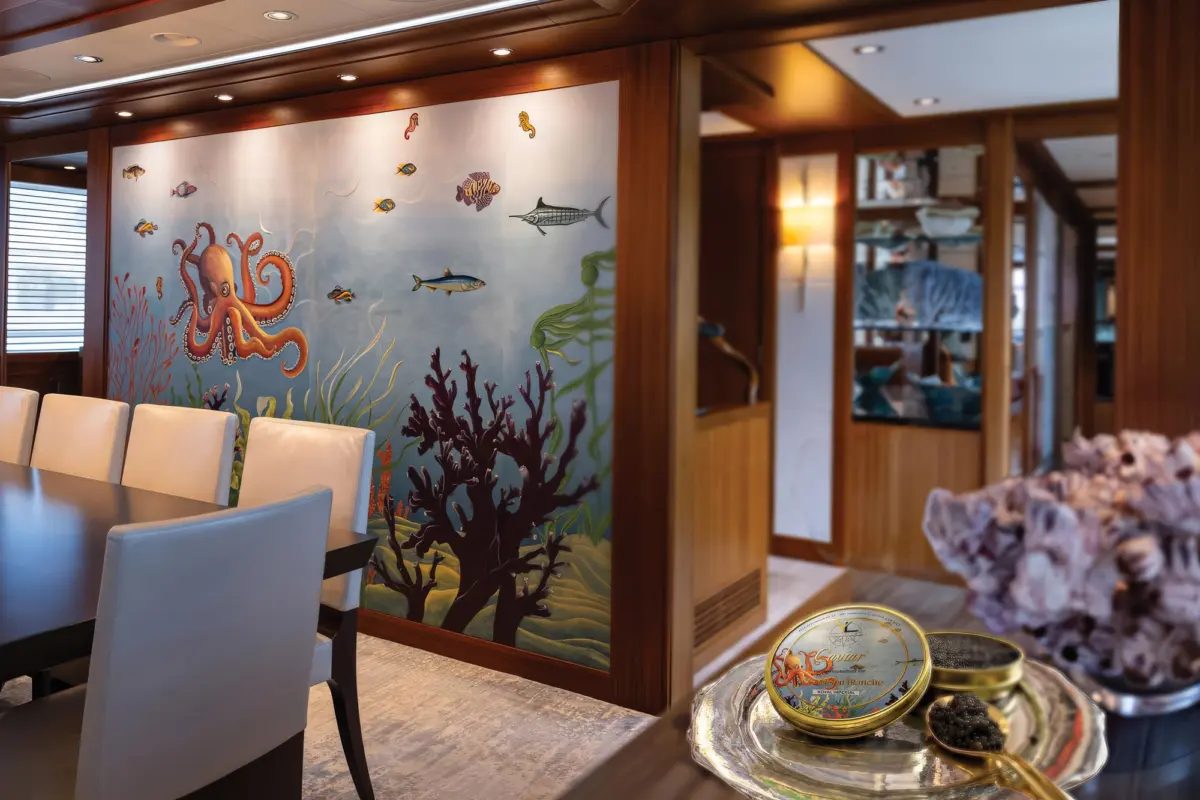
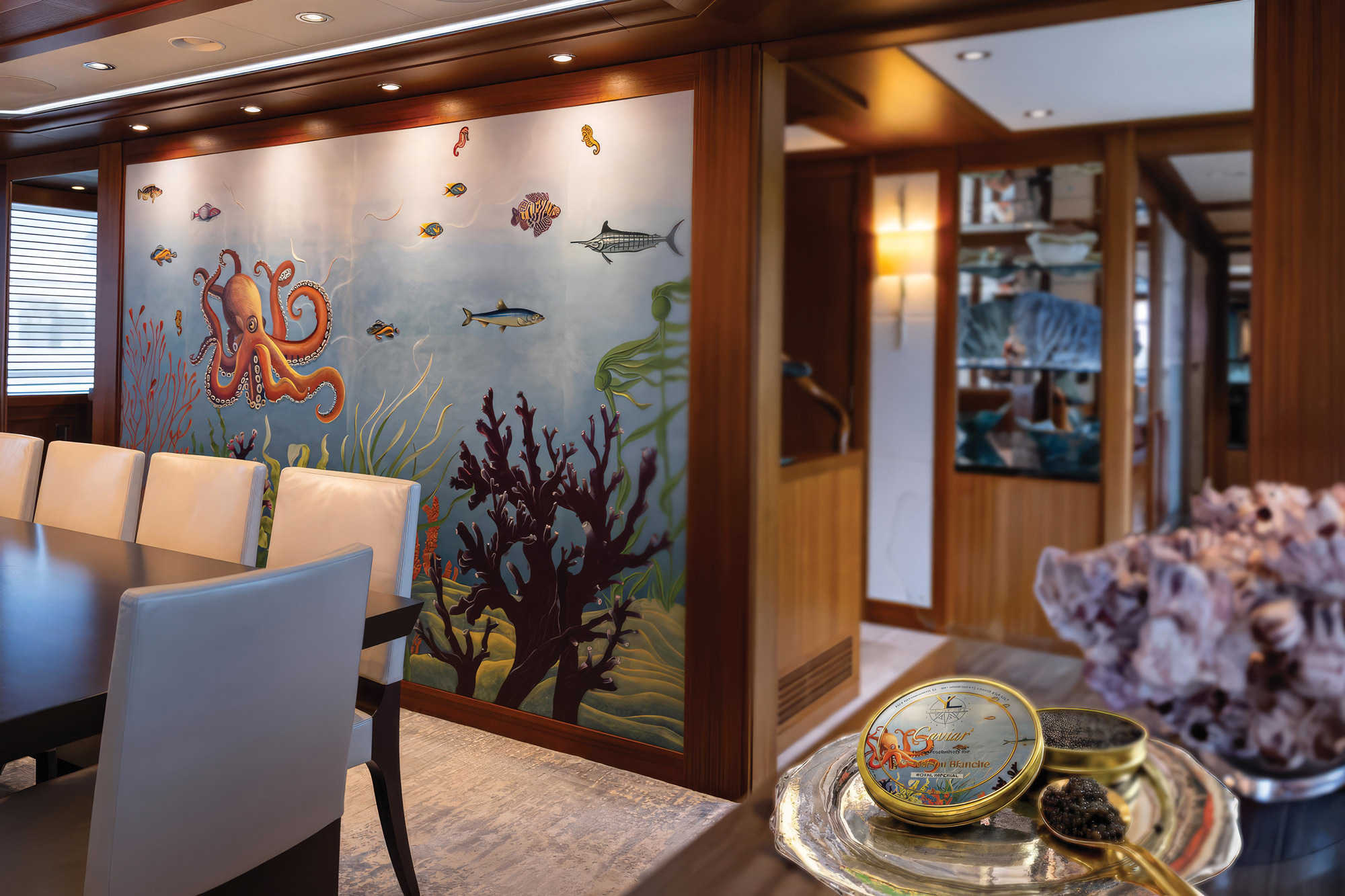
The Interior Motif: During a comprehensive refit, Knowles commissioned a specialized de Gournay art piece for the yacht’s formal dining area. At first glance, the wall installation appears to be a completely hand-painted mural. Upon closer inspection, however, the centerpiece—an intricate octopus—is revealed to be meticulously crafted from thousands of hand-embroidered silk threads.
The Gastronomic Translation: Recognizing the profound visual and emotional impact of this custom artwork on both the owner and visiting charter guests, Knowles made the decisive leap from bulkhead to tin. The embroidered octopus was digitally adapted to form the striking centerpiece of the custom caviar tins served on board.
The Contents: Nestled inside these bespoke tins is Royal Imperial caviar, historically celebrated as the rarest, lightest-colored roe reserved exclusively for royalty, distinguished by its large pearls and rich, buttery, nutty flavor profile.
The Revival of Culinary Tradition
In addition to custom packaging, Knowles advocates for a return to historical consumption methods that elevate the sensory experience. Eschewing traditional mother-of-pearl spoons in favor of an ancient merchant tradition, Knowles encourages guests to sample caviar au natural:
"You basically kiss it off your hand," Knowles explains, describing the method of placing a "bump" of caviar on the back of the hand between the thumb and index finger. "That’s the original way of consuming caviar. It was done by merchants as they traveled around the Caspian Sea, tasting different kinds of caviar. That’s my favorite way of eating caviar. And when I tell that story, most people try it au naturale, and they keep coming back."
Official Statements & Insights
Patrick Knowles’ philosophy centers on the idea that true luxury must engage all five senses to create an indelible emotional imprint. In interviews detailing his transition from spatial architecture to gastronomic curation, his vision for the future of maritime design becomes abundantly clear.
On the limitations of traditional yacht design:
"When a yacht designer designs for a yacht owner or client, we speak about the proverbial stuff: custom carpet, custom furniture, custom light fixtures," Knowles observes. "It’s stuff that is basically taken for granted that it will be designed. They’ve become like the monogrammed towels and uniforms."
On closing the loop between the visual environment and the palate:
"We create a visual and a physical environment for them to enjoy. Now they can taste that environment," Knowles states. "The inspiration of putting the caviar together is all part and parcel of my thought process about the project. It culminates now in an extension of the brand. You can put it on your palate and take the experience to a whole new bespoke level that nobody else in the industry is doing."
On absolute exclusivity and branding ownership:
"I took a core element from the interior of the boat, and I translated that into a design for the label, the tin, of the caviar," Knowles explains regarding his work on Maison Blanche. "That’s what I’ve done with my other yachts as well. I’ve taken bespoke elements that I’ve designed, and incorporated it into the label. There’s no question that this caviar belongs to this boat."
On setting industry standards through ventures like The Quintessential Yachtsman:
"We want to be the pace-setter for this level of bespoke customization," he affirms, pointing to exclusive offerings like Yacht Life Vodka—available only to owners and charter guests aboard vessels like the 144-foot Palmer Johnson Alta.
Future Outlook
As the superyacht industry marches further into the 21st century, the definition of wealth is shifting away from mere material accumulation toward experiential rarity and hyper-personalization. Owners no longer simply want a bigger boat; they want a floating estate that tells an entirely unique, cohesive story from the hull plates to the dining room table.
Patrick Knowles’ pioneering work with The Quintessential Yachtsman signals the early stages of a broader paradigm shift in maritime luxury:
Holistic Branding for Private Vessels: Just as corporate brands manage every touchpoint of the consumer experience, superyacht owners are beginning to treat their vessels as private lifestyle brands. Expect to see future builds feature fully integrated private-label programs encompassing not just caviar and vodka, but custom-aged wines, artisanal olive oils, and bespoke aromatic profiles tailored to each cabin’s HVAC system.
The Rise of the Gastronomic Designer: Interior designers will increasingly collaborate with agricultural producers, master distillers, and master caviarmakers during the early phases of yacht construction, ensuring that the vessel’s culinary identity is established long before the first guest steps onboard.
Redefining Charter Exclusivity: For charter vessels, offering proprietary, non-commercial culinary experiences will become a primary competitive differentiator. When a charter client realizes they are tasting a vintage or roe profile that cannot be purchased anywhere else on earth—and is inextricably tied to the interior architecture of the yacht they are inhabiting—the value proposition of the charter elevates exponentially.
Ultimately, Patrick Knowles has demonstrated that design does not have to stop at the edge of a custom carpet or the frame of a de Gournay wall mural. By extending his artistic philosophy to the human palate, he has unlocked a new dimension of superyacht luxury—one where every single bite tells a story, and every sip tastes precisely like home on the water.