








Executive Overview
In a landmark development for India’s domestic defense technology sector, Mumbai-based marine automation provider Accurate Industrial Controls is set to begin the physical conversion of three patrol vessels into fully autonomous Unmanned Surface Vessels (USVs). This initiative represents the first phase of a comprehensive six-vessel contract signed with the Indian Navy in 2022. Having successfully completed a rigorous feasibility assessment, the company is preparing to initiate conversion operations at the Indian Navy’s premier ship repair and maintenance facility, the Naval Dockyard in Mumbai.
This project marks a significant milestone in India’s transition toward autonomous naval warfare and persistent maritime surveillance. The conversion program leverages Accurate Industrial Controls’ proprietary "Intelligent Situational Awareness and Collision Avoidance" (ISACA) technology stack. This software and hardware suite has recently secured prestigious classification certification from the Indian Register of Shipping (IRS).
By retrofitting existing crewed hulls with autonomous capabilities, the Indian Navy is pioneering a cost-effective, high-yield strategy to expand its operational footprint. This move addresses security challenges across the Indian Ocean Region (IOR) while advancing the national mandate for defense indigenization (Atmanirbhar Bharat).
Detailed Chronology of the Program (2022–2026)
The upcoming vessel conversions are the culmination of a highly structured, multi-year developmental pathway designed to mitigate the risks inherent in deploying autonomous lethal and non-lethal assets in crowded marine environments.
[2022] Contract Signed -> [Autonomy Stack Dev (5 Milestones)] -> [Build Test USVs (13m & 5m)] -> [2,500+ Hours of Sea Trials] -> [IRS AUTN 4-R(N) Certification] -> [2026: Conversion Begins]Phase 1: Contractual Genesis and Audited Milestones (2022–2024)
The relationship began in 2022 with the signing of a long-term development and supply contract between the Indian Navy and Accurate Industrial Controls. Under this agreement, the automation provider was tasked with developing an entirely domestic Autonomy Stack. To ensure engineering rigor and operational safety, the development process was divided into five distinct, audited milestones. Each milestone was scrutinized by naval engineers and third-party inspectors to validate the software’s decision-making logic, sensor integration capabilities, and fail-safe protocols.
Phase 2: Prototyping and Rigorous Field Testing (2024–2025)
Following the validation of the core software architecture, Accurate Industrial Controls constructed two specialized test USVs to serve as technology demonstrators:
- A 13-meter interceptor craft optimized for high-speed maneuvering and tactical simulations.
- A 5-meter Search and Rescue (SAR) workboat designed to test precise pathfinding and low-speed close-quarters maneuvering.
These platforms underwent more than 2,500 hours of grueling sea and river trials. Conducted in tandem with the Indian Navy, these trials exposed the autonomy algorithms to diverse environmental conditions, including heavy river currents, high sea states, dense civilian maritime traffic, and degraded GPS environments.
Phase 3: Regulatory Validation and Class Certification (Early 2026)
The critical final step before scaling to the active fleet was obtaining formal class certification. Following the successful completion of the sea trials, the Indian Register of Shipping (IRS) formally certified Accurate’s ISACA technology stack.
The system was awarded the IRS AUTN 4-R(N) class notation. This certification officially confirms that the autonomous system complies with the International Regulations for Preventing Collisions at Sea (COLREGs), a fundamental requirement for integrating unmanned vessels into international and domestic shipping lanes.
Technical Breakdown: The ISACA Tech Stack and Platform Conversions
The conversion program involves retrofitting two distinct classes of operational naval vessels, transforming them from traditional, crewed patrol boats into highly intelligent, remote-controlled, or fully autonomous assets.
The Target Vessels Scheduled for Conversion
The first phase of the deployment focuses on three specific hulls:
| Vessel Class | Quantity | Length | Primary Operational Profile | Range / Endurance |
|---|---|---|---|---|
| Fast Interceptor Craft (FIC) | 1 | 13 meters | Coastal reconnaissance, high-speed interception, shallow-water patrol | High-speed sprint, localized endurance |
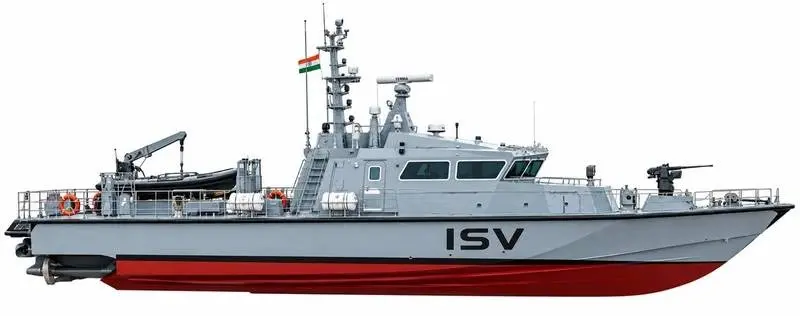
| Immediate Support Vessel (ISV) | 2 | 23 meters | Offshore asset protection, frigate escort, mid-ocean surveillance | 400 nautical miles |
The Fast Interceptor Craft (FIC) is traditionally utilized for rapid-response missions, anti-smuggling, and littoral security. Converting this platform to a USV allows the Navy to deploy high-speed intercept capabilities in high-threat environments without putting human boarding teams or operators at immediate risk.

The Immediate Support Vessels (ISVs) are larger, more robust platforms designed for deeper waters. They frequently operate in support of capital warships, such as frigates and destroyers, or guard critical offshore infrastructure (e.g., oil rigs in the Mumbai High field). With a substantial 400-nautical-mile range, these unmanned ISVs will provide persistent, long-endurance surveillance screens around naval task forces.
                    +---------------------------------------+
                    |       ISACA Autonomy Tech Stack       |
                    +---------------------------------------+
                                        |
       +--------------------------------+--------------------------------+
       |                                |                                |
+------v------+                  +------v------+                  +------v------+
|   SENSORS   |                  |   CONTROL   |                  |   SAFETY    |
|  - Radar    |                  |  - Remote   |                  |  - COLREGs  |
|  - INS      |                  |    C2       |                  |    Engine   |
|  - EO/IR    |                  |  - Autonomous|                 |  - Fail-safe|
|  - LiDAR    |                  |    Pathing  |                  |    Modes    |
+-------------+                  +-------------+                  +-------------+
The Intelligence Behind the Autonomy: The ISACA Stack
At the heart of all six converted vessels is the Intelligent Situational Awareness and Collision Avoidance (ISACA) system. This proprietary technology stack integrates hardware and software to replicate and exceed the decision-making capabilities of a human bridge team.
- Multi-Sensor Fusion Engine: The ISACA system fuses data from multiple onboard sensors, including marine Radar, Inertial Navigation Systems (INS), and Electro-Optical/Infrared (EO/IR) camera payloads. This real-time sensor fusion allows the system to construct a dynamic, 360-degree digital map of its surroundings, identifying and tracking both cooperative (AIS-transmitting) and non-cooperative targets.
- COLREGs-Compliant Algorithmic Decision Making: The core navigation algorithms are programmed to respect international maritime laws. When encountering another vessel, the system calculates the Closest Point of Approach (CPA) and Time to Closest Point of Approach (TCPA), executing compliant maneuvers (such as giving way or maintaining course) without human intervention.
- Dual-Mode Operation (Remote & Autonomous): The vessels can operate under direct human oversight via a secure, encrypted remote command-and-control (C2) link, or run fully autonomously along pre-programmed patrol routes, dynamically adjusting their path only to avoid obstacles or investigate anomalies.
Strategic Implications & Market Context
The conversion of these six patrol boats occurs at a critical juncture in global naval strategy. The war in Ukraine has demonstrated the asymmetric power of Unmanned Surface Vessels in modern conflict, prompting navies worldwide to rapidly accelerate their unmanned system programs.
Strengthening the Indian Navy’s Littoral and Blue-Water Capabilities
For the Indian Navy, the integration of autonomous FICs and ISVs provides several strategic advantages:
- Persistent Maritime Domain Awareness (MDA): Unmanned vessels can remain on station longer than crewed vessels, free from the constraints of crew fatigue, provisioning, and safety limits.
- Force Multiplication: A single crewed frigate or offshore patrol vessel (OPV) can act as a mothership, controlling a swarm of autonomous ISVs to screen a vast area of ocean against submarine, surface, or aerial threats.
- Risk Mitigation in High-Threat Zones: Deploying USVs for harbor defense, choke-point monitoring (e.g., the Strait of Malacca or the Bab-el-Mandeb), and offshore oil rig security protects human personnel from asymmetric attacks and harsh weather conditions.
The Push for "Atmanirbhar Bharat" in Naval Automation
Historically, Indian defense procurement relied heavily on foreign OEMs for advanced software, sensor suites, and automation systems. The partnership with Accurate Industrial Controls highlights a shift toward domestic development. By designing, testing, and certifying the ISACA stack within India, the program ensures that critical codebases and intellectual property remain under sovereign control. This reduces vulnerability to supply chain disruptions and foreign sanctions.
Official Statements and Leadership Perspectives
Reflecting on the transition from technology demonstration to active fleet integration, Dharmesh Popatlal Gala, Director of AI & Robotics at Accurate Industrial Controls, emphasized the scale of the achievement:
"The conversion of these three vessels is a watershed moment for Indian marine engineering. We have proved that domestic AI and robotics can meet the stringent requirements of the Indian Navy. Our ISACA tech stack didn’t just pass laboratory tests; it survived 2,500 hours of rigorous, real-world trials on the water, proving its reliability to both naval planners and the Indian Register of Shipping."
Gala further noted the versatility of the technology:
"Whether we are retrofitting a agile 13-meter Fast Interceptor Craft or a heavy-duty 23-meter Immediate Support Vessel, the core ISACA architecture remains identical. This modularity allows the Indian Navy to rapidly scale autonomy across different vessel classes, creating a unified, interoperable fleet of unmanned assets."
Future Outlook: The Evolution of Unmanned Maritime Warfare
As work begins at the Naval Dockyard in Mumbai, the immediate priority remains the successful conversion, testing, and operational hand-over of the first three vessels. Once these platforms enter active service, the conversion of the remaining three vessels under the six-vessel agreement will commence, incorporating real-world operational feedback into the final builds.
Looking further ahead, the successful deployment of these USVs is expected to pave the way for larger autonomous platforms. Industry analysts suggest that the Indian Navy may eventually seek to integrate autonomy into larger utility landing crafts, minesweepers, and oceanographic research vessels.
By establishing a robust, certified, and combat-tested autonomy stack today, Accurate Industrial Controls and the Indian Navy have laid the groundwork for India to become a leading developer of autonomous maritime technology on the global stage.