








Executive Overview
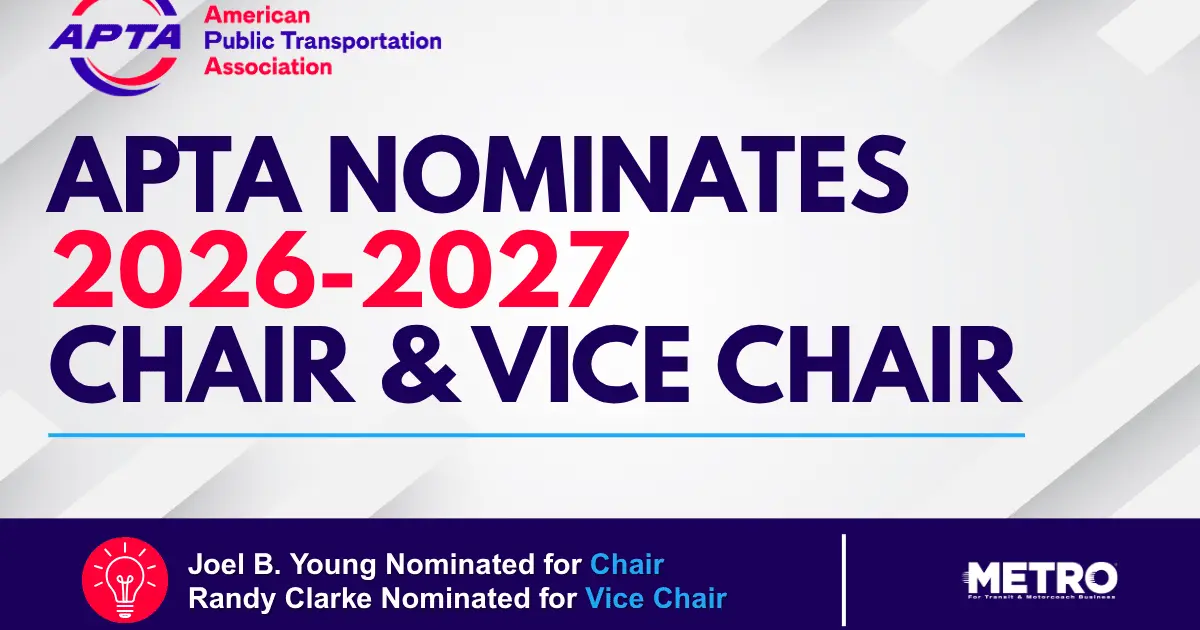
As the United States transit sector navigates an unprecedented paradigm shift defined by post-pandemic ridership recovery, accelerating electrification mandates, and evolving technological demands, the American Public Transportation Association (APTA) has officially announced its leadership nominations for the 2026–2027 term. Following a rigorous deliberation process by the association’s 2026 Nominating Committee, Joel B. Young, a seasoned board member of the Alameda-Contra Costa Transit District (AC Transit) in Oakland, California, has been nominated to serve as APTA Chair. Concurrently, Randy Clarke, the dynamic general manager and chief executive officer of the Washington Metropolitan Area Transit Authority (WMATA), has been nominated for the role of Vice Chair.
The announcement, released ahead of the association’s pivotal governance votes, highlights a leadership ticket blending deep regional governance experience with high-profile metropolitan system management. This pairing arrives at a crucial juncture for American public transportation. Agencies nationwide are tasked with absorbing historic federal capital investments derived from the Infrastructure Investment and Jobs Act (IIJA), transitioning legacy diesel fleets to zero-emission alternatives, hardening infrastructure against extreme weather events driven by climate change, and restoring public trust in urban mobility networks.
In addition to the top executive posts, the nominating committee cemented key continuities and renewals across the association’s governing body. Jannet Walker-Ford, advisory and planning business line executive at WSP USA, is set to continue her crucial multi-year term as Secretary-Treasurer, ensuring financial stewardship and strategic continuity through 2028. Meanwhile, Leanne Redden transitions into the role of Immediate Past Chair, bringing her considerable institutional memory to bear as an advisor to the incoming administration.
The comprehensive slate of nominees encompasses leaders from transit agencies, state departments of transportation, academic institutions, and private-sector industry suppliers. This broad coalition will be formally presented to the APTA membership for ratification on October 3 during the Annual Meeting of the Members—a landmark gathering hosted in conjunction with the APTA TRANSform Conference & EXPO in Chicago, Illinois. Chicago’s selection as the host city for this major transit milestone underscores the Midwestern hub’s historic and ongoing status as a powerhouse of American public mobility.
Detailed Chronology: The Path to the 2026–2027 Leadership Slate
The formulation of APTA’s leadership slate is not a matter of sudden appointment, but rather the culmination of a months-long, highly structured governance protocol designed to ensure balanced geographical representation, sector-wide inclusivity, and strategic vision.
The Nominating Committee Convenes
The foundational steps for the 2026–2027 leadership cycle crystallized on September 2, when APTA’s 2026 Nominating Committee convened. Composed of diverse representatives from across the transit spectrum—including urban rail operators, rural transit providers, state transit association executives, and private industry stakeholders—the committee was charged with evaluating potential candidates based on leadership track records, governance experience, and demonstrated commitment to the advancement of public transportation.
Over the course of intensive deliberations, the committee reviewed dossiers of prospective leaders who could capably steer the organization through a rapidly evolving political, technological, and economic landscape. The objective was clear: identify individuals who not only possess a deep understanding of their respective regional networks but also hold the national perspective required to advocate effectively before the United States Congress, the Federal Transit Administration (FTA), and other federal agencies.
Selection of the Executive Ticket
By the conclusion of their September deliberations, the committee reached a consensus on the principal officers:
- Joel B. Young (Nominee for Chair): Representing AC Transit, Young brings extensive experience in regional transit governance. His background highlights a commitment to equitable transit access, labor-management collaboration, and sustainable regional planning in the San Francisco Bay Area—one of the nation’s most progressive and multimodal transit markets.
- Randy Clarke (Nominee for Vice Chair): As the chief executive of WMATA, Clarke manages one of the most complex heavy rail, bus, and paratransit systems in North America. His career is characterized by sweeping operational turnarounds, a relentless focus on safety culture, and aggressive modernization initiatives in major metropolitan areas, including Boston (MBTA) and Austin (CapMetro) prior to his tenure in the nation’s capital.
Financial Stewardship and Institutional Memory
Governance stability requires a balance of fresh executive vision and steady fiscal oversight. To this end, the committee confirmed that Jannet Walker-Ford will continue her tenure as Secretary-Treasurer, maintaining her dedicated service through her 2025–2028 term. Walker-Ford’s dual expertise in technical engineering planning and executive business advisory through WSP USA provides APTA with crucial private-sector acumen and financial governance discipline.
Furthermore, Leanne Redden is slated to step into the role of Immediate Past Chair. Redden’s extensive background—marked by leadership at the Regional Transportation Authority (RTA) in northeastern Illinois—ensures that the institutional knowledge amassed during her tenure will directly inform the strategic priorities of Young and Clarke.
The Chicago Confluence: October 3 Vote
The culmination of this chronological sequence is scheduled for October 3, during the Annual Meeting of the Members. Integrated directly into the prestigious APTA TRANSform Conference & EXPO in Chicago, this democratic voting process invites transit systems, business members, and governance affiliates from across the nation to cast their ballots. The ratification of the slate will formally usher in the Young-Clarke leadership era, setting the stage for their official assumption of duties and the rollout of their strategic agenda for the association.
Supporting Context & Metrics: The State of American Public Transportation
To fully grasp the magnitude of the responsibilities awaiting the incoming APTA leadership team, it is essential to examine the macroeconomic, operational, and demographic realities shaping public transit today.
The Post-Pandemic Ridership Recovery and Structural Shifts
Public transit in the United States has undergone a fundamental transformation since 2020. While peak-hour commuter rail and downtown-centric bus routes have experienced permanent contractions due to the widespread adoption of hybrid and remote work models, overall ridership has steadily rebounded, driven largely by essential workers, students, and transit-dependent populations relying on off-peak and crosstown services.
According to recent APTA quarterly ridership reports, public transit agencies across the U.S. have recovered approximately 75% to 80% of their pre-pandemic ridership levels, with several bus-heavy systems and rapid transit networks exceeding 90%. However, this numerical recovery tells only part of the story. Agencies are forced to redesign service schedules from traditional "peak-period reinforcement" models to all-day, high-frequency network structures that cater to decentralized travel patterns.
The Federal Funding Landscape: IIJA and Beyond
The 2021 Infrastructure Investment and Jobs Act (IIJA)—also known as the Bipartisan Infrastructure Law (BIL)—injected roughly $108 billion into public transportation, representing the largest federal investment in transit history. For transit agencies, this funding has been a double-edged sword:
- The Opportunity: Billions of dollars are currently flowing into capital projects, including fleet modernizations, station accessibility upgrades (ADA compliance), and major state-of-good-repair backlog reductions.
- The Challenge: The influx of capital funds requires massive administrative bandwidth, robust project management, and navigation through complex federal procurement regulations, all while agencies struggle with persistent inflationary pressures on raw materials, labor shortages, and supply chain bottlenecks for buses and railcars.
The Zero-Emission Transition
Perhaps the most monumental operational hurdle facing transit agencies is the mandated transition to 100% zero-emission fleets. Driven by federal initiatives and aggressive state-level policies—such as the California Air Resources Board’s Innovative Clean Transit (ICT) rule, which requires all public transit agencies to transition to 100% zero-emission bus fleets by 2040—agencies are investing heavily in battery-electric buses (BEBs) and hydrogen fuel cell electric buses (FCEBs).
However, this transition involves far more than simply swapping out vehicle purchases:
- Infrastructure Overhaul: Depots must be completely retrofitted with heavy-duty high-voltage charging or fueling infrastructure, requiring complex coordination with local electric utilities.
- Grid Capacity: The sheer electrical load required to charge entire municipal bus fleets poses significant challenges to local electrical grids, necessitating microgrid installations and battery energy storage systems (BESS).
- Operational Range and Maintenance: Mechanics, drivers, and dispatchers require specialized training to handle high-voltage systems, manage thermal regulation of batteries in extreme weather, and optimize scheduling around vehicle range limitations.
Safety, Security, and Public Confidence
In the wake of public health crises and societal shifts, maintaining a secure, clean, and welcoming environment across transit properties has emerged as a top priority for agency executives. Transit safety encompasses physical infrastructure hardening, fare-evasion mitigation, mental health crisis intervention, and visible security presence. Leaders like Randy Clarke at WMATA have repeatedly emphasized that restoring consumer confidence relies on a holistic approach that pairs law enforcement with social services and aggressive cleanliness campaigns.
Official Statements and Governance Framework
The nomination of Joel B. Young and Randy Clarke signals a purposeful alignment between policy governance and hands-on operational execution. While official acceptance statements and detailed policy platforms will be unveiled closer to the October 3 vote, industry analysts and governance insiders have parsed the implications of this leadership combination.
The Governance Philosophy of Joel B. Young
Joel B. Young’s background with AC Transit positions him as an advocate for community-centric transit planning. AC Transit serves a diverse population spanning two California counties, operating an expansive network of local, transbay, and bus rapid transit (BRT) services. Young’s leadership philosophy historically emphasizes:
- Equitable Mobility: Ensuring that historically underserved communities receive equitable investments in transit frequency, infrastructure quality, and station amenities.
- Labor Partnership: Fostering constructive, collaborative relationships with transit labor unions—a critical component given the nationwide shortage of transit operators and mechanics.
- Sustainable Innovation: Championing AC Transit’s pioneering work in hydrogen fuel cell technology and zero-emission deployment, serving as a model for mid-to-large-scale agencies nationwide.
The Operational Pragmatism of Randy Clarke
Randy Clarke’s career is defined by crisis management, operational transparency, and aggressive modernization. Having led transit systems in Austin, Boston, and now Washington, D.C., Clarke has earned a reputation as a pragmatic executive unafraid to tackle systemic deficiencies head-on. Key tenets of Clarke’s leadership approach include:
- Safety First Culture: Transforming organizational culture to prioritize uncompromising safety standards over arbitrary schedule adherence.
- Customer-Centric Communication: Leveraging digital platforms, real-time data feeds, and transparent reporting to rebuild public trust and keep riders informed.
- Federal Advocacy: Working hand-in-glove with federal lawmakers to secure sustainable funding streams that insulate operating budgets from economic downturns.
The Role of the Executive Committee and Board of Directors
The broader governance framework supporting Young and Clarke includes the newly minted Executive Committee and Board of Directors nominees. These leaders represent a cross-section of the entire mobility ecosystem:
- Transit System Directors: Comprising general managers and board chairs from municipal bus systems, heavy rail authorities, commuter rail lines, and rural transit districts. Their collective voice ensures that APTA’s legislative lobbying positions reflect the practical, on-the-ground realities faced by operators daily.
- Business Member Directors: Representatives from engineering firms, rolling stock manufacturers, technology vendors, and consulting groups. Their inclusion acknowledges that the modernization of public transit is a collaborative enterprise relying heavily on private-sector innovation and public-private partnerships (P3s).
Future Outlook: The Strategic Horizon for APTA (2026–2028)
Looking ahead to the 2026–2027 term and beyond, the incoming APTA leadership team will inherit an ambitious agenda. The strategic horizon for the association is defined by several critical imperatives that will dictate the future of American mobility for decades to come.
1. Securing Post-IIJA Federal Funding Sustainability
With the authorizations tied to the Infrastructure Investment and Jobs Act set to expire in coming years, one of APTA’s most urgent lobbying priorities will be securing long-term, predictable federal funding reauthorization. Unlike highway trust funds, which enjoy dedicated gas tax revenues, mass transit funding frequently faces political headwinds and scrutiny regarding operating subsidies. Young, Clarke, and the APTA advocacy team must make a compelling economic case to Congress that public transit is not merely a social service, but an indispensable economic engine that drives local commerce, reduces highway congestion, and enhances national productivity.
2. Accelerating Digital Transformation and Mobility-as-a-Service (MaaS)
The modern commuter expects seamless, multimodal digital experiences. Future transit ridership growth depends heavily on the integration of public fixed-route networks with emerging mobility options—including microtransit, dockless bikeshare, e-scooters, and ride-hailing services. During the 2026–2027 term, APTA will likely spearhead initiatives helping agencies implement open-payment systems (contactless credit/debit and mobile wallet boarding), unified account-based ticketing, and real-time predictive data analytics that make multi-leg journeys as frictionless as driving a personal automobile.
3. Workforce Development and Talent Retention
The transit industry faces a generational demographic shift. As veteran operators, engineers, and maintenance personnel reach retirement age, agencies are struggling to attract and retain younger talent in a hyper-competitive labor market. APTA’s leadership will need to expand workforce development programs, foster partnerships with vocational schools and community colleges, and modernize recruitment pipelines to position transit careers as high-tech, meaningful, and lucrative professions.
4. Climate Resilience and Infrastructure Hardening
Recent extreme weather events—ranging from catastrophic flooding in northeastern transit tunnels to historic heatwaves warping rail lines in the West—have exposed the vulnerability of legacy infrastructure. The incoming APTA administration will be tasked with guiding agencies as they utilize federal resilience grants to harden tunnels, elevate electrical substations, upgrade drainage systems, and deploy smart monitoring technologies to protect passengers and capital assets against the compounding effects of climate change.
Conclusion
The nomination of Joel B. Young and Randy Clarke to lead the American Public Transportation Association for the 2026–2027 term marks a defining moment for the U.S. transit industry. Backed by the financial oversight of Jannet Walker-Ford and the institutional wisdom of Leanne Redden, this leadership slate combines strategic vision with rigorous operational experience. As members gather in Chicago this October to ratify the slate at the APTA TRANSform Conference & EXPO, the message to the nation is unmistakable: American public transportation is poised, resilient, and aggressively modernizing to meet the mobility demands of the 21st century.