






Executive Overview
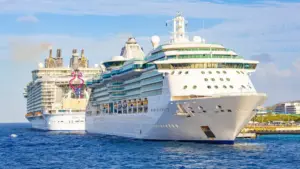
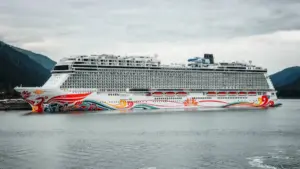
In the annals of modern commercial cruising, few voyages achieve legendary status before they even complete their itineraries. Yet, the current voyage of the Carnival Legend has secured its place in maritime history. On August 12, 2026, up to 2,134 passengers and an attentive crew aboard the 88,500-gross-ton Spirit-class vessel experienced a rare celestial phenomenon: a total solar eclipse viewed from the absolute center of the path of totality at sea.
Departing Dover, England, on August 9, 2026, this historic 11-night Carnival Journeys voyage represents Carnival Cruise Line’s maiden foray into astronomical tourism. As the moon’s shadow swept across the globe, positioning the ship off the rugged northern coast of Spain, guests and maritime experts alike witnessed a convergence of navigation, science, and leisure.
The extraordinary demand for this niche voyage caught even seasoned cruise executives by surprise. The sheer volume of elite loyalty members on board forced Carnival to temporarily suspend standard priority VIFP (Very Important Fun Person) benefits for Platinum-level guests due to unprecedented saturation. Far from a mere novelty, this successful venture has catalyzed an aggressive expansion into eclipse-themed itineraries, signaling a lucrative and rapidly expanding intersection between cruise travel and astronomical observation.
Detailed Chronology: The Making of a Celestial Voyage
Departure and Positioning (August 9 – August 11, 2026)
The journey began with palpable anticipation at the Port of Dover, where 2,134 eager guests boarded the Carnival Legend. Unlike standard Caribbean circuits or repetitive regional loops, this Carnival Journeys itinerary was meticulously engineered to weave through European ports of call—including destinations across France, Portugal, Spain, and Belgium—while maintaining a strict navigational schedule to intercept the lunar shadow precisely on August 12.
As the vessel plowed southward through the English Channel and into the Bay of Biscay, the onboard atmosphere was distinct from standard holiday cruises. Passengers traded traditional trivia books for star charts, and the ship’s lounges hosted impromptu lectures regarding solar mechanics, photography angles, and the physics of totality. The bridge crew, working closely with meteorological teams and cruise operations, fine-tuned the ship’s speed to ensure absolute precision upon reaching the coordinates required for optimal viewing.
The Moment of Totality (August 12, 2026)
The crescendo of the voyage arrived on the morning of August 12. Cruise tracking data confirmed that at the crucial hour, the Carnival Legend was perfectly stationed in open waters off the northern coast of Spain.
At precisely the right moment, the moon slipped directly between the Earth and the sun, plunging the vessel and the surrounding Atlantic into an eerie, silvery twilight. The sky transformed into a deep indigo, revealing bright stars and planets in midday, while the sun’s corona flared like a ghostly halo around the lunar silhouette.
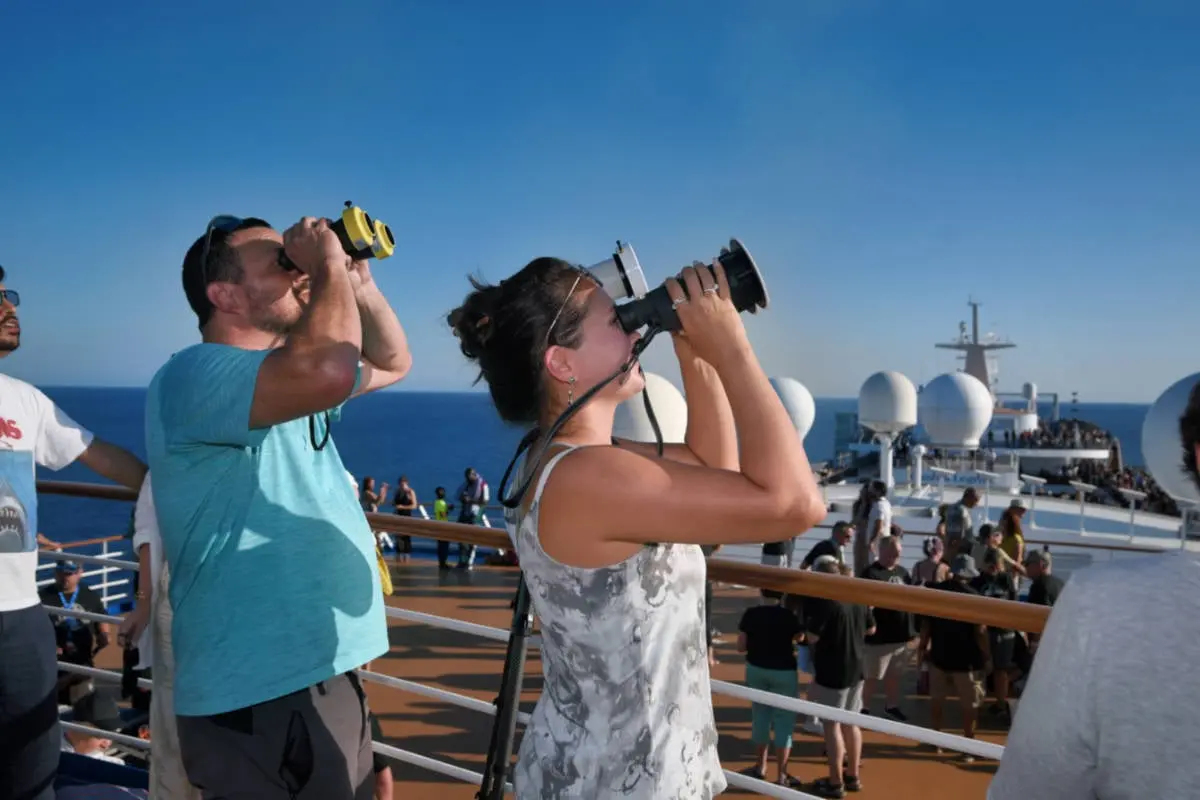
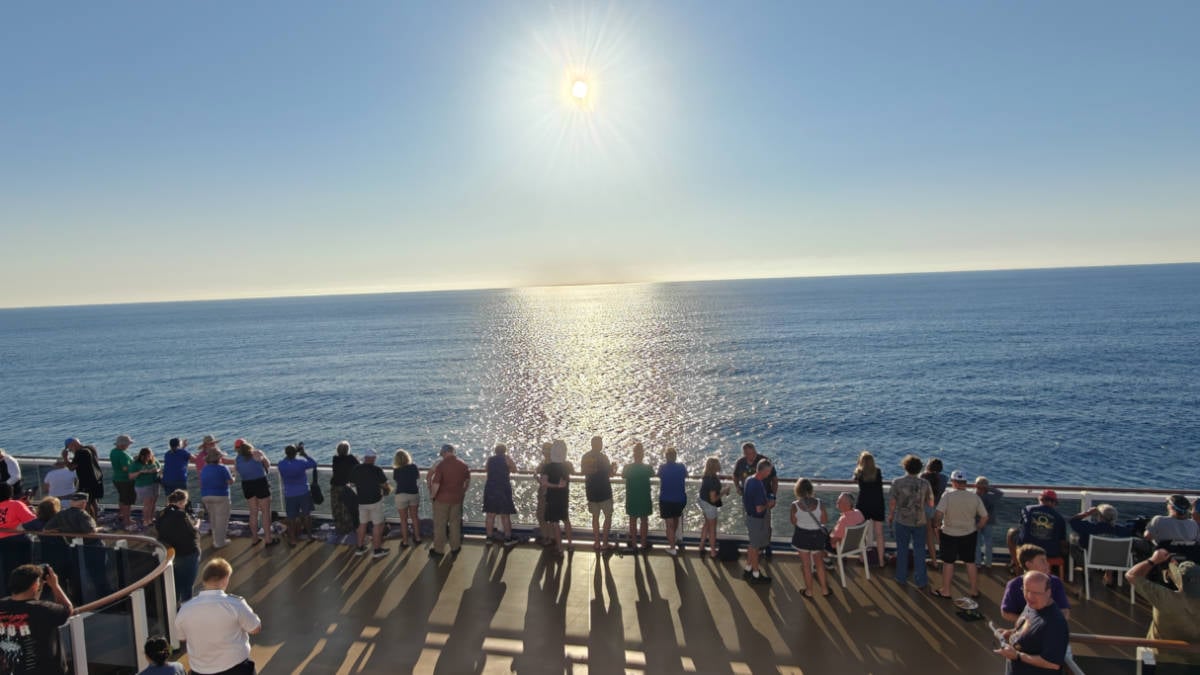
Though the cosmic alignment was awe-inspiring, its physical duration was fleeting. The totality lasted for just under two minutes—a brief window of time that felt simultaneously suspended and rushed for the thousands watching from the decks. Crew members had previously distributed certified ISO-compliant solar eclipse viewing glasses, allowing passengers gathered on the outer decks to look safely skyward during the partial phases of the eclipse before whipping them off to witness the naked-eye wonder of totality.
Following the event, the ship immediately transitioned back into its celebratory posture, charting a course toward Vigo, Spain, for its scheduled August 13 call, while kicking off an extended onboard festival featuring themed entertainment, specialty cocktails, and astronomy-focused activities designed to last for the remainder of the voyage.
Supporting Context & Metrics: The Mechanics and Scale of Eclipse Cruising
Understanding the Path of Totality
Executing an eclipse cruise requires a delicate balance of marine architecture, meteorology, and celestial mechanics. A total solar eclipse occurs only when the new moon intersects the direct line between the Earth and the sun, casting an umbral shadow across the planet’s surface. Because roughly 71% of the Earth is covered by water, the ocean often provides the most unobstructed viewing platforms, free from terrestrial impediments like mountain ranges or cloud-trapping valleys.
For the August 12, 2026, eclipse, the path of totality swept primarily across Greenland, western Iceland, northern and eastern Spain, and a tiny corner of Portugal. By positioning the Carnival Legend in the maritime corridor off northern Spain, Carnival’s itinerary planners maximized the probability of clear skies while ensuring the vessel remained comfortably inside the narrow corridor of 100% obscuration.
Fleet-Wide and Industry-Wide Impact
Carnival Corporation, the parent company of Carnival Cruise Line, dominated the maritime viewing space for this specific celestial event. Beyond the Carnival Legend, several sister brands deployed ships directly into the path of totality.
- Cunard Line: Fielded three of its majestic ocean liners—the Queen Mary 2, Queen Victoria, and Queen Anne—to intercept the shadow, offering luxury travelers an opulent backdrop for astronomical observation.
- Princess Cruises: Utilized the Sky Princess, placing another major Carnival Corporation asset within striking distance of the lunar path.
- Competitor Adjustments: The phenomenon was not exclusive to the Carnival family. Royal Caribbean notably altered the itinerary of the Liberty of the Seas earlier in the year to ensure its passengers could share in the rare spectacle, underscoring how competitive the cruise industry has become in capturing high-yield special-interest travelers.
The Logistics of Loyalty: Managing the VIFP Crunch
The unprecedented appeal of the Carnival Legend solar eclipse sailing exposed logistical hurdles regarding passenger demographics. Carnival Journeys sailings—defined as voyages lasting nine days or longer—traditionally attract the cruise line’s most dedicated clientele.
The demand for this specific eclipse itinerary was so intense that the volume of high-tier loyalty members threatened to overwhelm the ship’s infrastructure and service tiers. In a rare administrative move, Carnival Cruise Line had to formally drop priority VIFP benefits for Platinum-level guests. This decision, though frustrating to some elite cruisers, was a necessary operational adjustment to maintain equity and service standards in the face of a ship filled to the brim with top-tier loyalty status holders.
Future Outlook: The Horizon of Astronomical Cruising
Carnival’s 2027 Eclipse Expansion
Building upon the monumental success of the Carnival Legend voyage, Carnival Cruise Line has officially confirmed that it is doubling down on astronomical tourism. Three additional solar eclipse cruises have been slated for 2027, promising even more ambitious itineraries for space enthusiasts and avid cruisers alike.
- The Carnival Firenze South-to-North Voyage (February 2, 2027):
Kicking off the 2027 eclipse calendar, this massive 16-night Carnival Journeys sailing takes guests from the vibrant culture of Buenos Aires, Argentina, all the way to Miami, Florida, capturing southern hemisphere celestial alignments along the route. - The Carnival Sunshine Mediterranean Odyssey (July 25, 2027):
Departing from Barcelona, Spain, this 10-night Mediterranean voyage positions the mid-sized ship ideally for summer eclipse viewing in European waters. - The Carnival Miracle European Circuit (July 29, 2027):
Following closely behind, the Carnival Miracle will embark on an 11-night itinerary departing from Dover, England, mirroring the historic geographic launch point of the Legend while calling on ports in Portugal, Spain, France, and Belgium.
The Evolution of Special-Interest Cruising
The pivot toward eclipse chasing highlights a broader evolutionary trend within the multi-billion-dollar cruise industry. Traditional cruising—characterized by standardized Caribbean loops and predictable onboard programming—is increasingly sharing floor space with experiential, bucket-list tourism.
Whether chasing the Northern Lights in Alaska and Norway, navigating the Northwest Passage, or intercepting the moon’s shadow in the middle of the Atlantic and Mediterranean, modern travelers are seeking deeper meaning and once-in-a-lifetime validation from their vacations. For Carnival Cruise Line, the success of the Carnival Legend proves that travelers are more than willing to pay premium rates for precision-engineered memories. As the industry looks toward the 2027 deployments and beyond, the marriage of luxury seafaring and observational science has firmly established itself as a permanent fixture of the high seas.