Docking a large, heavy powerboat in a dark marina with a crosswind is a universally stressful experience that has tested the nerves of professional mariners and weekend boaters alike for generations. High-consequence maneuvers in tight quarters remain the ultimate friction point of recreational boating. However, a major technological leap is poised to permanently transform this high-stress maritime ritual. Simrad Yachting, operating under the umbrella of Brunswick Corporation’s Navico Group, has unveiled AutoCaptain—an advanced, factory-integrated autonomous docking and maneuvering system.
By seamlessly pairing an array of six hardtop-mounted stereo cameras with sophisticated machine learning algorithms and Mercury Marine’s proprietary Joystick Piloting technology, AutoCaptain takes over the delicate tasks of docking, undocking, and executing slow-speed, short-range maneuvers. Unlike aftermarket sensor kits or piecemeal third-party installations, AutoCaptain represents the industry’s first natively integrated, end-to-end autonomous marine solution built entirely by a parent company that controls everything from steering and propulsion to displays and sensors.
Currently making its debut aboard the flagship Boston Whaler 405 Conquest, AutoCaptain establishes a new benchmark for level two-plus semi-autonomous boating. It promises to democratize the water for beginners while alleviating the cognitive load for seasoned skippers. This in-depth report explores the technology, engineering, architecture, operational mechanics, and future roadmap of Simrad’s revolutionary AutoCaptain system.
Detailed Chronology: From Dreaded "Dockmares" to Push-Button Precision
High-stakes marine maneuvers have long inspired anxiety. Decades ago, running race-committee boats or managing heavy single-screw cabin cruisers without thrusters meant relying heavily on daylight, favorable tides, and sober deckhands. When those variables aligned poorly, the results frequently manifested as scuffed gelcoat, bruised egos, and tense post-trip conversations with marina operators.
While sensor-assisted docking has seen various iterations over the years, previous solutions often relied on aftermarket add-ons, disparate components, and complex multi-vendor integrations that could lead to finger-pointing when faults occurred. Simrad Yachting recognized that true autonomy required a holistic architectural approach. By leveraging Brunswick Corporation’s powerful vertical integration strategy—which unites Simrad electronics, Navico Group software, and Mercury propulsion under a single corporate roof—the engineering teams were able to bypass the limitations of aftermarket hardware.
The result of this cross-functional collaboration is AutoCaptain. Debuting initially on the premium Boston Whaler 405 Conquest, the system signals a major milestone in marine automation. Brunswick Corporation plans to systematically expand AutoCaptain to additional new-build platforms across its portfolio, ensuring that factory-level precision replaces the traditional trial-and-error of docking.
Technical Architecture: Hardware, Software, and Artificial Intelligence
Underneath its polished, intuitive user interface lies a remarkably complex web of hardware sensors, high-powered computing units, and advanced artificial intelligence models.
Achieving true 360-degree environmental awareness requires robust physical infrastructure. The AutoCaptain hardware ecosystem on the Boston Whaler 405 Conquest incorporates:
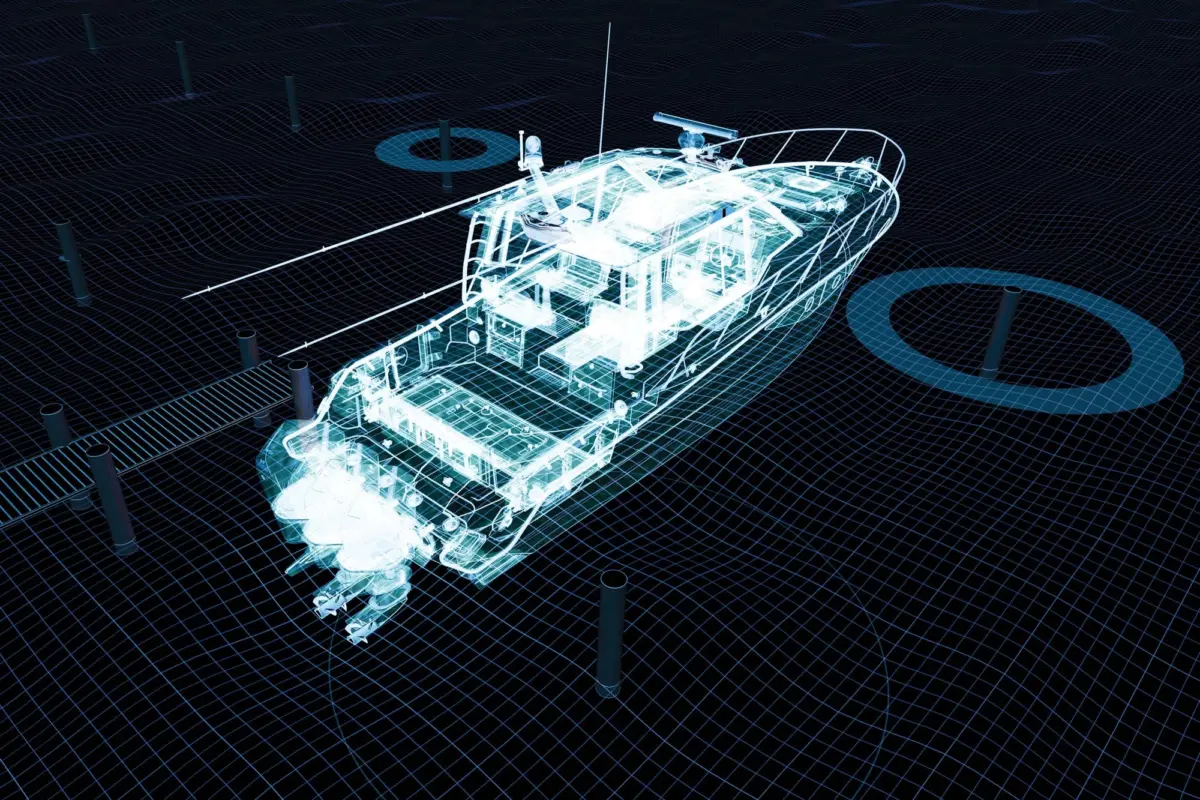
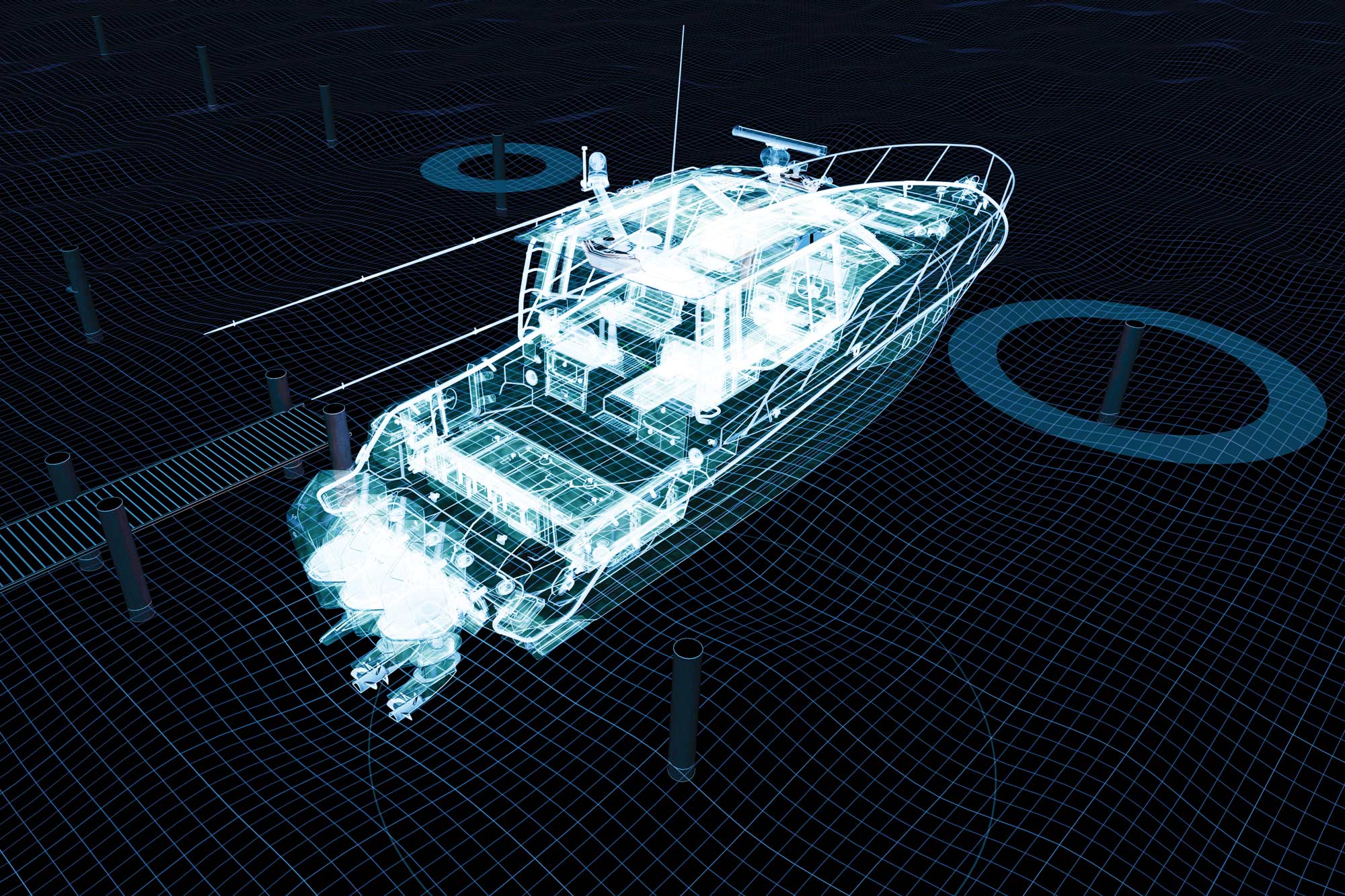
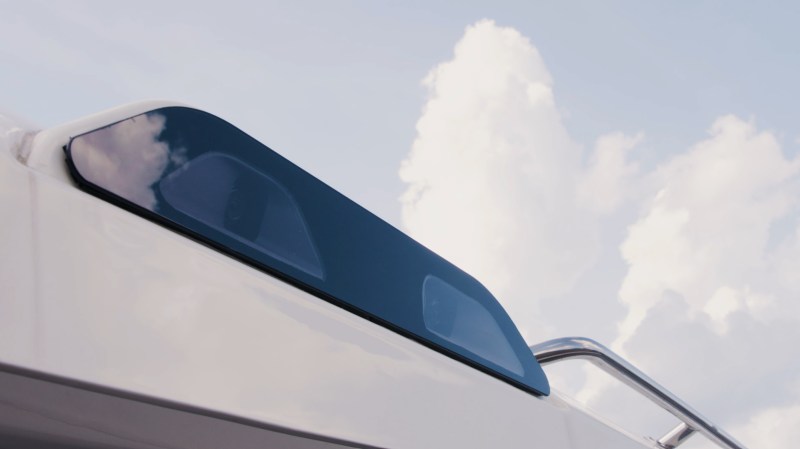
Six Stereo Cameras: Strategically installed within the hardtop to provide comprehensive, overlapping fields of view around the entire perimeter of the yacht. Stereo cameras were specifically chosen over monocular lenses or basic radar for their superior accuracy in calculating distance and depth of field. These cameras require minimal ambient light to operate effectively.
Black-Box Processing Unit: The central computational hub that ingests real-time video streams, runs environmental detection algorithms, and computes safe maneuvering paths.
Multifunction Displays (MFDs): At least one Simrad NSO 4 or NSS 4 display running the specialized AutoCaptain application.
Global Navigation Satellite System (GNSS) Receiver: Delivers precise geographic positioning data to map the vessel’s exact location relative to its surroundings.
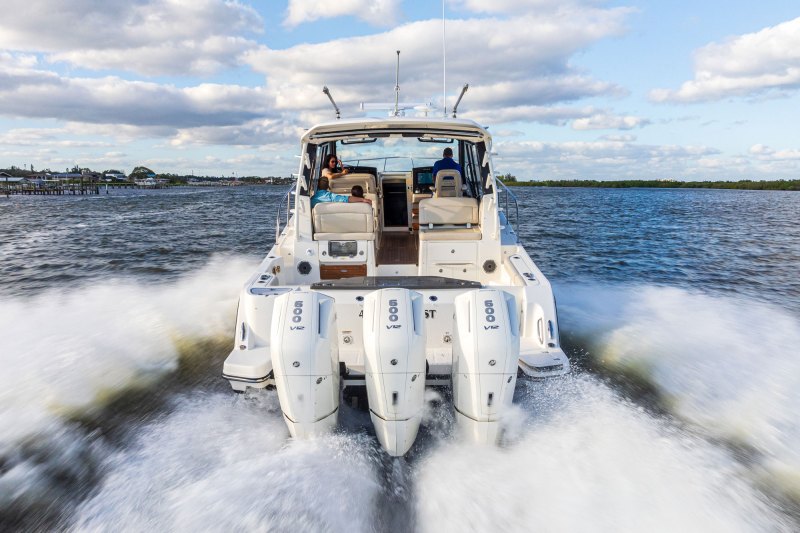
Propulsion and Steering: At least two compatible Mercury outboards paired with Mercury’s advanced Joystick Piloting system. (While bow thrusters can enhance performance, they are not universally required; any maneuver achievable via Mercury Joystick Piloting can be executed autonomously by AutoCaptain).
Software, Machine Vision, and Machine Learning
The software architecture is divided into two primary algorithms—one dedicated to non-water object detection and another focused on dynamic route planning. Furthermore, the system relies on two distinct forms of artificial intelligence:
Machine Vision: Empowers the processor to "see" and interpret above-the-waterline objects, structures, and vessels captured within the video stream.
Machine Learning: Enables the system to evolve organically over time without requiring explicit software reprogramming.
When a vessel first visits a marina, AutoCaptain constructs a ground-up spatial map using its stereo cameras and GNSS receiver. The system catalogs docks, pilings, neighboring boats, and floating obstacles. Because of onboard data storage and machine learning capabilities, this map improves with every subsequent visit. The more times the yacht docks in a specific slip, the more refined, efficient, and confident the autonomous system becomes.
Operational Mechanics and User Interface
Operating AutoCaptain is designed to be as straightforward as modern consumer electronics, though it maintains strict safety protocols that keep the human operator firmly in the loop. Brandon Ferriman, Brunswick’s senior director of program management, classifies AutoCaptain’s current autonomy as Level 2+ on the National Highway Traffic Safety Administration’s scale: it is hands-off, but the human must remain at the helm.
Step-by-Step Operation
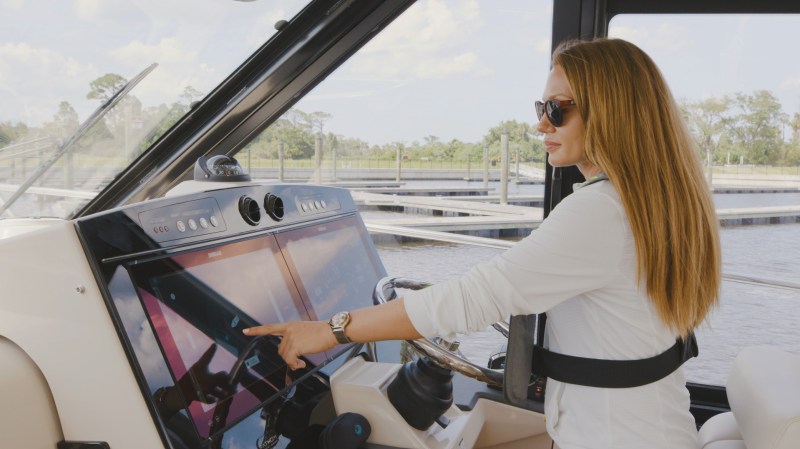
System Initialization: The operator opens the AutoCaptain application on the Simrad NSO 4 or NSS 4 display and explicitly acknowledges that they will remain helmside.
Command Input: Using the display’s touchpad, the operator instructs the system on where and how to position the yacht (e.g., directing it into a starboard-side slip with the bow facing outward).
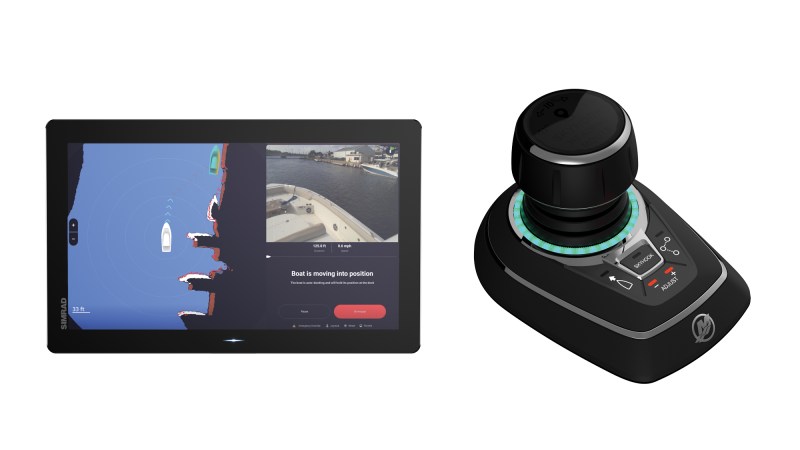
Screen Layout: The MFD interface is split into three distinct panes:
Port Two-Thirds: Displays a camera-generated vector map of the immediate vicinity.
Starboard One-Third (Top): Shows a live camera feed highlighting the yacht’s exact direction of travel.
Starboard One-Third (Bottom): Features a dialog box containing prominent "Disengage" and "Pause" buttons.
Active Safety and the "Pause" Feature
During execution, AutoCaptain continuously monitors the surrounding waters via its camera network. If an unmapped obstacle enters the vessel’s path, the system immediately recalculates a safe alternative route. If the system encounters a scenario it cannot definitively resolve, it smoothly transitions into a safety mode.
A standout innovation is the Pause button, a Skyhook-like station-keeping feature governed entirely by the autonomy software. When engaged, Pause mode commands the Mercury propulsion system to hold the yacht’s exact position and heading within a one-meter tolerance. This acts as a reliable "time-out" option if the captain needs a moment to assess changing dockside conditions.
AutoCaptain immediately enters standby mode if the human operator manually interacts with the steering wheel, throttles, joystick, or physical controls, or if they tap the on-screen disengage button. Upon successful completion of autonomous docking, a dedicated dock-hold feature maintains the vessel’s position against wind and tide, buying the captain crucial time to step away from the helm and secure the dock lines.
Supporting Context, Metrics, and Market Positioning
Feature / Specification
AutoCaptain Integration Details
Autonomy Level
Level 2+ (Hands-off, human helmside requirement)
Primary Launch Platform
Boston Whaler 405 Conquest (Expanding to other new builds)
Autonomous Docking, Undocking, and Short-Range Low-Speed Maneuvers
Station-Keeping Tolerance
Within 1 meter (via autonomous "Pause" mode)
Diagnostics & Support
Mercury G3 Service Tool integration
Navigating market positioning requires balancing accessibility with exclusivity. Jeremiah Clark, Navico Group’s vice president of product management for electronics solutions, emphasizes that AutoCaptain is strictly an original equipment manufacturer (OEM) offering.
"There’s no aftermarket. There’s no dealer install. The only way to get this is with a new boat."
Targeting premium midsize builds—such as the Boston Whaler 405 Conquest—ensures that the vessel possesses the structural real estate (specifically, a hardtop robust enough to house the 360-degree camera array) and the advanced electrical backbone required to support heavy computational loads. While smaller runabouts lack the physical architecture for this specific hardware suite, AutoCaptain effectively bridges two distinct demographic groups: it lowers the barrier to entry for novice boaters while providing a sophisticated technological safety net for seasoned skippers navigating adverse currents and tight spaces.
Future Outlook and Industry Implications
While AutoCaptain represents a massive leap forward in marine electronics, Simrad and Brunswick view the current iteration merely as Day One of an expansive software-driven roadmap. Because Brunswick owns the entire technology stack—encompassing navigation, sensors, displays, and propulsion—future upgrades will not require cumbersome hardware overhauls.
The Software-Defined Horizon
Future iterations of AutoCaptain are expected to arrive seamlessly via over-the-air or dealer-applied software updates. Developers are actively exploring ways to integrate additional proprietary sensor technologies already found on modern yachts, including:
Forward- and side-scanning sonar systems
Doppler-enabled marine radar
Automatic Identification System (AIS) transceivers
Because Navico and Mercury operate within a unified ecosystem, system diagnostics are streamlined. Service technicians can utilize tools like Mercury’s G3 Service Tool to troubleshoot both propulsion and autonomous navigation faults through a single interface, eliminating the frustrating multi-vendor finger-pointing that has historically plagued marine electronics.
Limitations and the Human Element
Industry analysts note that AutoCaptain is not currently programmed to interpret COLREGS (International Regulations for Preventing Collisions at Sea) for open-ocean navigation, nor is it designed for high-speed, long-range collision avoidance. Furthermore, critics occasionally caution against overreliance on automation among greenhorns.
However, technology advocates point out that nothing prevents AutoCaptain owners from occasionally stepping in to practice the traditional, manual "dark arts" of docking. For the modern yacht owner investing in a premium, Mercury-powered vessel, AutoCaptain transforms one of boating’s most stressful chores into a seamless, push-button experience—ultimately ensuring that every day on the water ends as relaxation, rather than a docking nightmare.