Executive Overview
As the Atlantic hurricane season continues to present logistical challenges for the maritime travel industry, Carnival Cruise Line has initiated proactive communications with thousands of passengers across the United States. Tropical Storm Isaias is rapidly organizing and gathering strength over the warm waters of the Gulf of Mexico. Meteorological models and advisories issued by the National Hurricane Center (NHC) indicate that the system is on a steady trajectory to intensify into a Category 1 hurricane before making landfall along the U.S. Gulf Coast.
In response to the developing severe weather system, Carnival’s Fleet Operations Center in Miami has escalated monitoring protocols. The cruise operator has placed a total of six vessels and 12 upcoming or active sailings under close weather watch. Passengers currently onboard these ships, as well as travelers holding reservations for imminent departures, have begun receiving automated text messages, emails, and formal letters outlining the situation.
Although major cruise homeports—such as New Orleans and Galveston—are currently not in the direct path of the projected landfall zone, the storm’s extensive wind field and hazardous maritime conditions threaten key navigational corridors. Tropical Storm Isaias is tracking directly across vital shipping lanes connecting major Gulf Coast homeports to destinations in the Eastern and Western Caribbean. This positioning forces cruise executives, ship captains, and meteorologists to evaluate potential itinerary diversions, delayed returns, and course alterations in real-time.
While the vast majority of itineraries continue to operate as scheduled for the time being, the unfolding weather event highlights the inherent unpredictability of cruising during peak tropical storm season. It also showcases the sophisticated coordination required between shipboard leadership and shore-side operations to ensure passenger and crew safety while minimizing vacation disruptions.
Detailed Chronology of the Weather Event and Operational Response
The Evolution of Tropical Storm Isaias
The meteorological narrative of Tropical Storm Isaias began taking shape in early October, as atmospheric conditions in the southwestern Gulf of Mexico favored tropical cyclogenesis. Fueled by high sea-surface temperatures and favorable moisture levels, the system organized steadily over several days.
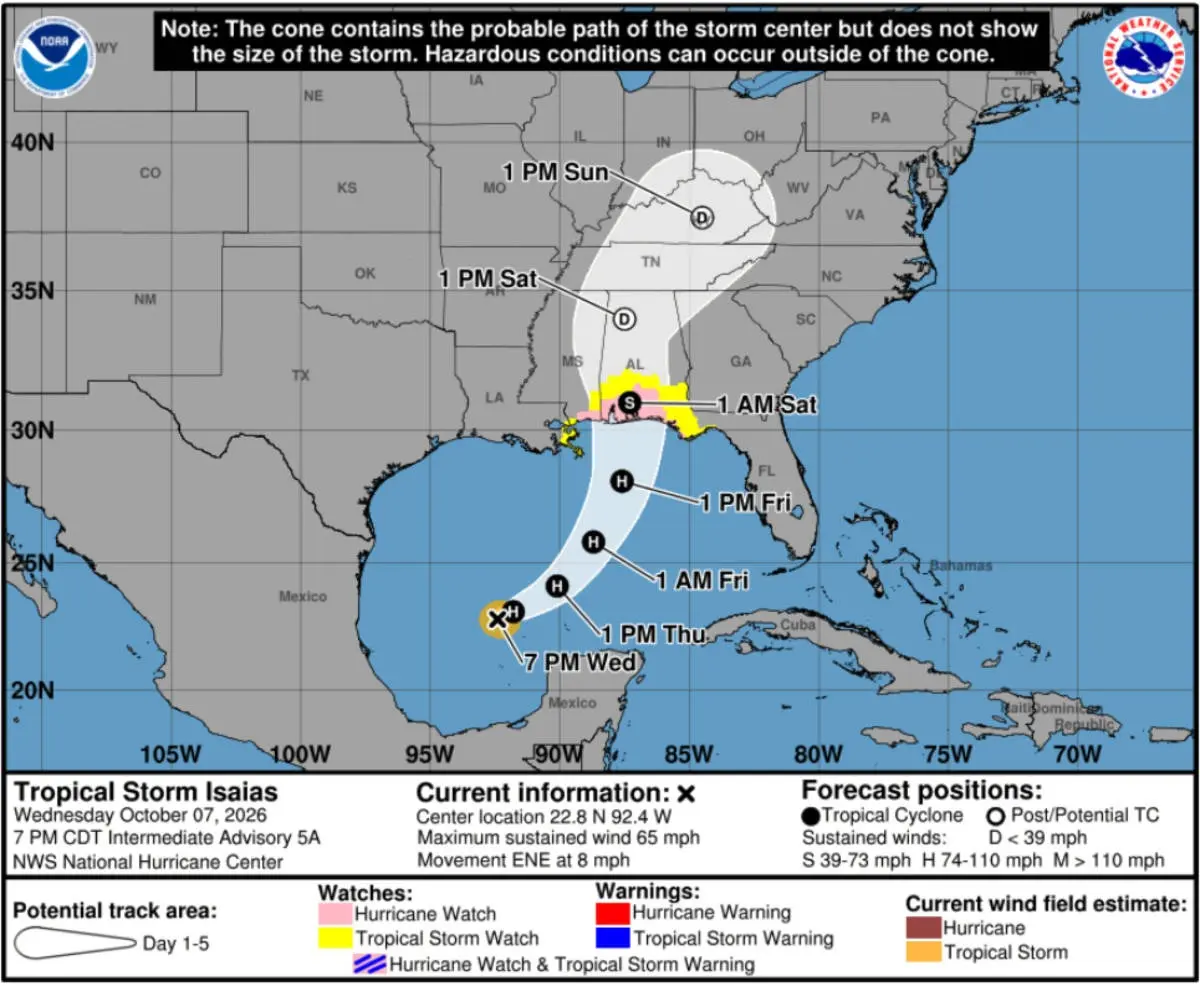
According to the official 7:00 PM CDT advisory released by the National Hurricane Center on October 7, Tropical Storm Isaias was located approximately 200 miles west-northwest of Progreso, Mexico. At the time of the advisory, the storm was generating maximum sustained winds of 65 miles per hour—just shy of the 74-mph threshold required for hurricane status. The system was moving at a relatively slow forward speed of 8 miles per hour in an east-northeast direction.
Forecasters at the NHC and private meteorological firms anticipate that Isaias will continue to accelerate slightly as it tracks deeper into the central and northern Gulf. The favorable environmental conditions are widely expected to push the storm across the Category 1 threshold before it makes official landfall.

Carnival’s Coordinated Communication Strategy
Carnival Cruise Line’s corporate headquarters and shipboard management teams enacted their heavy-weather communication protocols as soon as the NHC established a definitive cone of uncertainty for Isaias. Recognizing that anxiety can run high among travelers unaccustomed to navigating severe weather at sea, the company opted for transparent, multi-channel updates.
Guests currently booked on affected departures received direct communications via SMS text messaging and electronic mail. For instance, travelers booked on the October 10 departure of Carnival Breeze received timely text notifications directly from the cruise line, reassuring them that operations remained normal while emphasizing that conditions were under constant observation.
Concurrently, passengers already at sea experienced firsthand how cruise lines manage weather disruptions. Onboard the Carnival Dream, which was actively sailing an autumn itinerary, Captain Zvonko Anic addressed guests directly via a formal letter distributed on October 7.
"In partnership with our Fleet Operations Center in Miami, we are actively monitoring Tropical Storm Isaias," Captain Anic wrote. "Currently, there is no adjustment to our plans, but since forecasts can change, we will continue to monitor the weather and provide timely updates as we sail."
This proactive approach aims to balance operational transparency with guest reassurance, ensuring that travelers are neither caught off guard by sudden itinerary shifts nor unnecessarily alarmed by preliminary weather advisories.
Supporting Context, Route Impacts, and Operational Metrics
Geographic Scope: Ships and Sailings Under Watch
Carnival’s operational oversight currently spans six individual cruise ships and 12 distinct sailings intersecting with the projected path or residual swells of Tropical Storm Isaias. Because modern cruise ships are capable of altering course at speeds exceeding 20 knots, the primary objective is not necessarily to outrun a storm entirely, but rather to navigate well clear of high-risk wind zones, torrential squalls, and severe marine wave action.
The operational footprint encompasses vessels operating out of major Gulf Coast hubs. The geographic distribution of these ships means that fleet management must account for varying departure windows, return schedules, and regional sea states.

The Carnival Valor Case Study
A prime example of the dynamic decision-making required during such weather events is the Carnival Valor. The vessel was nearing the conclusion of a five-night Western Caribbean cruise as Isaias developed in the Gulf.
Carnival Valor is scheduled to complete its voyage and return to its homeport of New Orleans as planned on Thursday morning. However, the ship’s subsequent departure, slated for October 8, represents a crucial test case for the fleet. Depending on the exact forward speed and positioning of Isaias upon the ship’s turnaround, the Carnival Valor may become the first vessel in the Carnival fleet to execute a formally confirmed itinerary modification or delayed departure due to the storm. Marine operations teams are weighing whether to alter the ship’s initial southbound heading or adjust port stops in the Western Caribbean to keep passengers completely out of harm’s way.
Maritime Geography: Homeports vs. Open-Sea Corridors
A critical nuance in analyzing the threat posed by Tropical Storm Isaias involves the distinction between homeport landfalls and open-water navigational hazards.
According to current meteorological tracking models, Isaias is projected to make landfall just east of Mobile, Alabama. Notably, Mobile does not currently host active cruise departures for Carnival during this specific timeframe, meaning direct structural or infrastructural impacts to major cruise terminal operations in that immediate city are minimal.
However, the broader track of the storm cuts straight through the middle of the Gulf of Mexico. This area serves as the primary maritime highway for cruise ships transiting between central Gulf homeports—such as Galveston, Texas, and New Orleans, Louisiana—and popular cruise destinations in the Western and Eastern Caribbean. Consequently, the hazard is not necessarily a direct structural hit to a pier, but rather the generation of severe open-ocean swells, heavy localized rainfall, and gale-force winds across these critical shipping lanes.
Official Statements and Industry Insights
The management of severe weather events in the cruise industry relies heavily on a sophisticated matrix of meteorological data, naval architecture, and corporate risk management. Modern cruise ships are floating mega-resorts equipped with advanced radar systems, satellite weather tracking technology, and stabilizers designed to mitigate roll. Nevertheless, passenger comfort and absolute safety remain the paramount concerns for cruise line executives.
Fleet Operations Center Protocols
Carnival Cruise Line’s Fleet Operations Center in Miami operates around the clock during hurricane season (which officially runs from June 1 through November 30). Staffed by veteran master mariners, meteorologists, and logistics coordinators, the center analyzes real-time data feeds from agencies such as the National Hurricane Center, the National Oceanic and Atmospheric Administration (NOAA), and the Joint Typhoon Warning Center.
When a system like Tropical Storm Isaias reaches critical developmental thresholds, the Fleet Operations Center runs dozens of route simulations. These models evaluate fuel consumption implications, alternative port availability, tender operations safety, and passenger comfort metrics. If a Captain determines that an itinerary must be reversed, a port call must be canceled, or a sea day must be added to avoid rough seas, the corporate office immediately coordinates dockage availability and notifies shore-side vendors.
The Passenger Perspective: Navigating Autumn Cruises
Cruising during the autumn months offers distinct advantages, including lower pricing, less congested ports, and pleasant weather across many global regions. However, travelers booking Caribbean and Gulf itineraries during peak tropical activity windows must accept a degree of flexibility.
Industry analysts consistently emphasize that a cruise ship is fundamentally safer during a tropical storm than a fixed coastal structure. Unlike homes or land-based hotels located in flood zones or hurricane paths, cruise ships possess the ultimate luxury: mobility. By simply lifting anchor and altering course by 100 or 200 miles, a ship can completely bypass the most dangerous quadrants of a hurricane.
Carnival’s ticket contract explicitly outlines the line’s right to alter itineraries, skip scheduled ports, or substitute alternative destinations in the interest of safety, without providing financial compensation or refunds for such weather-related changes. Despite this, passenger relations teams strive to maintain high satisfaction levels by offering onboard credits, extending communication channels, and ensuring transparency at every turn.
Future Outlook and Best Practices for Travelers
As Tropical Storm Isaias continues its progression across the Gulf of Mexico, the coming 48 hours will be critical for determining the full extent of its operational footprint.
What to Expect Next
- Intensification Phase: Meteorological models will continue to monitor whether Isaias achieves Category 1 status prior to landfall. Any unexpected acceleration or intensification could compress the decision-making window for departing vessels.
- Itinerary Adjustments: While ships like Carnival Valor (departing October 8) and Carnival Breeze (departing October 10) are currently operating under close observation, travelers should expect formal announcements regarding route modifications if the storm’s wind field expands.
- Return and Turnaround Logistics: For vessels returning to New Orleans and Galveston late in the week, harbor pilots and port authorities will assess channel conditions to ensure safe docking procedures, preventing any extended delays outside the harbor.
Essential Advice for Cruise Passengers
For travelers currently booked on upcoming Gulf or Caribbean cruises during the autumn season, industry experts recommend several proactive steps:
- Stay Informed: Monitor official communications from the cruise line via email and text message rather than relying solely on speculative social media reports.
- Download the Hub App: Ensure the Carnival Hub app is installed and notifications are enabled for real-time onboard updates.
- Build in Travel Flexibility: Arrive at the homeport city at least one day prior to embarkation to buffer against potential flight delays or localized travel disruptions caused by outer rain bands.
- Secure Comprehensive Travel Insurance: Purchase third-party travel insurance policies that specifically cover trip interruption, weather-related delays, and emergency medical evacuation.
As the situation develops, Carnival Cruise Line remains committed to adapting its operations dynamically, proving once again that safety at sea relies on a delicate balance of cutting-edge technology, vigilant seamanship, and transparent communication.