











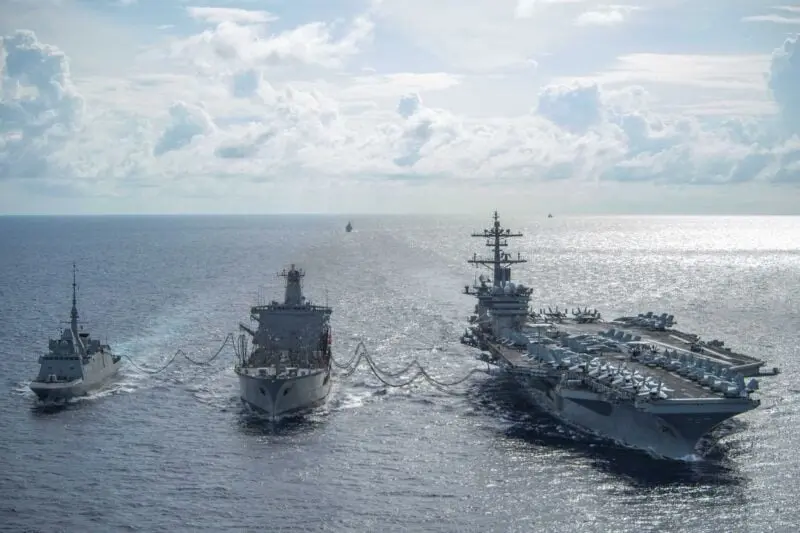
WASHINGTON, D.C. — In a significant escalation of American military posture in the Middle East, the Pentagon has ordered the deployment of an additional aircraft carrier strike group alongside 10,000 sailors and Marines to the Persian Gulf. The strategic realignment, confirmed by a senior U.S. defense official, provides President Donald Trump with a expanded suite of military options should he choose to intensify kinetic operations against Iran following the upcoming November midterm elections.
The move comes at a critical juncture in an eight-month-old conflict that has pushed global energy markets to the brink and severely tested the operational limits of the United States Navy.
Executive Overview
On Sunday, October 3, 2026, the Nimitz-class aircraft carrier USS Theodore Roosevelt (CVN-71) quietly departed its home port of San Diego, California, charting a course for the Middle East. The deployment of the Theodore Roosevelt and its accompanying strike group represents a major reinforcement of the U.S. Fifth Fleet’s area of operations. Upon its arrival, the U.S. military could once again operate three carrier strike groups (CSGs) in the region—a concentration of naval power not seen on a sustained basis since the 2003 invasion of Iraq, save for a brief window in late April of this year.

This naval surge is unfolding against a backdrop of heightened political and economic volatility. President Trump has publicly signaled that more intense military strikes against Iranian targets remain "possible" once the domestic political dust settles after the November midterms.
To bolster this posture, the Pentagon has also dispatched the USS Makin Island Amphibious Readiness Group (ARG), carrying the 15th Marine Expeditionary Unit (MEU)—a force of 2,200 Marines trained in amphibious assault, raid operations, and crisis response. Concurrently, the USS Boxer ARG is patrolling the highly sensitive waters near the Strait of Hormuz, a critical global choke point where Iran has attempted to assert unilateral control.
However, the decision to maintain such an aggressive posture is drawing sharp warnings from defense analysts. The relentless deployment cycle is exacerbating deep-seated readiness and maintenance issues within the U.S. Navy’s carrier fleet. Sailors are facing unprecedented operational tempos, underscored by the grueling 11-month deployment of the USS Gerald R. Ford and the 9-month tour of the USS Abraham Lincoln, raising serious concerns about crew mental health and material wear-and-tear.
Detailed Chronology
The current naval buildup is the culmination of weeks of shifting deployments, political maneuvering, and strategic posturing in both Washington and Tehran.

[Late April 2026] ------------------> [Late Sept 2026] --------------> [Oct 3, 2026]
Peak presence: 3 CSGs                 USS George H.W. Bush            USS Theodore Roosevelt
deployed in the Middle East           temporarily departs region      departs San Diego for Gulf
The Naval Chessboard
- Late April 2026: The U.S. military achieves a peak presence of three carrier strike groups in the Middle East to deter Iranian retaliation during a period of intense kinetic exchanges.
- September 2026: The USS George H.W. Bush (CVN-77) temporarily departs the Middle East for scheduled maintenance and crew relief, leaving the USS George Washington (CVN-73) as the sole operating carrier in the immediate theater.
- Late September 2026: In response to intelligence indicating potential Iranian provocations and to prepare for potential post-election offensive options, the Pentagon finalizes plans for a renewed surge.
- Sunday, October 3, 2026: The USS Theodore Roosevelt departs San Diego. The carrier, along with its air wing and guided-missile escorts, begins its transit across the Pacific toward the Indian Ocean and the Persian Gulf.
- Monday, October 4, 2026: The USS Makin Island (LHD-8) Amphibious Readiness Group, carrying 2,200 Marines of the 15th MEU, sets sail for the Middle East to provide U.S. Central Command (CENTCOM) with robust amphibious landing and rapid-reaction capabilities.
Defensive Fortifications in the Gulf
In parallel with these naval movements, the U.S. has quietly reinforced land-based air defenses in the region. Over the past several weeks, Washington has deployed two additional air and missile defense batteries—likely Patriot or THAAD systems—to Qatar and Saudi Arabia.
According to regional security sources, these batteries are positioned specifically to shield vital oil and gas infrastructure from potential Iranian ballistic missile or drone counterstrikes, reassuring regional allies of Washington’s commitment to their defense ahead of any potential escalation.
Supporting Context & Metrics
Naval Readiness Strain and the Human Cost
While deploying three carriers provides unparalleled tactical flexibility, the long-term strategic cost to the U.S. Navy is severe. Maintaining a continuous multi-carrier presence in a single theater disrupts the Navy’s carefully balanced Optimized Fleet Response Plan (OFRP), which dictates cycles of maintenance, training, and deployment.
+--------------------------+---------------------+-----------------------+
| Vessel                   | Deployment Length   | Prior Operations      |
+--------------------------+---------------------+-----------------------+
| USS Gerald R. Ford       | 11 Months           | Venezuela / Mideast   |
| USS Abraham Lincoln      | 9 Months            | Western Pacific / Gulf|
| USS Theodore Roosevelt   | Active (Just Begun) | East Coast / Pacific  |
+--------------------------+---------------------+-----------------------+
Ronald O’Rourke, a highly respected naval analyst and retired expert from the Congressional Research Service (CRS), warned of the compounding toll this takes on the fleet:
"Maintaining even a two-carrier presence in that area over an extended period of time would be a strain for the carrier force. But maintaining a three-carrier presence in that area for an extended period would be a significantly greater strain."
This strain is not merely mechanical; it is deeply human. The USS Gerald R. Ford (CVN-78) was kept at sea for 11 months, having been diverted to the Middle East immediately after completing operations near Venezuela. Similarly, the crew of the USS Abraham Lincoln (CVN-72) recently arrived in Thailand for a brief respite after a grueling nine-month deployment. The length of these tours has forced senior leadership to make crew mental health a top operational priority, with dedicated psychological support teams deployed directly aboard the vessels to combat burnout and depression.
Economic and Market Implications
The prospect of an expanded conflict in the world’s most critical energy corridor has sent tremors through global financial markets. Investors are forced to perform a delicate balancing act: weighing the inflationary pressures of a potential oil shock against signs that the U.S. Federal Reserve may adopt a more cautious approach to interest rate hikes.
- Brent Crude Pricing: Following news of the Theodore Roosevelt‘s deployment and the threat of post-election strikes, Brent crude rose 0.4% to $102.74 a barrel, compounding a sharp 4% gain recorded earlier in the week.
- The Hormuz Factor: The Strait of Hormuz, a narrow waterway separating Iran from the Arabian Peninsula, is transit point for approximately one-fifth of the world’s liquid petroleum. Any active hostilities that disrupt transit through the strait could rapidly push oil prices well north of $120 a barrel, threatening global economic growth.
The Diplomatic Impasse
The military buildup occurs during a fragile, temporary lull in active strikes. The war, now entering its eighth month, remains deadlocked over fundamental issues. Chief among these is Iran’s insistence on asserting operational control over the Strait of Hormuz and demanding the withdrawal of Western naval forces.
Behind the scenes, backchannel diplomacy continues. Iranian Foreign Minister Abbas Araghchi has privately signaled that Tehran might be willing to grant International Atomic Energy Agency (IAEA) inspectors renewed access to nuclear facilities that were damaged in previous U.S. or allied airstrikes. In exchange, however, Tehran is demanding substantial relief from the crippling economic sanctions reinstated and expanded by the Trump administration.
Official Statements
Despite the visible movement of massive naval assets, official channels in Washington remain highly guarded, citing operational security.
U.S. Central Command (CENTCOM), which oversees all military operations in the Middle East, declined to confirm specific arrival dates or tactical plans for the incoming strike groups, releasing a brief statement:
"We don’t discuss unit schedules for operational security reasons."
However, President Trump has been far more vocal regarding his administration’s posture. Speaking to reporters ahead of the crucial November midterms, Trump left little doubt that the current diplomatic lull is highly conditional:
"Increased military strikes against Iran are certainly possible. We are looking at all options, and those options will become much clearer after the elections."
On the ground in the Gulf, the deployment of missile defense batteries to Qatar and Saudi Arabia was characterized by regional officials as a direct security guarantee. A senior Middle Eastern defense official, speaking on the condition of anonymity, noted:
"The deployment of these missile batteries is a clear message. Washington is telling us that if they choose to strike, they will not leave their partners vulnerable to the inevitable retaliation from Tehran."
Future Outlook
The coming weeks are poised to determine the trajectory of the Middle East for the next decade. Analysts point to two distinct paths that the conflict may take as the USS Theodore Roosevelt nears its destination.
Scenario A: Post-Election Escalation
If President Trump views the midterm election results as a mandate, or if he seeks to project decisive strength, the presence of three carrier strike groups will allow for a sustained, high-intensity air campaign.
The primary targets would likely be Iran’s remaining nuclear infrastructure, ballistic missile silos, and Islamic Revolutionary Guard Corps (IRGC) naval bases along the coast. The USS Makin Island and USS Boxer ARGs would secure shipping lanes, attempting to keep the Strait of Hormuz open by force.
Scenario B: Leverage for a Diplomatic Breakthrough
Alternatively, the overwhelming concentration of military force may be designed as the ultimate "maximum pressure" leverage. By positioning three carriers, amphibious assault groups, and advanced missile defense systems on Iran’s doorstep, Washington may be attempting to force Foreign Minister Araghchi and the Iranian leadership to accept a highly unfavorable diplomatic settlement—one that permanently curtails Tehran’s nuclear ambitions and regional proxy network in exchange for economic survival.
Regardless of the political outcome, the immediate future will test the structural integrity of the U.S. Navy. If the Pentagon continues to rely on extended deployments to project power in the Gulf, it risks degrading its fleet readiness to a point that could compromise American naval readiness in other critical theaters, most notably the Indo-Pacific.


