










Executive Overview
As the global transition toward renewable energy accelerates, the solar power industry faces a paradox of its own making: while demand for photovoltaic (PV) generation is reaching historic highs, the physical space required to build these facilities is increasingly scarce. Developers nationwide are encountering a formidable matrix of challenges, including local community opposition, complex municipal zoning laws, stringent federal and state regulations, and skyrocketing land competition. In densely populated urban areas and growing suburbs, finding expansive, flat, unobstructed parcels of land has become nearly impossible.
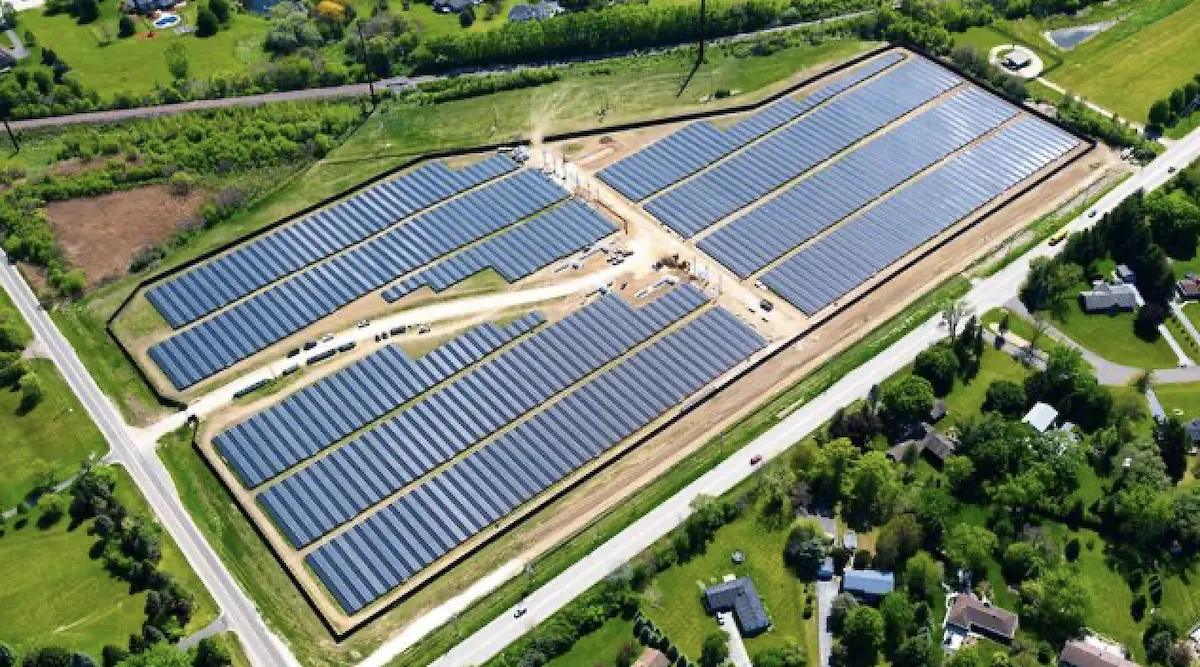
Enter the realm of spatial innovation. A groundbreaking 11-megawatt (DC) solar project recently brought online in Elgin, Illinois, illustrates how next-generation engineering can overcome severe spatial and environmental limitations. Developed by Cultivate Power and powered by a high-density, software-enabled racking system from Planted Solar, the Bowes Solar array proves that clean energy can thrive in seemingly impossible locations. Sandwiched between residential subdivisions, high-voltage power lines, active train tracks, and sensitive wetlands, this 22-acre project defies traditional rules of solar development.
Beyond its engineering marvels, the Bowes project represents a masterclass in community-centric clean energy infrastructure. By leveraging the economic engine of community solar, the facility delivers millions of dollars in utility bill savings to low- and moderate-income (LMI) households, local businesses, and municipal entities. Supported by equity investments from firms like Generate Capital, projects like Bowes and its rural counterpart, the Goldenrod Solar array in Mercer County, demonstrate that the future of solar energy lies in maximizing efficiency, respecting community aesthetics, and directly enriching local economies.
Detailed Chronology: The Making of the Bowes Solar Project
The realization of the Bowes Solar array was not a matter of simply dropping panels into a vacant field. It was an exercise in strategic planning, meticulous engineering, and multi-year project execution designed to navigate an exceptionally hostile landscape for conventional development.
Phase 1: Identifying and Evaluating a "Rejected" Parcel
For years, the 22-acre parcel in Elgin, Illinois—one of the state’s largest cities outside of Chicago—sat largely neglected. Real estate developers had repeatedly passed over the land due to a constellation of geographic and logistical deterrents. Situated awkwardly between two established residential subdivisions, the property was bisected or bordered by high-voltage transmission lines and active railroad tracks. To compound these hurdles, a protected wetlands ecosystem occupied a significant corner of the site.
Under traditional industry standards, this parcel would have been written off immediately. Conventional utility-scale and community solar projects require contiguous, flat, open acreage with minimal environmental encumbrances. However, Cultivate Power identified an opportunity where others saw only red tape. Recognizing the acute demand for localized clean energy in the Chicago metropolitan area, the development team set out to engineer a custom solution for a site that defied conventional rules.
Phase 2: Site Partitioning and Environmental Protection
To tackle the irregular footprint of the Elgin parcel, the Cultivate Power team executed a divide-and-conquer strategy. Rather than attempting to force a single, uniform array onto the fragmented land, the developers divided the installation into two distinct, interconnected arrays.
This architectural division served two critical functions:
- Regulatory Compliance: Splitting the site provided the necessary geometric flexibility to respect municipal setback requirements from neighboring residential properties, roadways, and infrastructure.
- Ecosystem Preservation: The dual-array layout allowed engineers to completely detour around the sensitive wetlands area in the corner of the property, preserving local biodiversity and eliminating the risk of environmental regulatory violations or costly legal battles.
Phase 3: High-Density Integration and Aesthetic Harmonization
Once the spatial layout was established, the next challenge was maximizing energy generation potential. A standard 11-megawatt project would typically require anywhere from 55 to 77 acres of land under traditional racking configurations. Squeezing 11 megawatts into a 22-acre footprint required an unprecedented leap in hardware technology.
Cultivate Power partnered with Planted Solar to deploy a cutting-edge, high-density racking system. Unlike traditional fixed-tilt or tracking systems that require wide spacing to prevent inter-row shading, Planted Solar’s software-enabled infrastructure optimizes panel density per square foot.
Furthermore, community integration required sensitivity to local aesthetics. Because the site is tightly hemmed in by residential neighborhoods, visual impact was a primary concern for local stakeholders. The Planted Solar system features a low-profile design that sits remarkably close to the ground. Cultivate Power supplemented this low-slung hardware by installing a high-grade opaque fence and extensive natural vegetative screening. As a result, the sprawling power plant remains entirely invisible to passersby and neighboring homeowners, effectively neutralizing aesthetic opposition before it could materialize.
Phase 4: Interconnection and Commissioning
With the physical infrastructure secured, the project was tied into the regional grid via Commonwealth Edison (ComEd). By feeding clean energy directly into the local distribution network, the Bowes array seamlessly transitioned from a construction site into an active community solar generating station, immediately beginning to yield dividends for regional ratepayers.
Supporting Context & Metrics: The Science of High-Density Solar
To fully understand the significance of the Bowes Solar project, one must examine the macroeconomic and technical metrics driving the evolution of the solar industry.
The Land-Use Dilemma
As prime, easily accessible flat land becomes scarce and increasingly expensive, solar developers face diminishing returns. Industry benchmarks historically dictate that standard community solar developments require 5 to 7 acres for every megawatt-peak (MWp) generated. Under this conventional calculus, an 11-megawatt plant would demand a minimum of 55 to 77 acres.
When developers attempt to force large capacities onto smaller parcels using old-fashioned methods, projects frequently collapse under the weight of ballooning land acquisition costs and engineering impossibilities. Conversely, scaling down the capacity to fit a smaller parcel often renders the project economically unviable due to fixed administrative and interconnection costs.
Planted Solar’s Technological Breakthrough
Planted Solar was founded to shatter these spatial limitations. By engineering a high-density racking system supported by advanced spatial software, the firm has successfully reduced the land requirement to approximately 2 acres per MWp.

To put this metric into perspective:
- Conventional 5 MW Project: Requires 25 to 35 acres.
- Planted Solar 5 MW Project: Requires only about 15 acres.
- Bowes Solar 11 MW Project: Fits comfortably into a constrained 22-acre urban parcel that would have been mathematically and physically incapable of hosting a traditional array.
Overcoming Topographical Constraints
Beyond spatial density, terrain constraints historically kill countless solar projects during the initial feasibility study. Industry rules of thumb dictate that any site with a slope exceeding 10% requires intensive, expensive grading. Substantial earthwork not only drives up capital expenditures but also triggers prolonged environmental reviews, erosion control hurdles, and permitting delays that can kill a project.
The Planted Solar racking architecture bypasses this roadblock through a terrain-following strategy capable of accommodating existing surface grades of up to 27%. This capability opens up vast swathes of previously disqualified land—such as rolling pastures, brownfields, and irregular industrial parcels—allowing developers to harvest solar energy without disturbing topsoil, altering natural drainage patterns, or incurring massive grading bills.
Official Statements and Stakeholder Perspectives
The success of the Bowes Solar project has reverberated across the clean energy sector, drawing commentary from developers, tech innovators, financial backers, and local journalists.
Cultivate Power on Constrained Land Development
In an official statement provided to clean energy media outlets, representatives from Cultivate Power emphasized that urban and constrained-site development is no longer a niche strategy—it is the bleeding edge of the industry:
"Developing solar on constrained parcels is a growing focus for the industry. It’s becoming more important as competitive land use drives solar onto smaller and smaller parcels."
The company’s ability to execute complex urban projects highlights a broader industry shift: developers who master the art of navigating regulatory, spatial, and environmental hurdles will capture the lion’s share of future distributed generation markets.
Financial Backing and Rural Applications: Generate Capital
Cultivate Power’s primary equity investor, Generate Capital, has been instrumental in scaling these high-impact projects. Generate notes that while urban projects like Elgin showcase spatial ingenuity, the same principles of community-focused, space-efficient design are equally transformative in rural agricultural communities.
Highlighting another Cultivate collaboration—the Goldenrod Solar project commissioned in Mercer County, Illinois—Generate Capital pointed out the dual economic pressures facing rural landowners:
"In a rural farming community like Mercer County, solar savings are out of reach for renters and low- and moderate-income families who are unable to install their own panels. Landowners, meanwhile, face pressure to keep every acre productive. Community solar answers both, extending savings to local subscribers, while giving a working farm stable new income alongside its crops."
The 5-megawatt Goldenrod installation demonstrates that whether planted in an urban nook in Elgin or integrated into a working agricultural landscape in Mercer County, modern solar engineering can harmonize competing land uses.
Local Economic Impact and Community Solar Metrics
Community solar’s true differentiator lies in its direct economic trickle-down effect to local populations. Reporting by Bill Dwyer of Chronicle Media sheds light on the tangible financial benefits realized by the residents of Elgin and surrounding Cook County areas.
According to project disclosures, the Bowes array is structured to deliver profound, long-term economic relief:
- Direct Household Savings: The project supplies discounted electricity via ComEd to 580 low- and moderate-income (LMI) households, cutting participating customers’ energy charges by approximately 20%.
- Broad Commercial & Municipal Inclusion: In addition to residential subscribers, the array serves three small businesses, two local municipalities, and a regional church.
- Long-Term Consumer Dividends: Cultivate Power officials project that cumulative subscriber savings on their utility bills will reach an astonishing $13.9 million over the next 40 years.
- Municipal Tax Revenue: The project is slated to generate $2.1 million in property tax revenues over the same four-decade timespan, directly bolstering the local school district and municipal agencies.
- Philanthropic Engagement: Beyond statutory taxes and utility savings, Cultivate Power has dedicated substantial financial contributions to regional institutions, including Elgin Community College, Food for Greater Elgin (a Northern Illinois Food Bank partner agency), Friends of the Fox River, We Care Solar, and the Evolve Foundation.
Future Outlook: The Scalability of High-Density Solar
As municipal populations grow and community pushback against large, land-hungry energy projects persists, the energy transition faces a definitive bottleneck. Traditional utility-scale solar models—characterized by vast, uniform arrays sprawling across thousands of acres of cleared farmland—are increasingly running into local resistance and spatial exhaustion.
The blueprint established by Cultivate Power and Planted Solar in Elgin, Illinois, offers a compelling vision for the future of decentralized generation:
- Unlocking "Unusable" Land: By mastering high-density racking, software-driven layout optimization, and high-slope terrain adaptation, developers can tap into millions of acres of dormant, irregular, or environmentally sensitive parcels that were previously deemed undevelopable.
- Deepening Community Buy-In: The integration of community solar models ensures that clean energy infrastructure is not viewed as an intrusive imposition by local residents, but rather as a welcome economic asset that slashes utility bills for vulnerable populations and funds public education and municipal services.
- Bridging the Urban-Rural Divide: Innovations proven in dense urban environments translate seamlessly to rural landscapes, offering farmers a reliable secondary revenue stream while protecting arable topsoil and preserving agricultural heritage.
The clean energy revolution is no longer solely about chasing gigawatts across open horizons; it is about precision, creativity, and maximizing efficiency in every square foot we occupy. As high-density racking technologies mature and scale, the fossil fuel industry will find itself increasingly hemmed in—not by a lack of available land, but by a relentless wave of smart, space-efficient, and community-empowering solar infrastructure.