





Executive Overview
For decades, the global wind energy industry has followed a rigid path of technological convergence. Across continents and coastlines, the standard formula for utility-scale generation has settled on a singular design: a massive, three-bladed, upwind turbine mounted atop a towering, freestanding tubular steel structure. It is a configuration born of extensive trial, error, and hard-won economic optimization. Consequently, when alternative designs emerge—particularly those that resurrect long-abandoned ideas like downwind rotors or multi-turbine floating platforms—they are typically met with deep skepticism from industry veterans.
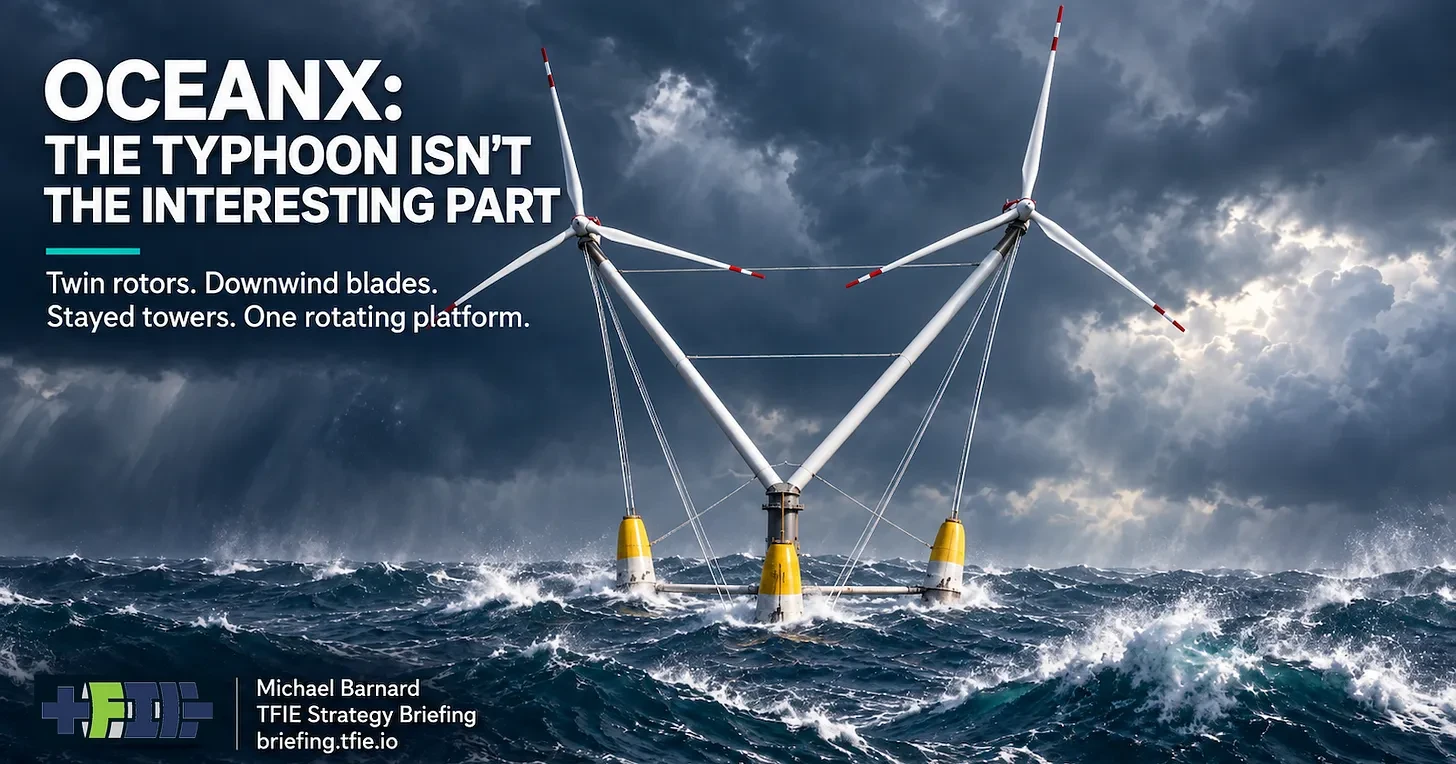
The OceanX floating wind turbine was initially primed to trigger that exact skepticism. Featuring an unconventional twin-rotor layout and a downwind architecture, it appeared to defy the foundational engineering consensus that has governed the wind sector for years. However, theory and computer models can only dictate so much; the ultimate validation for any offshore energy system comes when it is thrown into the crucible of extreme weather.
That crucible arrived in the form of Super Typhoon Yagi, a ferocious meteorological event that delivered punishing winds and towering waves directly to Mingyang’s offshore testing grounds. Against the odds, OceanX weathered the tempest with flying colors, registering minimal nacelle inclination and confirming that its pre-storm structural simulations were remarkably accurate.

Yet, the true significance of the OceanX test extends far beyond its ability to survive a severe storm. A closer engineering dissection reveals that the machine’s most compelling innovations lie not in its headline-grabbing twin rotors, but in its holistic architectural choices: slender, stayed support structures, downwind operation, and a whole-platform weather-vaning capability. While questions regarding long-term economics and component redundancy remain, the empirical data gathered during Super Typhoon Yagi demands that the offshore wind community re-evaluate long-held biases against downwind floating turbine concepts.
Detailed Chronology: From Skepticism to the Crucible of Typhoon Yagi
The Initial Skepticism of Unconventional Architecture
Years prior to its baptism by fire, the foundational concepts behind OceanX were largely dismissed by mainstream wind energy analysts. The historical evolution of the wind industry was not accidental; it was forged through decades of addressing mechanical failures, aerodynamic inefficiencies, and lifecycle fatigue costs.
Traditional industry wisdom dictates two primary rules that OceanX brazenly broke:
- The Upwind Monopoly: Modern turbines place the blades upwind of the tower so that the rotors operate in clean, undisturbed air. Historically, downwind turbines—where the wind passes the support structure before hitting the blades—suffered from severe fatigue issues. Every time a blade passed through the turbulent wake generated by a massive tower, it experienced sudden load spikes. This cyclic stress accelerated material fatigue and produced a characteristic, disruptive low-frequency noise.
- The Single-Rotor Standard: Scaling up to one massive rotor per platform maximises generation efficiency while minimising mechanical complexity. Doubling up on rotors introduces duplicate drivetrains, hubs, and control systems, drastically expanding the surface area for potential mechanical failure.
Given these established engineering principles, OceanX’s initial blueprints—combining twin rotors and downwind operation on a single floating platform—appeared to be an uphill battle against physics and economics.
The Arrival of Super Typhoon Yagi
The turning point for this unconventional machine came when it was subjected to one of the most severe natural stress tests possible: Super Typhoon Yagi. As the storm bore down on the installation, operating conditions rapidly deteriorated to extreme levels.
According to post-storm data released by Mingyang, the environment pushed the offshore system to its structural limits:

- Nacelle Wind Speeds: Sustained velocities exceeding 41.5 meters per second (over 93 mph).
- Significant Wave Heights: Averaging 6.5 meters.
- Maximum Individual Waves: Reaching a staggering 9.8 meters.
For an unproven, full-scale floating machine carrying two widely separated rotors on long, inclined supports, these were harrowing metrics. The critical question for engineers was whether the complex load interactions between wind, waves, moorings, and the upper structural stays would trigger runaway resonance or catastrophic structural failure.
Supporting Context & Metrics: Decoding the Post-Storm Performance
When the storm cleared, the data telemetry and physical inspections provided a series of surprisingly reassuring revelations. Rather than bucking violently or suffering permanent structural deformation, OceanX demonstrated remarkable physical stability.
Key Performance Metrics During Yagi
- Nacelle Inclination: The tilt of the nacelles varied by only 0 to 3 degrees throughout the height of the storm. For a floating platform subjected to 9.8-meter waves and 41.5 m/s winds, maintaining such a tight attitude control limit is an extraordinary feat.
- Simulation Fidelity: Mingyang reported that the actual physical response of the platform tracked its pre-storm computational fluid dynamics (CFD) and finite element models with high fidelity. There was no evidence of abnormal structural resonance, unexpected harmonic vibration, or lasting plastic deformation in the platform’s attitude.
- Structural Integrity: The complex network of pretensioned stays and slender support members successfully transferred dynamic loads without shedding components or fatiguing past critical thresholds.
Deconstructing the Design: Why the Components Matter
To truly understand why OceanX managed to survive Yagi so gracefully, deeper structural analyses—such as those detailed in the TFIE Strategy Briefing—suggest breaking the machine down into four distinct design choices. Crucially, these choices solve entirely different engineering problems and should not be lumped together:
- Twin Rotors: Splitting generation capacity across two smaller rotors reduces individual hub heights and keeps component weights manageable. However, it also doubles the mechanical complexity, requiring two distinct drivetrains, dual hubs, and six total blades.
- Downwind Operation: By positioning the blades downwind of the supports, the system alters how aerodynamic forces interact with the structure, though it traditionally invites wake-induced fatigue.
- Stayed Supports: Instead of relying on conventional, heavy, freestanding tubular steel towers, OceanX utilizes slender, inclined members anchored by a web of robust, pretensioned steel stays.
- Whole-Platform Weather-Vaning: Rather than utilizing energy-consuming active yaw motors in each nacelle to constantly rotate the turbines into the wind, the entire floating platform is designed to passively weather-vane relative to its moorings as wind directions shift.
Official Statements & Engineering Insights
The performance data from Super Typhoon Yagi has triggered a notable shift in perspective among technical analysts who previously wrote off downwind architectures.
"The part that changed my view was not the typhoon. It was the engineering around the rotors," noted technical observers tracking the deployment. #
While the typhoon proved that the integrated physical structure could withstand extreme dynamic loading without buckling, the deeper engineering revelation lies in how OceanX bypasses the historical pitfalls of downwind turbines.
Solving the Downwind Penalty
On a traditional land-based or fixed-bottom downwind turbine, the heavy, thick tubular tower creates a massive wake. When a blade sweeps through that turbulent shadow behind the tower, it experiences a sharp drop in aerodynamic lift followed by an instantaneous recovery. This continuous, high-frequency pressure fluctuation is what historically destroyed downwind blades through fatigue and generated acoustic pollution.
OceanX fundamentally alters this equation by eliminating the massive tower entirely. By substituting conventional towers with slender, inclined structural members secured by a network of pretensioned stays, the physical footprint obstructing the airflow is drastically reduced. A narrower, cleaner structural profile produces a significantly weaker wake. Consequently, the historical "downwind penalty"—the accelerated blade fatigue caused by massive tower shadows—is mitigated at its source, rather than simply compensated for by building heavier, more expensive blades.
Furthermore, the implementation of whole-platform weather-vaning ensures that the incoming wind always strikes the slender supports and rotors at an optimal angle. Because the entire floating platform rotates organically on its moorings, the rotors, supports, and stays maintain a consistent geometric relationship with the airflow. This passive alignment eliminates the need for aggressive, power-hungry active yaw systems while keeping the slender support members aligned with minimal aerodynamic drag.

The Unresolved Debate Over Twin Rotors
Despite the architectural brilliance of the stayed, downwind, weather-vaning upper structure, the twin-rotor layout remains a point of contention among naval architects and wind engineers.
The presence of two complete turbine assemblies immediately raises capital expenditure (CapEx) and operational expenditure (OpEx) concerns:
- Hardware Redundancy: Two nacelles mean two separate gearboxes (or direct-drive generators), dual power electronics, two control systems, and double the moving parts that require offshore maintenance.
- Component Interactions: Operating two large rotors in close proximity on a single floating platform introduces complex wake interference and aerodynamic cross-coupling that single-rotor machines do not have to manage.
Because the twin rotors are the most visually striking feature of the OceanX platform, they tend to dominate initial impressions. However, technical evaluations emphasize that the twin rotors are not inextricably linked to the system’s core innovations. A stayed support structure, a downwind rotor configuration, and a weather-vaning floating foundation can theoretically exist and function effectively without doubling up on complete turbine assemblies.
Future Outlook: The 25-Year Economic Horizon
The successful survival of Super Typhoon Yagi provides invaluable empirical evidence that the OceanX macro-structure can handle extreme environmental extremes. A nacelle inclination of zero to three degrees under 9.8-meter waves offers far more credibility than any computer-generated rendering or idealized wave-tank simulation.
Yet, surviving a single catastrophic storm is only the first hurdle in a grueling marathon. The ultimate metric of success for any energy infrastructure project is its levelised cost of energy (LCOE) over a 25-year operational lifespan.
Critical Questions That Remain Unanswered:
- Long-Term Fatigue Data: While Yagi tested peak instantaneous loads, 25 years of continuous, cyclic wave action and wind turbulence will test the micro-fatigue limits of the pretensioned stays and anchor lines. How these materials degrade under constant saltwater exposure and cyclic tension remains to be seen.
- Maintenance and Component Replacement: Servicing offshore wind turbines is notoriously expensive. If a drivetrain fails inside one of OceanX’s twin nacelles, what are the logistics and costs associated with heavy-lift vessel operations in open water compared to a standard single-rotor floating turbine?
- Lifecycle Economics: Does the reduction in tower mass and the benefits of weather-vaning sufficiently offset the financial penalty of maintaining duplicate generation hardware?
A Catalyst for Fresh Consideration
Ultimately, OceanX has achieved something rare in modern engineering: it has forced the wind energy community to question dogmatic assumptions that have stood unchallenged for decades.
By marrying a floating platform with slender stayed supports and passive whole-platform alignment, the design alters enough variables in the traditional engineering comparison to make downwind floating wind worthy of a blank-slate review. Whether the twin rotors ultimately justify their added mechanical complexity remains to be seen, but the broader architectural concept has officially graduated from a theoretical curiosity to a serious contender in the future of deep-water wind energy generation.