









Executive Overview
The public transportation landscape is undergoing a profound transformation. As cities densify, climate goals tighten, and passenger expectations shift toward seamless, on-demand mobility, transit agencies are under immense pressure to modernize. However, this evolution often collides with a stubborn reality: legacy infrastructure. For decades, public transit authorities have cobbled together disparate hardware, software, and operational tools purchased from a revolving door of vendors. The result is a fragmented digital ecosystem where critical data remains siloed, upgrades are prohibitively expensive, and agencies find themselves trapped in rigid, long-term vendor contracts.
Enter Almaviva, a global leader in digital transformation with more than 40 years of experience serving businesses and government agencies. Employing over 40,000 professionals across Europe, North and South America, and the Middle East—with pro forma revenues exceeding $2 billion—Almaviva has steadily expanded its footprint in the transportation sector. A major milestone in this expansion came with the 2024 acquisition of Iteris, an intelligent mobility infrastructure management solutions provider. Today, the company’s growing North American Transit division is spearheading the deployment of advanced digital solutions anchored by its flagship Moova mobility platform.
At the helm of this North American push is Eric Reese, Senior Vice President of Transit North America for Almaviva Group. With an extensive background spanning transit operations, consulting, and leadership roles within the supplier community—including serving as CEO of Bytemark and leading the Americas region for Vix Technology—Reese possesses a panoramic view of the industry’s structural pain points.
In this comprehensive discussion, Reese breaks down the critical concepts reshaping modern transit technology: interoperability, open architecture, modular design, and the liberation of transit agencies from the costly cycle of vendor lock-in.
Detailed Chronology & Industry Evolution
To understand the urgency of modern transit technology integration, it is necessary to examine how public agencies arrived at their current technological crossroads.
The Era of Siloed Infrastructure (1990s – 2010s)
For decades, transit technology procurement was defined by monolithic, single-vendor solutions. An agency looking to overhaul its ticketing, computer-aided dispatch/automatic vehicle location (CAD/AVL), and passenger information systems would typically contract a single major vendor to supply a comprehensive suite of proprietary products.
While this approach offered a semblance of uniformity initially, it created catastrophic long-term vulnerabilities:
- The "Black Box" Problem: Proprietary software and hardware operated on closed networks that did not permit external data exchanges.
- Capital Expenditure Cycles: When a single component failed or became obsolete, agencies were often forced into multi-million-dollar, root-and-branch replacements because modular updates were technically impossible.
- Stagnant Innovation: Because agencies were locked into proprietary ecosystems, incumbent vendors had little incentive to rapidly innovate or lower maintenance fees.
The Rise of Multi-Modal Mobility (2010s – 2020)
As smartphones permeated society, passenger expectations shifted dramatically. Commuters no longer evaluated public transit in a vacuum; they compared it to ride-sharing applications, bike-sharing networks, and real-time mapping software. Transit agencies scrambled to introduce mobile ticketing, real-time arrival tracking, and multi-modal integration.
However, because these new digital layers were frequently bolted onto legacy back-end systems without proper integration planning, data silos deepened. Agencies found themselves managing a patchwork of disconnected applications that frustrated passengers and overburdened internal staff.
The Strategic Consolidation and Modernization Wave (2020 – Present)
The post-pandemic era accelerated the need for resilient, flexible, and cost-effective transit operations. Faced with fluctuating ridership, labor shortages, and constrained municipal budgets, transit authorities could no longer justify the exorbitant costs of custom-coded software patches and proprietary hardware replacements.
This environment catalyzed strategic industry maneuvers, such as Almaviva’s 2024 acquisition of Iteris, designed to merge intelligent mobility infrastructure with robust digital transformation platforms. Industry leaders recognized that the future of public transportation required a pivot away from closed proprietary systems toward open, interoperable, and modular ecosystems. Under the leadership of executives like Eric Reese, companies began focusing intensely on delivering platforms like Moova—solutions engineered to bridge legacy infrastructure with the demands of modern, multi-modal mobility.
Supporting Context & Metrics: The Cost of Disconnection
The operational and financial friction caused by non-communicating systems is not merely an inconvenience; it is a systemic drain on public resources. When asked about the highest costs and operational challenges organizations face when vendor systems fail to communicate, Eric Reese pinpoints three primary pain points: manual labor, financial drain, and operational blindness.
1. The Burden of Manual Processes
In many transit agencies, staff members spend hours manually transferring data between disconnected systems—such as reconciling fare collection data with scheduling software or transcribing maintenance logs. This reliance on human intervention introduces human error, increases operational overhead, and pulls skilled personnel away from strategic passenger-facing initiatives.
2. Custom Integration and Maintenance Costs
When systems are fundamentally incompatible, agencies resort to custom-coded integrations to bridge the gap. These bespoke connections are notoriously fragile. Every time a vendor pushes a software update, custom integrations frequently break, triggering a recurring cycle of expensive emergency maintenance, consultant fees, and administrative headaches.
3. The Absence of Real-Time Operational Visibility
Perhaps the most damaging consequence of system fragmentation is the lack of a unified, real-time operational picture. Reese notes: "When systems don’t share information, no one has an accurate, real-time picture of what is happening, which makes it take longer to identify and fix problems." Whether dealing with unexpected network delays, vehicle breakdowns, or surging commuter demand, dispatchers operating in data silos are forced to react sluggishly, compounding delays and degrading the passenger experience.
+--------------------------------------------------------------------------+
                   THE COST OF SYSTEM FRAGMENTATION
+---------------------------+----------------------------------------------+
| Impact Area               | Operational & Financial Consequence          |
+---------------------------+----------------------------------------------+
| Administrative Overhead   | High reliance on error-prone manual data     |
|                           | entry and reconciliation across silos.       |
+---------------------------+----------------------------------------------+
| Engineering & Maintenance | Recurring costs to build and repair fragile, |
|                           | custom-coded software integrations.          |
+---------------------------+----------------------------------------------+
| Situational Awareness     | Delayed incident response due to a lack of   |
|                           | unified, real-time operational visibility.   |
+---------------------------+----------------------------------------------+
Official Statements & Expert Insights: The Reese Q&A
To unpack how modern transit agencies can overcome these structural hurdles, Eric Reese shares deep insights into interoperability, open architecture, vendor evaluation, and modular design.
Interoperability: Bridging the Legacy Gap
METRO: Why has interoperability become such an important consideration when organizations are building or upgrading systems today?
Eric Reese: Most organizations run a variety of disconnected tools, hardware, and products purchased from different vendors over many years. When those pieces can’t talk to each other, every upgrade becomes its own expensive project. Few organizations can afford to rip out and replace everything to make progress, especially with limited budgets. Interoperability lets transit agencies add one new piece while managing time and money better.
METRO: What are the highest costs or operational challenges organizations face when systems from different vendors can’t communicate or work together?
Eric Reese: There are many challenges transit agencies face when systems don’t work together. The costs really show up in three places: manual labor by agency staff, cost, and visibility. Our job is to make it easier. First, we help agencies automate by reducing time-consuming, error-prone manual processes; second, we eliminate expensive custom integrations and the recurring costs of fixing them after vendors update their software. Finally, when systems don’t share information, no one has an accurate, real-time picture of what is happening, which makes it take longer to identify and fix problems.
Open Architecture: Speaking a Universal Language
METRO: How does an open-architecture approach reduce the amount of customization required, and where can that translate into meaningful cost or time savings?
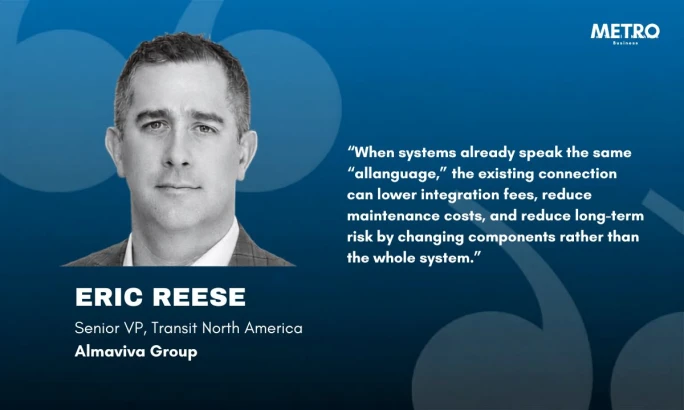
Eric Reese: Open architecture uses shared, published rules for moving data in and out, rather than a proprietary format only one vendor understands. When systems already speak the same “language,” the existing connection can lower integration fees, reduce maintenance costs, and reduce long-term risk by changing components rather than the whole system. In short, the payoff is less time and money spent on standing up a system, paying for its maintenance, and reducing the cost of a complete rebuild.
METRO: Vendor lock-in is a concern with many technology investments. What should organizations look for when evaluating a system to make sure they maintain flexibility and aren’t tied to a single vendor long-term?
Eric Reese: Before you sign the dotted line, it is the responsibility of a strategic organization to ask the right questions about the system’s future. Don’t fall for “future-proofing” marketing-speak. Instead ask: Does the system use open, widely adopted data and communication standards? Who owns the data, and can you export and reuse it elsewhere? Will it work with our existing hardware? What happens if we switch vendors later? If vendor responses include phrases such as “closed, proprietary format,” “required replacements,” and “start over,” the system is unlikely to add, remove, or replace without a full rebuild.
Modularity: Phasing Success and Mitigating Risk
METRO: How does modular design allow organizations to take a phased approach rather than making a large investment all at once?
Eric Reese: Modular design unlocks a system by breaking it down into separate, connected components rather than a binary, all-or-nothing one. This gives agencies the flexibility to prioritize essential components, prove they work, and build the case for the next. This cadence mirrors agency budgeting, which is based on stages across cycles. Modularity also lowers risk, since right-sized rollouts make it easier to manage, adapt, and learn before scaling.
METRO: As technology continues to evolve, how can interoperability and modularity help organizations expand or upgrade their systems without having to start over?
Eric Reese: Technology doesn’t stand still; there are always new tools, data formats, and expectations. Building a system on open standards and modular components lets transit agencies swap or upgrade components without disrupting the rest of the system. That is the real goal: instead of budgeting for a full system replacement every decade, organizations can evolve while preserving investments already made. Interoperable, modular systems can do more than break vendor lock-in; they can show passengers and the broader community that agencies can deliver projects that move the whole region faster.
Future Outlook: The Next Horizon in Transit Digital Transformation
As public transportation agencies look toward the horizon, the mandate for digital maturity has never been more urgent. Urban centers face escalating traffic congestion, tightening environmental mandates, and heightened public expectations for real-time, frictionless mobility services. Meeting these challenges requires a definitive departure from the legacy mindset of monolithic software procurement.
Under the guidance of industry leaders like Eric Reese, organizations such as Almaviva are proving that digital transformation does not require burning down existing infrastructure. By championing open architecture, strict adherence to universal data standards, and modular platform designs—exemplified by the Moova mobility suite—transit authorities can finally break the cycle of vendor lock-in.
Looking ahead, the successful transit agencies will be those that treat technology not as a static collection of hardware and software, but as a living, adaptable ecosystem. By embracing interoperability, agencies protect past capital investments while retaining the agility to integrate emerging innovations—whether autonomous vehicle fleets, artificial intelligence-driven scheduling, or hyper-personalized passenger applications.
Ultimately, the shift toward open, modular systems transcends IT strategy; it is a commitment to public stewardship. By eliminating wasteful custom integrations, reducing administrative friction, and maximizing operational visibility, transit providers can deliver faster, more reliable, and future-proof mobility networks that genuinely move their communities forward.