









Executive Overview
In the rapidly evolving landscape of agricultural technology, innovations promising sustainable inputs frequently capture the imagination of growers and investors alike. Among the most recent entries is "Green Lightning," a localized plasma-based system designed to produce nitrogen fertilizer on-demand using nothing more than air, water, and electricity. The underlying chemical mechanism—using electrical arcs to fix atmospheric nitrogen into usable nitrates—is scientifically sound, tracing its conceptual lineage back over a century to early industrial nitrogen fixation methods.
However, a profound discrepancy has emerged between the physical output of these machines and the ambitious marketing claims made regarding their commercial viability. A rigorous mass-balance analysis reveals a staggering arithmetic gap: the actual quantity of nitrogen atoms physically generated by a standard Green Lightning unit is a tiny fraction of the conventional fertilizer it is purported to replace. While the technology successfully produces measurable nitrates, claiming that these trace outputs can substitute for tens of thousands of pounds of traditional chemical inputs defies fundamental agricultural science. Crops require physical nitrogen atoms to build proteins, DNA, and cellular structures; if those atoms are not supplied by the machine, they must originate from somewhere else in the soil ecosystem.
This investigative report examines the mechanics of plasma-based nitrogen generation, evaluates data from independent field trials such as Precision Planting’s 2024 evaluations, analyzes manufacturer counterclaims from companies like Nytro, and explores the vital distinction between supplemental crop nutrition and complete fertilizer displacement. As agriculture faces mounting pressure to decarbonize, separating genuine agronomic utility from marketing hyperbole remains essential for protecting growers’ investments and safeguarding global food security.

Detailed Chronology and Technological Evolution
Roots in Century-Old Chemistry
The concept of utilizing electrical discharges to fix atmospheric nitrogen is far from novel. In 1903, Norwegian scientist and industrialist Kristian Birkeland, alongside his partner Sam Eyde, developed the Birkeland-Eyde process. This industrial method used a high-voltage electric arc to mimic lightning, fixing atmospheric nitrogen ($textN_2$) and oxygen ($textO_2$) into nitric oxide ($textNO$), which was subsequently processed into nitric acid and calcium nitrate. While revolutionary for its time, the process was notoriously energy-intensive and was largely abandoned following the commercialization of the far more energy-efficient Haber-Bosch process in the early 20th century.
Modern innovations like Green Lightning represent a contemporary, localized reinvention of this plasma-oxidation pathway. Instead of centralizing production in massive industrial complexes, these modern systems are scaled down to fit on a farm or regional depot. By passing electricity through air in the presence of water, the systems oxidize atmospheric nitrogen, yielding a dilute liquid nitrate solution that can theoretically be applied directly to fields.
The Shift Toward On-Demand Production
As global fertilizer prices spiked in the wake of geopolitical conflicts and supply chain disruptions between 2021 and 2023, interest in decentralized, on-farm input generation surged. Farmers sought protection from the volatility of global commodity markets. Enterpreneurs and engineering firms capitalized on this sentiment, marketing localized plasma generators as autonomy tools that could liberate growers from traditional supply chains.
Yet, as these technologies transitioned from laboratory curiosities to commercial hardware, a critical friction point developed between engineering reality and agronomic sales pitches. While the machines successfully produced a weak nitrate solution, the scale of production relative to the immense nitrogen demands of high-yield modern crops (such as corn and wheat) was severely understated in promotional materials.
The 2024 Precision Planting Field Trials
The rubber met the road during the 2024 agricultural season when independent testing provided a real-world stress test for the technology. Precision Planting, a respected name in agronomic research and equipment testing, conducted a rigorous field trial evaluating the complete replacement of a conventional nitrogen program with Green Lightning.
In this trial, the Green Lightning treatment applied 120 gallons per acre spread across six separate applications. The resulting corn crop yielded 235.9 bushels per acre. By contrast, the benchmark conventional urea-ammonium nitrate (UAN) program generated 280.7 bushels per acre—a substantial deficit of nearly 45 bushels per acre.
While researchers noted operating challenges during the trial, including hard water fouling and difficulties in maintaining consistent system output, the trial served as an empirical benchmark. It challenged the core premise that plasma-generated nitrate streams could seamlessly step into the shoes of traditional, highly concentrated chemical fertilizers without compromising yield potential.
Supporting Context and Metrics: The Arithmetic of Nitrogen
To understand why the Green Lightning replacement claims present an uphill mathematical battle, one must examine the baseline chemistry of crop nutrition. Nitrogen is not merely a stimulant or a growth catalyst; it is a foundational building block. Every molecule of chlorophyll that captures sunlight, every strand of DNA within a plant cell, and every amino acid assembled into plant protein requires physical nitrogen atoms.
The Discrepancy Between Output and Replacement
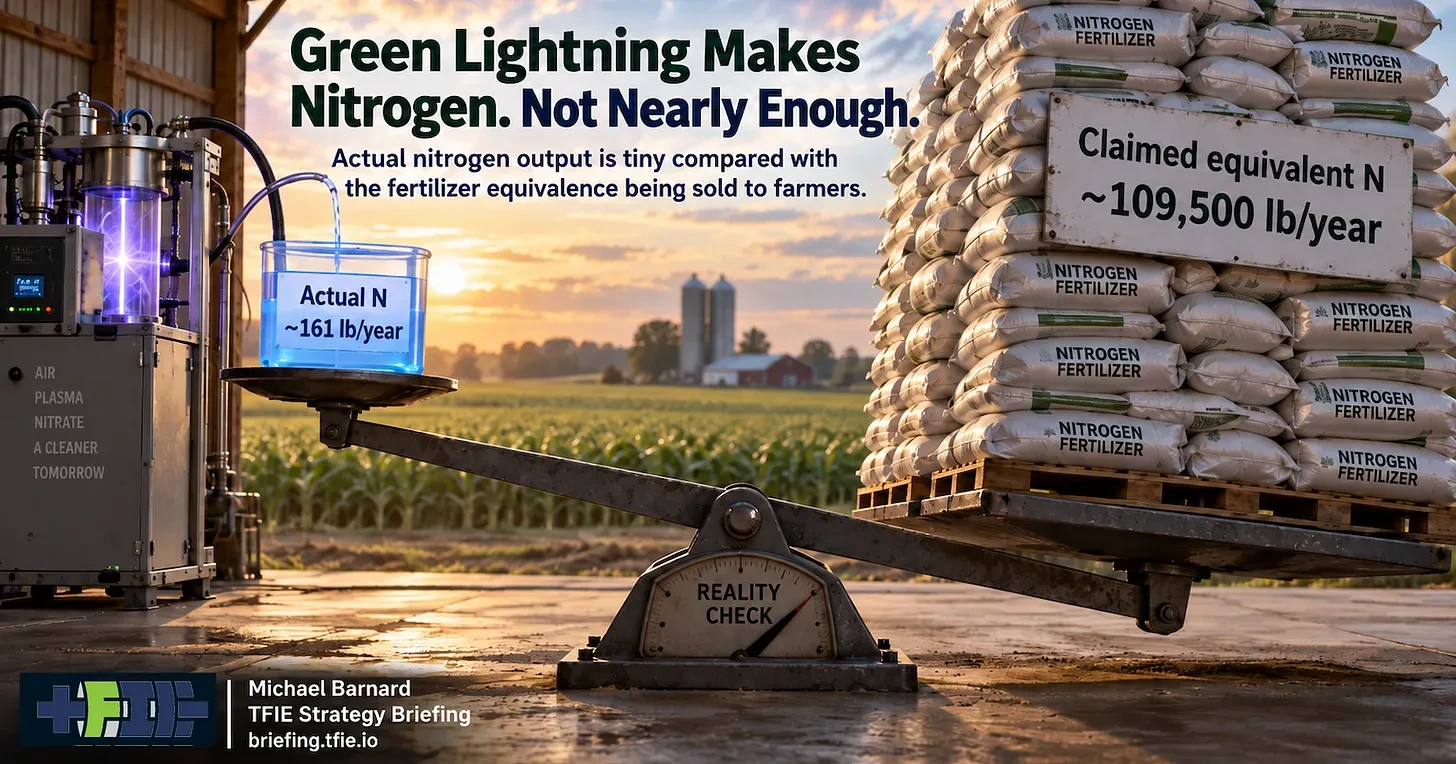
According to operational data reported by Washington State University Extension, a standard Green Lightning machine operating at a continuous output of 100 gallons per day fixes approximately 161 pounds of actual elemental nitrogen per year.
However, promotional literature for comparable systems has frequently framed the output in terms of conventional fertilizer equivalence, often citing figures as high as three pounds of conventional nitrogen replacement per gallon of product. At a 100-gallon-per-day production rate, this translates to a claimed 109,500 pounds of conventional-nitrogen replacement annually.
+-----------------------------------------------------------------+
|              THE 680-FOLD ARITHMETIC DISCREPANCY                |
+-----------------------------------------------------------------+
| Physical Nitrogen Produced:    ~161 lbs / year                  |
| Claimed Fertilizer Equivalent: ~109,500 lbs / year              |
| Resulting Disparity Ratio:     ~680-fold                        |
+-----------------------------------------------------------------+
This represents an astounding 680-fold difference between the nitrogen physically synthesized by the machine and the nitrogen supposedly offset in the field.
The Law of Conservation of Mass
Agronomists and soil scientists point out a fundamental physical law that marketing departments often overlook: None of the standard efficiency improvements in agriculture create nitrogen atoms.

While practices such as split applications, subsurface band placement, and nitrification inhibitors can drastically reduce nitrogen losses through volatilization, leaching, and denitrification—thereby allowing farmers to extract more utility from every pound applied—they do not conjure new nitrogen out of thin air.
If a commercial crop maintains its historical yield after a massive volume of conventional fertilizer is withheld, and a plasma generator supplies only a minute fraction of new nitrogen, the deficit must be drawn from pre-existing pools. These pools include:
- Soil organic matter mineralization: Breaking down native carbon-nitrogen bonds, which ultimately degrades long-term soil health and organic carbon levels.
- Residual soil nitrate ($textNO_3^-$): Leftover fertilizer from previous growing seasons.
- Manure or organic amendments: Historical applications already present in the soil profile.
- Biological fixation: Natural contributions from soil microbes and legume rotations.
Relying on soil mining to make up for a 680-fold deficit is not a sustainable fertility program; it is an unacknowledged withdrawal from the soil’s natural capital.
Official Statements and Industry Perspectives
The debate surrounding plasma-generated nitrogen has divided equipment manufacturers, independent agronomists, and academic researchers.
Manufacturer Responses and Future Claims
Representatives from Nytro and associated technology developers have pushed back against blanket dismissals of their hardware, reporting significantly more favorable results in private, company-sponsored trials. Manufacturers maintain that newer generations of equipment feature upgraded reactor designs capable of achieving substantially higher nitrate concentrations per gallon.
In public statements, technology proponents emphasize that early-stage hardware inevitably faces growing pains, and that incremental engineering improvements will close the performance gap. Furthermore, they argue that comparing liquid plasma output directly to dry or concentrated liquid fertilizers (like UAN-32) ignores the unique behavior of freshly ionized, highly reactive aqueous nitrates in the rhizosphere.
The Scientific and Academic Standpoint
Independent researchers, however, maintain that higher nitrate concentrations do not magically alter the underlying mass-balance equations. Dr. Theodore Vance, an independent soil chemist and contributor to agricultural technology briefings, notes:
"While boosting the concentration of nitrate in the output water improves the logistics of hauling and applying the product, it does not rewrite the periodic table. If a plant requires 200 pounds of nitrogen per acre to achieve a 280-bushel corn yield, those atoms must be delivered to the field. If the machine accounts for only a fraction of a pound, the remainder must be accounted for through rigorous mass balance—not hand-waving about biological synergy."
Academic institutions stress that until manufacturers submit their systems to multi-year, peer-reviewed, blinded field trials conducted across diverse soil types, extraordinary claims of complete fertilizer displacement must be treated with extreme skepticism.
Future Outlook: Supplemental Tool vs. Silver Bullet
As the agricultural sector navigates the complexities of the 21st century, the role of on-farm plasma generation requires careful recalibration.
Finding the Proper Commercial Niche
The failure of Green Lightning to live up to its most grandiose marketing claims does not render the technology entirely useless. Precision agriculture thrives on diversification and input reduction. A machine capable of producing a clean, supplemental stream of liquid nitrate on-demand can still offer tangible value under specific operating conditions:
- High-Value Specialty Crops: Crops grown on smaller acreages with high per-acre revenue potential and strict environmental caps on nitrogen runoff may benefit from small, continuous doses of localized nitrate.
- Fertigation Integration: Farms equipped with advanced drip or micro-irrigation systems can integrate low-concentration nitrate streams directly into their watering schedules, providing continuous, low-stress feeding during critical growth stages.
- Remote Operations: For farms located in extreme geographic isolation where fertilizer transport costs dwarf the commodity price, local generation—even in modest quantities—provides logistical resilience.
The Danger of Over-Promise
The primary peril facing plasma nitrogen technology is not technical failure, but rather market rejection driven by over-promising. When farmers invest capital in equipment under the explicit promise of eliminating their fertilizer bills, subsequent yield drops and nitrogen deficiencies quickly destroy trust.
For the technology to achieve long-term commercial viability, manufacturers must pivot away from sweeping claims of total fertilizer replacement. Instead, transparency regarding exact output capacities, realistic operational costs per pound of actual nitrogen, and integration strategies that treat plasma generators as supplements rather than replacements will be paramount.
Conclusion
Green Lightning is a fascinating application of plasma chemistry, proving that localized electrical nitrogen fixation is technically achievable. However, agriculture remains bound by the immutable laws of mass balance and plant physiology. Until hardware efficiency catches up with ambitious marketing, these systems must be viewed for what they are: intriguing supplemental tools that cannot yet replace the foundational chemistry driving modern global agriculture.