









Executive Overview
When travelers picture Italy’s lakeside paradises, their minds almost invariably drift northward. The glamorous, cliff-draped shores of Lake Como or the dramatic, Alps-ringed vistas of Lake Garda dominate international imagination, serving as the quintessential backdrops for romance, high-end tourism, and cinematic luxury. Yet, far from the bustling promenades of Lombardy and the hyper-curated tourism hubs of the north lies an alternative narrative of Italian waterscapes—one defined by raw tranquility, agricultural heritage, and biological richness.
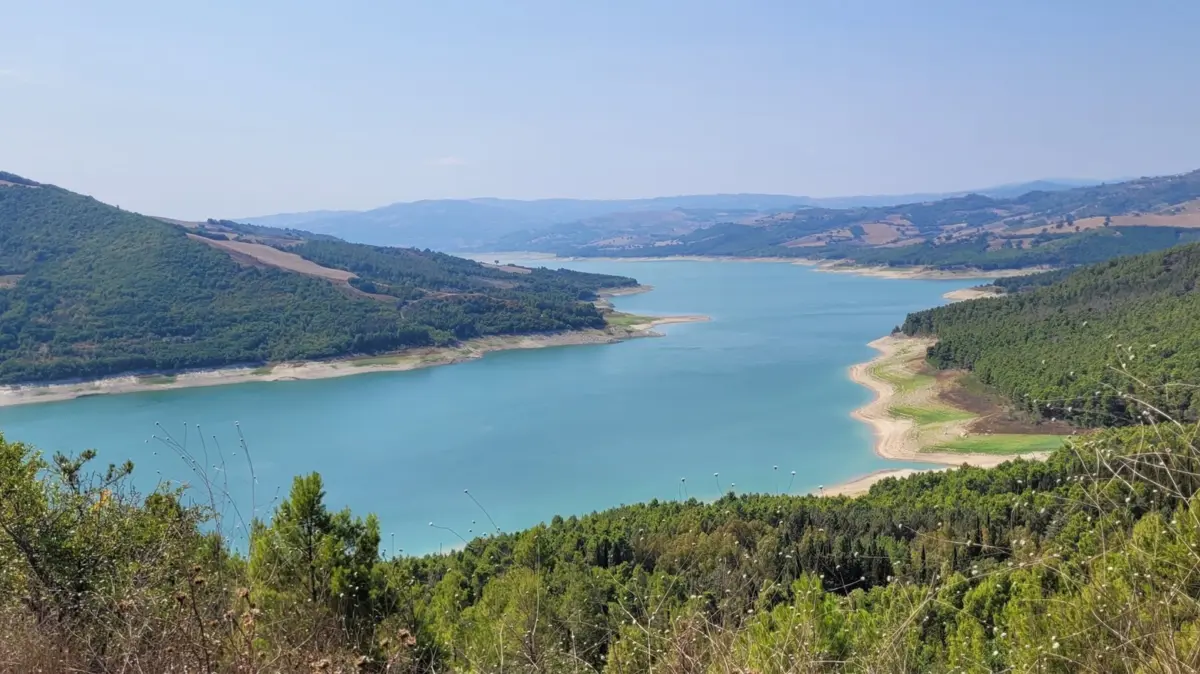
Nestled deep within the sun-drenched southern half of the Italian peninsula, Lago di Occhito (Occhito Lake) stands as a monumental yet remarkably overlooked geographic feature. Spanning the rugged borderlands between the regions of Puglia and Molise, Occhito is one of the largest artificial lakes in the country and holds the distinction of being the largest reservoir by volume on the Italian mainland. Stretching approximately 7.5 miles in length and boasting a staggering capacity of 250 million cubic meters of water, this sprawling body of liquid expanse is framed not by snow-capped alpine peaks, but by the rolling, vineyard-laced hills of the Fortore Valley.
Despite its impressive dimensions, Lago di Occhito has largely eluded the mass tourism radar. It occupies a liminal space between the globally celebrated, whitewashed cliffside towns of Puglia (frequently likened to a crowd-free Santorini) and the deeply traditional, castle-studded hill villages of Molise. Designated entirely as a Natura 2000 site under the European Union’s Habitats Directive, the lake and its surrounding woodlands represent a pristine refuge for rare migratory birds, elusive aquatic mammals, and freshwater ecosystems.
This comprehensive journalistic feature explores the multifaceted identity of Lago di Occhito—examining its engineering origins in the Fortore Valley, its surging appeal among eco-travelers and catch-and-release anglers, its profound ecological significance, and its strategic potential as a sustainable tourism anchor for an undiscovered slice of southern Italy.
Detailed Chronology: From River Valley to Engineering Marvel
To understand Lago di Occhito in its modern context, one must retrace the historical and engineering timeline that transformed a wild, unpredictable river valley into a vital southern lifeline.
The Pre-Dam Era: The Impetuous Fortore River
For centuries, the Fortore River served as the geographic and cultural spine of the borderlands separating what are now the provinces of Foggia (Puglia) and Campobasso (Molise). Flowing from the Apennine Mountains down toward the Adriatic Sea, the Fortore was notoriously volatile. During the wet winter and spring seasons, torrential downpours would turn the modest river into a roaring, destructive torrent, eroding fertile topsoil and devastating local agricultural settlements. Conversely, the scorching southern summers reduced the river to a trickle, leaving the surrounding rural communities parched and struggling to sustain their agrarian economies.
Mid-20th Century: The Genesis of the Occhito Dam
The post-World War II era in Italy ushered in a sweeping state-backed campaign known as the Cassa per il Mezzogiorno (Fund for the South), designed to modernize southern infrastructure, mitigate chronic water shortages, and stimulate regional agriculture. Civil engineers identified the narrow gorges of the Fortore Valley as an ideal bottleneck for hydraulic intervention.

Construction of the Occhito Dam commenced in the mid-20th century, a monumental civil engineering undertaking that required reshaping the natural landscape. By damming the Fortore River on the northern boundary of the prospective basin, engineers engineered a massive barrier designed to capture and regulate the seasonal water surges. As the concrete wall rose, the waters slowly backed up behind it, gradually submerging low-lying agricultural plots, ancient pathways, and wild riverbanks. By the time the reservoir reached operational capacity, it had birthed Lago di Occhito—an artificial expanse spanning over 7.5 miles and altering the regional microclimate permanently.
Evolution into an Ecological Sanctuary
While the primary objective of the dam was strictly utilitarian—providing irrigation water for the arid plains of Puglia and flood control for the Fortore Valley—nature immediately began reclaiming the man-made asset. Over the decades, the fluctuating shorelines, newly formed wetlands, and regenerating upland forests evolved into a complex, self-sustaining ecosystem. Recognizing its unique biodiversity value, European environmental authorities stepped in during the late 20th and early 21st centuries, incorporating the lake and its protective perimeter into the European Union’s elite Natura 2000 network. Today, the timeline of Lago di Occhito shifts away from raw infrastructure toward ecological stewardship, sustainable recreation, and rural cultural tourism.
Supporting Context & Metrics
Evaluating Lago di Occhito requires examining the precise geographic, ecological, and regulatory data that define the reservoir and its surrounding ecosystem.
Geographic and Hydrological Metrics
- Total Length: Approximately 7.5 miles (12 kilometers), making it a significant linear water body within the southern Italian landscape.
- Storage Capacity: Holds an astounding 250 million cubic meters of water, securing its status as the largest artificial reservoir by volume on the Italian mainland (surpassed nationwide only by Lake Omodeo on the island of Sardinia).
- Geographic Placement: Straddles the administrative and cultural boundary between Puglia (specifically the Daunian Mountains and Capitanata plains) and Molise (the Fortore Valley).
- Surrounding Topography: Bounded by rolling green hills, dense broadleaf forests, olive groves, and agricultural plateaus dotted with medieval and Renaissance-era hill towns.
Biodiversity and Natura 2000 Conservation Parameters
Under the European Union Habitats Directive, Lago di Occhito (site code IT7222248) is cataloged as a vital conservation area. The landscape is a mosaic of three distinct primary habitats:
- Wetlands & Littoral Zones: Shallow mudflats and reed beds that provide essential feeding grounds for wading birds.
- Grasslands: Open pastures supporting diverse insect populations and small mammals.
- Forests: Sub-Mediterranean broadleaf woodlands dominated by oak species, providing crucial corridors for local fauna.
Key Faunal Species Recorded:
- Avian Life: The lake is a premier destination for ornithologists. Regular sightings include the vibrant Common Kingfisher (Alcedo atthis), grey and purple herons, majestic Ospreys (Pandion haliaetus) during migration seasons, and the striking Eurasian Spoonbill (Platalea leucorodia).
- Mammalian Life: Along the banks, particularly near the northern dam structure, patient observers can spot populations of the Eurasian Otter (Lutra lutra), a notoriously elusive semi-aquatic mammal whose presence serves as a primary bio-indicator of pristine water quality.
- Aquatic Fauna: The deep, nutrient-rich waters sustain a diverse population of freshwater fish, including wild carp, perch, brown and rainbow trout, tench, European eel, and heavyweight Wels catfish.
Official Statements & Expert Perspectives
The management of Lago di Occhito involves a delicate balance between water resource allocation, agricultural demands, and strict ecological preservation. Regional authorities, environmental scientists, and local stakeholders have increasingly emphasized the need for integrated, sustainable management models.
Regional Water and Forestry Governance
The Regione Puglia and the Consorzio per la Bonifica della Capitanata (Capitanata Land Reclamation Consortium) oversee the operational management of the Occhito Dam and its water distribution networks. In policy briefings concerning climate adaptation and watershed management, officials have consistently highlighted the strategic importance of the reservoir.
"Lago di Occhito is not merely a regional asset; it is the beating heart of our agricultural security in the Capitanata plain," notes a regional agricultural development report from the Foreste Regione Puglia. "As southern Europe faces increasingly severe summer droughts driven by climate change, the retention capacity of Occhito provides an indispensable buffer for thousands of hectares of olive groves, vineyards, and arable crops."
Environmental Management and Community Networks
On the conservation front, academic researchers and European ecological networks emphasize that human interaction with the lake must be strictly regulated to preserve its Natura 2000 status. The Community of Practice for the Sustainable Management of Forests Surrounding the Occhito Lake brings together local municipalities, environmental NGOs, and forestry experts to balance public access with habitat protection.
Local tourism promoters and outdoor guides frequently champion the lake as an antidote to over-tourism. As noted in visitor testimonials curated by regional green-tourism boards: "The forest around Lago di Occhito is fabulous. It offers a profound sense of isolation and peace, paired with sweeping views of neighboring orchards and historic towns that feel entirely untouched by modern commercialism."
Future Outlook: Sustainable Tourism and Conservation Challenges
As Italy grapples with the pressures of mass tourism in iconic hotspots like Venice, Amalfi, and Lake Como, the nation’s interior and southern regions are looking toward low-impact, sustainable alternatives. Lago di Occhito stands at the vanguard of this tourism evolution, though it faces distinct operational and environmental challenges in the years ahead.
Expanding Slow Tourism and Infrastructure
The future roadmap for the Occhito basin centers on expanding "slow tourism"—initiatives that encourage visitors to linger longer, spend locally, and minimize environmental footprints.
- The Puglian Shoreline: The infrastructure here is the most developed for visitors. The Alcedo Visitor Center, situated near the northern dam, serves as an educational hub featuring interpretive nature trails, picnic areas, and bicycle rental facilities. Plans are underway to expand the existing network of hiking and mountain biking loops, creating a cohesive multi-use trail system that links the lakeshore directly to nearby hill towns.
- The Molise Frontier: On the western and northern banks falling within Molise, development is intentionally restrained to protect the natural landscape. However, local municipalities are investing in agro-tourism (agriturismo) networks, encouraging travelers to pair a day of birdwatching or catch-and-release fishing with culinary stays in historic villages.
The Angling Experience: Strict No-Kill Regulations
Fishing at Lago di Occhito represents a model for sustainable freshwater sports management. To protect the aquatic ecosystem from depletion, fishing is strictly permitted on a no-kill basis. Anglers targeting massive carp, pike, and perch must carefully release their catches back into the reservoir unharmed. Furthermore, regulatory compliance is strictly enforced: foreign anglers must secure specialized short-term permits, such as the three-month foreign fishing license issued by the Regione Puglia, ensuring that all human activity on the water is monitored and accountable.
Climate Resilience and Ecological Vulnerability
Looking ahead, the greatest challenge facing Lago di Occhito is environmental resilience. Climate projections for southern Italy indicate rising average temperatures and more erratic precipitation patterns. While the dam was engineered to capture massive water volumes, prolonged droughts threaten both the agricultural outflow capacity and the delicate littoral wetlands that support species like the kingfisher and the otter.
To combat these pressures, environmental agencies are intensifying watershed protection programs, reducing agricultural runoff into the feeder streams of the Fortore River, and strictly enforcing zoning laws within the Natura 2000 perimeter.
Conclusion: A Quiet Horizon
Lago di Occhito remains a masterclass in geographical duality. It is a monumental feat of mid-century industrial engineering that has gracefully metamorphosed into a tranquil, biodiverse Eden. For the discerning traveler willing to venture beyond the well-trodden paths of northern lakes and coastal resorts, Occhito offers a rare, unfiltered encounter with southern Italy’s soul. Here, framed by the castle-crowned hills of Molise and the sun-baked agricultural heritage of Puglia, the waters of the Fortore Valley whisper a timeless story of resilience, conservation, and untamed natural beauty.