









Executive Overview
The transformation of the global automotive landscape has crossed a historic threshold. In August 2026, China’s New Energy Vehicle (NEV) market achieved a staggering 65% overall market share, setting a new all-time record. Yet, the anatomy of this milestone marks a profound structural shift from previous records. While past highs were driven primarily by compounding waves of aggressive EV adoption, August’s triumph was catalyzed by a concurrent, systemic collapse of internal combustion engine (ICE) vehicle sales.
Faced with a volatile economic climate, high domestic gas prices, and an endless barrage of technologically superior battery-electric (BEV) and plug-in hybrid (PHEV) models, the broader Chinese automotive market contracted by 24% year-over-year (YoY) to roughly 1.5 million total units. Within this sea of red, traditional powertrains suffered catastrophic declines. Plug-in hybrids dropped 30%, and extended-range electric vehicles (EREVs) fell 22%. In stark contrast, pure BEVs managed a 1% YoY increase, anchoring the market’s resilience.
When combining the 45% pure BEV market share with the 20% share held by PHEVs, a remarkable two-thirds of all automobiles sold in China during August 2026 featured a plug. This acceleration puts the world’s largest automotive market on a definitive trajectory to achieve full electrification before 2030, with pure BEVs poised to dominate completely prior to 2035. As China’s domestic market approaches near-total saturation of electrified powertrains, the global legacy automotive industry faces an existential crisis. Pouring capital into internal combustion engine research and development is no longer just a risky gamble—it is financial self-immolation.
Detailed Chronology and Market Dynamics
The month of August 2026 laid bare the accelerating obsolescence of fossil-fuel vehicles across every operational segment. The cumulative NEV share for the year-to-date (YTD) surged to 57%, sitting three full points above the final full-year result for 2025. Pure BEVs alone captured 38% of the YTD market, up significantly from 33% in the previous year. Industry analysts project that the final tally for 2026 will easily clear 60% market share for electrified vehicles, with BEVs alone punching north of the 40% mark.
The Shift Back to Pure Electric Power
A critical internal trend within the Chinese market is the shifting balance between pure electrics and plug-in hybrids. Earlier in the year, PHEVs capitalized on minor regulatory incentive adjustments that briefly dampened pure BEV momentum. However, August data demonstrates that pure electrics are roaring back with a vengeance.
The August powertrain breakdown registered at 69% for BEVs versus 31% for PHEVs, bringing the 2026 average to a solid 67% to 33% split. Historically, this represents the highest pure BEV dominance since 2023, signaling a reversion toward the foundational 80/20 BEV-to-PHEV ratio seen in the nascent stages of China’s EV revolution. With regulatory incentives for plug-in hybrids and range-extended EVs scheduled to phase out at the end of 2027, the market is structurally primed to accelerate its purge of transitional hybrids in favor of zero-emission battery platforms.
The Export Tsunami and Global Ripple Effects
Domestic saturation is only half the story. August 2026 also underscored a seismic shift in international trade, as local Chinese OEMs unleashed an unprecedented wave of exports. Close to a million units—specifically 888,000 vehicles—were shipped abroad, representing a staggering 78% jump YoY.

Significantly, the EV share of these exports mirrored the domestic transformation, hitting 58% in August compared to 40% in the same month last year. As Chinese manufacturers aggressively expand their footprints—bolstered by rising domestic titans and emerging international players like Vietnam’s VinFast, Türkiye’s Togg, and India’s Tata and Mahindra—legacy Western OEMs are caught in a vicious pincer movement. Squeezed relentlessly inside the world’s largest automotive market, legacy brands are discovering that clinging to ICE architectures in international export markets is a doomed strategy. The export of Chinese EVs is actively dragging foreign markets toward forced electrification.
Supporting Context and Metrics: Segment Analysis
The death of the internal combustion engine is no longer a theoretical projection; it is visibly chronicled in the micro-data of every vehicle segment. In August 2026, every single top-ten best-selling model list was comprised exclusively of electrified vehicles, with a dominant eight out of ten being pure BEVs. Consequently, tracking mixed overall market rankings has become redundant, heralding an era where "overall market" and "EV market" are synonymous terms.
Segment Highlights
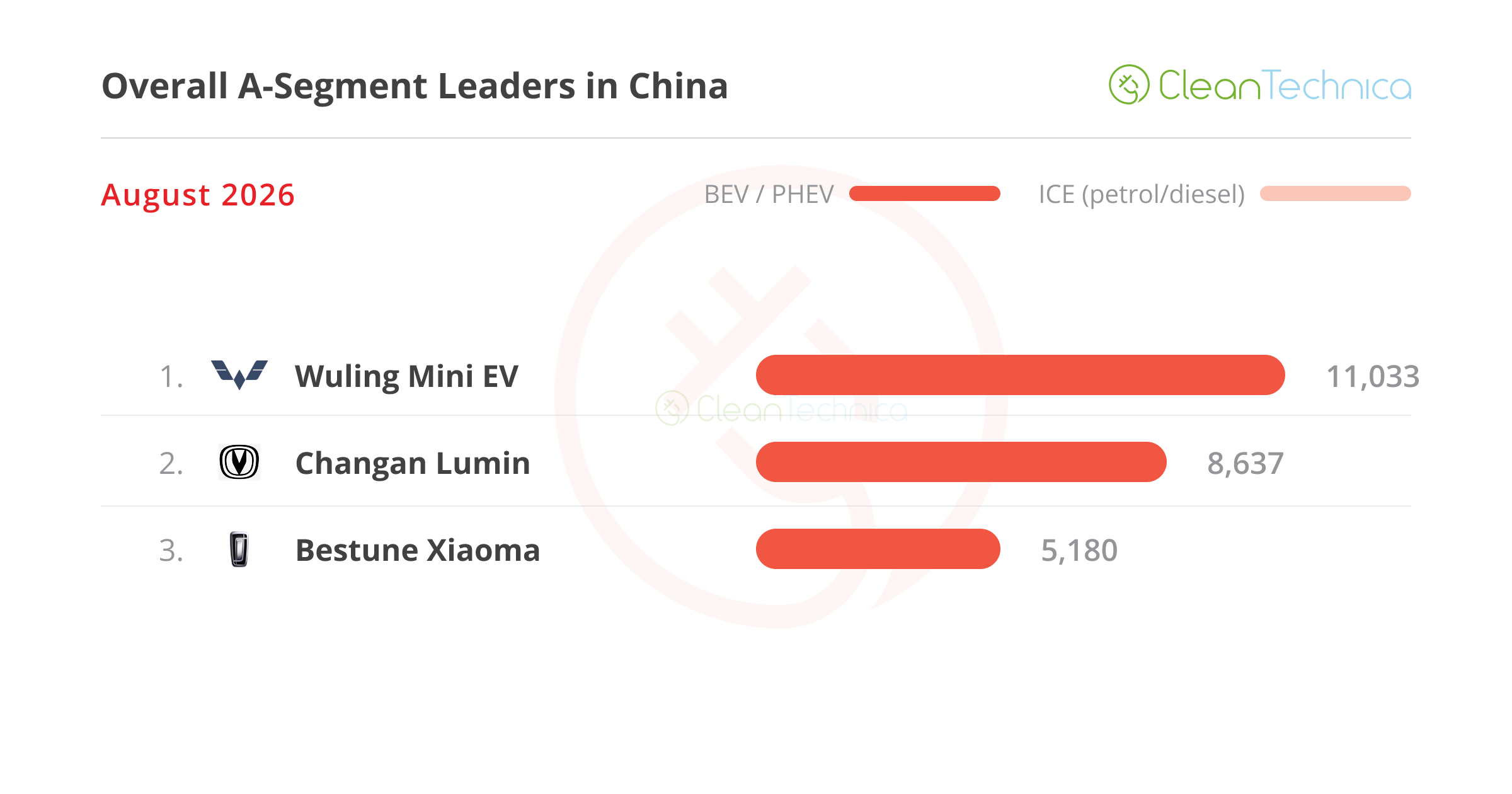
- A-Segment (City Cars & Subcompacts): Impacted by early-year subsidy adjustments, the city car category has experienced a gradual recovery. While the perennial Wuling Mini EV continues to anchor the segment, the Changan Lumin secured a yearly best with 8,637 registrations in August, outperforming the Bestune Xiaoma and Geely Panda. However, the market craves fresh metal—a demand that the anticipated BYD Racco aims to satisfy.
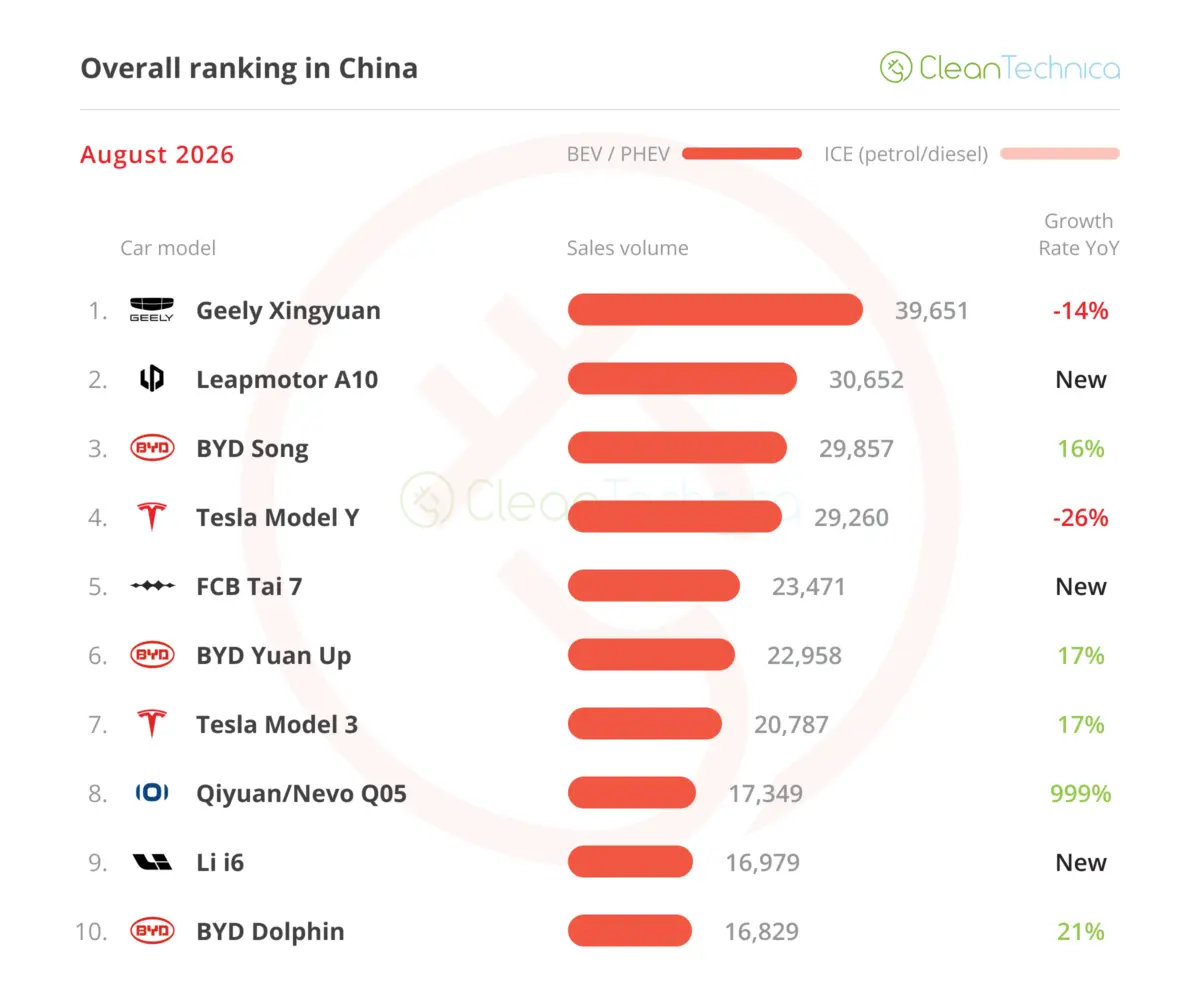
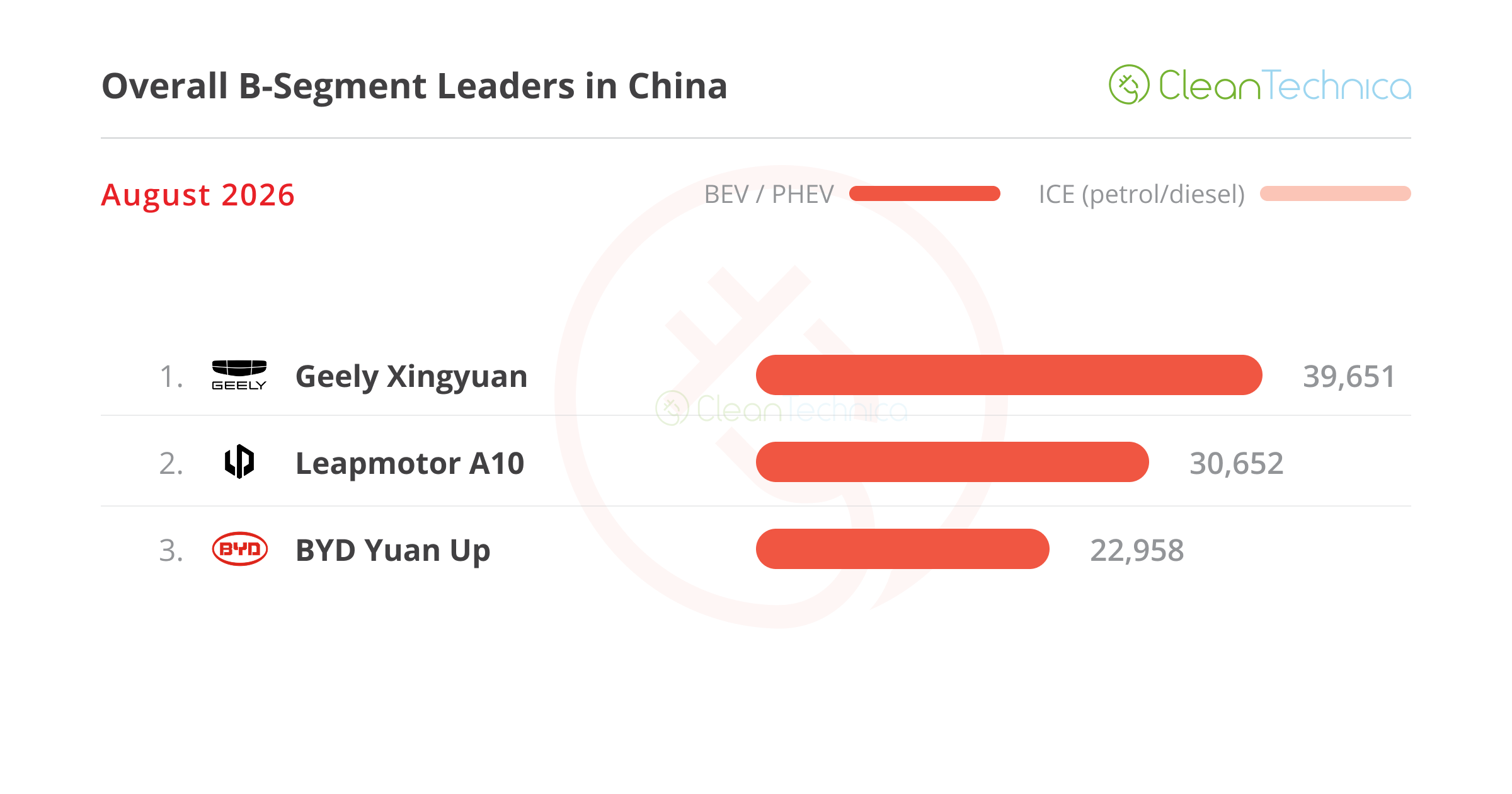
- B-Segment (Hatchbacks and Small Crossovers): This remains the hottest battleground in the Chinese market. Geely’s groundbreaking Xingyuan—conceptualized around the ethos of offering a "BYD Dolphin for BYD Seagull money" ($10,000 USD)—captured the #1 spot overall with 39,651 registrations. Yet, competition is fierce. Leapmotor’s new A10 crossover rocketed to 30,652 registrations, claiming the silver medal, while its sibling hatchback, the A05, crossed 8,000 units in its early ramp-up phase. Alongside the new-generation Wuling Bingo and Chery QQ3, the subcompact segment is locked in a relentless innovation war.
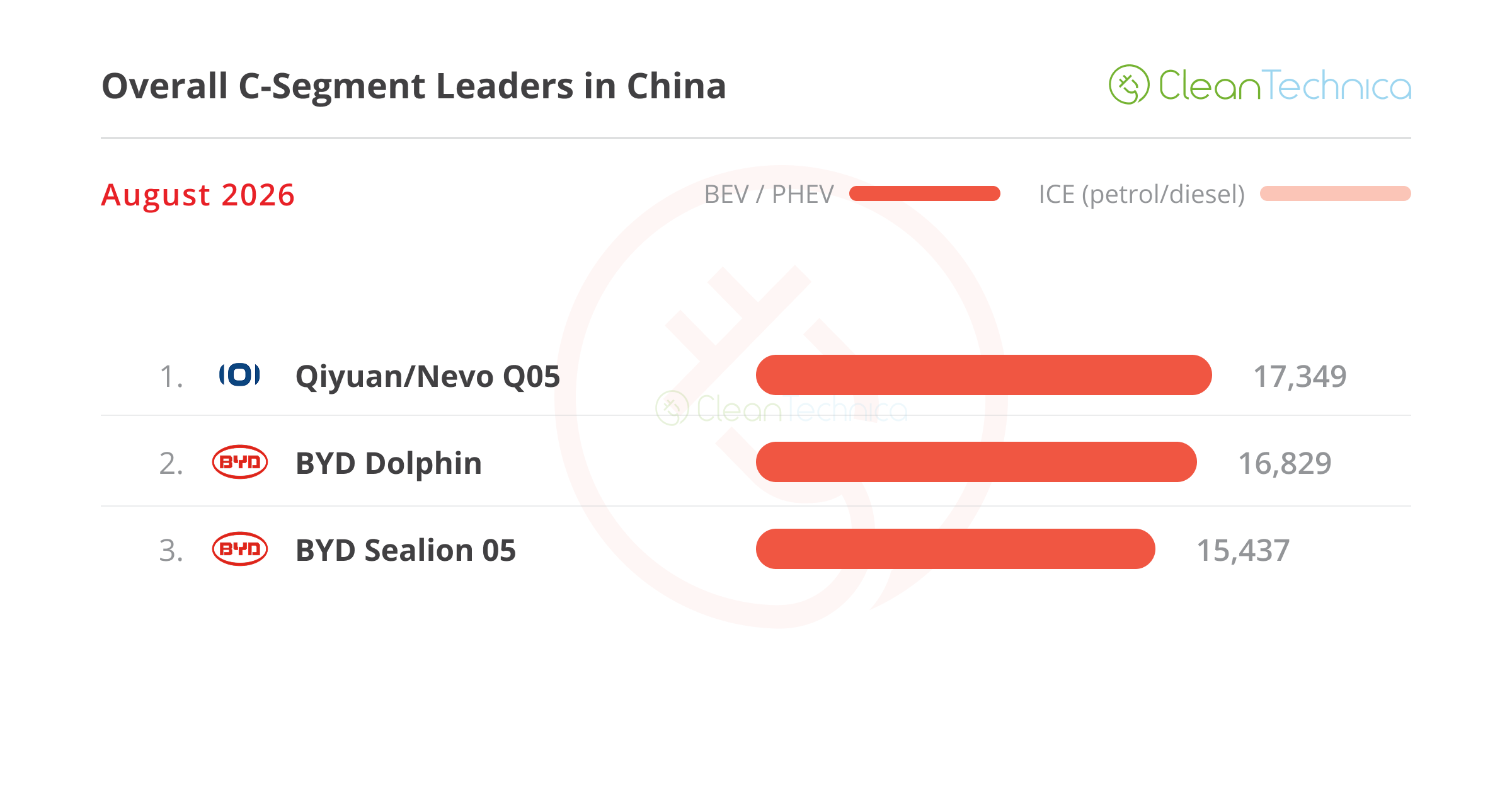
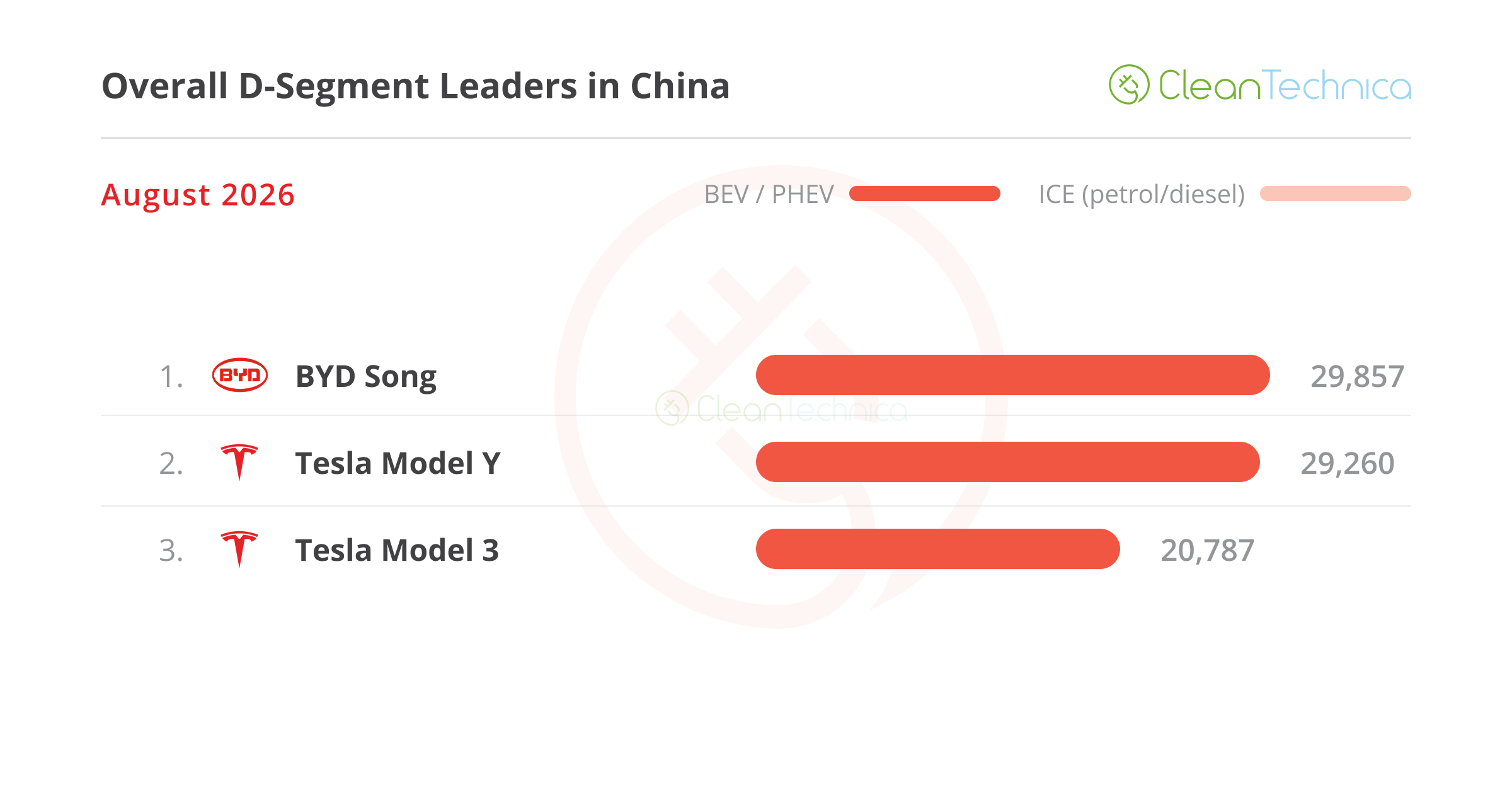
- C & D Segments (Midsize SUVs and Sedans): The Tesla Model Y continues to leverage its newly introduced long-wheelbase ("L") variant to stay afloat, delivering 29,260 units in August—though this still represented a 26% YoY drop. Meanwhile, BYD’s midsize Song SUV (BEV+PHEV) surged to 29,857 registrations, up 16% YoY, propelled by the rollout of its "Ultra" generation featuring 1,500 kW DC charging and advanced lidar capabilities starting at an aggressive 152,000 yuan ($22,000 USD).
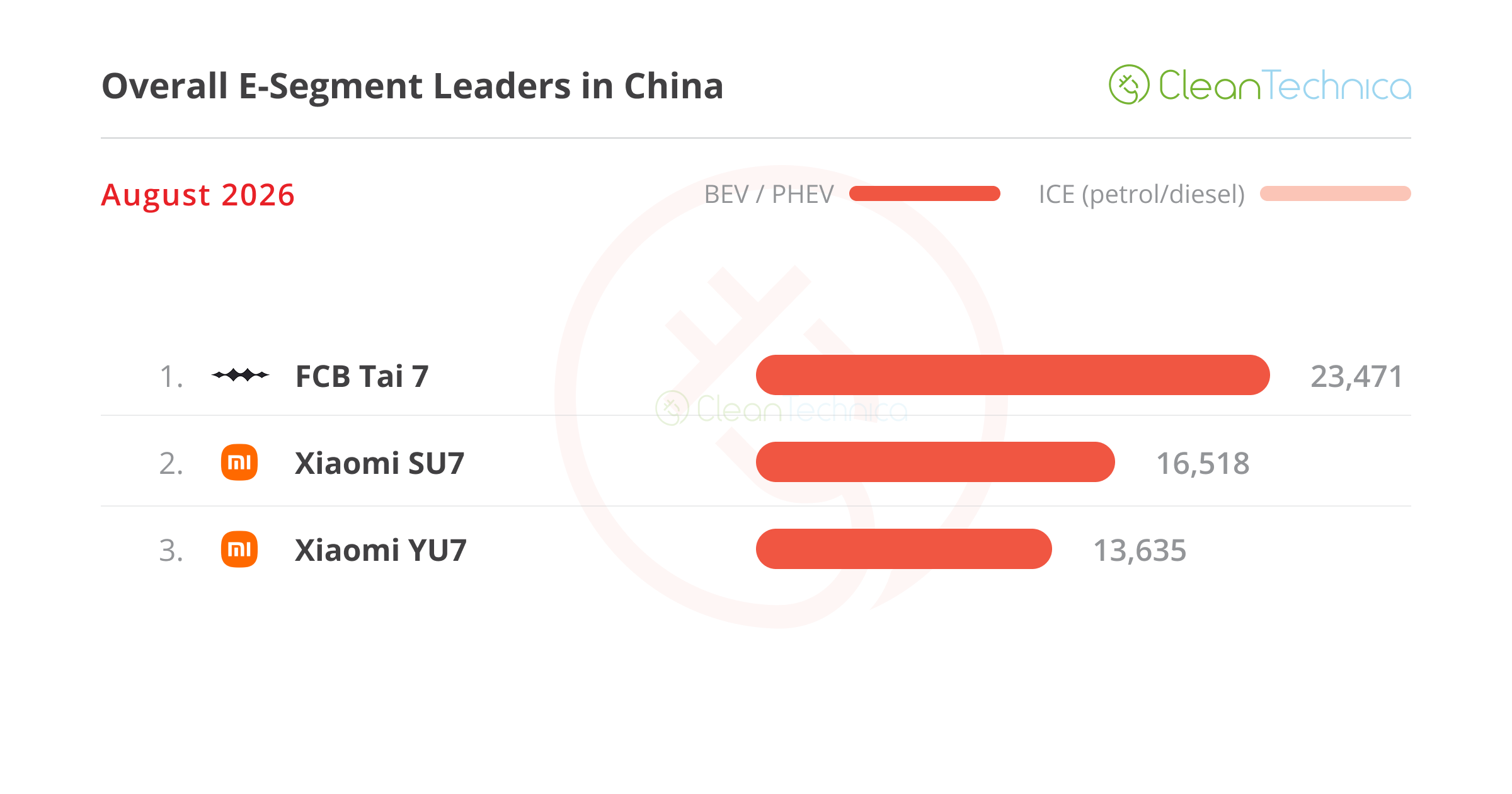
- E-Segment (Full-Size and Luxury): Fang Cheng Bao, BYD’s premium off-road arm, delivered a massive success with its boxy Tai 7 SUV. Registering 23,471 units in August, the model crossed a psychological barrier: for the first time, its pure BEV variants (12,909 units) outsold its PHEV counterparts (10,562 units), driven by the integration of ultra-fast flash charging.
The Top 20 Model Breakdown
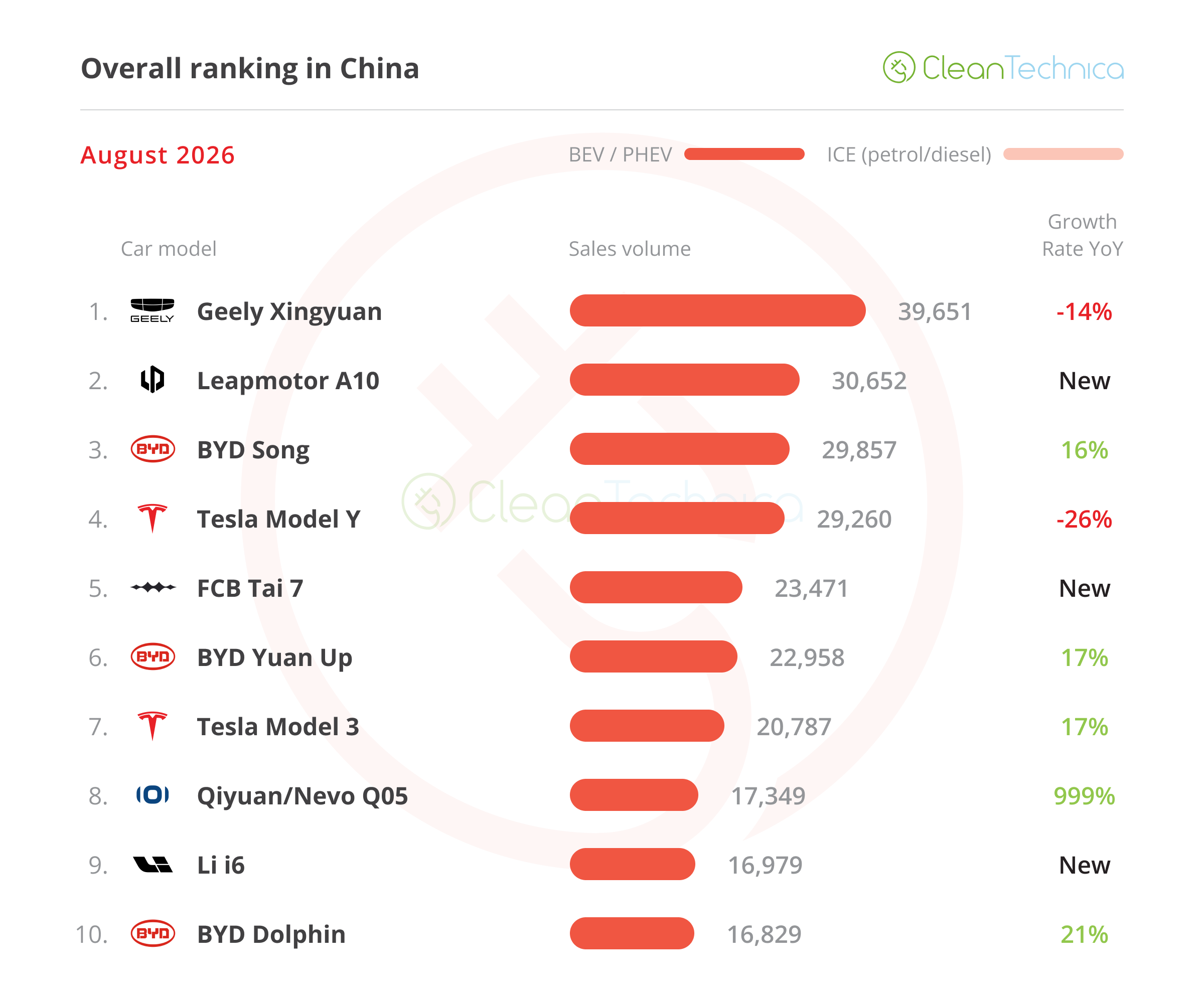
- Geely Xingyuan: 39,651 registrations. Despite a 14% YoY drop due to intense cross-segment cannibalization, it retains the crown.
- Leapmotor A10: 30,652 registrations. Rapid production scaling and aggressive sub-70,000 yuan pricing have turned this crossover into an instant phenomenon.
- BYD Song (BEV+PHEV): 29,857 registrations. Up 16% YoY as the market embraces its next-generation architecture.
- Tesla Model Y: 29,260 registrations. Down 26% YoY as a six-year-old vehicle architecture faces relentless 800V competition from domestic rivals.
- Fang Cheng Bao Tai 7: 23,471 registrations. A stellar performance for BYD’s rugged luxury contender, proving that boxy, high-tech BEVs command immense consumer desire.
Rounding out the lower tiers, the Tesla Model 3 rebounded unexpectedly to 7th place with 20,787 units, while emerging heavyweights like the Haval H10 "land yacht" and the Luxeed V9 MPV—Chery’s luxury minivan home run—signal that Chinese OEMs are capturing market share across every conceivable vehicle class.
Official Statements and Industry Insights
The divergence between local Chinese manufacturers and legacy foreign giants has never been starker. Industry commentary highlights a stark bifurcation in corporate health. While domestic startups and established giants like BYD, Geely, and Leapmotor report record-shattering production ramps, legacy international brands are staring down catastrophic contractions.
In the overarching manufacturer rankings, the narrative is written in red ink for foreign marques. Toyota absorbed a 21% sales drop, while Volkswagen suffered a staggering 40% crash, sliding to 4th place. Japanese automakers endured particularly punishing months: Honda sales cratered by 50% YoY to 27,000 units, and Nissan plummeted 55% to 24,000 units, relegating it to 21st place.
Conversely, startups like Leapmotor are redefining market velocity. Leapmotor registered an astonishing 64.4% brand share (up 0.3% in August), cementing its status as an emergent automotive superpower. Analysts note that Leapmotor’s disciplined yet comprehensive product rollout—avoiding the byzantine model overlap seen at competitors like BYD while spanning city cars to full-size architectures—positions it uniquely for global scale. Industry observers have even posited that Leapmotor’s maturation could eventually challenge Tesla’s global footprint by the end of the decade, should it successfully execute its international expansion strategies, such as potential European partnerships modeled after recent high-end joint ventures.
Future Outlook
As the industry enters the final stretch of 2026, the trajectory of the Chinese automotive sector points toward absolute structural transformation. Several key milestones define the horizon:
- The 60% Baseline: With YTD EV penetration already sitting at 57% and August hitting 65%, the final full-year average for 2026 is virtually guaranteed to surpass 60%. Pure BEVs are locked in to clear the 40% threshold.
- The Phase-Out of Transitional Hybrids: The approaching expiration of tax exemptions and subsidies for plug-in hybrids and extended-range vehicles at the end of 2027 will force a decisive market consolidation. Expect manufacturers to aggressively reallocate R&D budgets away from internal combustion hybrids entirely into pure battery-electric and solid-state architectures.
- The Marginalization of Legacy ICE: Foreign legacy OEMs that failed to pivot early are running out of runway. With Chinese automakers exporting nearly a million units a month—nearly 60% of which are electrified—the competitive pressure will no longer be confined to domestic borders. International markets are importing China’s EV transition wholesale.
The writing is on the wall for the global automotive industry. Investing capital into internal combustion engine development in 2026 is fundamentally throwing money away; there is simply no longer enough market runway left to amortize the costs. The era of the fossil-fuel automobile is entering its twilight years, and the acceleration witnessed in August suggests that the final curtain will fall much sooner than legacy executives ever anticipated.