








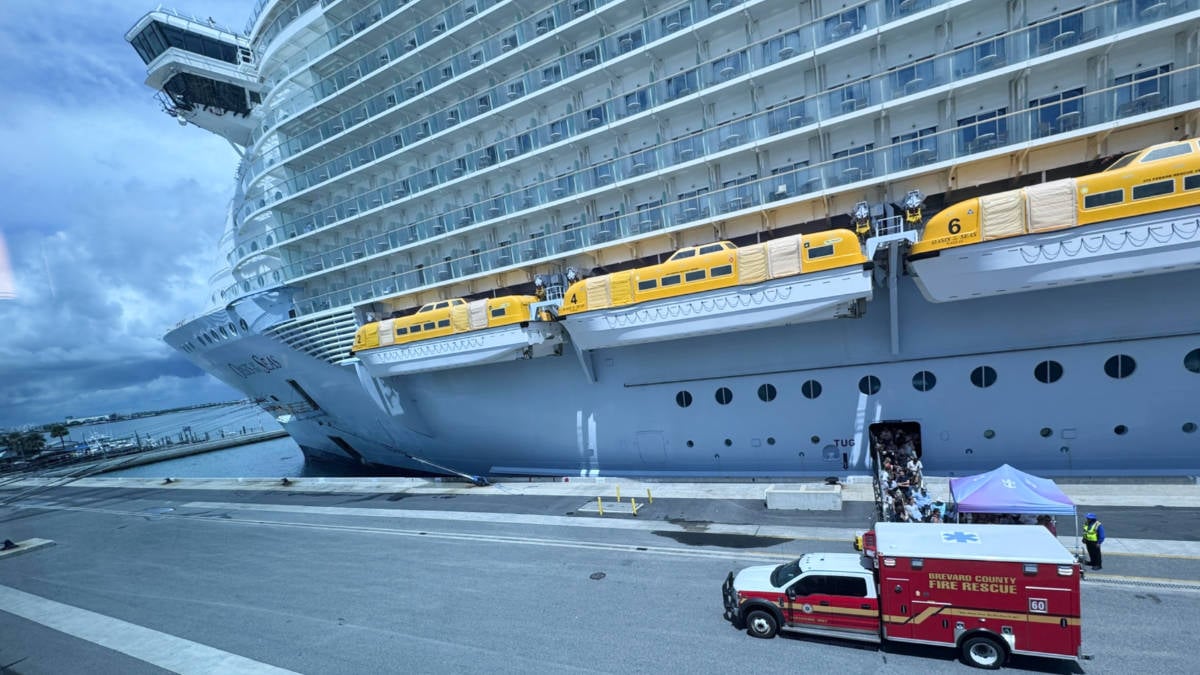
CAPE LIBERTY, New Jersey — Maritime operations are rarely predictable, and the delicate balance between maintaining a rigid commercial schedule and safeguarding human life was brought into sharp relief this weekend. Royal Caribbean International’s mega-ship, Oasis of the Seas, has suffered a significant itinerary disruption following back-to-back medical emergencies at sea.
The cascading consequences of these urgent evacuations will delay the vessel’s arrival back to its homeport of Cape Liberty, New Jersey, on Sunday, September 20, 2026. Consequently, the disruption has forced sweeping changes to the cruise liner’s subsequent sailing, including delayed embarkation windows, a complete cancellation of a scheduled Florida port stop, and a revised sequence of island calls in the Bahamas.
While cruise line executives and shipboard officers have moved swiftly to mitigate the impact on thousands of affected travelers through financial accommodations, compensation packages, and logistical support, the incident underscores the profound logistical challenges cruise operators face when unexpected medical crises alter a ship’s trajectory on the open ocean.
Executive Overview
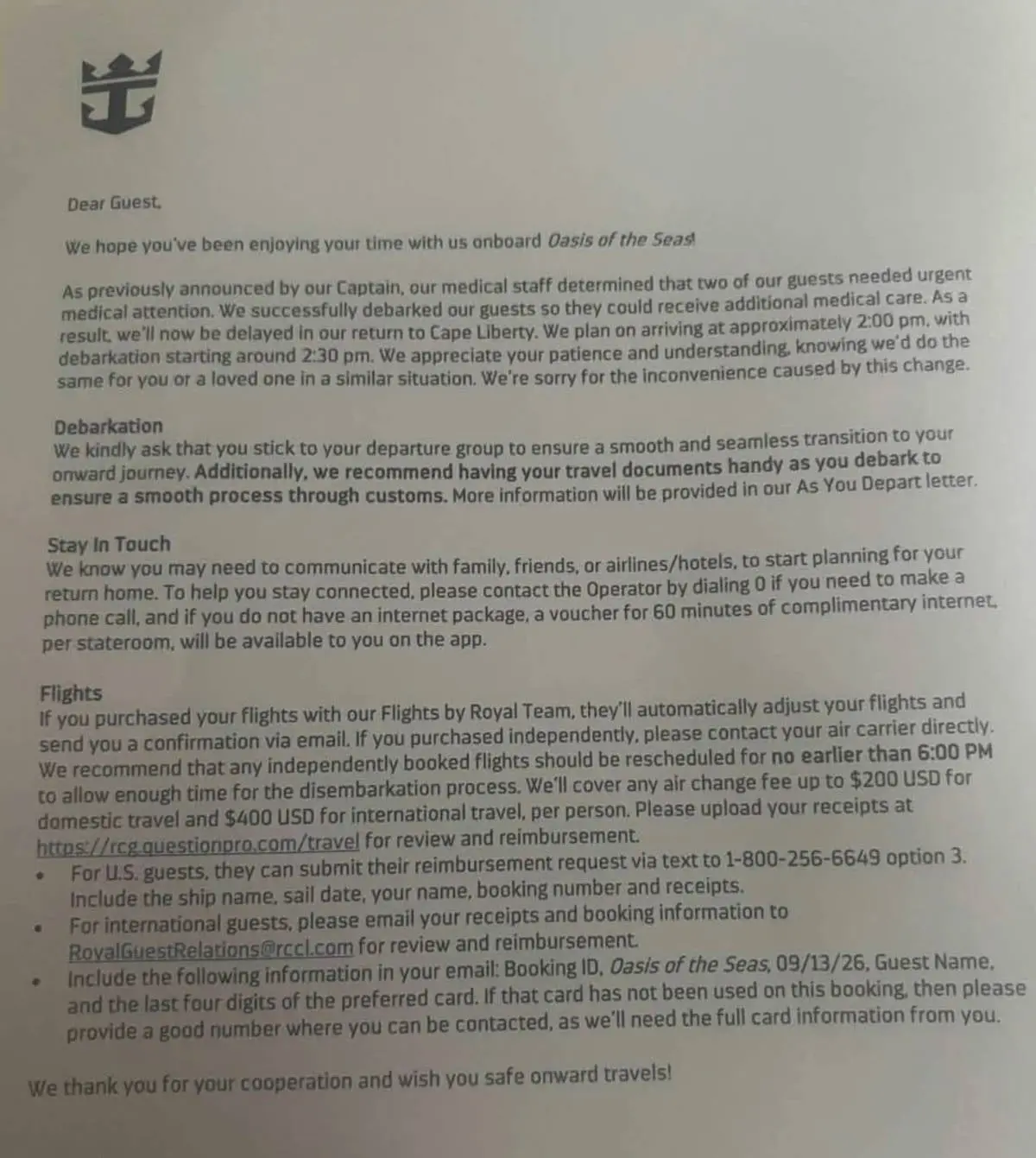
The unfolding situation aboard the 5,400-passenger Oasis of the Seas highlights the complex operational domino effect triggered by emergency medical interventions. Originally scheduled to dock at Cape Liberty at approximately 6:00 a.m. on Sunday, September 20, 2026, the ship’s arrival has been pushed back by roughly eight hours. The vessel is now projected to clear customs and arrive at the New Jersey cruise terminal at approximately 2:00 p.m., with passenger debarkation slated to commence at 2:30 p.m.
The delay stems from an unexpected diversion earlier in the voyage. While navigating northeast of the Bahamas, the ship was forced to abruptly reverse course and head back to Nassau to disembark two critically ill passengers in separate incidents. The first emergency involved a critically ill seven-year-old child, requiring the vessel to steam toward the closest available advanced medical infrastructure in the Bahamian capital. While en route back to Nassau, a second passenger suffered a severe medical crisis, necessitating a secondary response from the ship’s onboard medical team and executive staff.
The resulting deviation—combined with the immense geographic distance from the northern Bahamas back to the New York metropolitan area—has heavily impacted both current passengers trying to catch homeward-bound flights and incoming travelers preparing to board the vessel for its next voyage. In response, Royal Caribbean has rolled out a comprehensive assistance package. This includes financial reimbursements for independent air travelers, waived change fees, complimentary internet vouchers, and tiered non-refundable onboard credits designed to cushion the blow of a severely altered vacation experience.
Detailed Chronology of Events
To understand the scope of the delay, maritime analysts and cruise industry observers have mapped out the timeline of decisions that unfolded behind the scenes on the current voyage.

The Divergence and Double Evacuation
The disruption began as the Oasis-class vessel was completing the northbound portion of its itinerary. According to Automatic Identification System (AIS) tracking data, the ship was positioned east of Treasure Cay—approximately 120 miles northeast of Nassau—when shipboard leadership made the critical decision to alter course.
The captain’s public address announcements detailed the gravity of the situation, confirming that medical staff had identified an urgent, life-threatening condition in a young, 7-year-old guest. Because Nassau offered the closest and most viable port facility capable of handling the specialized pediatric and emergency care required, the ship spun around and steamed at maximum safe speeds southward toward New Providence Island.
However, maritime emergencies rarely arrive singly. While the massive vessel was actively navigating back toward Nassau to execute the first evacuation, a second passenger experienced an acute medical crisis. The ship’s onboard medical staff stabilized both individuals while orchestrating a dual-patient debarkation protocol upon arrival in the Bahamas.
According to official shipboard announcements, the medical operations concluded just before 1:00 p.m. on Friday, September 18, at which point Oasis of the Seas cleared the port and laid in a course for New Jersey.
The Race North: Pushing the Engines to the Limit
Once clear of Bahamian waters, the captain engaged the ship’s full propulsion capabilities to claw back as much lost time as possible. In a recorded address to passengers, the master of the vessel outlined the arduous transit ahead:
"We are now heading full speed towards Bayonne. I have all available engines on full load, and we’re doing about 20 to 20.5 knots [roughly 23.5 miles per hour]."
Despite pushing the multi-thousand-ton floating resort to its operational thresholds, maritime navigation physics cannot be easily cheated. Even maintaining a sustained speed of 20 to 20.5 knots without accounting for congestion in New York Harbor, harbor pilot embarkation windows, or docking maneuvers, naval calculations indicated that the ship would require well over 46 hours of continuous, unhindered steaming to reach Cape Liberty.
This mathematical reality solidified the projected Sunday afternoon arrival time of 2:00 p.m., dashing hopes of an early morning turnaround.
Supporting Context & Metrics
The ripple effects of an eight-hour terminal delay on a turnaround day for a ship the size of Oasis of the Seas are profound. Operating one of the largest cruise ships in the world requires precision timing to process thousands of disembarking guests while simultaneously receiving thousands of incoming passengers.
Logistical Impact on Current Passengers
For the guests currently onboard, the primary casualty of the delay is flight schedules. An eight-hour delay shifts disembarkation from a leisurely morning window to the mid-afternoon, rendering morning and early afternoon flights impossible to make.
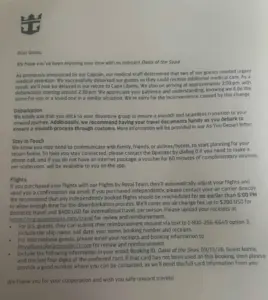
To mitigate the stress on passengers, Royal Caribbean distributed formal letters to every stateroom alongside targeted technological and financial interventions:
- Internet Vouchers: Each stateroom received a complimentary 60-minute internet access voucher via the Royal Caribbean mobile application, enabling stranded passengers to instantly contact airlines, hotels, and loved ones to rebook logistics.
- Flight Protections (Corporate): Passengers who booked their air travel directly through the cruise line’s Flights by Royal program faced minimal friction; their itineraries were automatically adjusted to align with the new arrival time, with confirmation details dispatched via email.
- Flight Protections (Independent): For guests who booked flights independently, Royal Caribbean implemented a robust reimbursement policy. The cruise line committed to covering airline change fees up to $200 USD per person for domestic flights and $400 USD per person for international flights, subject to the submission of standard receipts and documentation.
Privacy and Policy Protocols
As is standard procedure across the global cruise industry, Royal Caribbean has withheld specific details regarding the nature of the medical emergencies, the identities of the patients, and whether the two medical events were epidemiologically or circumstantially linked.
This strict adherence to privacy is designed to protect the personal health information of the affected individuals and shield their traveling families from public scrutiny during a highly stressful time. Both patients were safely transferred to local medical facilities in Nassau, though no further updates regarding their conditions have been made public.
Official Statements & Passenger Accommodations
While passenger safety rightfully took precedence, the operational consequences for the next group of travelers—those booked on the September 20, 2026, 7-night Bahamas itinerary—were severe enough to warrant sweeping itinerary overhauls and substantive financial goodwill gestures from corporate headquarters.
Revamped Embarkation and Port Cancellations
Incoming passengers arriving at the Cape Liberty cruise terminal on Sunday afternoon were met with significantly altered instructions:
- Delayed Check-In: Terminal arrival windows were pushed back by 7 to 8 hours. All embarking guests were mandated to complete the check-in process and be physically onboard the vessel no later than 9:30 p.m.
- Port Canaveral Cancellation: The ship’s originally planned Tuesday visit to Port Canaveral, Florida (scheduled for 12:30 p.m. to 8:30 p.m. on September 22) has been completely cancelled. Instead, Oasis of the Seas will spend that day traversing the ocean as a dedicated sea day, making up lost mileage on its southbound leg toward the Bahamas.
- CocoCay Adjustments: To compensate for the lost Florida stop, the ship will arrive slightly earlier at Royal Caribbean’s private island destination, Perfect Day at CocoCay, on Wednesday, September 23. The vessel will pull alongside the private island at 7:45 a.m. (up from the original 8:30 a.m. slot), while keeping its standard 5:00 p.m. departure time intact.
Shore Excursion Refunds and Goodwill Credits
Recognizing the disappointment of missing a marquee Florida port and enduring a chaotic embarkation day, Royal Caribbean structured a comprehensive compensation matrix.
Any pre-paid shore excursions purchased through the cruise line for Port Canaveral have been automatically cancelled. These funds are being processed as direct onboard credit to passenger accounts; any residual balance remaining at the conclusion of the cruise will be automatically refunded to the guest’s card on file.
Furthermore, Royal Caribbean introduced a non-refundable onboard credit as a gesture of goodwill to honor passenger patience:
- Inside & Ocean View Staterooms: $100 USD credit per stateroom.
- Balcony & Neighborhood Staterooms: $150 USD credit per stateroom.
- Suites: $200 USD credit per stateroom.
- Third and Fourth Guests: An additional $50 USD credit per person for any third or fourth occupants sharing the same cabin.
Future Outlook
As Oasis of the Seas navigates the final stretches of its transit toward the New York metropolitan area, the incident serves as a stark reminder of the unpredictable nature of open-ocean voyages. Modern cruise ships are floating cities equipped with advanced medical facilities, stabilization systems, and highly trained emergency response teams, but they remain subject to the harsh realities of human health and maritime geography.
Industry analysts note that while itinerary disruptions of this magnitude cause temporary logistical headaches for cruise operators and port authorities alike, Royal Caribbean’s proactive management—combining clear communication, structural flight reimbursement policies, and tiered goodwill credits—helps preserve long-term consumer trust.
For the passengers currently aboard, the voyage will be remembered not for the glamour of the Caribbean, but for the profound moment when thousands of vacationers collectively paused so that two individuals could receive life-saving medical care. With operations expected to normalize following the adjusted departure from Cape Liberty, Oasis of the Seas will look to execute its remaining autumn schedule smoothly as it continues its powerhouse deployment along the Eastern Seaboard and the Bahamas.