





On the morning of 7 January 2026, the maritime corridors linking Ireland and Wales played host to a dramatic and potentially catastrophic incident that ultimately underscored the resilience of modern vessel engineering and the composure of a well-trained shipboard crew. At approximately 0750 UTC, the Stena Estrid—a state-of-the-art roll-on/roll-off passenger (RoPax) ferry operating its regular international route between Dublin, Ireland, and Holyhead, Wales—made violent contact with an unprotected turning fender at the northern extent of Terminal 3 within Holyhead Port.
The impact tore through the vessel’s steel plating, breaching the hull both below the waterline in the starboard engine room and above the waterline on the cargo deck. Approximately 500 tonnes of seawater rushed into the engine room, threatening to compromise the ship’s stability and power generation systems, while an unknown quantity flooded an adjacent void space. Despite the severity of the breach, swift and decisive actions by the crew prevented a total marine disaster. Through emergency shoring, pumping, and careful ballast manipulation, the shipboard personnel stabilized the vessel, enabling it to complete its berthing process safely, discharge its 91 passengers and 95 vehicles, and clear the terminal with minimal delay.
Following the incident, the Marine Accident Investigation Branch (MAIB) launched a preliminary assessment (PA summary 3/2026: Stena Estrid) to examine the mechanics of the collision and the subsequent response. With swift corrective measures enacted by both Stena Line Limited and Stena Line Ports Limited—including planned infrastructural improvements at the Welsh port—the MAIB has officially closed its investigation. This comprehensive report explores the timeline of the accident, the technical particulars of the vessel and voyage, the environmental conditions at the time of the collision, and the systemic lessons drawn from the event.
Detailed Chronology: The Events of 7 January 2026
Approach and Maneuvering in Adverse Weather
The voyage began in Dublin under challenging meteorological and sea conditions. The Stena Estrid, carrying 66 crew members, 91 passengers, and a cargo complement of 95 vehicles, set out across the Irish Sea on its routine international crossing. By the time the vessel approached Holyhead Port in Wales, the external environment had deteriorated significantly. A strong westerly wind, blowing at a formidable Force 6 to 7, exerted immense lateral pressure on the high-sided superstructures typical of modern RoPax ferries, complicating precision navigation within restricted port waters.
At 0750 UTC, as the vessel prepared to back into Terminal 3, the navigational team executed a routine turning maneuver to port just north of the jetty. To assist with control against the stiff westerly gale, a harbour tug had been made fast on the ferry’s port aft quarter. However, as the complex interaction between the vessel’s propulsion, the assisting tug, and the heavy wind played out, the alignment of the ship shifted outside safe parameters.
The Collision and Immediate Breach
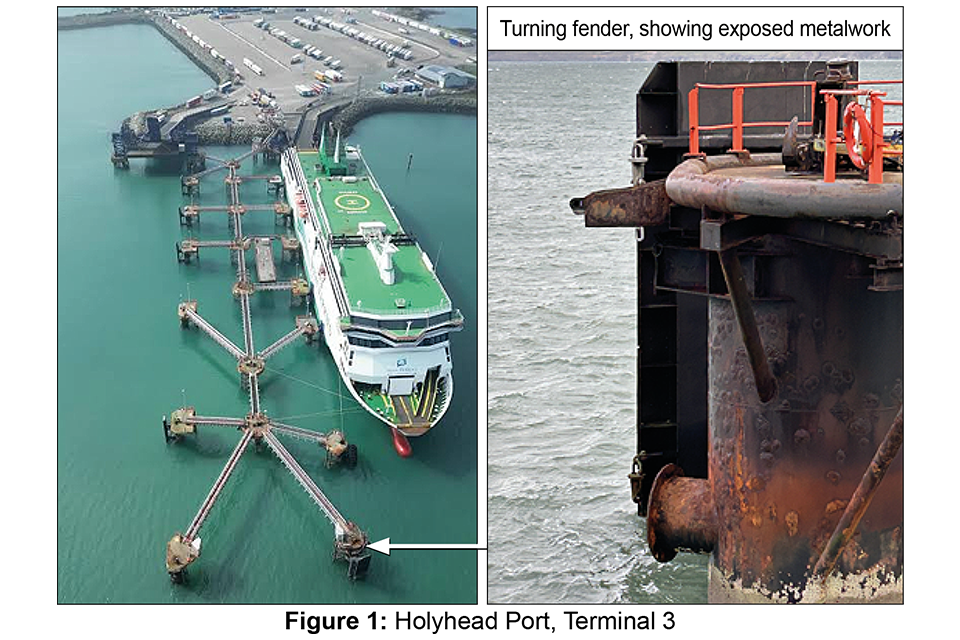
The consequence of this navigational excursion was direct and severe. The starboard side of the Stena Estrid collided forcefully with an unprotected turning fender situated at the northern extent of Terminal 3.
The kinetic energy of the 41,671-gross-tonne vessel concentrated against the unyielding structure of the fender, puncturing the hull in two distinct locations:

- Below the Waterline: A critical breach opened directly into the starboard engine room, immediately breaching the watertight envelope.
- Above the Waterline: A secondary structural rupture occurred higher up on the vessel’s cargo deck level.
Within moments, the breach below the waterline permitted an estimated 500 tonnes of seawater to cascade into the starboard engine room. An additional, unquantified volume of water entered an adjacent void space, threatening to alter the vessel’s trim and stability dangerously.
Emergency Response and Damage Control
Faced with rapidly rising water levels in a vital machinery space, the crew of the Stena Estrid initiated emergency response protocols with exemplary speed and precision. Maritime safety management systems were put to the test as engineering and deck personnel swung into action:

- Shoring Up: Damage control teams rapidly deployed timber and metal shores to reinforce weakened internal bulkheads and slow potential secondary failures.
- Dewatering: High-capacity bilge and emergency pumping systems were brought online to expel incoming water from the flooded compartments.
- Ballast Transfer: In a critical tactical maneuver, the crew shifted internal ballast water to induce a controlled port list. This intentional listing had the dual effect of stabilizing the vessel’s lateral posture and lifting the starboard hull breach above the external waterline, effectively halting the passive influx of seawater.
Berthing, Passenger Disembarkation, and Port Operations
Remarkably, once the situation on board was brought under control and stability was restored, the master and bridge team retained situational awareness sufficient to safely complete the berthing operation at Terminal 3.
Passengers and vehicles were successfully disembarked without significant delay, sparing travelers from prolonged uncertainty. Simultaneously, port authorities acted to secure the area, temporarily closing Holyhead Port to incoming and outgoing ferry traffic. Later that evening, once the Stena Estrid was safely shifted to an alternative berth, marine surveyors conducted a thorough damage assessment of the Terminal 3 jetty. Finding no significant structural damage to the pier itself, port authorities cleared the terminal to return to active service.
Following temporary repairs carried out at Holyhead, the Stena Estrid was cleared to travel under its own power across the Irish Sea to a commercial dry dock in Liverpool, England, for permanent steel renewal and system overhauls.
Supporting Context & Metrics
Understanding the scope of this marine casualty requires examining the technical specifications of the vessel, the parameters of the voyage, and the environmental factors that shaped the incident.
Ship Particulars
The Stena Estrid is a modern, high-capacity RoPax ferry engineered for intensive cross-channel operations. Built in 2019 by China Merchants Jinling Shipbuilding Co. Ltd., the vessel represents the cutting edge of contemporary ferry design, balancing fuel efficiency, passenger comfort, and massive vehicular throughput.
- Vessel’s Name: Stena Estrid
- Flag: Cyprus
- Classification Society: DNV GL
- IMO Number: 9807293
- Type: Roll-on/roll-off passenger (RoPax) ferry
- Registered Owner: LS-CYP1 Co Ltd
- Manager: Stena Line Limited
- Operator: Stena Line Irish Sea Ferries Limited
- Construction Yard: China Merchants Jinling Shipbuilding Co. Ltd.
- Year of Build: 2019
- Length Overall (LOA): 214.5 meters
- Gross Tonnage: 41,671
- Minimum Safe Manning: 19 crew members
- Authorised Cargo: Commercial and private vehicles, alongside foot and motoring passengers
Voyage Particulars
The incident occurred on a routine international transit that links major economic and transport hubs in Ireland and the United Kingdom.
- Port of Departure: Dublin, Ireland
- Port of Arrival: Holyhead, Wales
- Type of Voyage: International short-sea crossing
- Cargo Information: 95 vehicles (comprising a mix of freight and passenger cars) and 91 passengers
- Total Crew Manning: 66 personnel (exceeding the minimum safe manning requirement to support enhanced onboard services and operations)
Marine Casualty Information & Environmental Data
Compiled by the MAIB, the formal classification of the event highlights the severity of the structural impact contrasted against the fortunate absence of personal injury.
- Date and Time: 7 January 2026 at 0750 UTC
- Type of Marine Casualty: Serious Marine Casualty
- Location of Incident: Terminal 3, Holyhead Port, Wales
- Place on Board: Starboard engine room and cargo deck
- Injuries / Fatalities: None
- Damage / Environmental Impact: Major hull puncture with significant engine room flooding (no reported marine pollution)
- Ship Operation: RoPax ferry maneuvering during berthing operations
- Voyage Segment: Terminal approach and docking phase
- Environmental Conditions: Westerly wind blowing at Force 6 to 7 (strong breeze to near gale), creating challenging hydrodynamic and windage forces
- Total Persons on Board: 157 (91 passengers + 66 crew)
Official Statements and Institutional Findings
The MAIB Preliminary Assessment
The Marine Accident Investigation Branch utilizes preliminary assessments to gather factual data on significant incidents without necessarily launching a protracted, full-scale public investigation, provided that safety issues have been adequately recognized and addressed by the stakeholders involved. In the case of PA Summary 3/2026, the MAIB reviewed the navigation logs, environmental telemetry, crew actions, and structural damage reports.
Investigators focused heavily on the interaction between the ferry’s maneuvering profile, the assistance of the port-quarter tug, and the unyielding nature of the unprotected turning fender at Terminal 3. While the environmental conditions—specifically the Force 6 to 7 westerly winds—created profound handling difficulties, the investigation underscored the critical importance of infrastructure design in mitigating the consequences of navigational errors or environmental set-offs.
Corrective Actions Taken by Stakeholders
Prompt interventions by both the ship management company and the port operator satisfied the MAIB that systemic risks were being actively managed, leading to the formal closure of the investigation:
-
Stena Line Limited (Vessel Manager):
- Implemented immediate internal reviews of bridge resource management (BRM) procedures during high-wind berthing operations at Holyhead.
- Enhanced communication protocols between ship masters and assisting tug operators when operating in restricted turning basins under adverse weather.
- Conducted comprehensive structural audits and oversaw permanent repairs during the vessel’s dry-docking phase in Liverpool.
-
Stena Line Ports Limited (Port Operator):
- Initiated a comprehensive review of fender placements and protection standards across Holyhead Port facilities, with a specific focus on Terminal 3.
- Commenced planning for port infrastructure improvements designed to absorb and deflect high-impact loads more safely.
- Re-evaluated terminal lighting, aids to navigation, and localized wind monitoring systems to assist incoming vessels during severe gales.
Future Outlook: Lessons for Short-Sea Ferry Operations
The collision of the Stena Estrid serves as a sobering reminder of the vulnerability of even the most modern vessels when pitted against severe meteorological forces in confined port waters. RoPax ferries are inherently susceptible to windage due to their high, expansive side profiles, making them vulnerable to leeway when maneuvering at slow speeds near jetties and piers.
Enhancing Bridge Resource Management and Tug Coordination
A primary takeaway from the Holyhead incident is the necessity of seamless coordination between a ferry’s bridge team and assisting harbour tugs. When winds reach Force 6 to 7, the margin for error during complex pivot and backing maneuvers narrows dramatically. Future training regimens across short-sea operators are expected to place increased emphasis on contingency planning for sudden wind-induced sets, ensuring that tugs can effectively counteract lateral drift before a vessel approaches structural hazards.
Infrastructure Resilience and Port Modernization
Beyond shipboard operations, the incident casts a spotlight on port infrastructure. The presence of an "unprotected turning fender" at Terminal 3 played a direct role in puncturing the hull rather than safely deflecting the vessel’s energy. The commitments made by Stena Line Ports Limited to upgrade terminal fendering systems represent a vital step forward. Modern ports handling mega-ferries must continually adapt their civil engineering to match the increasing size and momentum of contemporary commercial tonnage.
Conclusion
Ultimately, the story of the Stena Estrid on 7 January 2026 is one of operational resilience triumphing over potential catastrophe. Because of rigorous emergency preparedness, rapid damage control, and a disciplined crew, a serious marine casualty resulted in zero injuries, no environmental pollution, and minimal disruption to the vital transport link between Ireland and Wales. With the MAIB investigation formally closed and infrastructural upgrades underway at Holyhead Port, the maritime community moves forward with enhanced safeguards designed to protect passengers, crew, and vessels alike on the turbulent waters of the Irish Sea.