



Executive Overview
The staging of a major international sporting event presents an extraordinary logistical stress test for any host nation. When the globe converges on a handful of metropolitan areas for a month-long tournament, the pressure shifts immediately from stadiums and fan zones to the arteries of urban mobility: buses, trains, ferries, motorcoaches, and regional rail networks.
During the historic World Cup tournament spanning Canada, the United States, and Mexico, North American transit agencies and private operators faced an unprecedented operational challenge. Hundreds of thousands of international visitors, local commuters, and tournament personnel had to be moved seamlessly across vast geographical distances on tight schedules.
The successful execution of this massive logistical undertaking required unprecedented cooperation between public transit authorities, private charter networks, municipal governments, and frontline transit workers. From Vancouver and Los Angeles to Atlanta, Boston, and Houston, public transportation systems absorbed millions of incremental passenger trips. Agencies scaled up operations by adding thousands of daily trips, introducing specialized bus and rail routes, deploying customer-service ambassadors, and integrating private motorcoach networks to solve complex first- and last-mile connectivity challenges.
This comprehensive report examines how public agencies and private operators managed the immense surge in ridership, the specific strategies deployed across key host cities, the vital behind-the-scenes contributions of frontline workers, and the enduring lessons public transit systems are applying as they look toward future mega-events, most notably the 2028 Olympic and Paralympic Games.
Detailed Chronology & Regional Case Studies
The operational footprint of the World Cup required hyper-localized strategies tailored to the unique urban geographies of each host city. Across the continent, agencies initiated multi-modal expansions that transformed how urban transit networks handled mega-event traffic.
Vancouver: Scaling Up Multi-Modal Capacity on the Coast
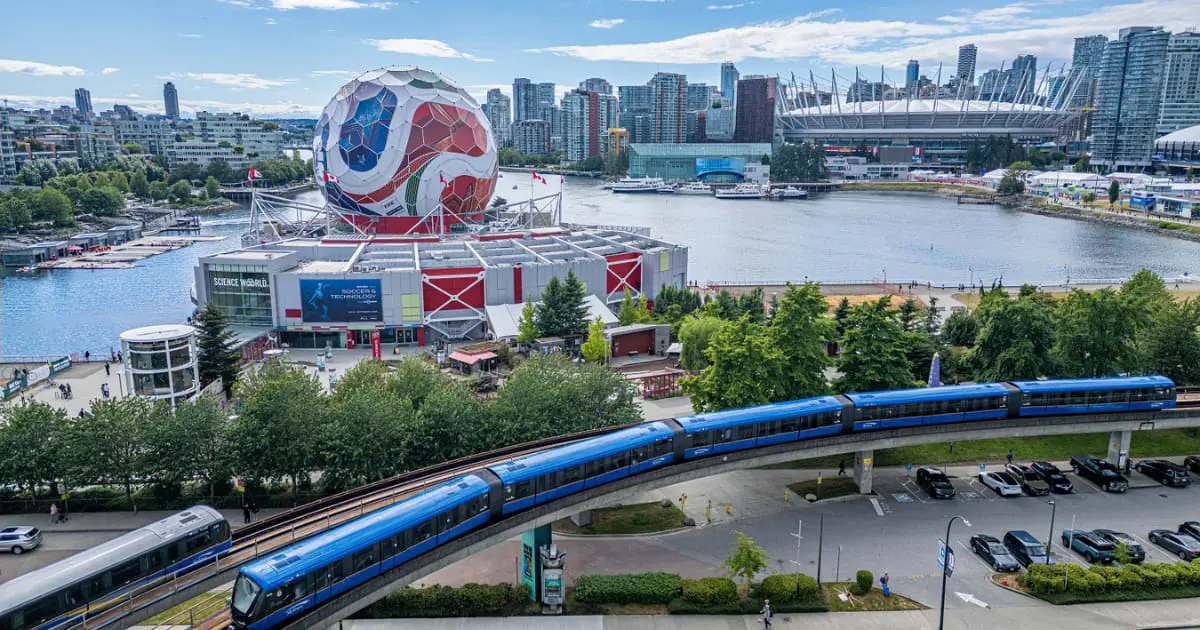
In the Pacific Northwest, TransLink assumed the monumental task of keeping Vancouver moving during the city’s seven high-stakes match days. Operating across an integrated network of buses, the SkyTrain rapid transit system, the SeaBus passenger ferry, and the West Coast Express commuter rail, TransLink implemented a robust service enhancement plan designed to absorb massive crowds along the scenic waterfront.
Preliminary operational data revealed that TransLink recorded an average of 87,000 additional transit boardings on each of the city’s seven match days. To accommodate this sudden influx, the agency injected sweeping service increases. Most notably, TransLink added 600 daily bus trips, introduced two entirely new routes specifically tailored to event venues, and boosted capacity across multiple transport modes. The agency’s strategic coordination ensured that fans traveling to and from coastal fan zones and match venues experienced minimal friction, proving the resilience of Vancouver’s multi-modal transit blueprint.
Atlanta: MARTA’s Historic 35-Day Surge
Further south, the Metropolitan Atlanta Rapid Transit Authority (MARTA) faced a prolonged period of high-intensity transit management. Over a compressed 35-day window that incorporated World Cup matches alongside overlapping major urban events, MARTA’s rail network registered a staggering 4.7 million passenger trips.
The focal point of this massive movement was MARTA’s bustling Five Points Station, which acted as a critical nexus for thousands of global football fans. Despite operating at peak capacity for over a month, MARTA maintained system integrity through precise crowd-control architecture, enhanced security protocols, and real-time operational adjustments. The agency’s performance during this 35-day gauntlet demonstrated how legacy rapid transit systems can absorb high-density, multi-event demand without suffering systemic gridlock.
Boston and Los Angeles: Frontline Execution and Brand Transformation
In the Northeast, the Massachusetts Bay Transportation Authority (MBTA) tackled the complex task of dispersing crowds around historic Boston-area sporting venues. Here, the frontline workforce proved to be the ultimate differentiator. Transit employees stationed outside venues managed sprawling pedestrian flows, provided multilingual directions, and facilitated smooth transfers between regional rail lines and stadium gates.
Meanwhile, on the West Coast, the Los Angeles Metro undertook a two-fold mission: managing immediate tournament mobility while gathering invaluable operational intelligence for the upcoming 2028 Olympic and Paralympic Games. Behind-the-scenes maintenance crews played a crucial role, applying vibrant, custom World Cup branding to Los Angeles Metro buses to welcome international visitors. This branding initiative did more than just build festive spirit; it established clear visual wayfinding cues for tourists navigating an unfamiliar transit landscape. The data, crowd-management techniques, and inter-agency coordination strategies tested during the Los Angeles World Cup window are already serving as the foundational textbook for 2028 Olympic transportation planning.
Supporting Context & Metrics: Public-Private Synergy
While fixed-rail networks and municipal bus fleets carried the bulk of commuter and fan traffic, a vital network of private charter operators, motorcoach companies, and technology-driven mobility platforms bridged the operational gaps. The interplay between public infrastructure and private fleets formed the backbone of the tournament’s logistics chain.
Bridging the First- and Last-Mile Gap
Traditional fixed-route transit systems excel at moving large volumes of people along established corridors, but they frequently struggle with the "first- and last-mile" dilemma—getting spectators from regional park-and-rides, hotels, and transit hubs directly to stadium gates.
Private mobility innovators like CharterUP stepped in to solve this structural challenge. By deploying dynamic fleets for park-and-ride shuttles, dedicated hotel loops, and direct stadium feeder routes, CharterUP and similar private operators absorbed overflow demand. This integration prevented station platform overcrowding and ensured that suburban and regional visitors had reliable, direct access to match venues without relying on private automobiles.
VIP, Team, and Media Logistics: Specialized Motorcoach Fleets
Beyond general spectator movement, the tournament required an intricate, highly secure logistics framework for national teams, FIFA executives, media personnel, and broadcast crews. Managing the synchronized movement of dozens of international delegations across multiple host nations demanded elite coordination.
Companies like First Class Transportation and Lux Bus America deployed specialized, fully branded motorcoaches to manage these high-stakes movements. For instance, First Class Transportation staged specially wrapped motorcoaches dedicated to national teams such as Germany and Curaçao, supporting everything from team base camp transfers to media excursions. Similarly, Lux Bus America provided secure, dedicated transport for national squads, FIFA officials, and broadcast workers, including custom-branded motorcoaches for the Qatar national team. These private fleets operated under strict security and scheduling protocols, ensuring that the tournament’s VIP stakeholders arrived precisely on schedule.
Human Capital: Ambassadors and Customer Support
Technology and rolling stock alone cannot guarantee a smooth transit experience; human touchpoints remain indispensable. Across host cities, agencies heavily invested in human infrastructure.
In Houston, the Metropolitan Transit Authority of Harris County deployed uniformed customer service ambassadors—affectionately dubbed METROnauts—to greet international visitors at major hubs. Armed with multi-lingual maps, real-time app guidance, and enthusiastic assistance (embodied by slogans like "One small step aboard, and one giant leap to your destination"), these ambassadors demystified complex ticketing and routing systems for first-time riders, drastically reducing processing times at station turnstiles.
Official Statements and Industry Insights
The massive undertaking of moving millions of tournament-goers prompted reflections from transit executives, municipal leaders, and industry observers across North America.
Industry analysts noted that the tournament served as an unprecedented stress test for modern mobility infrastructure. While large-scale sporting events routinely strain municipal resources, the multi-nation, multi-city footprint of this World Cup forced transit agencies to adopt agile, data-driven management styles that broke down traditional bureaucratic silos.
Frontline management teams emphasized that the success of the transit network relied fundamentally on the adaptability of on-the-ground personnel. As one transit operations director noted:
"When you introduce hundreds of thousands of visitors from every corner of the earth into a domestic transit ecosystem, fixed schedules and digital wayfinding are only half the battle. The true success of our system hinged on the situational awareness, patience, and proactive engagement of our frontline staff and station ambassadors."
Private sector partners echoed the sentiment regarding cross-sector collaboration. Representatives from the private motorcoach sector highlighted that the seamless integration between public transit agencies and private charter networks established a new benchmark for how North American cities can handle mega-events in the future. By treating public rail, municipal buses, and private motorcoach fleets as a single, unified mobility ecosystem, host cities avoided the paralyzing congestion that has plagued past international tournaments.
Future Outlook: Legacy and the Road to 2028
As the echoes of the World Cup fade and municipal planners audit their post-tournament data, the legacy of this massive mobilization is already reshaping the future of North American public transportation.
Data-Driven Mobility and Predictive Analytics
One of the most enduring legacies of the tournament is the acceleration of real-time data analytics in transit management. Agencies that once relied on historical ridership models for scheduling were forced to adopt dynamic, predictive modeling tools. By tracking cellular foot traffic, Wi-Fi handshakes at stations, and real-time bus telemetry, transit control centers learned to anticipate crowd surges before they overwhelmed platforms. These predictive capabilities are now being integrated into permanent daily operations to better manage ordinary peak-hour commuters.
Infrastructure Upgrades and Permanent Service Enhancements
The temporary service bumps—such as TransLink’s added bus routes and MARTA’s high-frequency rail deployments—provided agencies with empirical proof of consumer demand for expanded transit options. Several host cities are now evaluating whether to make certain temporary enhancements permanent, particularly those serving growing suburban corridors and developing entertainment districts.
The 2028 Olympic Horizon
Perhaps the most valuable output of the World Cup mobilization was the practical, hands-on rehearsal it provided for upcoming global spectacles. For regions like Los Angeles, managing the complex influx of World Cup visitors served as a vital dress rehearsal for the 2028 Olympic and Paralympic Games.
The lessons learned regarding inter-agency communication, crowd-control architecture, branded visual wayfinding, and public-private fleet integration have provided municipal leaders with a battle-tested playbook. As North American cities continue to grow and attract world-class events, the blueprint forged during this historic tournament ensures that public transit will remain the reliable, efficient backbone of urban mobility for decades to come.