








Executive Overview
Stepping aboard a modern cruise ship for the first time opens up a floating world of grand atriums, sprawling multi-tier dining rooms, and a rich, centuries-old lexicon unique to the maritime industry. Among the most fundamental terms every traveler must master are port and starboard. While seasoned mariners and frequent cruisers use these directional designations automatically, newcomers often find themselves disoriented by terminology that replaces simple concepts like "left" and "right."
However, the use of port and starboard is far more than an exercise in nautical tradition; it is a critical safety mechanism. Because directional references like "left" or "right" depend entirely on the observer’s physical orientation, they introduce dangerous ambiguity in fast-moving operations, crisis management, and routine navigation. By fixing these definitions permanently to the vessel itself, maritime crews ensure absolute clarity.
This comprehensive guide explores the historical origins of port and starboard, breaks down practical memory techniques to help you master shipboard orientation, analyzes how your choice of cabin location can dramatically impact your cruise experience, and introduces broader nautical terminology essential for navigating your next voyage with confidence.
Detailed Chronology: The Historical Evolution of Maritime Terminology
The language of the sea is built upon centuries of trial, error, and practical adaptation. To truly understand why a cruise ship relies on terms like "port" and "starboard," one must trace their lineage back to the infancy of seafaring.
The Era of the Steering Oar and the Birth of Starboard
Before modern mechanical rudders were invented and integrated into ship design, watercraft were maneuvered using a specialized steering oar. Because the vast majority of the human population throughout history has been right-handed, early mariners naturally positioned this steering oar on the right side of the vessel to maximize their physical leverage and control.
This operational layout gave rise to the term starboard, which is a linguistic evolution of two Old English words: stēor, meaning "to steer," and bord, meaning the side of a boat or ship. Originally combined as steorbord, the term literally translates to "the steering side of the boat."
Because the right side of the ship was permanently occupied by the heavy steering oar, sailors could not safely bring the vessel up against a wooden dock or wharf on that side without risking catastrophic damage to the steering apparatus. Consequently, ships were invariably brought alongside docks using the opposite side—the left side—for loading cargo, supplies, and passengers.
From "Larboard" to "Port": Eliminating Linguistic Confusion
For generations, the left side of the vessel was known as larboard, a term derived from Middle English meaning "loading side." However, as ships grew larger, engine noise increased, and maritime communications became more complex, a glaring hazard emerged: larboard and starboard sounded virtually identical over the roar of wind, waves, and early machinery. Misheard helm or deck commands during a critical maneuver could lead to groundings or collisions.
To eliminate this dangerous auditory confusion, the Royal Navy and international maritime communities officially transitioned away from larboard during the mid-nineteenth century. The left side was officially renamed port, as it designated the specific side of the ship safely presented to the dock or harbor facilities during port calls.
Global Standardization and the Origin of Red and Green Lights
As European maritime powers—particularly the British Empire—expanded global trade routes, colonized new territories, and established international shipping lanes, these terms were disseminated worldwide. By the nineteenth and twentieth centuries, international governing bodies formalized maritime rules of the road, cementing port and starboard as the universal standard.
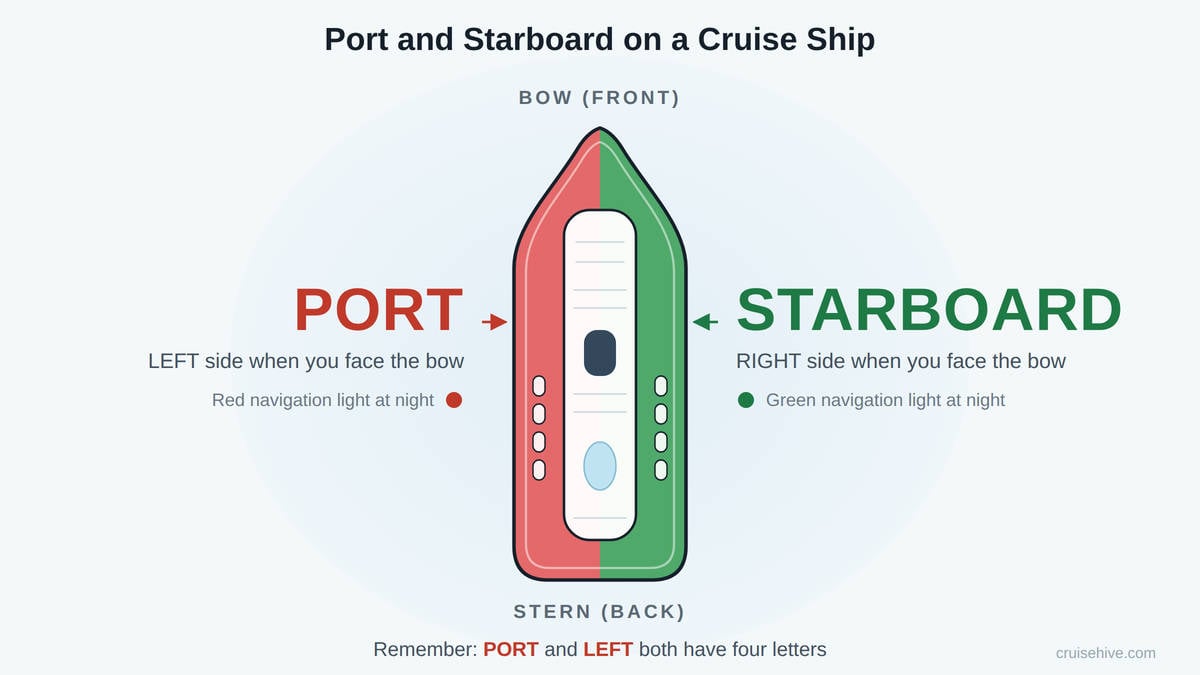
Even the color codes associated with ship navigation—red for port and green for starboard—possess historical roots. In the early days of maritime illumination, red lanterns were significantly easier and less expensive to manufacture than green ones due to the chemical composition of glass production and the widespread availability of copper compounds. Red lights were consequently adopted first to mark harbors and coastal ports, eventually becoming permanently tethered to the port side of vessels. Green glass technology eventually advanced to a point where a contrasting starboard marker could be reliably produced, completing the standard navigational lighting array used today.
Supporting Context & Metrics: Why Fixed Orientation Matters
For the uninitiated traveler, substituting "left" and "right" with "port" and "starboard" can feel like an unnecessary affectation. In practice, however, these terms serve as an indispensable cognitive framework for vessel safety, traffic management, and onboard logistics.
The Danger of Relative Direction
Consider an onboard emergency—such as a localized fire or a medical crisis. If a crew member urgently broadcasts over the ship-wide intercom system, "Crew, the ship’s left side is on fire!" the instruction is inherently flawed. A crew member standing on the bridge facing forward will interpret "left" as port. Simultaneously, a crew member standing in an aft stateroom facing the stern will interpret "left" as starboard. In a high-stress scenario, this simple perspective shift could send responders racing to opposite sides of the vessel, costing precious seconds.
By utilizing port (always the left side when facing forward) and starboard (always the right side when facing forward), absolute positional clarity is maintained regardless of where an individual is standing or which direction they are facing.
Navigational Rules and Buoyage Systems
Beyond internal ship operations, port and starboard dictate international marine traffic laws. When navigating coastal waters, captains rely on standardized lateral buoyage systems to mark safe channels.

- Red Buoys: Typically indicate the port side of a channel when returning from open sea. Under the standard international rule ("Red, Right, Returning" in certain regions, though global systems vary by IALA region), captains must understand these color designations relative to their heading.
- Green Buoys: Mark the starboard side of navigable channels.
At night or during severe weather conditions with low visibility, the red and green navigation lights mounted on the superstructure of all watercraft allow watch officers to instantly determine the heading, aspect, and right-of-way of approaching vessels, effectively preventing collisions at sea.
Practical Application: How to Master Port and Starboard Aboard a Cruise Ship
Whether you are navigating a massive mega-ship accommodating over 6,000 guests or exploring an intimate expedition vessel, keeping your bearings straight is essential. Here is how you can effortlessly determine which side of the ship you are on.
The Bow and Stern Rule
To establish your orientation, you must first identify the front of the ship, known as the bow (or fore), and the back of the ship, known as the stern (or aft).
Once you are standing in a corridor or on an open deck and facing directly toward the bow:
- Port is always on your left.
- Starboard is always on your right.
Proven Mnemonic Devices for Travelers
If you find yourself repeatedly second-guessing your orientation, utilize these time-tested memory tricks:

- The Letter Count Method: The words left and port both contain exactly four letters. Additionally, both words consist of a single syllable.
- The "R" Symmetry: The word starboard contains two letter "r"s, and it equates to right (which also begins with the letter "r"). Conversely, port contains only one "r" and equates to left.
- Alphabetical Order: Alphabetically, "L" comes before "R" (Left/Right), and "P" comes before "S" (Port/Starboard). Therefore, Port matches Left, and Starboard matches Right.
- The Port Wine Trick: Port wine is traditionally red in color. Because red corresponds to the port side of the ship, remembering "No port left without port wine" helps lock in the color and directional association.
Cabin Selection Strategy: Does Port vs. Starboard Matter?
One of the most practical applications of understanding maritime terminology comes into play before you even step foot on the ship: selecting your stateroom. While cabin size, layout, and amenities are generally identical regardless of which side of the vessel they occupy, the views and environmental exposure can vary dramatically based on your location.
One-Way Cruises and Coastal Scenery
On traditional round-trip sailings—such as a seven-night Caribbean cruise departing from and returning to Miami—both the port and starboard sides of the ship will experience a balanced mix of ocean horizons, island port calls, and coastal panoramas.
However, on one-way itineraries, cabin placement is paramount. Consider a northbound one-way Alaskan cruise departing from Vancouver and terminating in Seward. As the ship glides up the protected Inside Passage, the majestic Alaskan mainland and coastal mountain ranges remain predominantly to the east (right side).
- Northbound Sailings: A stateroom on the starboard side ensures continuous, unobstructed balcony views of the shoreline, glaciers, and passing wildlife.
- Southbound Sailings: The opposite holds true. When traveling south down the same coastline, the mainland will be to your left, making a port-side stateroom the optimal choice for shoreline vistas.
Note: Cruise lines are well aware of scenic advantages; staterooms positioned on the "view-heavy" side of iconic one-way itineraries often command a higher fare or sell out significantly faster.
Sunrises and Sunsets
For travelers who love photography or simply enjoy sipping coffee while watching the dawn, celestial orientation matters. Because the sun rises in the east and sets in the west, your vessel’s heading dictates your daily light exposure:

- If your ship is cruising northward along a coastal route, a starboard-facing balcony will generally offer prime sunrise viewing, while a port-facing balcony captures evening sunsets over the open ocean.
Decoding Cabin Numbers
When browsing deck plans to select your room, cruise lines typically employ a numerical system to designate sides:
- Even-numbered cabins are traditionally located on the starboard side of the ship.
- Odd-numbered cabins are traditionally located on the port side of the ship.
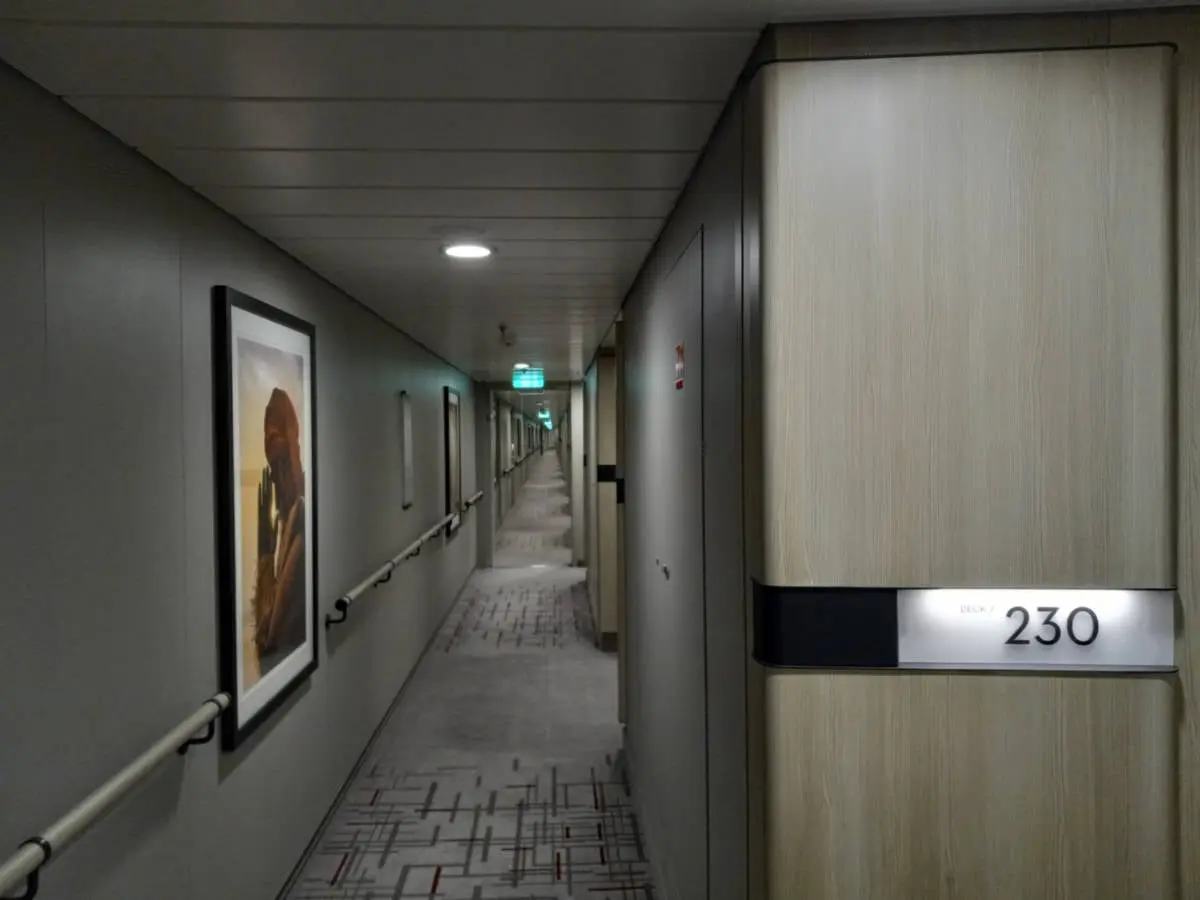
When exiting elevators or stairwells, modern cruise ships provide directional signage indicating whether that particular hallway corridor leads toward the bow or stern, paired with clear port and starboard markers. Veteran cruisers often memorize a specific onboard landmark—such as noting that the art gallery is always on the port side or the loyalty ambassador desk is on the starboard side—to instantly reorient themselves upon returning to their deck.
Essential Nautical Glossary for the Modern Passenger
Beyond port and starboard, familiarizing yourself with foundational maritime vocabulary will deepen your appreciation of cruise operations and help you converse fluently with crew members:
- Aft / Stern: The rear section of the ship.
- Beam: The maximum width of the ship measured at its widest point.
- Bow / Fore / Prow: The forward-most part of the ship.
- Bridge: The command center where the captain, officers, and navigational team operate the vessel.
- Draft: The vertical distance between the waterline and the bottom of the keel (hull), determining the minimum water depth required for the ship to safely float.
- Keel: The structural backbone running along the bottom center of the ship’s hull from bow to stern.
- Lee / Leeward: The side of the ship sheltered from the prevailing wind.
Future Outlook: Technology, Tradition, and the Modern Cruise Experience
As cruise ships continue to evolve into technological marvels outfitted with advanced satellite navigation, dynamic positioning systems, and automated propulsion azipods, the physical operation of vessels has transformed dramatically since the days of steering oars and canvas sails.
Yet, despite these rapid digital advancements, the maritime industry fiercely preserves its linguistic heritage. Terms like port and starboard remain legally and operationally binding across international waters. For the modern traveler, embracing this terminology is more than an exercise in memorization—it is an invitation to connect with thousands of years of seafaring history. By mastering these foundational concepts before embarkation, you ensure a smoother, more confident journey across the world’s great oceans.