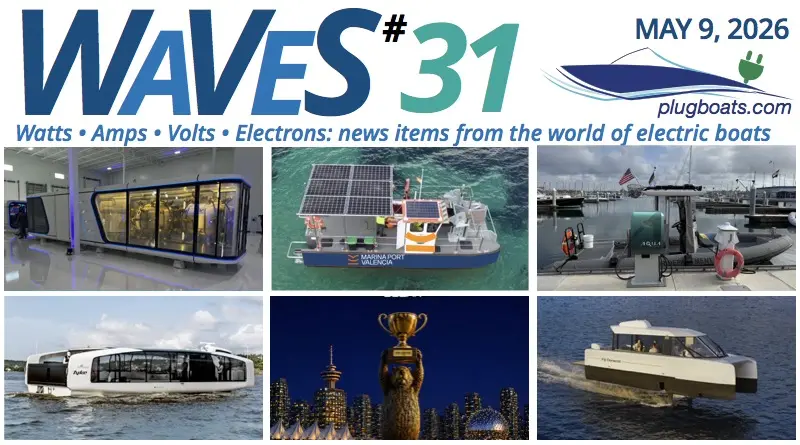
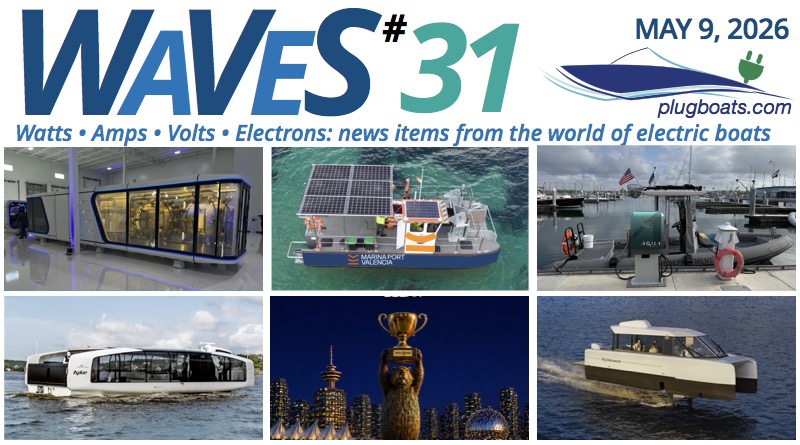
The global maritime industry is experiencing a profound transition, moving away from fossil-fuel reliance toward decentralized, high-efficiency, zero-emission technologies. As coastal cities and inland waterways face mounting congestion and stringent environmental regulations, electric and alternative-energy marine applications are no longer speculative concepts. They are scaling rapidly into commercialized, everyday realities.
This edition of Plugboats WAVES (Watts, Amps, Volts, Electrons) captures a defining moment in this evolution. From award-winning electric ferries in Norway completing rigorous, multi-month trials with unprecedented energy efficiency, to the cross-hemispheric expansion of hydrofoiling commuter networks in Tasmania, the landscape of waterborne transit is transforming.
Simultaneously, cutting-edge material sciences are unlocking new ways to harvest solar energy directly from marine decks, while specialized electric catamarans work tirelessly to scrub urban marinas of hydrocarbons and floating waste. On the infrastructure side, the rapid deployment of high-speed marine chargers—such as the latest installation in Newport Beach, California—is solving the critical "range anxiety" equation for commercial and recreational vessel operators. Looking further ahead, pioneering advancements in subcritical thorium microreactors are bringing the once-unthinkable concept of nuclear-powered electric superyachts and commercial tankers closer to commercial viability.
Together, these developments underscore a multi-faceted approach to decarbonizing the water, proving that the future of marine transportation will rely on a sophisticated mix of electrification, advanced hydrodynamics, smart energy capture, and next-generation power generation.
Detailed Chronology of Recent Maritime Milestones
The trajectory of marine electrification over the past several months has been marked by crucial performance verifications, infrastructure rollouts, and technological leaps across diverse sectors of the boating industry.
April 2024 – July 2025: Hyke F-15 Shuttle Completes Historic Trial
Operating within the municipal transport network of Fredrikstad, Norway, the fully electric, 50-passenger Hyke F-15 Shuttle completed a transformative 14-month trial. Winning accolades such as the 2024 Gussies Electric Boat Awards, the vessel serviced a high-frequency 225-metre urban river crossing with an average duration of just two minutes. By the conclusion of its trial, the shuttle had safely transported over 41,000 passengers, yielding vital real-world operational data that directly pitted electric propulsion against conventional diesel alternatives in a demanding public transit ecosystem.
Early 2026: Vessev Announces Tasmanian Expansion
Following its footprint in Perth, New Zealand-based electric hydrofoil manufacturer Vessev set its sights on Hobart, Tasmania. Partnering with the clean energy transport venture Fly Derwent, Vessev committed to deploying its advanced VS-9 and VS-12 hydrofoiling vessels along the Derwent River. Scheduled for arrival in early 2027, this initiative marks a major step in establishing a metro-style water transit network powered almost entirely by Tasmania’s renewable wind and solar grid.
Late April 2026: Open Waters Solar Wins "Beaver’s Den" Startup Competition
At Vancouver Science World, Canadian marine solar innovator Open Waters Solar captured top honors in the inaugural "Beaver’s Den" competition—a high-stakes showcase for pre-Series A startups modeled after popular venture capital television formats. Outpacing 25 finalists, the British Columbia-based company showcased its robust market traction, solidifying industry recognition for its durable, walkable, power-generating deck composite, SolaDek.
Spring 2026: Marina Port Valencia Deploys "NetBoat"
Spain’s Marina Port Valencia took delivery of the CatClean 75 "NetBoat," engineered by Ona Safe & Clean. Designed to maintain pristine waters while advancing the sustainability mandates of parent company Marina Norte, the 7.5-metre aluminum catamaran began executing its dual role of waste collection, hydrocarbon retention, and water oxygenation across the Mediterranean marina.
Mid-2026: Aqua superPower Activates Newport Beach Fast Charger
Strengthening the charging corridor along the Pacific Coast, Aqua superPower officially brought its high-speed marine charging station online at Marina Park in Newport Beach, California. Providing up to 24 kW of power via international CCS standards, the installation offers vital support to the local recreational boating community and the municipal government’s expanding fleet of electric workboats.
Supporting Context & Metrics
Evaluating the true viability of marine electrification requires a close examination of quantitative performance metrics, engineering specifications, and efficiency gains. The recent wave of deployments provides compelling data demonstrating that electric marine systems frequently outperform their internal combustion engine predecessors.
Hyke F-15 Shuttle: Energy Efficiency and Public Perception
The numbers generated by the Hyke F-15 Shuttle during its Fredrikstad deployment are staggering. According to project disclosures, the vessel requires up to 88 per cent less energy than similarly sized diesel-powered ferries navigating comparable routes. To put its power draw into perspective, the ferry operates on roughly the same electrical load as five household hair dryers.
Beyond mere energy savings, passenger adoption proved exceptionally high. Commuters rated the vessel at 4.72 out of 5 for overall satisfaction, highlighting the qualitative benefits of silent, vibration-free, and emission-free urban water transit.
+-------------------------------------------------------------+
|               HYKE F-15 SHUTTLE PERFORMANCE                 |
+-------------------------------------------------------------+
| Energy Consumption Reduction vs. Diesel:  Up to 88%         |
| Power Draw Equivalent:                    5 Hair Dryers     |
| Passenger Satisfaction Score:             4.72 / 5.0        |
| Total Passengers Transported (14 mos):    41,000+           |
| Average Crossing Time:                    ~2 Minutes        |
+-------------------------------------------------------------+
Vessev Hydrofoil Specifications (VS-9 & VS-12)
Hydrofoiling technology fundamentally alters vessel efficiency by lifting the hull entirely out of the water, dramatically reducing hydrodynamic drag at cruising speeds. Vessev’s models leverage this physics-based advantage across two distinct form factors:
VS-9: A 29-foot craft accommodating up to 10 passengers, capable of achieving a cruising speed of 25 knots with a maximum range of up to 50 nautical miles.
VS-12: A larger 37-foot variant designed to carry up to 30 passengers, scaling up capacity for high-density commuter routes.
Open Waters Solar SolaDek Engineering
Traditional marine solar panels have long suffered from structural fragility, bulky metal framing, and susceptibility to the harsh marine environment. Open Waters Solar solved these engineering roadblocks by developing a specialized composite material. This proprietary formulation suspends photovoltaic cells within a protective, resilient layer, achieving structural rigidity combined with essential flexibility. The resulting product, SolaDek, provides a non-slip, walk-friendly deck surface that generates clean power directly from areas previously wasted on foot traffic.
Ona Safe & Clean NetBoat Capacities
The CatClean 75 "NetBoat" deployed in Valencia packs impressive industrial capabilities into a relatively compact 7.5-metre catamaran hull with a 2.5-metre beam:
Hydrocarbon Retention Capacity: Up to 2,000 litres of surface oils and chemical pollutants.
Cleaning Coverage: Approximately 8.89 km² per hour.
Operational Endurance: Up to 16 hours daily, supported by an onboard electric propulsion setup augmented by integrated solar panels.
Aqua superPower Infrastructure Specs
The newly operational charger at Newport Beach delivers up to 24 kW of direct current via the international CCS (Combined Charging System) standard. Engineered specifically to withstand corrosive marine environments, the charger is brand-agnostic, ensuring compatibility with virtually every major electric boat manufacturer operating in North American and European waters.
Official Statements and Industry Insights
Key stakeholders across the marine technology sector have emphasized that these deployments represent foundational shifts in urban planning, infrastructure development, and propulsion engineering.
Halvor Vislie, CEO of Hyke, highlighted the untapped potential of urban waterways during the release of the Fredrikstad trial results:
"The project shows that our urban waters can be used much more efficiently. Instead of digging tunnels or building bridges, which are hugely costly, electric ferries can quickly be deployed to shuttle large numbers of passengers. It’s time to rethink urban planning by putting waterways at the centre. Together with Fredrikstad Municipality, we’ve demonstrated that the Hyke F-15 can operate as part of everyday public transport — efficiently, quietly and with strong passenger acceptance."
Cameron McCulloch, Principal of Fly Derwent, emphasized the broader implications of bringing Vessev hydrofoils to Tasmania’s Derwent River:
"From the very beginning this project has been about demonstrating how Tasmania’s renewable energy focus can translate into sustainable transport leadership. This technology unlocks affordable, river-based commuter and tourism transport in Hobart without the need for large-scale infrastructure changes. That’s what excites me most — not just the boats themselves, but everything they make possible in Hobart and beyond."
Niki Kearl of Open Waters Solar reflected on the startup’s triumph at the Beaver’s Den competition:
"We’re honoured to come out on top. We’ve developed a solution that delivers true durability, flexibility, and performance for those who seek the best and we went into this process with a strong data room, clear commercialization, and real market traction."
Patrick Reynés, CEO of Marina Port Valencia, framed the adoption of the NetBoat within a larger environmental philosophy:
"NetBoat isn’t just a cleaning tool, but a statement of intent about the marina model we want to build for the future. It is part of a broader roadmap centred around innovation, decarbonization and active conservation of the Mediterranean."
Scott Canning, US VP Business Development for Aqua superPower, underscored the significance of the Newport Beach installation:
"This installation represents a gamechanger for Southern California’s boating community. Newport Beach is a gateway to pristine coastal waters, and by bringing our fast-charging infrastructure here, we’re not just powering electric boats—we’re fuelling a sustainable future for marine electrification. Our brand-agnostic technology supports every major electric boat manufacturer, making the switch to e-boating seamless and accessible for all."
Future Outlook: The Road to Scaled Electrification and Nuclear Horizons
As the maritime sector looks toward the remainder of the decade, the trajectory is clear: regional scaling, expanded charging corridors, and radical long-term propulsion innovations.
Following its successful validation in Norway, Hyke is actively scaling its manufacturing operations through the construction of additional vessels and the formation of a strategic joint venture with one of Norway’s premier transport operators. Similarly, Vessev’s expansion into Tasmania sets a precedent for island nations and coastal cities seeking to leverage existing renewable energy grids for zero-emission public transit networks.
Infrastructure development continues to serve as the critical catalyst for market adoption. With Aqua superPower surpassing 60 global installations across North America and Europe—and future buildouts planned for high-traffic Southern California hubs like San Diego and Santa Barbara—the missing puzzle piece of rapid, reliable dockside charging is rapidly falling into place.
On the far horizon, the conversation surrounding heavy marine propulsion is expanding beyond lithium-ion batteries and fuel cells. Superyachts and commercial tankers present notoriously difficult engineering challenges due to their immense displacement and energy demands. However, emerging collaborations—such as the partnership between AMPERA and Monaco-based Scorpio Tankers—are investigating the feasibility of subcritical thorium microreactors.
Unlike traditional self-sustaining critical nuclear reactors, AMPERA’s subcritical design relies on external neutron generators to sustain fission. If the neutron generators are powered down, the reaction immediately ceases, eliminating runaway risks, extensive cooling delays, and xenon-poisoning transients. While commercial deployment is still in development, this architectural breakthrough brings the prospect of safe, nuclear-powered electric superyachts and floating power barges closer to engineering reality than previously imagined.
From a two-minute river crossing in Norway to hydrofoiling commuters in Tasmania, solar-integrated decks in British Columbia, clean-up catamarans in Spain, high-speed chargers in California, and subcritical nuclear concepts for luxury vessels, the electric boating revolution has transitioned firmly from experimentation to permanent industrial transformation.