




Executive Overview
The global transition toward sustainable maritime leisure has reached a compelling new inflection point. Electric boat builder ESEA has officially closed its initial seed funding round, capitalizing on the immense industry momentum generated by the high-profile launch of its flagship vessel, the F800, at the prestigious Boot Düsseldorf exhibition. This vital financial injection provides the company with the capital required to accelerate its long-term corporate vision: pioneering a new generation of watercraft meticulously engineered to be environmentally responsible, intuitively operated, and centered squarely around the genuine lifestyle needs of modern recreational boaters.
Traditional recreational boating has long carried a reputation for steep technical barriers, demanding mechanical upkeep, and a complex operational learning curve. ESEA was conceptualized to fundamentally dismantle these hurdles. By bringing together a diverse leadership team boasting deep expertise in superyacht sales, yacht fleet management, and non-naval consumer software design, the company recognized a significant white space in the market. They identified a growing demographic of affluent, time-constrained professionals who adore the serenity of the aquatic environment but lack deep-seated sailing backgrounds or mechanical inclination.
Guided by the corporate mantra of "Easy • Smart • Silent," ESEA has transformed this philosophy into tangible naval engineering. The F800 is not merely an electric adaptation of a traditional fossil-fuel hull; it is a ground-up reinvention of how humans interact with the water. Through strategic partnerships with world-class naval architects—including the UK-based Thorne Yacht Design—and a laser-focus on user-centric design, ESEA is successfully bridging the gap between high-end maritime luxury and mainstream operational simplicity.
Detailed Chronology & Strategic Development
The genesis of ESEA is rooted in the collective frustrations and insights of maritime industry veterans who observed a profound disconnect between the evolution of modern consumer technology and the stagnation of traditional boat design. While automotive, aviation, and consumer electronics industries rapidly embraced intuitive digitalization and electrification, the recreational marine sector often remained anchored to noisy, high-maintenance combustion engines and complex analog controls.
The Conceptualization Phase
Co-founder and Director Dee Du, alongside a multidisciplinary founding team, spent years analyzing the pain points of boat ownership. Fleet management data consistently revealed that casual boaters utilized their vessels for relaxation, socialization, and escapism, yet spent an inordinate amount of mental energy managing mechanical choke points, monitoring complex analog engine metrics, and wrestling with docking maneuvers in tight marinas.
The team realized that true mass-market adoption of electric mobility on the water would not be achieved by simply swapping a diesel engine for an electric motor in an existing hull. Instead, the entire ecosystem of the boat—propulsion, hull dynamics, software controls, and social ergonomics—needed to be reconceptualized as a single, unified architecture. This realization birthed the company’s foundational ethos and its phonetically intuitive namesake: ESEA (pronounced "easy").
The Boot Düsseldorf Breakthrough
The culmination of years of research, computer-aided design, and prototype testing materialized at Boot Düsseldorf, one of the world’s premier boat shows. The unveiling of the F800 served as an industry-shaking coming-out party for the brand. Capturing the attention of international marine journalists, prospective buyers, and forward-thinking venture capitalists alike, the vessel’s debut demonstrated that eco-friendly boating did not require compromises in comfort, aesthetic appeal, or range.
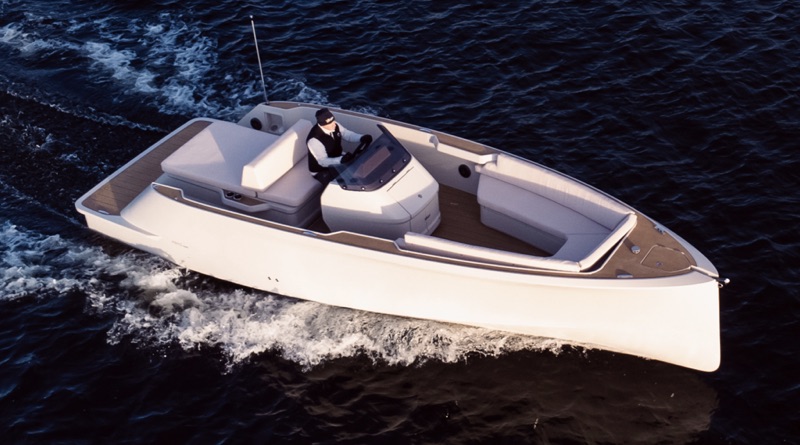
Riding the wave of this enthusiastic reception, ESEA swiftly closed its initial seed funding round. This financial backing validates the company’s product-market fit and secures the runway needed to transition from an emerging boutique builder to a scalable, globally minded manufacturer.
Engineering Philosophy & Innovative Architecture
At the heart of the ESEA F800 lies an uncompromising commitment to seamless integration. Traditional boat building often involves sourcing hulls from one manufacturer, engines from another, and electronics from a third, resulting in a fragmented user experience. ESEA discarded this fragmented playbook, opting instead for a holistic design approach.
The Optimized Displacement Hull and Split-Hull Construction
Maximizing efficiency is the holy grail of electric watercraft design. Because battery energy density, while steadily improving, remains finite compared to liquid fossil fuels, every watt of energy saved directly translates into extended cruising range and operational freedom. To achieve this efficiency, Esea enlisted the specialized talents of Thorne Yacht Design to engineer an optimized displacement hull.
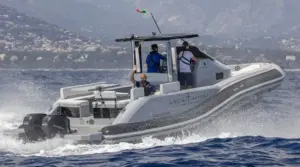
The standout architectural feature of the F800 is its remarkably sharp, almost knife-like bow. This ultra-fine entry angle slices effortlessly through the water, drastically reducing hydrodynamic drag and minimizing wake generation. However, achieving such a severe geometric angle presents a significant manufacturing challenge using standard single-mold fiberglass techniques. To overcome this, ESEA implemented an advanced split-hull manufacturing process. The hull is meticulously molded as separate port and starboard sections, which are then structurally bonded together under high-precision controls. The result is a hydrodynamic masterclass that glides through the water with minimal resistance.
Propulsion and Digital Integration
Electrification naturally aligns with ESEA’s "Easy • Smart • Silent" mantra. The transition from internal combustion to electric propulsion eliminates engine noise, vibrations, and noxious exhaust fumes, satisfying the "Silent" requirement instantly.
From a mechanical standpoint, electric motors possess a fraction of the moving parts found in traditional combustion engines, rendering the propulsion and drive systems virtually maintenance-free. Furthermore, because electric motors operate entirely on digital electrical impulses rather than mechanical combustion, they open up vast horizons for intelligent software integration. Performance parameters can be finely tuned, monitored, and optimized through software controllers, yielding a vessel that is vastly more precise and adaptable than its fossil-fuel counterparts.
On-Board Experience, Metrics, and User-Centric Features
While naval architecture provides the foundation, the true genius of the F800 reveals itself in the day-to-day user experience. Every square inch of the vessel has been optimized to eliminate friction, stress, and anxiety for both the helmsman and the passengers.

Unprecedented Range and Efficiency
The F800 is powered by a reliable 20 kW motor (roughly equivalent to 30–35 horsepower), which might sound modest to traditionalists accustomed to roaring V8 inboards. However, matched with the hyper-efficient displacement hull, this setup achieves staggering performance metrics.
At its optimal cruising speed of 6 knots (approximately 11 km/h or 7 mph), the F800 can run continuously for nearly 11 hours on a single charge. This yields an exceptional cruising range of 67 nautical miles (124 km / 77 miles). While the boat is fully capable of achieving higher velocities—reaching a maximum speed of 12 knots (22 km/h / 14 mph)—the displacement hull finds its absolute "sweet spot" at the slower, more contemplative cruising rate.
As Dee Du emphasized during the Düsseldorf exhibition, speed is rarely the primary desire of the ESEA demographic. High-speed boating invariably introduces complexity and stress: the pilot must maintain hyper-vigilance regarding submerged debris, navigational hazards, and wave angles, while passengers must brace themselves against sudden acceleration and watch their drinks. By focusing on tranquil, efficient displacement cruising, ESEA eliminates these stressors entirely.
Intelligent Docking and Digital Controls
Maneuvering a boat in tight marina quarters is a notorious source of anxiety for novice and experienced boaters alike. ESEA addresses this head-on with intuitive smart controls.
The F800 features a dedicated "dock mode" button that engages a digital gear, dampening throttle sensitivity to prevent sudden, erratic forward or backward lunges. This is paired with an advanced steerable pod drive capable of a remarkable 270-degree rotation arc, granting the pilot pinpoint maneuverability in cramped quarters.
At the helm, information overload is replaced by crystal-clear, intuitive visualization. A large, beautifully designed interface displays critical data—such as speed, GPS location, battery state of charge, and remaining range—at a single glance. Complex technical diagnostics like motor RPMs and voltage fluctuations are relegated to background systems, ensuring the person at the helm remains relaxed and present in the moment.
Ergonomics and Social Spaces
True to its philosophy of effortless enjoyment, the F800 is structured as a floating social lounge. The bow features an expansive, comfortable seating area ahead of the center console, while the stern boasts a generous sun bed and an integrated swimming platform.

For moments when the crew finds an idyllic cove for swimming or dining, the boat’s software includes a "virtual anchor" feature. This digital anchoring system automatically holds the vessel’s GPS position without the hassle of dropping physical ground tackle, freeing the driver to immediately join friends and family in the festivities. Additional peace of mind is provided via remote locking and geo-fencing security protocols.
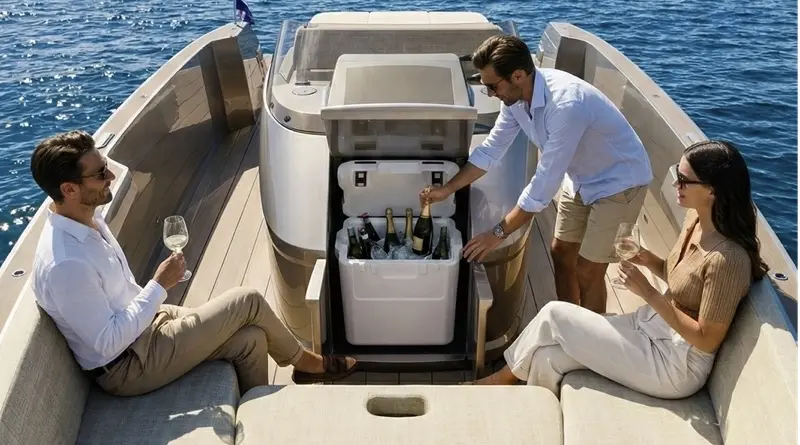
Subtle luxury details abound throughout the vessel. Deck lighting is ingeniously directed downward, casting a warm, ambient glow across pathways without ever blinding passengers or ruining night vision. A conveniently positioned cooler box is easily accessible from any seat on board, ensuring refreshments are always within arm’s reach.
Official Statements and Industry Perspectives
The philosophy driving ESEA’s corporate trajectory is best summarized by its leadership, whose collective vision continues to shape the brand’s market disruption.
"We founded ESEA with the belief that boating should feel simple, intuitive and enjoyable," stated Co-Founder and Director Dee Du. "With the F800, we have taken a fully integrated approach, bringing together propulsion, controls and onboard systems into a single, cohesive design that creates a more seamless and responsive experience on the water."
Elaborating on the emotional and sensory goals of the design, Du noted the profound difference that electrification brings to the maritime environment:
"The goal is for them to have an easy experience, whether they are driving it or as a passenger. No friction, just enjoyment. They can really enjoy the water and the natural surroundings without any noise, and their food and drinks without any fumes and smoke. Really, everything is designed for the name of the boat—easy. That’s our philosophy. Make everything easy for the user."
Industry analysts have taken note of ESEA’s distinct positioning. By targeting the intersection of zero-emission sustainability and uncompromising operational simplicity, the company has carved out a defensible niche that appeals directly to modern lifestyle consumers who view boating as a form of restorative leisure rather than a mechanical hobby.

Future Outlook & Scalability
The successful completion of ESEA’s initial seed funding round marks the end of the startup’s foundational phase and the beginning of an aggressive industrial scaling period. The newly acquired capital will not be funneled solely into marketing the F800; rather, it has been strategically earmarked for advanced research, modular product architecture development, and global manufacturing scalability.
Modular Architecture and Market Expansion
ESEA’s long-term product roadmap relies heavily on a modular product architecture. By standardizing core electrical, propulsion, and digital control modules, the company can efficiently design, test, and manufacture a diverse portfolio of vessel sizes and configurations without having to reinvent the engineering wheel for every new model.
The very first tangible step in this strategic expansion is already underway: the active development of a new 6-meter (approximately 20-foot) model. This upcoming watercraft will distill the core design philosophy, hydro-efficient hull technology, and intuitive user interface of the F800 into a more compact, accessible package. By entering this broader market segment, ESEA aims to capture a wider demographic of urban boaters, lake enthusiasts, and coastal commuters.
A Scalable Global Manufacturing Model
To meet anticipated international demand, ESEA is simultaneously refining a globally adaptable manufacturing model. By partnering with advanced composite fabricators and marine technology suppliers, the company is positioning itself to scale production efficiently while maintaining rigorous quality control standards.
As the maritime industry faces mounting regulatory pressure to decarbonize alongside a generational shift in consumer expectations, builders like ESEA are proving that sustainable boating does not require sacrificing luxury, aesthetics, or peace of mind. With fresh capital in the bank, a groundbreaking flagship on the water, and a rapidly expanding product pipeline, ESEA is well-positioned to lead the charge into a cleaner, quieter, and remarkably effortless nautical future.
Technical Specifications: ESEA F800
| Specification Metric | Measurement (Metric / Imperial) |
|---|---|
| Length Overall (LOA) | 8 m / 26 ft |
| Beam (Width) | 2.64 m / 8 ft 7 in |
| Motor Power | 20 kW / ~30–35 hp |
| Cruising Range | 67 Nm / 124 km / 77 mi (at cruising speed) |
| Cruising Speed | 6 kts / 11 km/h / 7 mph |
| Maximum Speed | 12 kts / 22 km/h / 14 mph |
| Hull Design | Optimized displacement hull with split-hull bow construction |
| Key Operational Features | Dock mode digital throttle, 270-degree steerable pod drive, virtual anchor, geo-fencing, integrated down-lighting |