






Executive Overview
The pristine waters of the Mediterranean off the coast of Monaco have long served as a proving ground for the absolute pinnacle of marine engineering. It was here, in 1904, that the world’s very first international powerboat race was contested, establishing a legacy of speed, endurance, and technological daring. More than a century later, that historic 500-meter course hosted a new kind of milestone—one that permanently alters the perception of electric watercraft.
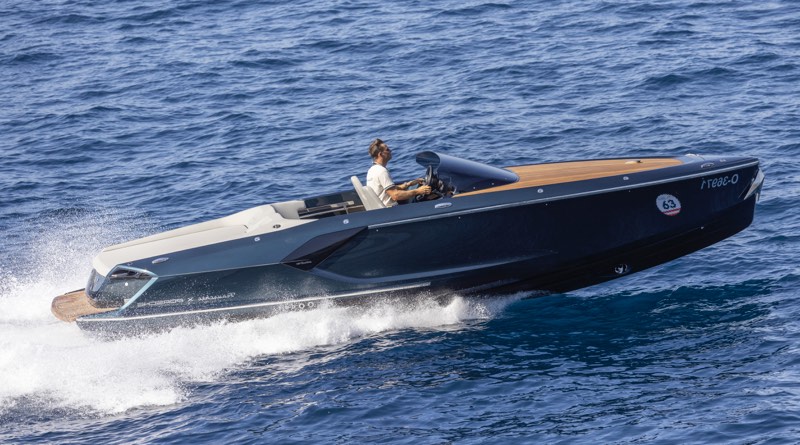
At the 13th annual Monaco Energy Boat Challenge (MEBC), hosted by the prestigious Yacht Club de Monaco (YCM), the collaborative efforts of Austrian boatbuilder Frauscher Bootswerft and German sports car icon Porsche culminated in a landmark achievement. Piloted by Bastien Bonnet, the newly unveiled Frauscher X Porsche 797 Spectre shattered the coveted 50-knot barrier, clocking a staggering official average speed of 51.05 knots (94.54 km/h / 58.75 mph) with an average elapsed time of just 38.2 seconds over the measured course.
This performance eclipsed the record set just the year prior by its sibling, the Frauscher-Porsche 850 Fantom, which posted an impressive 49.84 knots. More importantly, it marked a paradigm shift in marine architecture: the 797 Spectre is not merely a combustion hull retrofitted with a battery pack; it is a clean-sheet, purpose-built electric vessel designed from the keel up to harness the high-voltage powertrain technology of automotive royalty.
As the marine industry grapples with the global imperative for zero-emission propulsion, the success of the 797 Spectre demonstrates that sustainable luxury and high-performance thrills are no longer mutually exclusive.
Detailed Chronology: From Concept to Record-Breaking Reality
The journey to the 2026 Monaco speed record is a study in cross-industry collaboration, tracing a deliberate path from casual executive dialogue to the cutting edge of nautical design.
The Genesis of a Partnership (2016–2022)
The relationship between Frauscher and Porsche is rooted in shared values: both are family-driven enterprises with nearly a century of operational history (Porsche founded in 1931, Frauscher in 1927) and an uncompromising dedication to design, luxury, and engineering excellence. Though the two brands initially collaborated on a fossil-fuel project—the Frauscher Demon in 2016—the modern electric partnership was born in 2022.
During executive meetings regarding future technology, Porsche representatives revealed details of their upcoming all-electric Macan SUV platform. Conversation quickly turned to a tantalizing hypothetical question: What would happen if we integrated that automotive high-voltage drive system into a marine hull?
The 850 Fantom Air (2024–2025)
Moving with characteristic speed, Frauscher developed a functional prototype utilizing an existing, highly successful hull design—the 850 Fantom—originally penned by famed naval architect Harry Miesbauer. By retrofitting structural stringers and redistributing weight to accommodate the heavy, specialized battery pack and electric motor, the team created the Frauscher X Porsche 850 Fantom Air.

Unveiled to critical acclaim, the Fantom secured numerous accolades, including victories at the Gussies International Electric Boat Awards. In July 2025, it cemented its capability by capturing the MEBC speed record at 49.84 knots, stopping just a fraction of a knot short of the magical 50-knot threshold.
The 797 Spectre Debut and Monaco Triumph (2026)
Recognizing the limitations of modifying a combustion-engine hull, Frauscher set out to engineer a true thoroughbred electric boat. The result was the 797 Spectre, officially unveiled to the global public in January 2026 at Boot Düsseldorf.
Months later, at the 13th Monaco Energy Boat Challenge, the Spectre was unleashed on the historic YCM Speed Record course. Blasting past the breakwaters and sprinting toward the 500-meter marker, pilot Bastien Bonnet pushed the vessel past the historic 50-knot milestone, averaging 51.05 knots across the two-way timed run and securing its place in maritime history.
Supporting Context & Metrics: Anatomy of a Record-Breaker
To fully understand the magnitude of the 797 Spectre’s achievement, one must examine the rigorous framework of the Monaco Energy Boat Challenge and the distinct engineering philosophy behind a clean-sheet electric build.

The Monaco Energy Boat Challenge: A Multi-Class Ecosystem
The MEBC is structured to foster innovation across four distinct classes, bringing together brilliant university engineering students and established commercial leaders:
- Energy Class: Exclusively for university students to develop custom zero-emission propulsion systems on standardized catamaran hulls.
- AI Class: Focused on autonomous navigation and artificial intelligence applications in marine environments.
- SeaLab Class: Open to both academic and commercial ventures testing experimental hull designs and alternative energy tech.
- Open Sea Class: Dedicated to production-ready commercial electric and alternative-fuel boats.
The YCM Speed Record serves as the ultimate high-speed showdown between SeaLab and Open Sea contenders. Boats accelerate from a standing start just outside the YCM breakwaters, racing along the iconic Monaco coastline toward a turn marker 500 meters away. To eliminate variables such as wind and current, the winner is determined by the fastest average time of two consecutive legs—one outbound, one inbound.
Clean-Sheet Engineering vs. Retrofitting
The critical differentiator between the 2025 record-holding 850 Fantom and the 2026 record-shattering 797 Spectre lies in the drawing board.
Naval architect Harry Miesbauer, whose illustrious career includes designing high-performance racing yachts for the Volvo Ocean Race (such as Amer Sport One), faced a unique challenge when transitioning from wind-driven vessels to motorboats.

"The main thing with hull design is to know the weight of all of the parts, and then address the most important aspect—the center of gravity," Miesbauer explains. "That is what makes the boat ride properly and with optimum efficiency. With the Fantom electric, we had to redo certain structural aspects and some stringers to distribute weight in the same way as with the combustion engine. But with the Spectre, we had a blank sheet. We could address everything and have it as we wanted from the first sketches."
Because lithium-ion battery packs possess unique spatial dimensions and weight distributions compared to internal combustion engines and fuel tanks, designing the hull around the battery allows for flawless hydrodynamic balance. The Spectre is shorter and lighter than the Fantom, yet achieves superior top-end velocity and handling dynamics due to this bespoke structural integration.
Aesthetic and Functional Design Harmony
Stefan Iverwin, whose design career spans automotive projects at the Porsche Design Studio before spending a decade shaping Frauscher’s portfolio, ensured that the Spectre’s visual language reflected its advanced internal tech.
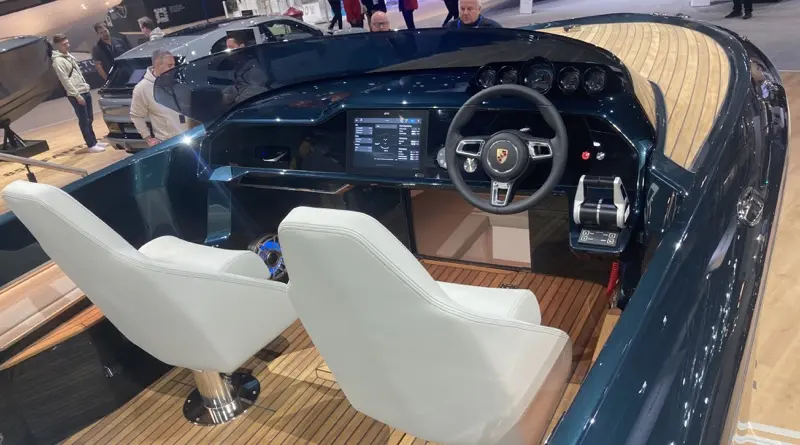
Rather than hiding the cooling requirements of the high-voltage powertrain, Iverwin celebrated them. The large-format battery pack necessitates sophisticated thermal management, which translates into striking side air intakes and outtakes. These functional apertures serve as the visual anchor for a dynamic body line that wraps around the stern, imbuing the boat with the muscular, athletic stance of a Porsche sports car while retaining the timeless elegance of Frauscher’s nautical DNA.

Official Statements & Industry Perspectives
The convergence of automotive engineering and marine architecture has unlocked new horizons for the luxury boating sector, a reality underscored by leadership reactions following the record run.
-
Stefan Frauscher, Managing Director of Frauscher Bootswerft:
“Breaking the record we set only last year is an exceptional achievement by the entire team. The 797 Spectre impressively demonstrates the potential created by the consistent joint development of the boat, hull, and electric powertrain.” -
Harry Miesbauer, Naval Architect:
When asked what reaction he expects from first-time drivers, Miesbauer noted:
“That it is surprisingly powerful. They would say, ‘I didn’t know you could have the same performance, maybe even better, with an electric boat, that you have with a combustion boat.’” -
Stefan Iverwin, Exterior and Interior Designer:
“For me, the best thing that can happen is if someone sees the boat and just has a gut reaction of ‘I love this boat, I want this boat.’ They also find reasons why it makes sense to decide for the boat, but I want that emotion, that feeling, saying ‘I love how it looks, I love how it feels when I drive it, I love how it performs.’”
Future Outlook: The Horizon of Zero-Emission Marine Speed
The breaching of the 50-knot barrier by a production-based electric boat marks a psychological and technical tipping point for the marine industry. For decades, electric watercraft have been stereotyped as slow, range-limited displacement cruisers suitable only for gentle inland lakes.
The Frauscher X Porsche 797 Spectre—powered by high-performance automotive technology and sculpted through uncompromising naval architecture—obliterates that outdated narrative. It proves that electric propulsion can deliver the violent acceleration, high top-end speed, and visceral emotional engagement demanded by elite yachting enthusiasts.
As battery chemistry improves, charging infrastructure expands along Mediterranean and global coastlines, and partnerships between automotive giants and boutique shipyards deepen, the 797 Spectre will likely be viewed retrospectively as the model that ushered in the modern era of high-speed maritime electrification. The waters of Monaco have witnessed the dawn of a new maritime epoch, and the wake left behind is entirely clean.