










Executive Overview
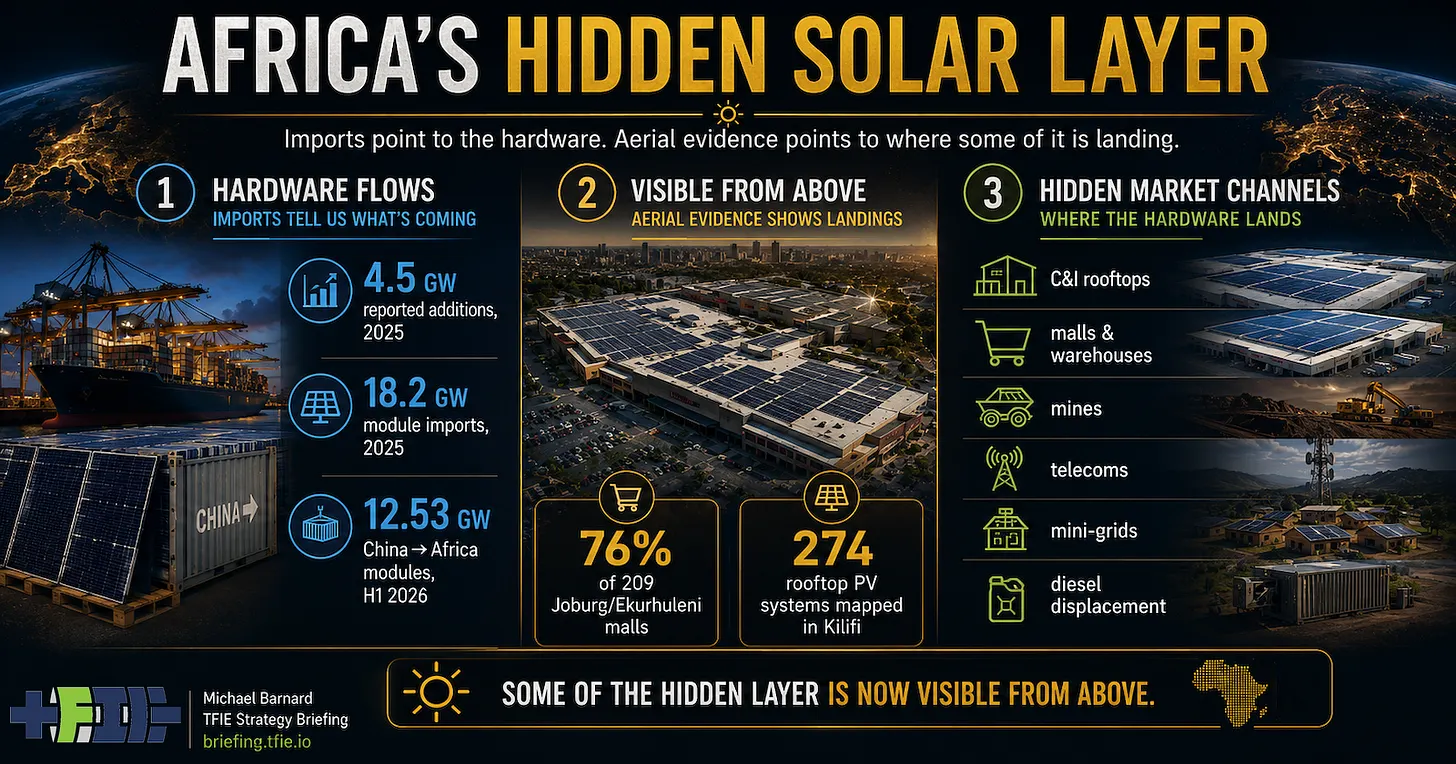
Official energy statistics are fundamentally failing to capture the true pace of Africa’s renewable energy transition. While government registries and traditional energy tracking mechanisms report modest additions to the continent’s power grids—such as an officially recorded 4.5 gigawatts (GW) of solar added in 2025—independent customs records, trade data, and cutting-edge satellite imagery tell a drastically different story.
During that exact same period, Africa imported roughly 18.2 GW of photovoltaic (PV) solar modules from China alone. By the first half of 2026, another 12.53 GW of finished Chinese solar hardware had been shipped to various African ports. While it is inaccurate to assume that every imported panel immediately translates to an operating kilowatt on a rooftop, the chasm between official capacity statistics and actual hardware imports is far too wide to dismiss as mere accounting discrepancies or warehousing stock.
This mismatch points to a massive, decentralized, behind-the-meter solar boom. Driven by collapsing global solar equipment prices, plunging battery storage costs, persistently high diesel prices, and chronic, unreliable grid infrastructure, commercial entities and private households are taking energy security into their own hands. Mines, shopping malls, factories, telecommunication networks, and farms are quietly bypassing traditional utility channels.
Recent aerial investigations and satellite mapping data are finally beginning to illuminate this hidden layer of infrastructure. By combining hardware flow metrics with high-resolution rooftop imagery, analysts are proving that Africa’s clean energy transition is not stalling—rather, it is simply advancing at a grassroots commercial level where conventional, top-down tracking systems observe it last.
Detailed Chronology of an Unseen Surge
The 2025 Disconnect: Imports Outstrip Official Metrics
The statistical blind spot began widening significantly through 2025. According to traditional energy reporting, the entire continent of Africa officially commissioned roughly 4.5 GW of new solar capacity across that year. For energy planners relying solely on government announcements, utility-scale project tenders, and state-backed grid interconnections, the market appeared to be growing at a modest, incremental pace.
However, international trade databases tracking Chinese module exports revealed an astronomical divergence. African markets collectively absorbed roughly 18.2 GW of solar panels over the course of 2025. Analysts immediately recognized that this hardware could not simply be chalked up to operational capacity—panels sitting in customs terminals, distribution hubs, or wholesaler warehouses do not generate electricity. Yet, the volume of incoming shipments was unprecedented, signaling that massive capital was flowing into private, decentralized supply chains that standard government trackers failed to monitor.
Early 2026: The 20 GW Thesis and Accelerating Hardware Flows
By the beginning of 2026, market observers tracking structural economic shifts rather than public utility announcements made bold predictions. Analysts forecasting through platforms like Redefining Energy posited that the African continent would absorb an extraordinary 20 GW of solar capacity over the course of the year.

This projection was not born from utility-scale announcements or state-sponsored green energy initiatives. Instead, it was a pure market-structure call. The underlying economic drivers were undeniable:
- Chinese module prices hit historic lows.
- Lithium-ion battery storage systems became increasingly affordable, neutralizing the intermittency problem of solar power.
- Traditional fossil fuels, particularly diesel, remained punishingly expensive.
- Grid unreliability and frequent blackouts imposed severe operational costs on businesses.
The thesis was immediately reinforced by ongoing trade data. By the end of the first half of 2026, an additional 12.53 GW of finished Chinese solar modules had already been cleared into African markets. The central question shifted dramatically: it was no longer a matter of whether official data was missing something, but rather where all of that hardware was physically going.
Mid-2026: Satellite Intelligence Illuminates the Rooftops
As trade data confirmed the continuous influx of hardware, researchers turned to high-resolution aerial and satellite imagery to bridge the gap between imported modules and operating systems.
A landmark geospatial analysis conducted by data organizations DataDesk and The Outlier focused on 209 commercial shopping malls across Johannesburg and Ekurhuleni in South Africa. The findings were staggering: rooftop solar installations were identified on 76% of the surveyed malls.
This empirical evidence confirmed the market-structure hypothesis. Shopping malls represent the archetypal customer profile for an invisible, market-driven solar boom. They possess sprawling, unshaded flat roofs, exceptionally high daytime electricity demand (driven by lighting, refrigeration, and air conditioning), direct corporate access to capital and financing, and acute economic exposure to expensive or unreliable municipal grid power. Crucially, a solar-covered shopping mall is born not from government energy targets or public utility project announcements, but from a private corporate ledger where an executive writes a check and contracts an engineering, procurement, and construction (EPC) firm to mount the panels.
Supporting Context, Metrics, and Market Mechanics
Comparing Regional Models: Africa vs. Pakistan
While the rapid surge of unrecorded solar installations bears some resemblance to international phenomena—such as Pakistan’s phenomenal, highly visible residential and commercial rooftop solar boom driven by cheap Chinese imports—Africa’s trajectory exhibits distinct structural differences.
In Pakistan, the solar wave swept extensively across entire residential neighborhoods, with households independently bypassing the national grid en masse. In contrast, the African evidence gathered thus far points to a much more concentrated, commercial, industrial, and institutional deployment.
The economic realities of the African continent explain this divergence. While middle-class and upper-class households in urban centers are certainly adopting solar and backup storage, the heavy concentration of imported hardware is heavily skewed toward entities for which power outages translate directly to devastating financial losses:
- Mining Operations: Seeking uninterrupted power for deep-shaft extraction and processing plants.
- Telecommunications Towers: Replacing diesel generators with solar-plus-storage hybrids to maintain cellular networks across remote regions.
- Agricultural Enterprises: Powering irrigation pumps and cold-storage facilities off-grid.
- Manufacturing and Warehousing: Protecting production lines and supply chains from volatile grid frequencies and sudden load-shedding.
The Inherent Limitations of Satellite and Customs Tracking
Despite the power of geospatial intelligence, analysts emphasize that satellite imagery is a complementary measurement layer rather than a wholesale replacement for traditional installation statistics.
Remote sensing presents several technical hurdles:
- Visibility Constraints: Large, clean commercial roofs and industrial warehouses are exceptionally easy to identify via satellite. Conversely, small residential homes, rural mini-grids, agricultural water pumps, health clinics, and telecom installations hidden beneath foliage or structured differently are far harder to catalog at scale.
- Temporal and Resolution Gaps: Image archives rely on specific capture dates and resolutions. A panel clearly visible from above does not inherently guarantee that the corresponding inverters, balance-of-system components, and battery banks are fully commissioned and safely operating.
- The Import-Versus-Installation Fallacy: Imported watts must never be casually relabeled as installed watts. Port congestion, bureaucratic delays, supply chain bottlenecks, and installation backlogs mean that a lag inevitably exists between hardware arrival and power generation.
Nonetheless, when independent data signals converge—customs logs revealing massive hardware inflows, satellite imagery confirming high adoption rates among key commercial sectors, and diesel consumption reports declining across specific industrial corridors—the collective evidence becomes impossible to ignore.

Official Perspectives and Regulatory Responses
Traditional utility companies, energy ministries, and regulatory bodies across Sub-Saharan Africa have historically relied on centralized generation reporting. Under legacy frameworks, power generation capacity is measured almost exclusively through large-scale hydro, coal, gas, and utility-scale solar farms connected directly to high-voltage transmission networks.
As the behind-the-counter boom accelerates, energy regulators are facing mounting pressure to adapt their accounting methodologies. Ministries of energy in economic hubs like South Africa, Kenya, Nigeria, and Egypt are beginning to recognize that distributed energy resources (DERs) are fundamentally altering national energy landscapes.
Energy sector experts and institutional stakeholders note that official statistics remain remarkably robust for utility-scale projects—where public permits, environmental impact assessments, and grid-connection agreements create a clear paper trail. However, these same statistics remain structurally blind to fragmented, customer-side, behind-the-meter systems.
Regulators are increasingly engaging with private industry associations, commercial distributors, and inverter telemetry data providers to establish better estimation frameworks. By acknowledging the hidden solar layer, governments can better forecast shifts in grid demand, plan transmission infrastructure upgrades, and assess the changing financial stability of state-owned distribution companies facing declining industrial revenues.
Future Outlook: Reshaping the African Energy Landscape
The rapid, unrecorded expansion of private solar and battery storage across Africa carries profound long-term implications that extend far beyond validating market predictions or correcting import statistics.
Transforming Industrial Competitiveness
By taking power generation into their own hands, African enterprises are insulating themselves from the structural disadvantages of unreliable public grids. Factories can run consistent shifts, mines can maintain continuous output, and agribusinesses can drastically reduce post-harvest losses. This transition directly enhances the operational competitiveness of African industries on the global stage, turning unreliable energy infrastructure from a permanent bottleneck into a manageable, localized engineering problem.
Shifting Utility Business Models
As commercial and industrial (C&I) clients—historically the most lucrative, reliable revenue sources for state utilities—defect behind the meter, traditional power companies face severe financial erosion. To survive, progressive utilities are shifting their business models away from centralized power generation monopolies toward grid maintenance, wheeling frameworks, and grid-stabilization services designed to support, rather than compete with, distributed renewables.
Accelerating Diesel Displacement
Perhaps the most immediate environmental and economic victory of Africa’s hidden solar layer is the systemic displacement of diesel fuel. For decades, millions of generators running on imported fossil fuels served as the continent’s true baseline power source. The influx of tens of gigawatts of solar panels paired with affordable battery storage is systematically silencing these generators, cutting carbon emissions, cleaning urban air, and freeing corporations from volatile global oil price shocks.
Conclusion: The Burden of Proof Has Shifted
Africa’s clean energy transition is advancing at a breathtaking pace, concentrated precisely within the decentralized, commercial segments of the economy that traditional tracking mechanisms observe last. While definitive, fully reconciled installation statistics will take time to catch up with reality, the argument is settled. The massive tide of imported hardware is rapidly transforming into operating, customer-side power. The burden of proof now rests firmly on those who claim the solar revolution hasn’t arrived.