






Executive Overview
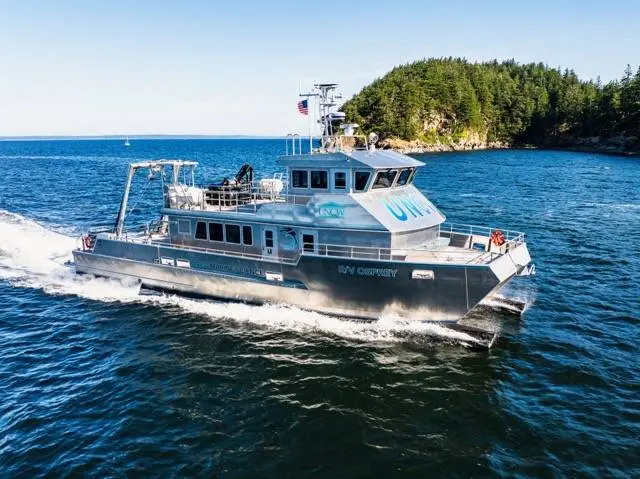
In a significant advancement for East Coast oceanographic research, All American Marine (AAM) has officially delivered the R/V Osprey, a state-of-the-art 78-foot aluminum research vessel commissioned by the University of North Carolina Wilmington (UNCW). Designed by the globally renowned Teknicraft Design of Auckland, New Zealand, the twin-engine catamaran represents a major leap forward in maritime engineering, hydrodynamics, and scientific capability. Following a series of rigorous and highly successful sea trials at AAM’s premier shipbuilding facility in Bellingham, Washington, the vessel has arrived in Florida and is currently transiting up the Atlantic seaboard to her permanent homeport in Wilmington, North Carolina.
The R/V Osprey is poised to become the flagship of UNCW’s coastal and offshore scientific operations. It will serve as a floating laboratory and classroom, supporting faculty, students, and a diverse array of regional research partners. Designed to conduct highly specialized scientific and educational missions, the vessel’s operational footprint will span the critical waters of the Mid-Atlantic, the broader U.S. East Coast, and deep offshore environments.
By integrating cutting-edge hull design with advanced marine electronics, wet and dry laboratories, and robust deployment infrastructure, the R/V Osprey establishes a new benchmark for mid-sized academic research vessels. It equips UNCW to address pressing marine science challenges, from climate change impacts on coastal ecosystems to the mapping of unexplored benthic habitats.
+-----------------------------------------------------------------------------+
|                            R/V OSPREY AT A GLANCE                           |
+-----------------------------------------------------------------------------+
|  Length (LOA):       78 Feet (73' x 26.7' Hull Dimensions)                  |
|  Builder:            All American Marine (Bellingham, WA)                   |
|  Designer:           Teknicraft Design (Auckland, NZ)                       |
|  Classification:     USCG Subchapter T                                      |
|  Propulsion:         Twin Scania Di16-082M EPA Tier 3 Engines (2x 800 mhp)  |
|  Cruising Speed:     22 Knots                                               |
|  Survey Speed:       1.5 Knots                                              |
|  Fuel Capacity:      1,500 Gallons                                          |
|  Accommodations:     10 Overnight Personnel / 20 Day-Trip Passengers         |
+-----------------------------------------------------------------------------+
Detailed Chronology: From Concept to Coastal Delivery
The realization of the R/V Osprey is the culmination of a multi-year collaborative effort between UNCW’s academic leadership, Teknicraft Design’s naval architects, and All American Marine’s skilled shipbuilders.
Phase 1: Conceptualization and Design (Auckland, NZ)
The project initiated with a rigorous assessment of UNCW’s operational requirements. The university needed a platform capable of navigating shallow estuarine waters while remaining stable enough to handle the rough seas of the open Atlantic and the Gulf Stream. Teknicraft Design was selected for its proprietary hydrofoil-assisted catamaran hull technology, which offers an optimal balance of speed, stability, and fuel efficiency. Over several months, naval architects refined the hull shape, structural weight distribution, and scientific integration to meet strict United States Coast Guard (USCG) Subchapter T standards.
Phase 2: Precision Construction (Bellingham, WA)
With finalized designs, construction commenced at All American Marine’s advanced aluminum fabrication facility in Bellingham, Washington. Known for its expertise in high-performance aluminum catamarans, AAM utilized state-of-the-art CNC cutting and welding technologies to assemble the hull and superstructure. Aluminum was chosen for its exceptional strength-to-weight ratio, corrosion resistance, and long-term durability in harsh marine environments. Throughout the construction phase, USCG inspectors conducted regular on-site evaluations to ensure absolute compliance with safety and structural regulations.
Phase 3: Sea Trials and Validation
In late 2023, the R/V Osprey underwent exhaustive sea trials in the Puget Sound. These trials validated the vessel’s speed, maneuverability, fuel burn rates, and acoustic profiles—the latter being critical for the onboard sonar and profiling equipment. The vessel met or exceeded all performance benchmarks, demonstrating a stable 22-knot cruising speed and exceptional handling.

Phase 4: Transit and Homeport Delivery
Following successful sea trials, the vessel was prepared for transit. Loaded onto a heavy-lift transport ship, the R/V Osprey made its way through the Panama Canal, arriving at a port facility in Florida. Currently, the vessel is executing its final transit leg, sailing under its own power up the Eastern Seaboard toward Wilmington, NC. Upon arrival, the ship will undergo final outfitting and scientific calibration before entering active service.
Supporting Context & Technical Metrics
The R/V Osprey is a masterclass in modern naval architecture, combining efficient propulsion, advanced hydrodynamics, and a highly functional scientific layout.
Hydrofoil-Assisted Hull Technology
At the core of the vessel’s performance is the Teknicraft hydrofoil-assisted catamaran hull. This design features a main foil spanning the tunnel between the two catamaran hulls, along with smaller interceptor foils at the stern.
   [ Catamaran Hull ] <==== Hydrofoil ====> [ Catamaran Hull ]
                                                  /
            _______[ Dynamic Lift Created ]______/
As the vessel gains speed, the hydrofoil generates dynamic lift, raising the hull partially out of the water. This action:
- Reduces wetted surface area and frictional drag.
- Improves fuel economy by up to 30% compared to conventional catamaran designs.
- Dampens pitch and roll motions, providing a exceptionally stable platform for scientific research and minimizing seasickness among students and crew.
Propulsion and Power Plant
To minimize the vessel’s environmental footprint while maintaining high operational capability, the R/V Osprey is powered by twin Scania Di16-082M EPA Tier 3 engines. Each engine is rated at 800 mhp at 2100 rpm.
This propulsion package drives the vessel to a comfortable cruising speed of 22 knots, allowing researchers to transit rapidly to offshore study sites. Conversely, for precise scientific operations such as benthic mapping, towing plankton nets, or deploying instrumentation, the propulsion system can maintain a steady, ultra-low survey speed of 1.5 knots. With a total fuel capacity of 1,500 gallons, the vessel possesses the range and endurance required for multi-day offshore missions.
Scientific Infrastructure & Sensor Suites
The R/V Osprey is equipped to serve as a high-fidelity data collection platform. Onboard scientific equipment and structural features include:
- Kongsberg ADCP (Acoustic Doppler Current Profiler): Used to measure the speed and direction of water currents throughout the water column, providing vital data for physical oceanography and climate studies.
- WASSP Multibeam Sonar System: A fixed, wide-angle multibeam system that delivers high-resolution bathymetric mapping of the seafloor and real-time 3D water column visualization.
- Dedicated Laboratories: The interior features distinct wet and dry lab spaces. The wet lab is designed for handling biological samples, water chemistry, and wet equipment, while the dry lab houses computer workstations, data servers, and sensitive electronic instrumentation.
- Overnight and Day-Trip Capacity: The vessel features climate-controlled live-aboard quarters capable of sleeping up to 10 personnel for extended multi-day research campaigns. For single-day educational excursions, the vessel can safely accommodate up to 20 passengers alongside the crew.
- Heavy Deployment Infrastructure: The aft deck is engineered to support demanding physical oceanography tasks. It includes a robust A-frame, an oceanographic winch, and dedicated dive-support stations designed for safe scuba operations, instrument mooring, and the deployment of Autonomous Underwater Vehicles (AUVs) and oceanographic buoys.
Official Statements & Stakeholder Perspectives
The delivery of the R/V Osprey represents a landmark achievement for both the shipbuilder and the university. Leaders from both organizations have emphasized the collaborative effort and the technological leap this vessel represents.
Ron Wille, President of All American Marine, highlighted the craftsmanship and specialized engineering that went into the build:
"Our mission at All American Marine is to build highly specialized, dependable, and efficient vessels that empower our clients to perform their vital work safely. Delivering the R/V Osprey to the University of North Carolina Wilmington represents another milestone in our commitment to supporting marine science and education. Working alongside Teknicraft Design, we have built a platform that combines speed, stability, and cutting-edge technology. We are incredibly proud to see this vessel begin its service life on the East Coast."
UNCW Center for Marine Science Leadership emphasized the transformational impact the vessel will have on the university’s research capabilities:
"The acquisition of the R/V Osprey is a game-changer for UNCW and our partners across the region. This vessel will allow our faculty and students to conduct advanced, multi-day research projects in offshore environments that were previously difficult to access. With its advanced sonar systems, laboratory spaces, and diving support infrastructure, the Osprey will serve as an invaluable tool for studying coastal dynamics, marine biology, and fisheries science. It represents a 30-year investment in the future of marine science education and stewardship along the Atlantic coast."
Future Outlook: Decades of Discovery in the Mid-Atlantic
With a projected service life of at least 30 years, the R/V Osprey is poised to play a central role in East Coast marine science for decades to come. The Mid-Atlantic and Southeastern U.S. coastlines are currently facing unprecedented environmental challenges and economic opportunities, all of which require robust scientific data to manage effectively.
+-----------------------------------------------------------------------------+
|                        R/V OSPREY: FUTURE MISSION PROFILE                   |
+-----------------------------------------------------------------------------+
|                                                                             |
|  [OCEANOGRAPHIC SURVEYS] -------------------> Benthic Mapping & Bathymetry  |
|                                               Sub-Bottom Profiling          |
|                                               Current Velocity Tracking     |
|                                                                             |
|  [BIOLOGICAL STUDIES] ----------------------> Marine Mammal Conservation    |
|                                               Fisheries Stock Assessments   |
|                                               Water Quality Monitoring      |
|                                                                             |
|  [EDUCATIONAL OUTREACH] --------------------> Hands-on Student Laboratories |
|                                               Agency Charter Missions       |
|                                               Public Science Integration    |
+-----------------------------------------------------------------------------+
Addressing Climate Change and Coastal Resilience
As sea levels rise and the frequency of severe weather events increases, understanding the dynamics of the continental shelf and coastal estuaries is more critical than ever. The R/V Osprey will facilitate continuous water-quality monitoring, sediment sampling, and current profiling to help researchers model coastal erosion and predict the impacts of climate change on vulnerable coastal communities.
Marine Mammal and Fisheries Conservation
The waters off North Carolina are vital migratory corridors and feeding grounds for numerous marine species, including the critically endangered North Atlantic right whale. The vessel’s stable platform and low acoustic signature make it an ideal tool for non-invasive marine mammal monitoring, acoustic tracking, and fisheries stock assessments. By collaborating with state and federal agencies, UNCW will use the Osprey to collect the data necessary to inform sustainable fisheries management and marine conservation policies.
Supporting Offshore Renewable Energy
As the United States expands its offshore wind energy infrastructure along the East Coast, detailed environmental impact assessments and seabed mapping are required. The R/V Osprey‘s advanced WASSP multibeam and sub-bottom profiling capabilities position UNCW to partner with energy developers and federal regulators to ensure that offshore energy installations are sited and constructed in an environmentally responsible manner.
Training the Next Generation of Oceanographers
Beyond its scientific endeavors, the R/V Osprey will serve as an invaluable educational resource. By hosting undergraduate and graduate students on day-long and multi-day research cruises, UNCW will provide hands-on training with industry-standard oceanographic equipment. Students will transition from the classroom directly to active research environments, preparing them for careers in marine technology, environmental consulting, and academic research.
The delivery of the R/V Osprey marks a proud new chapter for UNCW and All American Marine. As the vessel makes its final approach to Wilmington, it carries with it the promise of decades of scientific discovery, environmental stewardship, and educational excellence along the Eastern Seaboard.