






Executive Overview
Despite a comprehensive regime of Western sanctions designed to cripple Moscow’s energy-dependent economy, Russia has successfully executed a aggressive expansion of its maritime logistics network. In less than a year, the Russian Federation has nearly doubled its "dark fleet" of specialized tankers dedicated to transporting liquefied natural gas (LNG) from the highly contested, US-sanctioned Arctic LNG 2 project.
According to a comprehensive ship-tracking analysis, the fleet of active tankers servicing the facility in western Siberia has surged from 11 vessels at the close of December 2025 to at least 20 vessels by September 2026. This rapid buildup highlights Moscow’s determination to bypass Western export barriers and establish a permanent energy corridor to friendly nations, primarily China.
The strategic pivot comes as Russia seeks to replace lost European pipeline gas revenues with lucrative seaborne LNG exports. The Arctic LNG 2 project, located on the Gydan Peninsula, represents the crown jewel of Russia’s super-chilled fuel ambitions. While sanctions initially forced Moscow to delay its target of tripling LNG output by 2030, the rapid assembly of a shadow fleet has allowed exports to continue moving eastward.
This logistical feat is further supported by a shifting geopolitical landscape in Washington, where the administration of U.S. President Donald Trump has yet to match the aggressive, targeted sanctions enforcement of the previous Biden administration. Consequently, Moscow has found a willing partner in Beijing, cementing a bilateral energy relationship that underpins both nations’ economic and strategic alignments.
Detailed Chronology: The Evolution of the Arctic Shadow Fleet
The rapid development of Russia’s LNG shadow fleet is a testament to Moscow’s logistical resilience and tactical adaptability. Unlike crude oil, which can be transported in older, basic tankers, LNG logistics require highly sophisticated, technologically advanced vessels capable of maintaining temperatures of minus 162 degrees Celsius (minus 260 degrees Fahrenheit). The timeline of Russia’s bypass strategy reveals a coordinated effort to overcome these high technological barriers.
[Late 2023 - 2024] ──> [Dec 2025] ─────────> [Mid-2026] ──────────> [Late Aug 2026]
US imposes target      Shadow fleet         Fleet grows to 20;     Second domestic Arc7
sanctions; Western     stands at 11         opaque shell companies vessel loads cargo;
partners withdraw.     vessels.             obscure ownership.     Putin-Xi bilateral.
The Initial Sanctions Shock (2023–2024)
When the U.S. Department of State and the Office of Foreign Assets Control (OFAC) levied direct sanctions on the Arctic LNG 2 project in late 2023, the facility’s future appeared highly uncertain. International partners—including France’s TotalEnergies, Japan’s Mitsui & Co., and Chinese state firms CNPC and CNOOC—declared force majeure.
Furthermore, Western shipbuilders, most notably South Korea’s Hanwha Ocean, canceled contracts to construct state-of-the-art Arc7 ice-class LNG carriers for the project. Deprived of the specialized vessels required to navigate the frozen waters of the Ob Bay, Russia was forced to look inward and toward opaque secondary markets.

Amassing the Shadow Fleet (December 2025–Mid-2026)
By December 2025, Russia had managed to assemble a rudimentary fleet of 11 LNG carriers. Many of these vessels exhibited the classic hallmarks of the "dark fleet" or "shadow fleet":
- Opaque Ownership: Registration under newly formed shell companies based in jurisdictions like Dubai, India, and Singapore.
- Flag-Hopping: Frequent changes of maritime registries (such as Palau, Panama, or Gabon) to evade regulatory oversight.
- AIS Manipulation: Disabling or spoofing Automatic Identification System (AIS) transponders to mask loading operations at the Arctic LNG 2 terminal.
Throughout the first half of 2026, this fleet expanded rapidly. Moscow systematically acquired second-hand conventional LNG carriers and integrated them into its logistics chain, shielding the vessels behind layers of corporate anonymity.
The Autumn 2026 Breakthrough
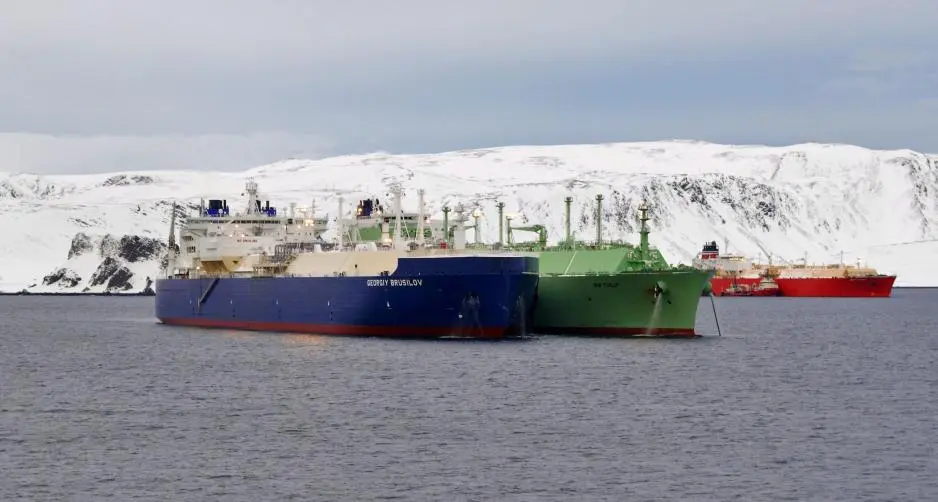
The latest and most significant addition to this fleet arrived in late August 2026. A newly constructed, Russian-built advanced ice-class vessel—the second of its kind manufactured domestically—was tracked loading a shipment from the Arctic LNG 2 facility over the weekend of August 29–30, 2026.
This vessel is designed to navigate the treacherous, ice-locked waters of the Northern Sea Route (NSR) year-round without the assistance of dedicated icebreakers. Its successful deployment represents a major technological milestone for Russia’s domestic shipbuilding sector, which has struggled to overcome bans on Western marine engineering components.
Supporting Context & Metrics: Navigating the Frozen Arctic Corridor
Operating an LNG export terminal in the extreme environment of western Siberia presents unprecedented logistical challenges. The Ob Bay is choked with thick ice for up to nine months of the year, rendering conventional shipping impossible without specialized equipment.
       [ Arctic LNG 2 Terminal ] (Gydan Peninsula)
                  │
                  ▼  (Specially designed Arc7 Icebreaking Tankers)
       [ Transshipment Hubs ] (Murmansk / Kamchatka)
                  │
                  ▼  (Conventional LNG Carriers / Dark Fleet)
       [ Final Buyers in Asia ] (Primarily China)
The Ice-Class Tier System and Transshipment Strategy
To export gas from Arctic LNG 2, Russia relies on a two-tier shipping model:
- The Ice-Breaking Leg (Arc7 & Arc4 Vessels): Highly specialized Arc7 ice-class tankers transport the super-chilled fuel directly from the terminal through the icy waters. Russia currently has three Arc7 vessels in operation, with a fourth expected by the end of 2026. Arc4 vessels, which can handle lighter ice conditions, assist during the summer and autumn months.
- The Transshipment Leg: To optimize the use of these rare ice-class vessels, Russia utilizes floating storage units (FSUs) located in ice-free waters—specifically near Murmansk in the west and Kamchatka in the Far East. The Arc7 vessels transfer their cargoes to these hubs, where the LNG is reloaded onto conventional tankers for long-haul transport to end markets.
Shipping Capacities and Production Estimates
Despite the sanctions, the expansion of the shadow fleet has forced energy analysts to revise their production forecasts upward.
| Metric / Parameter | Value / Status | Source / Context |
|---|---|---|
| Current Active Fleet | 20+ Vessels | Bloomberg Ship-Tracking Data |
| December 2025 Fleet | 11 Vessels | Historical Baseline |
| 2026 Production Estimate | 5.0 Million Tons (9% Increase) | Rystad Energy (Revised from July) |
| Current Fleet Export Capacity | 5.2M to 5.4M Tons/Year | Rystad Energy Analysis |
| Combined Nameplate Capacity | 13.2 Million Tons/Year | Trains 1 & 2 (Operational) |
| Required Conventional Vessels | ~30 Vessels | Estimated for Full Capacity |
While a production rate of 5 million tons is a significant achievement under sanctions, it remains well below the combined 13.2 million-ton annual capacity of the plant’s two operational production trains. This deficit highlights the ongoing shipping constraints facing the project.
"Shipping capacity remains the principal constraint," notes Daria Melnik, Vice President of Oil and Gas Research at Rystad Energy. However, the steady acquisition of vessels indicates that Moscow is slowly closing the gap.
According to Ashley Sherman, a senior LNG analyst at Vortexa, the math of Arctic logistics is straightforward: "In principle, four Arc7 ice-class vessels could enable two trains to operate at near-full capacity, but only if transshipment can scale up efficiently in Russian waters."
Official Statements and Geopolitical Alignment
The expansion of the Arctic LNG 2 shadow fleet does not occur in a vacuum; it is deeply intertwined with the shifting geopolitical dynamics between Moscow, Beijing, and Washington.
The Beijing-Moscow Axis
As Western markets remain closed to sanctioned Russian gas, China has emerged as the sole buyer of Arctic LNG 2’s output. This energy trade forms a cornerstone of the strategic partnership between Russian President Vladimir Putin and Chinese President Xi Jinping.
On August 31, 2026, the two leaders met on the sidelines of the Shanghai Cooperation Organization (SCO) summit in Kyrgyzstan. According to Kremlin officials, bilateral energy cooperation—specifically gas exports—topped the agenda.
"Moscow is putting in place the logistics to deliver increasing amounts of LNG to Asia from Arctic LNG 2."
— Malte Humpert, Founder of the Arctic Institute
For China, purchasing discounted Russian LNG aligns with its broader energy security strategy, diversifying its import routes away from the maritime chokepoints of the Malacca Strait. For Russia, Chinese demand provides an essential financial lifeline that helps fund its ongoing military expenditures.
The Washington Regulatory Shift
The growth of the LNG shadow fleet has also been facilitated by a shift in enforcement priorities in Washington. Under the Biden administration, the U.S. pursued a policy of systematic disruption against Arctic LNG 2, blacklisting not only the project itself but also individual hull numbers, maritime management companies, and transshipment facilities.
In contrast, the administration of President Donald Trump has adopted a less aggressive stance toward Russia’s gas industry and its expanding dark fleet. As of late 2026, Washington has not threatened or imposed secondary sanctions on Chinese entities purchasing the blacklisted fuel. This lack of enforcement has lowered the risk profile for Chinese buyers, accelerating imports of the sanctioned fuel throughout 2026.
Future Outlook: The Battle for the Northern Sea Route
As Russia looks toward the winter of 2026–2027, the viability of its Arctic LNG strategy will face its ultimate test. The winter freeze will block conventional vessels from accessing the Northern Sea Route, placing the entire logistical burden on Russia’s limited fleet of Arc7 ice-class carriers.
                       [ Future Challenges & Outlook ]
                                      │
         ┌────────────────────────────┼────────────────────────────┐
         ▼                            ▼                            ▼
[ Winter Navigation ]       [ Fleet Expansion ]         [ Infrastructure Expansion ]
Thick ice limits route      Delivery of 4th Arc7        Assembly of Train 3;
to Arc7 vessels only.       vessel by end of 2026.      aiming for 19.8M tons/year.
Key Milestones to Watch
- Delivery of the Fourth Arc7 Vessel: Moscow expects to receive at least one more domestically built Arc7 vessel by the end of 2026. If successfully deployed, this vessel could unlock the bottleneck identified by Vortexa, allowing the two operational production trains to run at near-full capacity.
- Assembly of the Third Production Train: Despite technological hurdles, work continues on the assembly of Arctic LNG 2’s third production train. Once completed, the plant’s nominal capacity will rise to 19.8 million tons per year, further intensifying the need for shipping capacity.
- The Conventional Fleet Expansion: To reach full export capacity, Rystad Energy estimates that Russia will need to expand its conventional shadow fleet to approximately 30 vessels. This will require continuous, clandestine acquisitions on the global second-hand market.
Long-Term Implications
The rapid expansion of the Arctic LNG shadow fleet demonstrates that Western sanctions, while highly disruptive, are rarely absolute when confronted with determined state actors and willing buyers. By constructing a parallel maritime logistics network, Russia is not only securing a market for its natural gas but is also establishing a precedent for the normalization of shadow fleets in the global LNG trade.
As the Northern Sea Route becomes increasingly navigable due to climate change, Moscow’s heavy investment in ice-class logistics may eventually secure its position as a dominant energy supplier to Asia, bypassing traditional maritime trade routes and Western regulatory oversight entirely.


