






Executive Overview
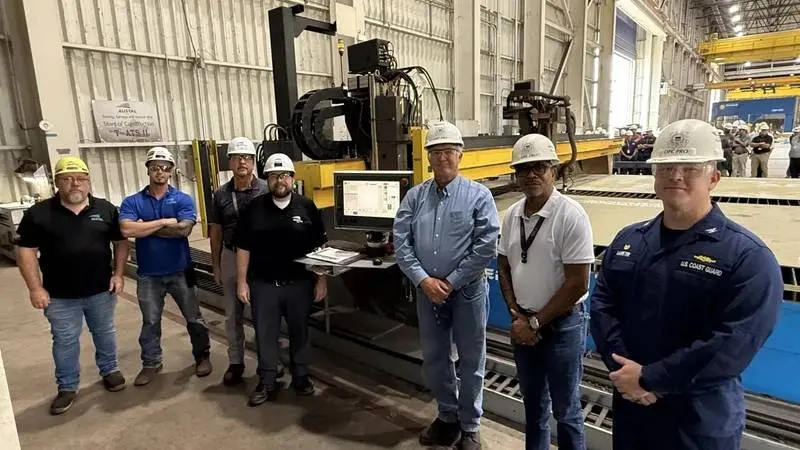
In a milestone that underscores the rapid evolution of the American domestic defense shipbuilding sector, Austal USA has officially commenced construction on the future USCGC Ingham (OPC 7). The ceremony, held at the company’s state-of-the-art steel manufacturing facility in Mobile, Alabama, marks the initiation of the third Heritage-class Offshore Patrol Cutter (OPC) to be built under Austal’s stewardship.
This build is part of a highly contested and strategically vital contract awarded to Austal USA for Stage II of the OPC program. The agreement includes options for up to 11 cutters, representing a total potential contract value of $3.3 billion. The OPC program serves as the United States Coast Guard’s (USCG) highest investment priority, designed to replace the service’s rapidly aging fleet of Medium Endurance Cutters (MECs).
The future USCGC Ingham represents more than just another hull in the water; it is a symbol of a profound industrial transition. Historically known for its high-speed aluminum vessels, Austal USA has aggressively pivoted to steel shipbuilding, establishing itself as a premier multi-material shipbuilder.
With three Heritage-class cutters now simultaneously under construction—the future USCGC Pickering (OPC 5), USCGC Icarus (OPC 6), and now USCGC Ingham (OPC 7)—the Mobile shipyard has solidified its position as a critical node in the U.S. national security industrial base.
Detailed Chronology
The Genesis of the OPC Program and Stage II Realignment
The path to the construction of the USCGC Ingham has been marked by industrial shifts, strategic re-evaluations, and intense competition. The Heritage-class program was originally envisioned to recapitalize the Coast Guard’s 210-foot and 270-foot Medium Endurance Cutters, some of which have been in service for more than half a century.
Initially, Stage I of the OPC program—covering the detail design and construction of the first four hulls (Argus, Chase, Ingraham, and Rush)—was awarded to Eastern Shipbuilding Group (ESG) of Panama City, Florida. However, the devastating impact of Category 5 Hurricane Michael on ESG’s facilities in October 2018 severely disrupted production timelines.
In response, the Department of Homeland Security and the U.S. Coast Guard opted to adjust the program, competing the remaining hulls under a "Stage II" acquisition strategy to mitigate program risk and ensure industrial base redundancy.
Austal USA’s Strategic Pivot to Steel
In June 2022, the Coast Guard awarded the Stage II contract to Austal USA. This decision followed a massive, self-funded $100 million investment by Austal to construct a brand-new, 117,000-square-foot steel assembly line adjacent to its existing aluminum production facilities in Mobile.
- April 2022: Austal USA officially opens its new steel shipbuilding facility, positioning itself to bid on major steel-hulled defense contracts.
- June 2022: The U.S. Coast Guard awards Austal USA the Stage II OPC contract, covering detail design and construction for up to 11 cutters.
- Late 2023: Construction begins on the first Austal-built OPC, the future USCGC Pickering (OPC 5).
- Early 2024: Construction commences on the second hull, the future USCGC Icarus (OPC 6).
- Late 2024: Austal USA cuts the first steel for the future USCGC Ingham (OPC 7), bringing three massive cutters into concurrent production.
This rapid scaling of production demonstrates the efficacy of Austal’s modular construction methodology, which relies on advanced digital design and pre-outfitting assemblies before they are joined on the slipway.
Supporting Context & Metrics
Technical Specifications of the Heritage-Class OPC
The Heritage-class Offshore Patrol Cutters are designed to operate across the globe, filling a critical operational niche between the larger, ocean-going National Security Cutters (NSC) and the smaller, coastal Fast Response Cutters (FRC).
| Parameter | Specification |
|---|---|
| Length Overall | 360 feet (110 meters) |
| Beam | 54 feet (16.4 meters) |
| Draft | 17 feet (5.2 meters) |
| Range | 10,200 nautical miles at a cruising speed of 14 knots |
| Endurance | 60 days of autonomous operation |
| Aviation Facilities | Flight deck and hangar capable of hosting MH-60T or MH-65 helicopters and UAS |
| Command & Control | C5ISR suite integrated with Navy-standard tactical systems |
Fleet Architecture: The Strategic "Bridge"
The U.S. Coast Guard’s fleet modernization strategy relies on a tiered operational architecture. Currently, the service faces a widening capability gap as its legacy Medium Endurance Cutters suffer from compounding maintenance fatigue, spare-parts obsolescence, and a lack of modern command-and-control infrastructure.
+-----------------------------------------------------------------+
|               National Security Cutters (NSC)                   |
|  - 418 Feet | High-Endurance | Deep Ocean Patrols               |
+-----------------------------------------------------------------+
                                |
                                v
+-----------------------------------------------------------------+
|             Offshore Patrol Cutters (OPC) - *The Bridge*        |
|  - 360 Feet | 10,200 NM Range | Law Enforcement & Interdiction  |
+-----------------------------------------------------------------+
                                |
                                v
+-----------------------------------------------------------------+
|               Fast Response Cutters (FRC)                       |
|  - 154 Feet | High-Speed | Near-Shore & Littoral Operations    |
+-----------------------------------------------------------------+
The Heritage-class OPC acts as the vital connector. It possesses the seakeeping capabilities and endurance required to conduct extended patrols in the transit zones of the Eastern Pacific and Caribbean Sea, yet is agile enough to navigate restricted ports and support domestic disaster response operations.
Austal USA’s Expanded Steel Portfolio
The start of construction on the Ingham solidifies Austal USA’s diversification strategy. The Mobile shipyard is no longer reliant on a single vessel class or material. Its active steel production portfolio now includes:
- Heritage-class OPCs: Hulls 5, 6, and 7 under active construction.
- Landing Craft Utility (LCU) 1700 Class: Heavy-lift shore-to-shore connectors for the U.S. Navy.
- Navajo-class Towing, Salvage, and Rescue Ships (T-ATS): Auxiliary vessels designed for open-ocean towing, rescue, and salvage operations.
- Auxiliary Floating Dry Dock Medium (AFDM): A critical support vessel for naval maintenance.
- Submarine Modules: Structural components supporting the U.S. Navy’s high-priority Virginia-class and Columbia-class submarine programs, built in partnership with General Dynamics Electric Boat and Newport News Shipbuilding.
Official Statements & Industrial Philosophy
Modular Construction and 3D Modeling
Central to Austal USA’s ability to concurrently manage multiple complex steel programs is its commitment to "Design for Manufacturability." By leveraging highly detailed 3D digital models early in the design phase, engineering teams can identify spatial conflicts, route piping and electrical conduits, and optimize weight distribution long before the first piece of steel is cut.
Austal’s modular assembly philosophy dictates that individual structural blocks are built, painted, and heavily outfitted with wiring, HVAC, and machinery in a controlled indoor environment. These completed modules are then moved to the final assembly bay to be joined. This approach dramatically reduces the number of hours workers must spend in cramped, unventilated shipboard spaces, thereby improving safety, boosting quality control, and shortening the overall construction timeline.
Industry and Defense Leadership Perspectives
While specific executive comments on the Ingham milestone emphasize pride in the workforce, broader industry analysis from defense acquisition experts highlights the national significance of the Mobile yard’s output.
According to naval analysts, the Coast Guard’s acquisition strategy has historically been vulnerable to single-source disruptions. By establishing a second, highly automated production line for the OPC program at Austal USA, the federal government has created a resilient industrial ecosystem. This dual-source potential ensures that even in the face of supply chain bottlenecks, labor shortages, or natural disasters, the delivery of these critical national security assets can continue with minimal disruption.
Future Outlook
Geopolitical Imperatives Driving the OPC Program
The deployment of the Heritage-class cutters comes at a time of heightened geopolitical tension and evolving maritime threats. The Ingham and her sister ships will be thrust into highly complex operational environments immediately upon commissioning.
- The Arctic Frontier: As polar ice continues to recede, competition for resource extraction and newly opened trade routes in the Arctic is intensifying. Russia and China have both increased their presence in high-latitude regions. With their robust construction and long range, OPCs will support Arctic objectives, helping to regulate emerging commerce, protect energy exploration, and project American sovereignty off the coast of Alaska.
- Counter-Drug and Migrant Interdiction: The transit zones of the Caribbean and Eastern Pacific remain hotbeds for transnational criminal organizations utilizing semi-submersible vessels and high-speed craft to smuggle narcotics. The OPC’s ability to deploy multiple over-the-horizon interceptor boats and operate advanced unmanned aerial systems (UAS) will significantly multiply the Coast Guard’s interdiction capabilities.
- Humanitarian Assistance and Disaster Relief (HADR): In the wake of increasingly severe hurricane seasons in the Gulf of Mexico and the Caribbean, the OPC’s role as a mobile command-and-control platform is more critical than ever. The ships can coordinate multi-agency rescue efforts, provide medical support, and restore communications in devastated coastal areas.
The Road Ahead for Austal USA
As steel continues to be shaped for the Pickering, Icarus, and now Ingham, Austal USA is positioned for long-term growth. If the Coast Guard exercises all remaining options under the Stage II contract, the Mobile facility will secure steady, high-paying manufacturing jobs for thousands of Gulf Coast shipbuilders well into the 2030s.
For the U.S. Coast Guard, the steady progression of the Heritage-class program offers a beacon of operational stability. As older legacy vessels are systematically retired, the arrival of modern, capable, and survivable cutters like the future USCGC Ingham ensures that the service remains ready to protect the nation’s maritime borders, enforce federal laws, and save lives on the high seas for generations to come.